


Crypto prop firms offer 24/7 market access and higher volatility potential, while traditional prop firms provide stability and established regulatory frameworks. Understanding these fundamental differences is essential for any trader choosing where to allocate their skills and time.
The proprietary trading landscape has evolved dramatically. What was once dominated exclusively by forex and stock-focused firms has expanded into cryptocurrency prop trading—a shift representing more than just a new asset class. It signals a complete transformation in how traders access capital, manage risk, and build profitable careers.
Whether you’re an experienced forex trader curious about digital assets or a newcomer evaluating your first prop firm, this guide breaks down everything you need to know. By the end, you’ll have the clarity to make a confident decision that aligns with your trading style and financial goals.
Crypto prop firms are proprietary trading companies that provide traders with capital specifically to trade digital assets like Bitcoin, Ethereum, and altcoins. These firms specialize in cryptocurrency and often integrate directly with major exchanges for institutional-grade execution.
Unlike traditional prop firms that evolved from established financial markets, crypto prop firms emerged specifically to address the unique characteristics of digital asset trading. They understand that cryptocurrency operates under different rules—24/7 markets, extreme volatility, and rapidly evolving technology—and build their platforms accordingly.
The business model mirrors traditional prop trading: pay an evaluation fee, demonstrate your skills through a challenge, and upon passing, gain access to funded capital. The firm takes a portion of your profits while you keep the majority. What distinguishes crypto prop firms is their infrastructure, market focus, and specialized tools.
Key characteristics include:
Traditional prop firms are established proprietary trading companies focusing primarily on forex, stocks, indices, and commodities. These firms have operated for decades within regulated financial markets and offer traders access to familiar instruments through well-known platforms.
Traditional prop firms excel in providing structured environments with clear rules, comprehensive educational resources, and time-tested evaluation processes. They operate within established regulatory frameworks and offer platforms like MetaTrader 4, MetaTrader 5, and cTrader that traders have used for years.
Key characteristics include:
Crypto markets never close, giving traders complete flexibility to execute strategies at any hour of any day. Traditional markets operate on restricted schedules that limit trading opportunities.
This fundamental difference shapes every aspect of your trading experience. Cryptocurrency operates continuously—365 days per year, including weekends and holidays. Traditional forex markets operate 24 hours per day but only five days per week. Stocks are even more restrictive, typically confined to 6.5 hours of regular trading daily.
| Feature | Crypto Prop Firms | Traditional Prop Firms |
|---|---|---|
|
Trading Hours
|
24/7/365
|
24/5 (forex) or limited hours (stocks)
|
|
Trading
|
Yes
|
No
|
|
Holiday Trading
|
Yes
|
Limited or none
|
|
Gap Risk
|
Minimal
|
Weekend gaps common
|
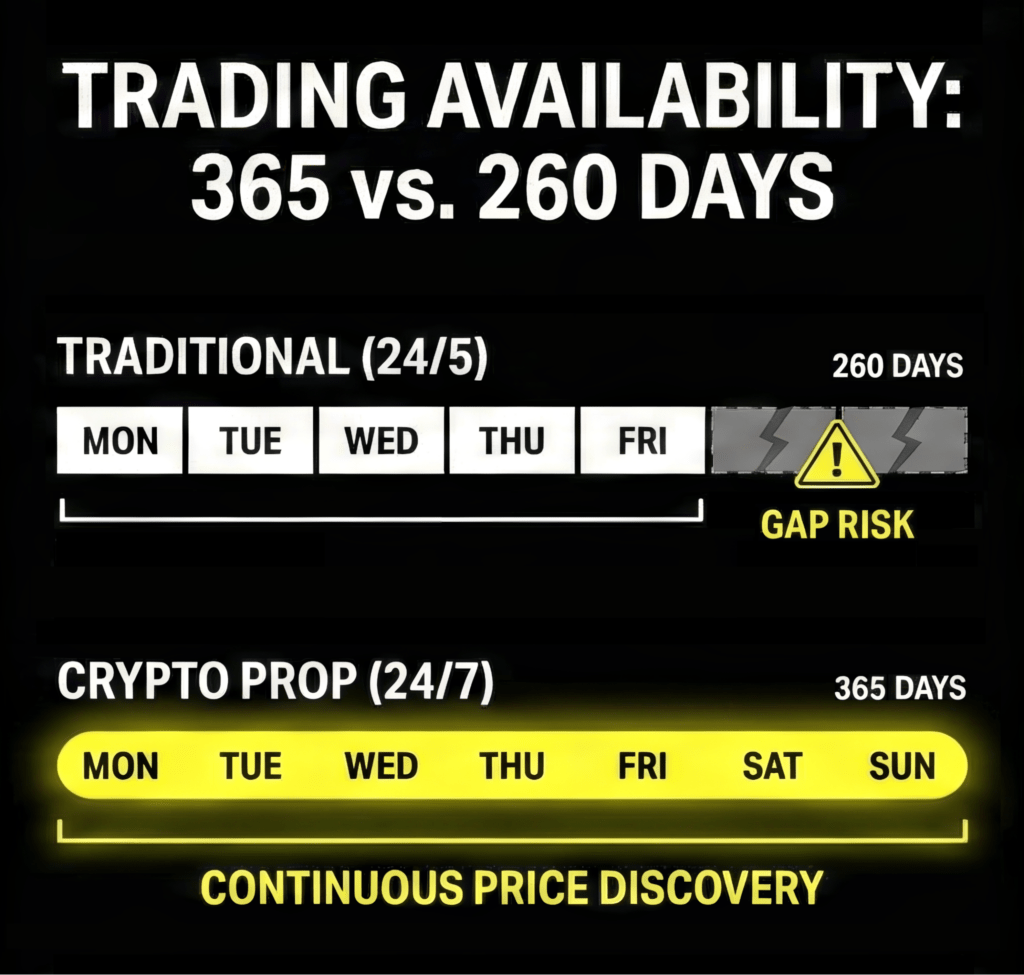
For traders with non-traditional schedules or those in different time zones, crypto’s continuous market represents genuine opportunity. You can trade during your optimal hours without forcing inconvenient session times. A trader in Singapore doesn’t need to wake at 3 AM to catch the London open—the crypto market is always live.
This 24/7 nature also eliminates weekend gap risk that forex and stock traders must constantly manage. Crypto positions experience continuous price discovery, reducing this particular risk entirely.
Cryptocurrency markets experience significantly higher volatility than traditional markets, creating larger profit opportunities but requiring stronger risk management. Daily crypto price swings of 5-20% are common, while forex pairs typically move 0.5-1%.
Volatility is where crypto prop trading truly differentiates itself. What takes forex pairs weeks to accomplish, Bitcoin can achieve in hours. This amplified volatility attracts traders seeking larger profit potential—but it demands respect and sophisticated risk protocols.
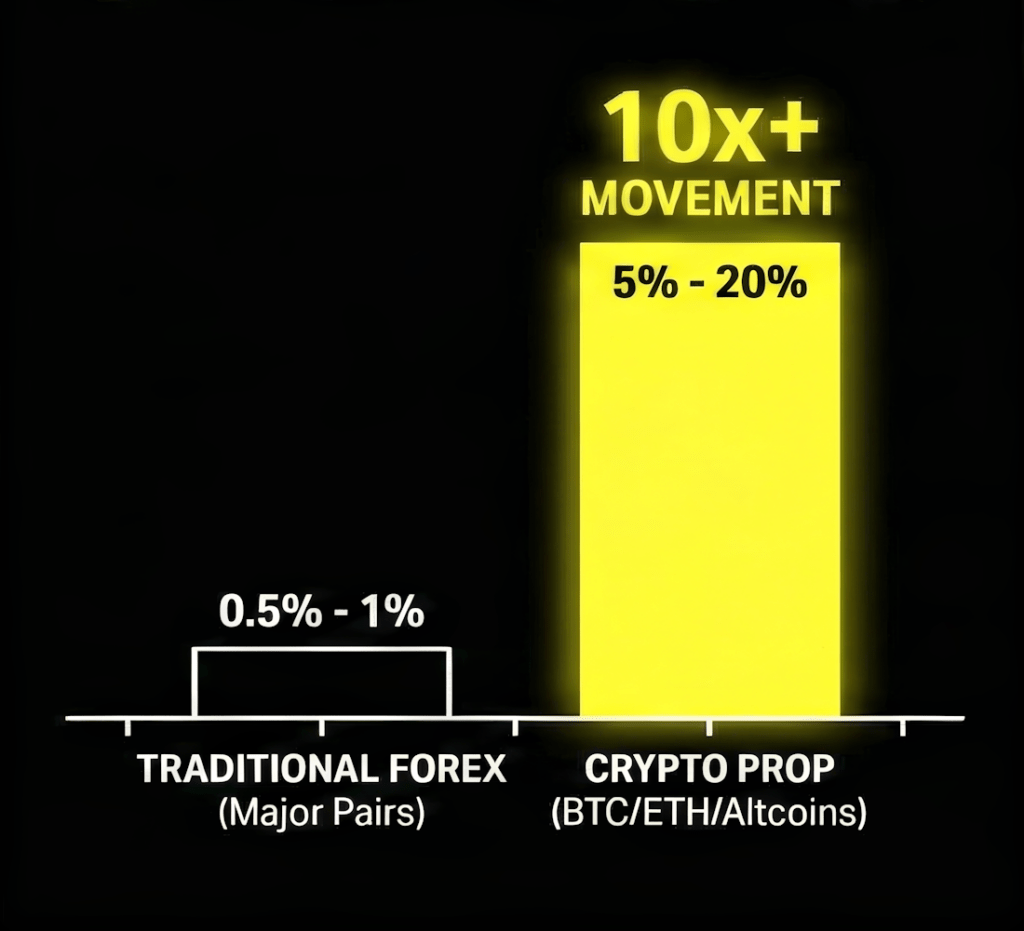
Volatility comparison by market:
This heightened volatility means crypto traders can potentially reach profit targets faster. A 10% profit target that might take weeks in forex could be achieved in days or hours in crypto. For prop firm challenges, this accelerated potential proves advantageous—though it cuts both ways.
The flip side requires acknowledgment: amplified volatility means amplified risk. Poor risk management that might cause moderate damage in forex can devastate a crypto account in minutes.
Crypto prop firms provide access to hundreds of digital assets spanning DeFi, Layer 1 protocols, gaming tokens, and emerging sectors. Traditional prop firms typically offer major currency pairs, indices, and limited crypto CFDs.
The breadth of tradeable instruments significantly impacts strategic flexibility. Traditional prop firms offer solid selections—major and minor forex pairs, popular indices, gold, oil, and sometimes cryptocurrency CFDs. A typical traditional firm might provide 50-100 total instruments.
Crypto-focused prop firms operate on a different scale entirely. Crypto Fund Trader, for example, provides access to over 715 trading pairs through its exclusive Bybit partnership—the largest selection in the industry. This extensive coverage enables trading strategies impossible with limited asset lists.
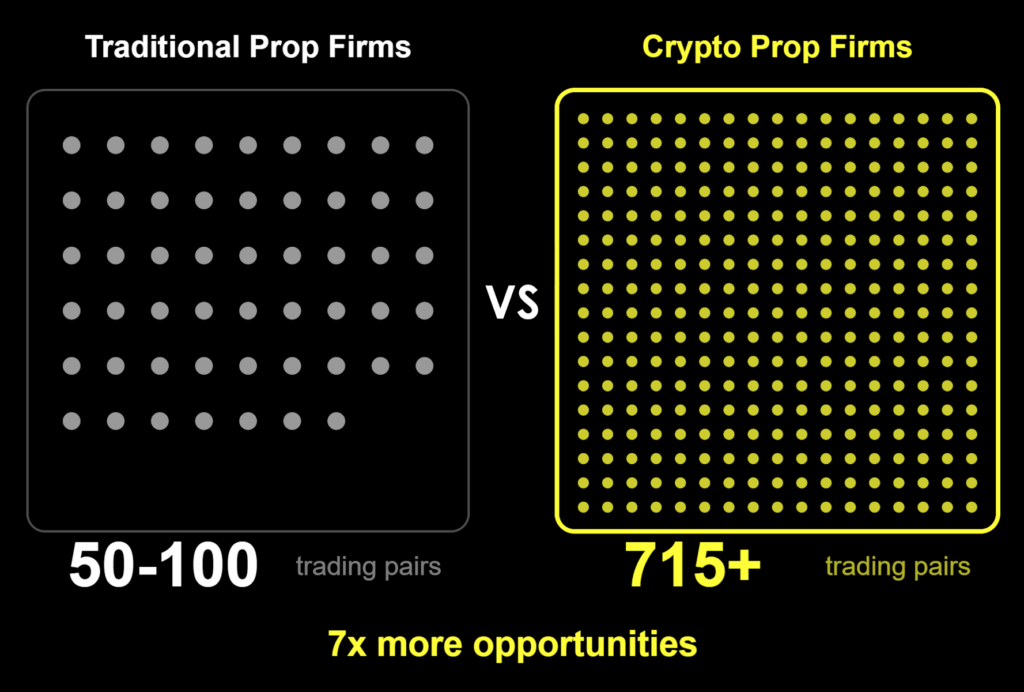
Why extensive pair selection matters:
Traditional firms typically restrict crypto trading to major pairs like BTC/USD and ETH/USD, often as CFDs rather than actual exchange products. This limitation prevents access to altcoin opportunities that frequently generate the largest returns.
Crypto prop firms integrate directly with major exchanges for institutional-grade execution, while traditional firms rely on retail-focused platforms that may use CFD structures. Technology infrastructure directly impacts trade execution and strategy capability.
Traditional prop firms commonly offer MetaTrader 4, MetaTrader 5, cTrader, and DXtrade. These platforms have served forex traders well for years, offering familiar interfaces and comprehensive charting tools.
Crypto prop firms take technology further by integrating directly with cryptocurrency exchanges. This provides advantages CFD-based trading cannot match:
Exchange integration benefits:
The best crypto prop firms offer multiple platform options—exchange integration for serious execution, MT5 for traders transitioning from forex, and specialized crypto platforms for discretionary trading. This flexibility lets traders choose technology matching their strategy.
Crypto Fund Trader exemplifies this multi-platform approach through its exclusive Bybit partnership, providing institutional-grade liquidity, lower trading costs, and faster execution than CFD alternatives. Combined with MT5 for traders transitioning from forex and MatchTrader for discretionary crypto trading, the platform accommodates diverse trading styles.
Leading crypto prop firms offer profit splits reaching 80-90%, with payout processing times as fast as 8-24 hours. Traditional firms offer comparable splits but may have longer processing periods.
Profit sharing structures have become increasingly competitive across both sectors. Most reputable firms now offer baseline splits around 80%, with opportunities to increase to 90% or higher through consistent performance.
| Factor | Crypto Prop Firms | Traditional Prop Firms |
|---|---|---|
|
Base Profit Split
|
70-80%
|
70-80%
|
|
Maximum Split
|
85-95%
|
85-95%
|
|
Payout Currency
|
Crypto (USDT, USDC, BTC)
|
Fiat or crypto options
|
|
Processing Time
|
8-24 hours (best)
|
1-7 days typical
|
Payout speed represents a meaningful differentiator. Cryptocurrency’s underlying technology enables faster settlement than traditional banking. Crypto Fund Trader exemplifies this advantage with 8-24 hour payout processing and profit splits reaching 90% with add-ons—eliminating delays while maximizing trader earnings.
Both crypto and traditional prop firms use evaluation challenges to assess trading skills, but crypto challenges benefit from 24/7 market access and higher volatility that can accelerate target achievement.
The evaluation process serves as the gateway to funded trading. Both firm types assess traders through structured challenges requiring profit targets while respecting drawdown limits.
Common evaluation components:
Crypto evaluations benefit from market characteristics that can accelerate progress. Higher volatility means profit targets can potentially be reached faster. The 24/7 market provides more trading opportunities within any timeframe.
Many crypto prop firms also offer Instant Challenge pathways with smaller starting accounts and significant scaling potential. Crypto Fund Trader’s evaluations range from $5,000 to $200,000 with maximum funded allocation of $300,000, while their Instant Challenge starts at $2,500 with scaling potential up to $1,280,000.
Crypto trading demands more sophisticated risk management due to higher volatility, while traditional markets offer more predictable conditions. Both environments reward disciplined traders who respect position sizing and drawdown limits.
Risk management separates successful prop traders from those who blow accounts. While fundamentals remain consistent across markets—position sizing, stop losses, risk-per-trade limits—crypto’s volatility demands heightened awareness.
Essential crypto risk management practices:
Traditional markets offer more predictable risk parameters. Forex volatility stays within historical ranges most of the time. Economic calendars provide advance warning of high-impact events.
Crypto’s unpredictability requires traders to expect the unexpected. Flash crashes, exchange issues, regulatory announcements, and viral social media posts can trigger dramatic movements with little warning.
Traditional prop firms operate within established regulatory frameworks, while crypto prop trading exists in a more dynamic regulatory landscape. Traders should understand these differences when evaluating firms.
Traditional financial markets have decades of regulatory development defining firm operations. Crypto regulation remains nascent and evolving—reflecting reality that regulators worldwide are still developing frameworks for digital assets.
Evaluation criteria for any prop firm:
When evaluating crypto prop firms, strategic partnerships with established exchanges provide additional credibility. Crypto Fund Trader, operating since November 2022, demonstrates this through its Bybit partnership and consistent track record of verified payouts—the stability serious traders require.
Crypto prop trading best suits traders who thrive in high-volatility environments, want 24/7 market access, and seek exposure to the digital asset ecosystem.
Crypto prop trading is ideal for traders who:
Traders transitioning from traditional markets often find crypto both exciting and challenging. The skills translate—technical analysis, discipline, risk management—but pace and volatility require adjustment. Starting with smaller account sizes allows comfortable adaptation before scaling.
Traditional prop trading suits traders who prefer established markets, stable volatility, and comprehensive regulatory frameworks.
Traditional prop trading is ideal for traders who:
Many successful traders maintain positions in both worlds. Traditional markets offer stability during crypto doldrums, while crypto provides opportunity when forex ranges sideways.
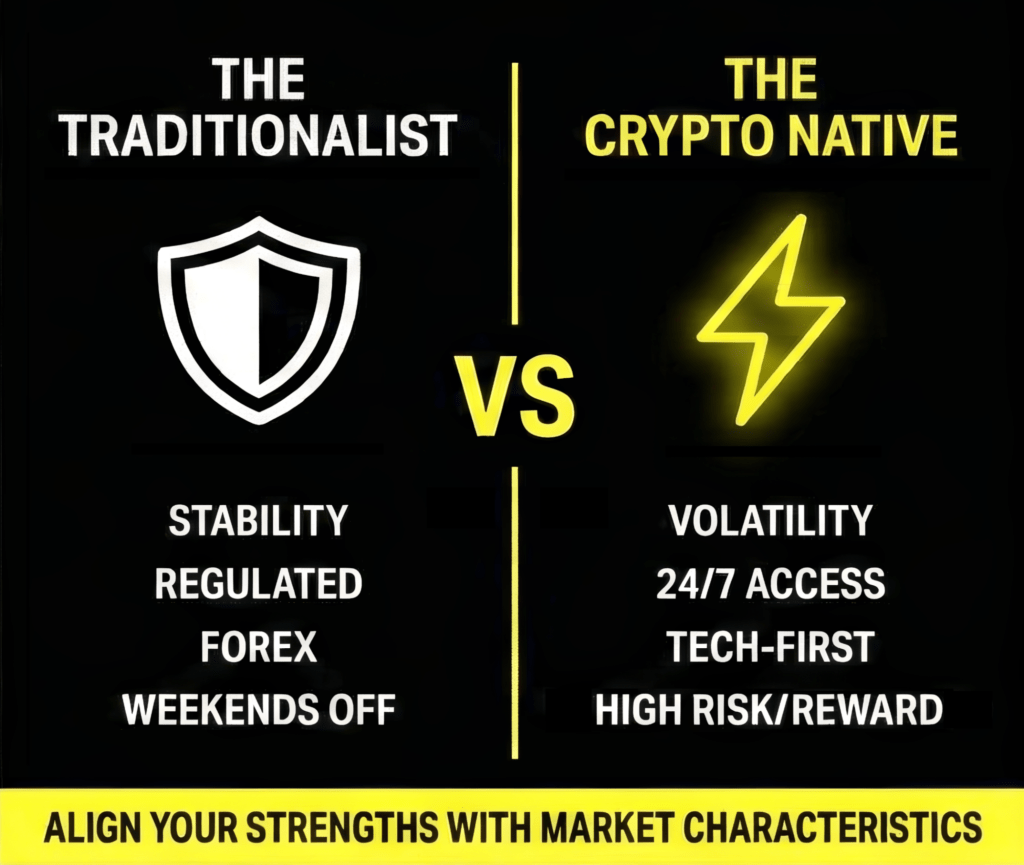
Selecting between crypto and traditional prop firms depends on your trading style, risk tolerance, schedule, and market interests. The best choice aligns natural strengths with market characteristics.
Questions to guide your decision:
Consider testing both environments before committing significant capital. Many firms offer free trials or low-cost challenges. For traders drawn to cryptocurrency’s potential, platforms with institutional exchange partnerships, competitive profit splits, and rapid payouts provide the foundation for serious trading careers.
The choice between crypto and traditional prop firms reflects your individual trading identity. Both environments reward discipline, skill, and consistent execution. Both offer legitimate pathways to trading with significant capital.
Crypto prop trading offers unmatched flexibility through 24/7 markets, amplified profit potential through higher volatility, and expanding opportunity through a rapidly evolving asset class. Traditional prop trading provides stability through established markets, predictability through familiar instruments, and structure through comprehensive frameworks.
Evaluate your trading style honestly. Consider where your skills and interests align. Then take action. The only certainty is that successful trading careers aren’t built through indecision.
Your funded trading future awaits.
Is it better to use a prop firm? — Prop firms offer significant advantages over retail trading: access to larger capital without personal risk, professional trading infrastructure, and profit splits up to 90%. For skilled traders lacking capital, prop firms provide a faster path to funded trading than building personal accounts from scratch.
What is the 2% rule for prop firms? — The 2% rule limits risk per trade to 2% of account equity. Most prop firms enforce similar risk parameters through daily drawdown limits (typically 4-5%) and maximum drawdown rules (8-12%). This protects both trader and firm capital while encouraging disciplined position sizing.
How many people fail prop firms? — Industry estimates suggest 70-90% of traders fail prop firm evaluations. Success requires consistent profitability, strict risk management, and emotional discipline. Crypto prop firms may offer faster target achievement due to higher volatility, though this demands stronger risk protocols.
How much is a $100,000 prop firm account? — Evaluation fees for $100,000 funded accounts typically range from $500-$1,000 depending on the firm and challenge type. Crypto Fund Trader offers evaluations from $5,000 to $200,000 with competitive pricing, scaling potential to $300,000 funded, and profit splits reaching 90%.
Why is $25,000 required to day trade? — The $25,000 PDT (Pattern Day Trader) rule applies only to US stock trading in margin accounts. Prop firms bypass this barrier entirely—traders access funded capital through evaluation challenges regardless of personal account size, making prop trading ideal for undercapitalized traders.
Can I make $1000 per day from trading? — Daily income depends on account size, strategy, and market conditions. With a $100,000 funded account, $1,000 represents just 1% daily return—achievable in volatile crypto markets. Consistency matters more than single-day gains; prop firms reward steady performance over time.
-
© 2026 - All Rights Reserved.
SWISS RLCRATES AG is a provider of educational services, all information available on our site is intended solely for the study purposes related to trading on financial markets. Accordingly, we do not offer financial, investment, tax, brokerage or other advice and/or services. Trading in financial markets is a high-risk activity, past performance do not guarantee future ones. It is highly advised not to risk more, than you can afford to lose. Brokers and operators of trading platforms are persons or entities that are separate from SWISS RLCRATES AG and their own terms and conditions will apply when you use their services and products. Neither SWISS RLCRATES AG nor RLCRATES, S.L. (as MT5 license holder) operate in countries where crypto or CFD’s activity is not allowed. The content in our platform is applicable to the extent local laws and/or regulations permit.