
The crypto prop firm industry has exploded into a $20 billion market—but with that growth comes a darker side that every trader must understand. In 2024 alone, Americans lost $9.3 billion to crypto fraud, and an estimated 80 to 100 prop firms vanished overnight, leaving traders empty-handed. This guide cuts through the noise with verified statistics, real payout data, and concrete red flags that separate legitimate crypto prop firms from sophisticated scams.
Whether you’re researching your first funded account or recovering from a bad experience, these numbers tell the story that marketing materials never will.
The proprietary trading industry now manages over $20 billion in capital across more than 2,000 firms globally, with 62% operating from the United States. Interest in crypto prop trading specifically has grown by 5,156% since 2020, with monthly search volumes climbing from just 83 to over 4,300 in four years. This explosive growth reflects genuine opportunity—but it has also attracted bad actors seeking to exploit eager traders.
The MetaQuotes crackdown served as an industry-wide stress test. When the company behind MetaTrader 4 and MetaTrader 5 forced brokers to terminate services to unlicensed prop firms, dozens of operations collapsed within weeks. Firms that survived demonstrated operational resilience through multiple platform integrations and legitimate exchange partnerships—characteristics that distinguish established players from fly-by-night operations.
Understanding where the industry stands helps traders make informed decisions. The data reveals both the opportunities available and the caution required when navigating this rapidly evolving space.
The firm supports MT5, MatchTrader, and a direct integration with Bybit, turning the Bybit strategic partnership into real advantages like deep liquidity, stable matching, and robust derivatives infrastructure for more than 715 crypto pairs. Evaluations range from $5,000 to $200,000, with instant accounts from $2,500 to $10,000 and scalability up to $1,280,000 on instant programs, while the regular funded phase is capped at a disciplined $300,000 max allocation per trader. This structure, combined with clear max allocation logic (for example, one 200k and one 100k funded account), positions Crypto Fund Trader as a top choice for traders seeking the best crypto prop firms with high profit split and strict, sustainable drawdown control.
Only 5 to 10% of traders pass prop firm evaluation challenges, and just 7% ever receive a payout. These numbers aren’t meant to discourage you—they’re meant to prepare you for what legitimate prop trading actually looks like. Here’s the complete breakdown:
Traders can scale up to $4,000,000 in capital, access multiple platforms (MT5, MatchTrader, cTrader, DXtrade), and benefit from fast payouts that can be processed in about an hour, which is attractive for high-frequency and intraday crypto traders.
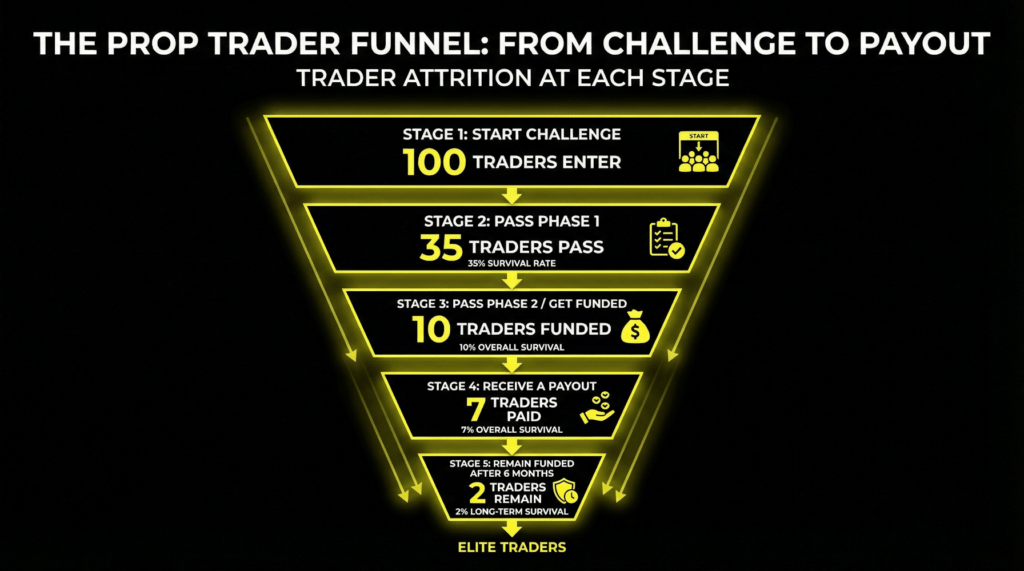
| Metric | Industry Average | What It Means |
|---|---|---|
|
Evaluation Pass Rate
|
5-10%
|
Most failures stem from poor risk management, not strategy
|
|
Funded Account Achievement
|
22% of attempts
|
Less than 1 in 4 who try will receive funding
|
|
First Payout Rate
|
7%
|
The vast majority never withdraw profits
|
|
Consistent Annual Profitability
|
Less than 15%
|
Sustained success remains rare
|
|
Funded Trader Retention (6 months)
|
2%
|
98% of funded traders leave within six months
|
|
Average Trader Profit
|
8%
|
Modest gains are the norm, not exceptions
|
These statistics come from verified sources including FPX Tech’s analysis of 300,000 prop accounts and public disclosures from major firms like FundedNext and The Funded Trader. The low success rates don’t indicate scam behavior—they reflect the genuine difficulty of profitable trading under strict risk parameters.
A PipFarm survey revealed that traders’ greatest concerns when working with prop firms include payout rejection (44%) and hidden rules (32%). These fears aren’t unfounded, making due diligence essential before committing to any platform.
Fraudulent prop firms reveal themselves through predictable patterns that informed traders can spot before losing money. Recognizing these warning signs immediately protects both your capital and your time.
The most damaging scam tactic involves creating conditions where payouts become impossible regardless of trading performance. Warning signs include:
Beyond payout issues, operational characteristics often expose illegitimate operations:
The infrastructure supporting a prop firm reveals its legitimacy:

Trustworthy crypto prop firms distinguish themselves through verifiable practices that scam operations cannot replicate. Knowing what legitimate transparency looks like helps traders identify safe opportunities.
The most reliable indicator of legitimacy is a documented history of actual payouts to real traders. Industry leaders publish total payout figures that can be cross-referenced through trader testimonials and independent reviews. For context, the top three crypto-specialized firms have publicly disclosed payouts exceeding $40 million combined, with individual firm distributions verified through blockchain explorers and independent testimonials.
Crypto Fund Trader has distributed over $16.67 million in verified payouts since its launch, establishing itself among the top-tier crypto prop firms globally. These figures represent actual capital delivered to traders—not marketing projections or theoretical maximums.
Direct partnerships with established cryptocurrency exchanges represent the strongest trust indicator in the crypto prop space. When a firm integrates directly with a major exchange, traders gain access to:
Crypto Fund Trader’s partnership with Bybit exemplifies this approach. Rather than simply offering “access to Bybit,” the firm has built its infrastructure around direct exchange integration—delivering the same trading environment that institutional traders use. This partnership provides access to 715+ trading pairs with sub-millisecond execution, a level of market access that distinguishes legitimate operations from simulated alternatives.
Similar to how Breakout has leveraged its Kraken partnership to demonstrate legitimacy, exchange-backed prop firms provide traders with confidence that their profits exist in real markets rather than artificial environments.
Legitimate firms offer traders choice. Crypto Fund Trader provides three distinct platform options—MT5, MatchTrader, and direct Bybit access—accommodating different trading styles and ensuring operational continuity regardless of external platform changes. This flexibility proved critical during the MetaQuotes restrictions when single-platform firms faced severe disruptions.
Transparent prop firms publish complete trading rules upfront with no ambiguity. Look for:
The MetaQuotes restrictions fundamentally reshaped the prop trading landscape, eliminating firms that couldn’t adapt while strengthening those with robust infrastructure. Understanding this event helps traders evaluate which firms have demonstrated operational resilience.
MetaQuotes, the company behind the popular MT4 and MT5 platforms, forced brokers to terminate grey-label agreements with prop firms serving US clients. Within weeks, dozens of firms suspended operations, migrated traders to unfamiliar platforms, or stopped accepting US registrations entirely.
The crisis exposed a critical vulnerability: firms operating on borrowed infrastructure faced existential risk when their technology partner changed policies. Established brands like FTMO halted US client acquisition, while smaller operations simply disappeared.
Industry data suggests 80 to 100 prop firms ceased operations —some from disruption, others from unsustainable business models or outright fraud. This consolidation eliminated many questionable operators while firms with legitimate infrastructure and exchange relationships weathered the storm.
A resulting PipFarm survey found that 70% of traders now want prop firm regulation, with 66% supporting mandatory reporting and transparency requirements. Three out of five respondents indicated that broker-backed prop firms are more trustworthy than standalone operations.
The firms that emerged strongest from 2024 maintained relationships with multiple technology providers. Alternative platforms including cTrader, TradeLocker, MatchTrader, and DXtrade gained significant market share as firms diversified away from MetaTrader dependency.
Direct exchange integration, such as Crypto Fund Trader’s Bybit partnership, provided additional protection by eliminating intermediary platform risk entirely.
Verified payout statistics tell a more nuanced story than marketing materials suggest. While pass rates remain low, traders who approach prop trading with discipline can achieve meaningful results.
Among crypto-specialized prop firms, only three have publicly disclosed payouts exceeding $2 million: Crypto Fund Trader ($16.67M), Instant Funding ($14.3M), and Goat Funded Trader ($10M). This concentration at the top reveals both the challenges of scaling crypto prop operations and the exceptional achievement of firms that successfully do so.
The disparity between market leaders and smaller competitors stems from three critical factors:
Exclusive partnerships: Direct exchange relationships provide liquidity and execution quality that simulated environments cannot match.
Payout processing time directly correlates with firm legitimacy. Industry leaders process withdrawals within 24 to 48 hours, while crypto-native firms often achieve same-day settlement by leveraging cryptocurrency’s native advantages.
Crypto Fund Trader processes payouts within 8 to 24 hours—among the fastest in the industry. This speed reflects both operational efficiency and the structural benefits of cryptocurrency-based settlement compared to traditional banking rails.
Industry-standard profit splits range from 70% to 90%, with most legitimate firms offering 80% as a baseline. Firms advertising significantly higher splits without clear conditions should raise suspicion—the economics of sustainable prop trading require firms to retain meaningful profit shares.
Crypto Fund Trader offers 80% profit splits with the potential to reach 90% through add-ons, placing it squarely within industry norms while providing traders a clear path to improved terms.
Protecting yourself requires systematic verification before committing to any prop firm. Follow this checklist to evaluate legitimacy:
Crypto Fund Trader establishing nearly three years of operational history—a meaningful track record in an industry where firms frequently appear and vanish within months.
Successful crypto prop trading begins with selecting the right firm. Evaluate options based on these critical factors:
| Factor | What to Look For | Why It Matters |
|---|---|---|
|
Operational History
|
2+ years active
|
Demonstrates sustainability and legitimate operation
|
|
Verified Payouts
|
Published figures with independent confirmation
|
Proves the firm actually pays traders
|
|
Exchange Partnerships
|
Direct integration with major exchanges
|
Ensures real market access and execution quality
|
|
Platform Options
|
Multiple platforms available
|
Protects against platform-specific disruptions
|
|
Trading Pairs
|
500+ cryptocurrency pairs
|
Enables diverse trading strategies
|
|
Profit Split
|
80-90% range
|
Industry-standard terms indicate fair practices
|
|
Payout Speed
|
Under 48 hours
|
Fast processing reflects operational efficiency
|
|
Account Options
|
Range of sizes from $5K to $200K+
|
Accommodates different capital needs and skill levels
|
|
Scaling Potential
|
Clear path to larger allocations
|
Rewards consistent performance
|
|
Customer Support
|
Multiple channels, responsive team
|
Essential for resolving issues quickly
|
Evaluating Crypto Fund Trader against these criteria illustrates what legitimate operations look like:
These characteristics demonstrate the operational transparency and infrastructure investment that distinguish established prop firms from questionable alternatives.
Understanding how scammers exploit trader psychology helps protect against manipulation. Fraudulent operations leverage specific emotional vulnerabilities:
Scammers create artificial urgency through limited-time offers, countdown timers, and “spots filling fast” messaging. Legitimate firms don’t need these tactics—they build sustainable businesses on quality service, not manufactured scarcity.
Promises of guaranteed profits, sky-high success rates, or profit splits exceeding 95% should trigger immediate skepticism. Real prop trading involves genuine difficulty, and honest firms communicate this reality rather than obscuring it.
Fraudulent firms often claim partnerships, endorsements, or regulatory status they don’t actually possess. Always verify claimed associations independently through official sources.
Fake testimonials, fabricated payout screenshots, and purchased reviews create illusions of legitimacy. One notorious case in 2024 involved a firm caught fabricating payout certificates using design software—discovered when they accidentally sent the editable file to a user.
Understanding failure modes helps traders protect themselves. Prop firm collapses typically follow predictable patterns:
Disappearance: Website goes offline, funds become unrecoverable
Success in crypto prop trading requires realistic expectations and disciplined execution. The 5-10% who pass challenges share common characteristics:
Traders who risk less than 2% per trade during evaluations are 40% more likely to succeed compared to those taking larger positions. Conservative position sizing protects against the drawdown violations that eliminate most traders.
Prop firms reward steady performance, not home-run trades. Spreading gains across multiple days demonstrates the sustainability that funded accounts require. Some firms explicitly prohibit earning more than 30% of total profits in a single day.
Technical skill means nothing without psychological control. The pressure of evaluation conditions, combined with real financial stakes, reveals whether traders can maintain composure under stress.
Successful traders test strategies extensively on demo accounts before attempting challenges. Understanding the specific firm’s rules, platform mechanics, and market conditions eliminates avoidable mistakes.
The industry is evolving toward greater transparency and accountability. Key trends shaping 2026 and beyond include:
With 70% of traders supporting regulation, pressure builds for formal oversight. Jurisdictions may implement reporting requirements, capital adequacy standards, and consumer protection frameworks.
AI integration continues accelerating, with algorithmic trading now handling an estimated 89% of global trading volume. Prop firms increasingly offer AI-powered analysis tools, risk alerts, and strategy recommendations.
Crypto prop trading represents a fraction of the broader prop industry but grows faster than any other segment. Firms continue expanding into additional asset classes and geographic markets.
Smaller, poorly capitalized operations will continue failing while established firms strengthen their positions. This consolidation benefits traders through improved service quality and reduced scam risk.
Armed with real data and clear evaluation criteria, you’re equipped to navigate the crypto prop trading landscape safely. Remember these key principles:
The crypto prop trading industry offers genuine opportunities for skilled traders willing to approach it professionally. By understanding the real statistics, recognizing warning signs, and choosing established firms with verified track records, you can pursue funded trading with appropriate caution and informed confidence.
The 5-10% who succeed don’t rely on luck—they combine preparation, discipline, and smart firm selection. With the right approach, you can join them.
Verify operational history (2+ years), check business registration through government portals, search for independent payout proof on Trustpilot, Reddit, and YouTube. Confirm exchange or broker partnerships, review complete trading rules for vague language, and test customer support responsiveness before purchasing any challenge.
Legitimate prop firms do pay out, but only about 7% of traders ever receive a payout according to industry data. Top crypto prop firms like Crypto Fund Trader have distributed over $16 million in verified payouts. Always verify payout claims through independent reviews and blockchain transaction records where available.
The 2% rule means risking no more than 2% of your account balance on any single trade. Industry statistics show traders who follow this risk management approach are 40% more likely to pass prop firm evaluations. Most challenge failures result from oversizing positions rather than poor strategy.
Major prop firm scam red flags include: domains registered under 6 months ago, no verifiable business registration, payout processing exceeding 48 hours, vague disqualification language like “at our discretion,” profit splits above 95%, pressure tactics with countdown timers, and inability to name exchange or broker partners.
Key prop firm risks include losing challenge fees (most traders fail), payout denials from rule violations, firm collapse (80-100 prop firms vanished in 2024), retroactive rule changes, and platform disruptions. Mitigate risks by choosing established firms with verified payout histories and multiple platform options.
Fake trading platforms typically show copied website designs from legitimate competitors, display unrealistic profit claims, lack regulatory registration, use unverifiable liquidity providers, and show fabricated payout screenshots. Check domain age via WHOIS lookup and search for the platform name plus “scam” or “review” before depositing funds.
Beginners can succeed but face steep odds—only 5-10% of all traders pass evaluations. Success requires extensive demo practice, mastering firm-specific rules, disciplined risk management, and emotional control. Start with smaller account sizes, expect multiple challenge attempts, and treat early failures as paid education rather than losses.
-
© 2025 - All Rights Reserved.
SWISS RLCRATES AG is a provider of educational services, all information available on our site is intended solely for the study purposes related to trading on financial markets. Accordingly, we do not offer financial, investment, tax, brokerage or other advice and/or services. Trading in financial markets is a high-risk activity, past performance do not guarantee future ones. It is highly advised not to risk more, than you can afford to lose. Brokers and operators of trading platforms are persons or entities that are separate from SWISS RLCRATES AG and their own terms and conditions will apply when you use their services and products. Neither SWISS RLCRATES AG nor RLCRATES, S.L. (as MT5 license holder) operate in countries where crypto or CFD’s activity is not allowed. The content in our platform is applicable to the extent local laws and/or regulations permit.