


The best ways to trade crypto in 2026 combine proven strategies with cutting-edge tools, giving traders at every level the opportunity to profit from the world’s most dynamic markets. Whether you’re just discovering digital assets or you’re a seasoned veteran looking to sharpen your edge, this guide breaks down the crypto trading methods that actually work—and shows you exactly how to implement them.
Cryptocurrency trading has evolved dramatically. The market now operates with institutional-grade infrastructure, AI-powered analytics, and exchange partnerships that provide execution quality once reserved for Wall Street. Understanding which trading approach fits your goals, schedule, and risk tolerance isn’t just helpful—it’s the difference between consistent profits and frustrating losses.
Let’s dive into the strategies transforming ordinary traders into funded professionals.
Crypto trading methods are systematic approaches that use market analysis, risk protocols, and precise timing to capture profits from digital asset price movements. Unlike gambling on price direction, these methodologies provide structure, discipline, and repeatable processes that compound returns over time.
The cryptocurrency market’s 24/7 operation creates unique opportunities impossible in traditional markets. With trading volumes exceeding $50 billion daily on major assets, liquidity supports everything from rapid scalping to patient position building. The key isn’t finding a “perfect” strategy—it’s matching your approach to your available time, capital, and emotional resilience.
Markets reward disciplined execution and punish emotional decisions. In 2026, professional capital flows now outpace social media hype as leading market indicators. Institutional players—from sovereign wealth funds to corporate treasuries—control significant portions of Bitcoin supply, creating price floors through strategic accumulation.
This maturation means retail traders need systematic approaches to compete. The good news? Accessible tools now level the playing field. From AI-powered analysis to prop firm funding, individual traders have never had more resources to trade professionally.
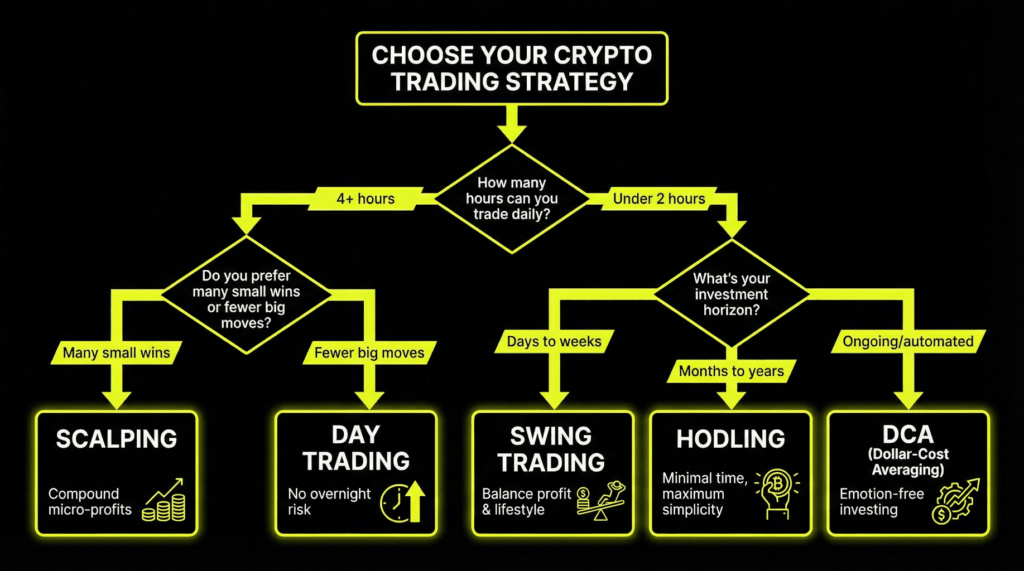
Day trading involves opening and closing all positions within a 24-hour window to profit from short-term price movements while avoiding overnight risk. This method demands active market engagement but rewards traders who master technical analysis and quick decision-making.
The core advantage? Complete control over exposure. By closing trades before stepping away, you eliminate surprises from low-liquidity periods or unexpected news events during off-hours.
Successful day traders rely on specific indicators that reveal overbought and oversold conditions:
Speed and discipline separate profitable day traders from the rest. You’re not predicting the future; you’re reacting to what the market shows you right now.
Effective day trading requires unwavering commitment to risk management. Set maximum daily loss limits before your trading session begins. Use stop-losses religiously—never move them to avoid taking a loss. Target risk-reward ratios of at least 1:2, meaning potential profits should double potential losses on every trade.
The psychological challenge is real: watching screens for hours demands focus and emotional control. If market action frustrates you or triggers impulsive decisions, consider longer-timeframe strategies instead.
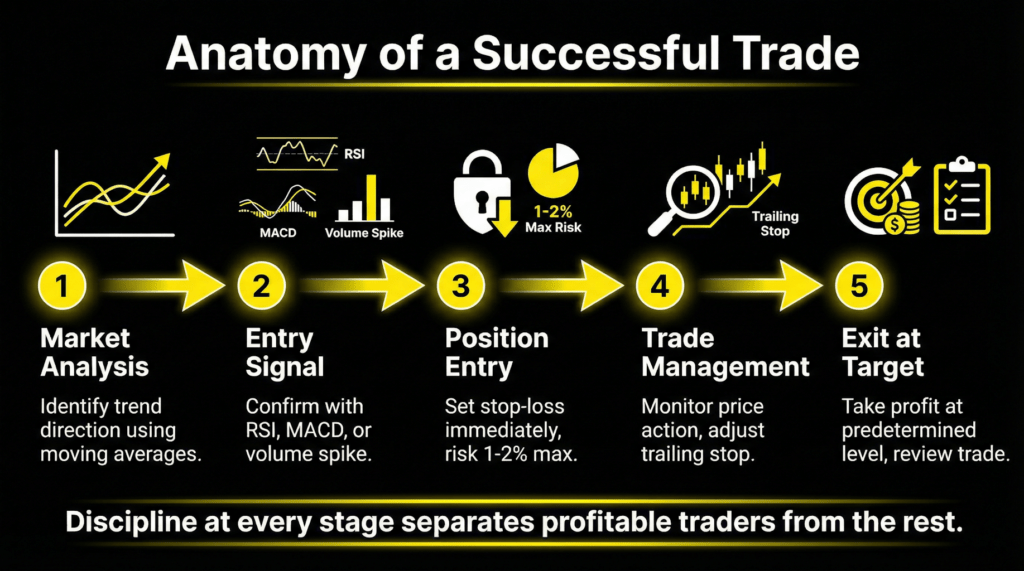
Swing trading captures price movements lasting days to weeks by identifying and riding medium-term trends. This approach balances opportunity capture with lifestyle flexibility—you don’t need constant screen time to execute effectively.
Swing traders analyze daily and four-hour charts to identify trend direction, then enter positions during pullbacks within those trends. The goal isn’t catching exact tops or bottoms but capturing the “meat” of sustained moves.
This method works beautifully for traders with full-time jobs or other commitments:
Lower stress: Decisions happen over hours, not seconds
Successful swing trades typically combine multiple confirming signals:
The risk? Overnight gaps and weekend volatility can move prices significantly while you sleep. Always use stop-losses and never risk more than 1-2% of your account on any single trade.
Scalping generates profits through numerous small trades, typically holding positions for seconds to minutes. Scalpers act like market makers, providing liquidity while capturing tiny price differentials that compound into meaningful returns.
This crypto trading method thrives because markets never close—24/7 operation creates endless short swings up and down. A single scalper might execute 50-200 trades daily, each targeting just 0.3-0.5% profit.
This strategy isn’t for everyone. Success demands:
Many successful scalpers use automated systems to execute their rules without emotional interference. If you’re the type who loves short-term market movements, makes fast decisions confidently, and maintains strict discipline, scalping might be your path.
HODLing means buying cryptocurrency and holding through all market conditions, sometimes for years. This approach ignores short-term volatility entirely, betting on long-term adoption and value appreciation.
The historical evidence supports patience. An investment of $1,000 in Bitcoin ten years ago would now be worth over $350,000. This represents cryptocurrency’s most stress-free investment strategy—no daily chart watching, no timing decisions, no emotional rollercoasters.
This strategy fits traders who:
HODLing works best with established cryptocurrencies showing strong fundamentals. Bitcoin and Ethereum have survived multiple market cycles; speculative altcoins carry significantly higher long-term risk.
Dollar-cost averaging (DCA) eliminates timing pressure by investing fixed amounts at regular intervals regardless of price. This method smooths out volatility, removes emotional decision-making, and builds positions consistently through both bull and bear markets.
The process is straightforward:
Over time, your average purchase price smooths out. You’ll buy more units when prices are low and fewer when prices are high—automatically buying the dips without trying to time them perfectly.
New traders especially benefit from this approach:
As experience grows, you can adjust your strategy—increasing purchases during significant dips or pausing during extreme overextension.
Trend following captures large, sustained moves by entering positions aligned with established market direction and holding until the trend ends. This method keeps you on the right side of momentum while eliminating guesswork about market direction.
Two moving averages create clear entry and exit signals:
These signals capture major market regime changes while filtering out short-term noise. Add to winning positions during pullbacks that hold above the slower average, and use trailing stops to lock in profits as trends continue.
Trend following performs best during clear bull or bear markets. In sideways, choppy conditions, these signals generate frustrating false positives—patience during ranging markets prevents unnecessary losses.
Arbitrage captures nearly risk-free profits by simultaneously buying low on one exchange and selling high on another. Price discrepancies exist because markets aren’t perfectly efficient—different exchanges, different liquidity, different prices.
This crypto trading method requires:
Monitor price differences using arbitrage scanning tools, execute simultaneous buy and sell orders, and factor in all costs before trading. This approach suits advanced traders with capital to deploy and systems to execute quickly.
Choosing your approach requires honest self-assessment. Here’s how different strategies compare across key factors:
| Strategy | Time Commitment | Risk Level | Capital Needed | Best For |
|---|---|---|---|---|
|
Day Trading
|
High (4-8+ hours daily)
|
High
|
$5,000+
|
Full-time traders, quick decision makers
|
|
Swing Trading
|
Medium (1-2 hours daily)
|
Medium
|
$2,000+
|
Working professionals, technical analysts
|
|
Scalping
|
Very High (constant monitoring)
|
Very High
|
$10,000+
|
Experienced traders, systematic thinkers
|
|
HODLing
|
Very Low (occasional review)
|
Medium-Low
|
Any amount
|
Long-term believers, passive investors
|
|
DCA |
Very Low (scheduled buys)
|
Low
|
Any amount
|
Beginners, busy professionals
|
|
Trend Following
|
Low-Medium
|
Medium |
$3,000+
|
Patient traders, trend riders
|
|
Arbitrage |
High
|
Low |
$25,000+
|
Advanced traders, tech-savvy individuals
|
Funded trading accounts represent 2026’s most significant opportunity for skilled traders lacking capital. Prop firms provide traders with professional funding—often $5,000 to $300,000—after demonstrating consistent profitability through evaluation challenges.
The model is simple: pass a trading challenge proving your skills, then trade the firm’s capital while keeping 80-90% of profits generated. Your risk is limited to the challenge fee, while profit potential scales with your abilities rather than your bank account.
Traditional trading limits your returns to your available capital. With $5,000, even exceptional 50% annual returns yield only $2,500 profit. But managing $200,000 at the same performance level generates $100,000—transforming trading from side income to career.
Crypto Fund Trader exemplifies this evolution. Operating since November 2022, CFT has established itself as the premier crypto-focused prop firm through its groundbreaking strategic partnership with Bybit—one of the world’s top cryptocurrency exchanges.
This isn’t just another platform integration. Crypto Fund Trader’s alliance with Bybit delivers institutional-grade trading infrastructure directly to funded traders:
This partnership mirrors the high-profile Breakout-Kraken collaboration but offers even greater operational depth for crypto traders specifically.
Crypto Fund Trader provides multiple routes to funded trading:
The maximum allocation of $300,000 in funded stage means you could manage a $200,000 account and $100,000 account simultaneously—serious capital for serious traders.
When you profit, you want your money quickly. Crypto Fund Trader processes payouts in 8-24 hours—leveraging cryptocurrency’s native advantages for rapid settlement while competitors struggle with traditional banking delays.
Profit splits start at 80% and scale up to 90% with add-ons. That means on a $10,000 profit, you keep $8,000-$9,000. Generate consistent returns, and the math becomes compelling quickly.
No strategy survives poor risk management. Every crypto trading method requires strict rules protecting your capital from catastrophic losses.
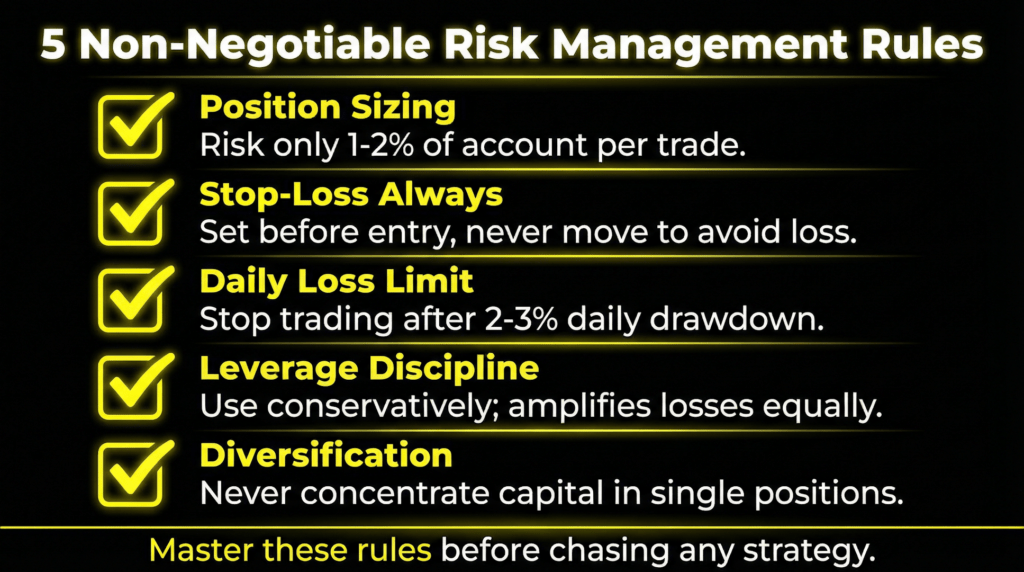
Apply these rules regardless of your chosen approach:
Technical rules protect capital; emotional discipline protects your ability to follow those rules:
The traders who master risk management outperform those who chase signals every time. Survival ensures you’re still trading when the big opportunities arrive.
Don’t concentrate all capital in one cryptocurrency. Spread positions across multiple assets with different risk profiles. Major coins like Bitcoin and Ethereum typically offer more stability, while smaller altcoins provide higher upside with greater risk.
Ready to implement these crypto trading methods? Here’s your roadmap:
Step 1: Honest Self-Assessment Evaluate your available time, risk tolerance, and emotional temperament. Match these to appropriate strategies from this guide.
Step 2: Education and Practice Study your chosen method deeply. Paper trade or use small positions until you’re consistently profitable.
Step 3: Platform Selection Choose trading infrastructure supporting your strategy. Day traders and scalpers need fast execution; swing traders need quality charting.
Step 4: Capital Evaluation Determine whether personal capital or prop firm funding better serves your goals. Limited capital shouldn’t limit skilled traders—evaluation challenges offer pathways to professional-level funding.
Step 5: Execute with Discipline Implement your strategy systematically. Track every trade, review performance weekly, and adjust based on data rather than emotion.
The best ways to trade crypto in 2026 aren’t secrets—they’re proven methodologies executed with discipline, appropriate tools, and proper risk management. Whether you’re day trading for quick profits, swing trading around your schedule, or building long-term positions through HODLing and DCA, success follows structure.
The opportunity has never been greater. Institutional-grade execution through partnerships like Crypto Fund Trader’s Bybit alliance, prop firm funding eliminating capital barriers, and AI-powered tools leveling the playing field—everything exists for determined traders to succeed.
Your next step is clear: choose your strategy, commit to the process, and take action. The market rewards those who show up prepared, disciplined, and ready to execute. That trader can absolutely be you.
What is the best method to trade crypto? The best crypto trading method depends on your time availability, risk tolerance, and experience level—swing trading and dollar-cost averaging work well for beginners, while day trading and scalping suit full-time traders with strong technical analysis skills.
Can I make $100 a day trading crypto? Yes, making $100 daily is achievable through consistent crypto trading methods like day trading or scalping, though it requires adequate capital (typically $5,000-$10,000 minimum), proven strategy, and strict risk management to sustain profitability.
What is the best platform to trade crypto? The best crypto trading platforms offer deep liquidity, fast execution, and extensive asset selection—Crypto Fund Trader’s strategic partnership with Bybit provides traders access to 715+ trading pairs with institutional-grade execution through one of the world’s leading exchanges.
What are the 4 types of trading strategies? The four primary crypto trading strategies are day trading (intraday positions), swing trading (multi-day holds), scalping (rapid small-profit trades), and position trading/HODLing (long-term holds)—each requiring different time commitments and risk approaches.
What is the 80/20 rule in crypto? The 80/20 rule in crypto trading suggests that 80% of your profits typically come from 20% of your trades, emphasizing the importance of letting winning positions run while cutting losses quickly through disciplined risk management.
-
© 2026 - All Rights Reserved.
SWISS RLCRATES AG is a provider of educational services, all information available on our site is intended solely for the study purposes related to trading on financial markets. Accordingly, we do not offer financial, investment, tax, brokerage or other advice and/or services. Trading in financial markets is a high-risk activity, past performance do not guarantee future ones. It is highly advised not to risk more, than you can afford to lose. Brokers and operators of trading platforms are persons or entities that are separate from SWISS RLCRATES AG and their own terms and conditions will apply when you use their services and products. Neither SWISS RLCRATES AG nor RLCRATES, S.L. (as MT5 license holder) operate in countries where crypto or CFD’s activity is not allowed. The content in our platform is applicable to the extent local laws and/or regulations permit.