


The crypto market in 2026 rewards traders who combine proven strategies with disciplined execution. With Bitcoin trading near all-time highs and institutional adoption accelerating, knowing which crypto trading strategies deliver consistent results separates profitable traders from those who struggle. This comprehensive guide breaks down the best crypto trading strategies used by professionals today—and shows you exactly how to implement them for real results.
Whether you’re just starting your trading journey or looking to refine your approach, understanding these battle-tested methods will transform how you navigate the volatile yet opportunity-rich cryptocurrency markets. Let’s dive into strategies that actually work.
The cryptocurrency market operates 24/7 across global exchanges, creating unique opportunities unavailable in traditional markets. Daily trading volumes now consistently exceed $60 billion, providing the liquidity needed for virtually any trading style. This accessibility means individual traders can capture significant opportunities in remarkably short timeframes—if they approach the market with the right strategies.
What makes 2026 particularly interesting is the maturation of trading infrastructure. Professional-grade platforms, AI-driven analytics, and sophisticated risk management tools that were once exclusive to institutions are now accessible to independent traders. The emergence of crypto prop trading firms has further democratized access to substantial trading capital, allowing skilled traders to amplify their results without risking personal savings.
However, this opportunity comes with a critical caveat: the same volatility that creates profit potential can quickly erode your capital without proper strategy and risk management. Bitcoin’s implied volatility consistently runs around 50%—more than double the S&P 500’s typical 20%. This heightened volatility demands that every trader master specific strategies suited to their goals, timeline, and risk tolerance.
Day trading involves opening and closing all positions within a 24-hour period to profit from short-term price fluctuations. This strategy eliminates overnight risk and capitalizes on the crypto market’s constant activity. For traders with the time, discipline, and quick decision-making skills required, day trading offers consistent profit opportunities in both bull and bear markets.
The core principle is straightforward: identify assets with strong intraday momentum, enter positions based on technical signals, and exit before the trading day ends. Successful day traders rely heavily on technical indicators like the Relative Strength Index (RSI) to spot overbought or oversold conditions, and MACD (Moving Average Convergence Divergence) to confirm momentum and trend direction.
Most day traders focus on the following approach:
The crypto market’s 24/7 operation creates persistent trading opportunities that simply don’t exist in traditional markets. Price movements that would take weeks in stocks can happen in hours with cryptocurrencies. This compressed timeframe means day traders can find multiple quality setups daily—assuming they know what to look for.
The key advantage of day trading is control. By closing positions daily, you avoid the anxiety of overnight gaps and weekend surprises. You know exactly where you stand at the end of each session, making it easier to maintain emotional discipline and stick to your trading plan.
Swing trading captures price “swings” that develop over several days to weeks, offering substantial profit potential without requiring constant screen time. This approach suits traders who want meaningful returns but can’t monitor markets every minute. By holding positions through natural market cycles, swing traders aim to capture the meat of each trend movement.
Successful swing trading combines technical analysis with patience. You’re not looking for quick scalps—you’re positioning for larger moves that take time to develop. The typical swing trade lasts anywhere from 2-3 days to several weeks, depending on market conditions and the strength of the identified setup.
The RSI divergence strategy has proven particularly effective for swing trading in 2026:
Research indicates that combining MACD Golden Cross formations with RSI divergence patterns yields approximately 73-77% win rates in identifying potential reversals. This dual-indicator approach filters false signals significantly more effectively than relying on any single indicator.
Swing trading requires checking charts perhaps once or twice daily rather than constantly. This makes it ideal for traders with other commitments—a full-time job, family responsibilities, or simply a preference for work-life balance. You can analyze markets in the morning, set your orders, and go about your day while your trades work.
The psychological benefits are substantial. Without the pressure of minute-by-minute decisions, you can think more clearly, stick to your plan, and avoid the emotional trading mistakes that plague day traders. Many successful prop traders favor swing trading precisely because it allows for systematic, disciplined execution.
Scalping targets small price movements through rapid, high-frequency trading. Scalpers may execute dozens or even hundreds of trades daily, accumulating small profits that compound into significant returns. This strategy demands excellent execution, tight spreads, and the ability to make split-second decisions under pressure.
The scalping edge comes from volume, not individual trade size. A successful scalper might average just 0.1-0.2% per trade, but executing 50+ trades daily can generate substantial daily returns. The key is maintaining a high win rate through precise entries, tight stops, and quick profit-taking.
Essential elements for successful scalping include:
Modern scalping increasingly relies on technology. AI tools and trading bots can execute strategies faster and more consistently than human traders, analyzing market sentiment and price action in real-time. However, this doesn’t mean manual scalping is obsolete—it means successful scalpers need an edge, whether through superior pattern recognition, unique timing strategies, or specialized market knowledge.
The demands are intense. Scalping requires sustained concentration, quick reflexes, and emotional neutrality in the face of rapid wins and losses. It’s not suitable for everyone, but for traders who thrive under pressure and enjoy fast-paced environments, scalping offers a path to consistent profits.
Trend following is the best strategy for capturing large, sustained price movements by using moving averages to guide entries and exits. This method keeps you aligned with market momentum, eliminating guesswork and letting price action dictate your decisions. When executed properly, trend following captures the biggest moves while filtering out market noise.
Moving average crossovers form the backbone of trend-following strategies. The classic approach uses the 50-day and 200-day moving averages:
Recent market analysis shows these crossovers successfully predicted approximately 70% of major price movements, particularly when combined with volume confirmation and supporting indicators like RSI and MACD.
For shorter-term trend following, traders often use the 20-day and 50-day moving averages on 4-hour or daily charts. The principles remain the same—crossovers signal trend changes, and price staying above rising moving averages confirms bullish momentum.
Trend following shines in directional markets but struggles during choppy, sideways conditions. The key is recognizing when markets are trending versus ranging and adjusting your approach accordingly. During consolidation periods, trend followers often reduce position sizes or step aside entirely, waiting for clear directional movement to resume.
The psychological advantage of trend following is significant. You’re not predicting—you’re reacting. When prices break out and moving averages align, you enter. When the trend weakens, you exit. This systematic approach removes emotional decision-making and keeps you on the right side of major moves.
Dollar-cost averaging (DCA) is the single most reliable way to build a crypto position over time, especially for those who want to remove emotions from investing. By investing fixed amounts at regular intervals regardless of price, DCA smooths out volatility and reduces the risk of buying at market tops.
The strategy couldn’t be simpler:
DCA works particularly well in volatile crypto markets where short-term timing is nearly impossible. Studies consistently show that systematic DCA outperforms most attempts at market timing over extended periods.
DCA is ideal for long-term investors who believe in crypto’s future but don’t want the stress of timing entries. It’s not designed for quick profits—it’s designed for wealth building over months and years. The strategy requires patience and consistency, but the results speak for themselves.
Many successful traders combine DCA with active trading. They maintain a core DCA portfolio for long-term growth while using a separate allocation for active strategies like swing trading or day trading. This hybrid approach provides both stability and opportunity.
Technical indicators remain fundamental to cryptocurrency trading success in 2026. Understanding how to read and combine these tools separates informed traders from those trading blind. While no indicator works perfectly in all conditions, mastering a core set of tools dramatically improves your decision-making.
| Indicator | Best For | Key Levels | Strengths | Limitations |
|---|---|---|---|---|
|
RSI
|
Overbought/oversold
|
Above 70 (overbought), Below 30 (oversold)
|
Quick momentum reads, divergence signals
|
Can stay extreme in strong trends
|
|
MACD
|
Trend direction & momentum
|
Signal line crossovers, zero line
|
Excellent for trend confirmation
|
Lags in fast-moving markets
|
|
Bollinger Bands
|
Volatility & breakouts
|
Upper/lower band touches
|
Shows volatility expansion/contraction
|
Less effective in trending markets
|
|
Moving Averages
|
Trend identification
|
20/50/200-day crosses
|
Filters noise, confirms direction
|
Lagging indicator
|
|
Volume Profile |
Support/resistance & conviction
|
High volume nodes
|
Reveals true market interest
|
Requires interpretation skill
|
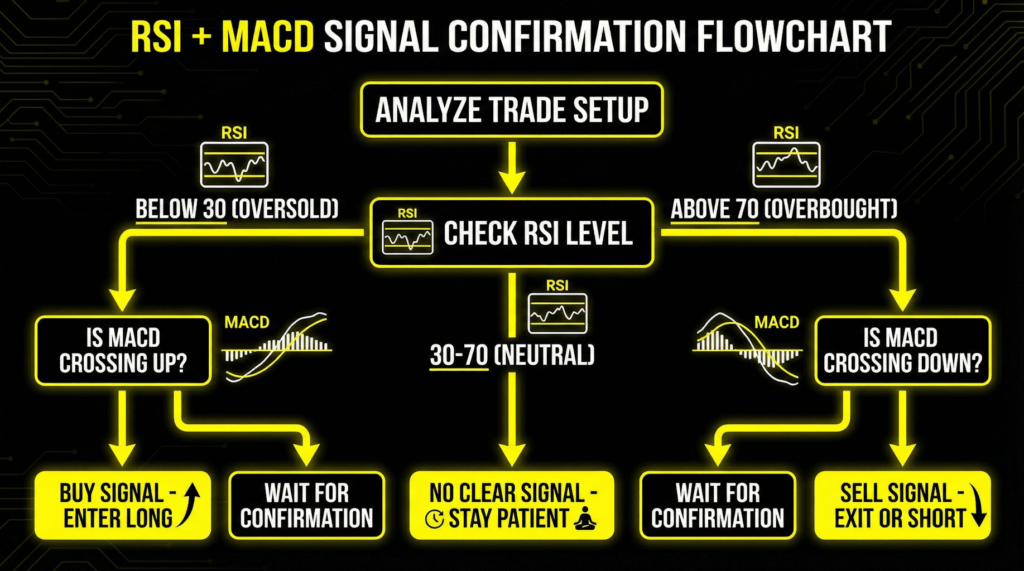
Research indicates that combining multiple indicators yields substantially better results than single-indicator analysis. When MACD, RSI, and volume signals align—a state traders call “confluence”—win rates increase significantly. Approximately 85% of market trend signals align when these indicators are combined strategically.
The practical application involves waiting for multiple confirmations:
This multi-confirmation approach requires patience but dramatically reduces false signals and improves your risk-reward ratio on every trade.
Effective risk management is more than just stop-losses—it’s the foundation that determines whether you’ll survive long enough to profit from your strategies. Most traders fail not because their strategy is bad, but because their risk management is broken. A single oversized position or missing stop-loss can wipe out months of careful work.
Professional traders and prop firms enforce strict risk parameters for good reason. These rules aren’t constraints—they’re survival mechanisms:
Crypto exchanges offer leverage up to 100x, but using it recklessly is a fast track to account destruction. Professional traders typically use far more conservative leverage—often 5x or less for swing trades and 10-20x maximum for shorter-term positions.
The math is unforgiving: 100x leverage means a 1% move against you wipes out your position. Even 10x leverage makes a 10% adverse move fatal. Start with low leverage (2-3x), prove your strategy works, then gradually increase as your skills and confidence grow.
Beyond the numbers, risk management is fundamentally psychological. You need the emotional discipline to take your stop-loss when it hits, resist the urge to “average down” on losing positions, and maintain consistent risk levels regardless of recent wins or losses.
The best traders treat risk management as their primary skill. Technical analysis tells you where to enter—risk management determines whether you’ll be around long enough to benefit from being right.
For traders who’ve developed consistent, profitable strategies, prop trading offers a transformative opportunity to scale results without risking personal capital. Crypto prop trading firms provide skilled traders with substantial funding, keeping a share of profits while covering losses—a model that aligns incentives and accelerates growth.
The concept is straightforward: prove your trading ability through an evaluation challenge, and the firm provides you with capital to trade. You focus on executing your strategy; they provide the resources. Profit splits typically range from 80% to 90% in the trader’s favor, with fast payout processing—often within 8-24 hours.
Crypto Fund Trader exemplifies the modern prop trading approach. Operating since November 2022, they’ve built a reputation for trader-friendly conditions and professional infrastructure. Their strategic partnership with Bybit—one of the world’s leading cryptocurrency exchanges—gives traders access to enterprise-grade execution technology, real exchange liquidity, and over 715 trading pairs.
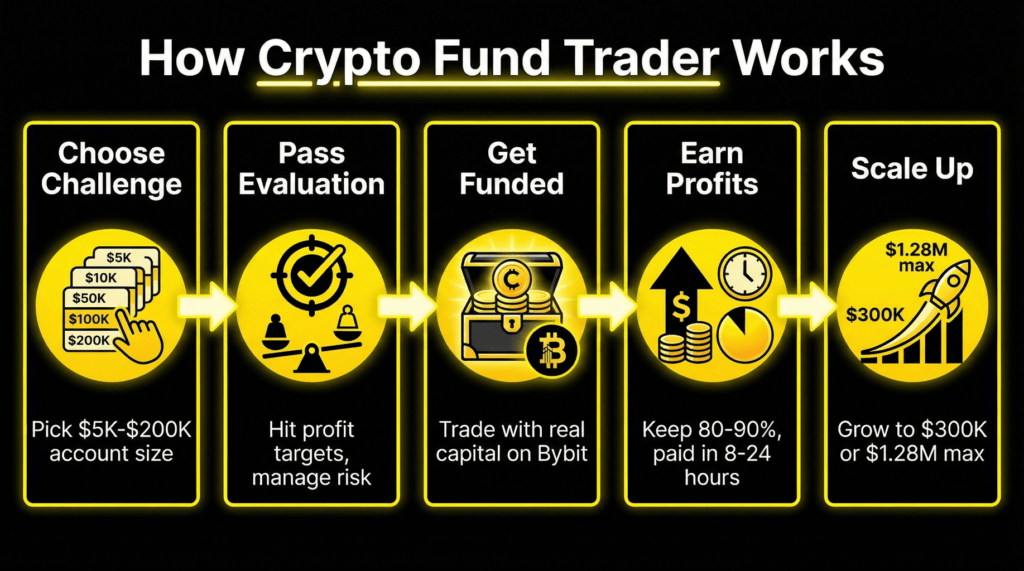
Different traders need different paths to funding. Crypto Fund Trader offers flexibility to match your style:
| Evaluation Type | Account Sizes | Scaling Potential | Best For |
|---|---|---|---|
|
Traditional Challenge
|
$5,000 - $200,000
|
Up to $300,000 (max allocation)
|
Methodical traders who prefer structured progression
|
|
Instant Challenge
|
$2,500 - $10,000
|
,
|
Aggressive traders seeking rapid scaling
|
The max allocation rule means you can manage up to $300,000 total in funded accounts—for example, a $200,000 account and a $100,000 account simultaneously. This allows for diversification across strategies or market conditions.
Your trading platform significantly impacts execution quality and strategy implementation. Crypto Fund Trader offers three distinct options:
The Bybit partnership deserves special attention. Unlike firms operating on simulated environments, this integration means you’re trading with genuine exchange liquidity—the same infrastructure used by professional crypto traders worldwide. This eliminates concerns about artificial price feeds or execution issues that plague some prop trading setups.
Trading with $100,000 in firm capital versus $5,000 of your own fundamentally changes your trajectory. The same 5% monthly return yields $5,000 versus $250. This mathematical reality is why skilled traders increasingly choose the prop trading path—it compresses years of account building into months.
The evaluation process itself improves your trading. The rules—profit targets, drawdown limits, consistency requirements—force disciplined habits. Many traders report that their performance improves simply from having clear parameters to operate within.
Success in crypto trading comes from matching your strategy to your personality, schedule, and goals, then executing with unwavering consistency. There’s no universally “best” strategy—there’s only the best strategy for you.
Consider these factors when selecting your main strategy:
Time availability: Day trading and scalping require hours of screen time; swing trading and DCA need only periodic attention.
Personality type: Do you thrive on fast-paced decisions or prefer analytical, patient approaches? Your natural tendencies should align with your strategy.
Risk tolerance: Aggressive strategies offer higher potential returns but require stomach for larger drawdowns. Conservative approaches build wealth more slowly but with less volatility.
Capital situation: Limited capital might benefit from prop trading to gain leverage. Substantial personal capital might prioritize capital preservation strategies like DCA.
Once you’ve identified your primary strategy, systematize it:
The traders who consistently profit are those who trade a system, not those who trade feelings. Your system doesn’t need to be complex—it needs to be clear, rules-based, and consistently applied.
Markets evolve, and your trading must evolve with them. Track your performance metrics religiously: win rate, average profit, average loss, maximum drawdown, and risk-adjusted returns. Review these monthly to identify patterns in your trading—both strengths to leverage and weaknesses to address.
Paper trading or small position sizes allow skill development without significant capital risk. Many successful traders still paper trade new strategies or market conditions before committing real capital. There’s no shame in practice—there’s only wisdom in preparation.
The strategies in this guide work—they’ve been proven by countless traders in markets far more challenging than today’s. But information without action changes nothing. The question isn’t whether these strategies can work; it’s whether you’ll commit to mastering one and executing it with discipline.
Start by identifying which strategy resonates most with your circumstances. If you’re new to trading, consider swing trading or DCA for their more forgiving learning curves. If you have experience and time, day trading or scalping might accelerate your growth. If you’ve developed consistent profitability, explore prop trading to multiply your results.
Whatever you choose, remember that trading success is a marathon, not a sprint. The traders who last are those who protect their capital, follow their rules, and continuously improve their craft. The crypto market isn’t going anywhere—take time to build your skills properly, and the opportunities will be there when you’re ready.
The funded trading lifestyle you envision—trading with substantial capital, capturing meaningful profits, and building real wealth—starts with proper preparation and disciplined execution. Master your chosen strategy, manage your risk religiously, and the results will follow.
Your journey to profitable crypto trading begins now. Choose your strategy, commit to the process, and prove what you’re capable of achieving.
The best crypto trading strategy depends on your available time, risk tolerance, and experience level—swing trading suits part-time traders seeking multi-day profits, while day trading rewards those who can monitor markets actively. Most successful traders combine technical analysis tools like RSI and MACD with strict risk management to maximize consistency across different market conditions.
Making $100 daily from crypto trading is achievable but requires sufficient capital and consistent 0.5-1% daily returns, which few traders sustain reliably. Prop trading firms like Crypto Fund Trader offer a faster path by providing funded accounts up to $300,000, allowing skilled traders to reach meaningful daily profits without risking personal capital.
The 3-5-7 rule is a risk management framework where you risk no more than 3% of capital per trade, limit exposure to 5% on any single market or asset, and cap total portfolio risk at 7% across all open positions. This layered approach to position sizing protects traders from catastrophic drawdowns while allowing meaningful profit potential.
The 80/20 rule (Pareto Principle) in crypto trading means roughly 80% of your profits typically come from 20% of your trades or holdings. Successful traders apply this by focusing their analysis on high-probability setups, concentrating capital in their best-performing strategies, and eliminating low-conviction trades that dilute overall returns.
The 30-day rule encourages traders to wait 30 days before making significant trading decisions or strategy changes to avoid emotional, impulsive actions driven by short-term market volatility. This cooling-off period helps cryptocurrency traders maintain discipline, evaluate setups objectively, and prevent FOMO-driven entries that often lead to losses.
-
© 2026 - All Rights Reserved.
SWISS RLCRATES AG is a provider of educational services, all information available on our site is intended solely for the study purposes related to trading on financial markets. Accordingly, we do not offer financial, investment, tax, brokerage or other advice and/or services. Trading in financial markets is a high-risk activity, past performance do not guarantee future ones. It is highly advised not to risk more, than you can afford to lose. Brokers and operators of trading platforms are persons or entities that are separate from SWISS RLCRATES AG and their own terms and conditions will apply when you use their services and products. Neither SWISS RLCRATES AG nor RLCRATES, S.L. (as MT5 license holder) operate in countries where crypto or CFD’s activity is not allowed. The content in our platform is applicable to the extent local laws and/or regulations permit.