


Algorithmic crypto trading with prop firm capital represents one of the most powerful opportunities for traders to scale their automated strategies without risking substantial personal funds. By combining the precision of trading bots with the financial backing of proprietary trading firms, you can access significant capital, trade 24/7, and retain the lion’s share of your profits—all while letting your algorithms do the heavy lifting.
The crypto markets never sleep, and neither should your edge. In this comprehensive guide, you’ll discover how to leverage algorithmic trading strategies with prop firm funding, the best platforms for automation, the different bot types available, key risks to manage, and emerging trends shaping the future of automated crypto trading.
Algorithmic crypto trading uses pre-programmed computer instructions to automatically execute buy and sell orders based on defined parameters such as price, volume, timing, and technical indicators. These automated systems—often called trading bots, Expert Advisors (EAs), or algos—remove emotional decision-making from trading while operating with millisecond precision across volatile cryptocurrency markets.
The cryptocurrency market’s unique characteristics make it particularly suited for algorithmic approaches. Unlike traditional markets, crypto trades 24/7 across hundreds of exchanges, creating constant opportunities that human traders simply cannot capture manually. Price discrepancies between exchanges, rapid trend movements, and high volatility all present scenarios where automated systems excel.
Modern algorithmic crypto trading has evolved far beyond simple rule-based bots. Today’s sophisticated systems incorporate machine learning models, sentiment analysis from social media, on-chain data metrics, and advanced technical indicators. Whether you’re running a momentum strategy, mean reversion bot, or arbitrage system, the fundamental advantage remains the same: speed, consistency, and emotionless execution.
Pairing your algorithmic trading strategy with prop firm funding creates a multiplier effect that dramatically accelerates your trading potential. Instead of deploying your bot on a limited personal account, you gain access to substantial capital—often ranging from $5,000 to $300,000 or more—while retaining 80% to 90% of the profits you generate.
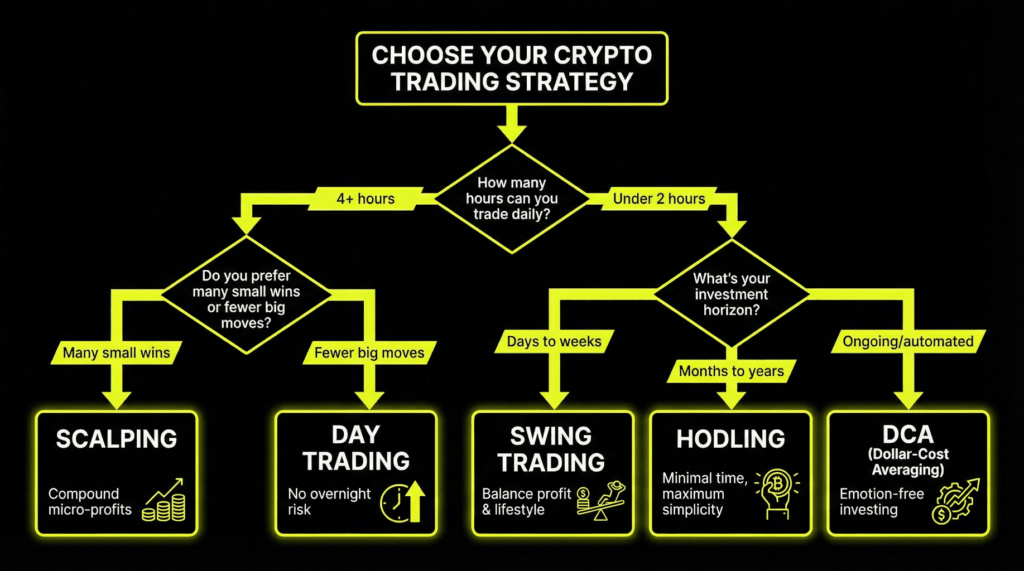
The prop firm model essentially transforms your proven algorithmic strategy into a revenue-sharing partnership. You bring the edge; they bring the capital. For algorithmic traders specifically, this arrangement is particularly attractive because bots can manage larger positions more effectively than manual traders, making full use of the available capital.
Crypto Fund Trader has established itself as a leading destination for algorithmic crypto traders seeking serious capital and lightning-fast payouts. Operating since November 2022, this prop firm stands apart through its strategic infrastructure designed specifically for automated trading systems.
What truly distinguishes Crypto Fund Trader is its exclusive partnership with Bybit—one of the world’s leading cryptocurrency derivatives exchanges. This isn’t merely offering “another platform option.” This strategic collaboration provides algorithmic traders with direct access to Bybit’s institutional-grade infrastructure, deep liquidity pools, and actual exchange order books. While many prop firms route orders through CFD brokers with synthetic pricing, Crypto Fund Trader’s Bybit integration ensures you’re trading on real market depth with genuine liquidity—crucial for algorithmic strategies that depend on accurate order book dynamics and execution certainty.
| Feature | Details |
|---|---|
|
Platforms Available
|
MT5, MatchTrader, Bybit (exclusive partnership)
|
|
Profit Split
|
80% standard, up to 90% with add-ons
|
|
Payout Processing
|
8-24 hours
|
|
Evaluation Accounts
|
$5,000 to $200,000
|
|
Maximum Funded Capital
|
Up to $300,000 (standard), $1,280,000 (Instant Challenge)
|
|
Trading Pairs
|
715+ cryptocurrency pairs
|
|
Operating Since
|
November 2022
|
The tri-platform architecture—MetaTrader 5 for Expert Advisors, MatchTrader for professional-grade execution, and direct Bybit integration—gives algorithmic traders unparalleled flexibility. Whether you’ve built your bot in MQL5, Python, or another language connecting via API, you’ll find infrastructure that supports your specific approach.
The Instant Challenge option offers account sizes of $2,500, $5,000, and $10,000 with scalability up to an impressive $1,280,000—notably exempt from the standard max allocation rules. For algorithmic traders looking to scale aggressively, this pathway provides exceptional growth potential. The max allocation rule for standard accounts—$300,000 total across all funded accounts—still provides ample room for portfolio diversification while maintaining proper risk management.
Understanding the various bot types helps you select or develop the right automated system for your trading goals and market conditions. Each bot category employs distinct logic and excels in specific scenarios.
Trend-following bots identify and ride existing market momentum, entering positions when price action confirms directional movement. These algorithms monitor technical indicators like moving average crossovers, RSI readings, or MACD signals to detect established trends. When Bitcoin breaks above its 50-day moving average with increasing volume, a trend bot enters long and rides the movement while trailing stop-losses to protect profits. These bots perform best in strongly directional markets but can struggle during sideways consolidation.
Mean reversion bots operate on the principle that prices eventually return to their historical average after significant deviations. When a cryptocurrency drops substantially below its typical trading range, the algorithm buys, anticipating a bounce back. Grid trading bots represent a popular mean reversion application—if Ethereum fluctuates between $1,800 and $2,200, a grid bot places layered buy orders near the lower boundary and sell orders near the upper boundary, profiting from the oscillation. These systems excel in ranging markets but require careful configuration to avoid losses during genuine breakouts.
Arbitrage bots exploit price discrepancies between different exchanges or related trading pairs. The fragmented nature of cryptocurrency markets—with prices varying slightly across hundreds of venues—creates persistent opportunities. These bots simultaneously buy on cheaper exchanges and sell on more expensive ones, capturing the spread. While conceptually simple, successful arbitrage requires exceptional speed and careful consideration of transaction fees, withdrawal times, and slippage.
DCA bots systematically accumulate positions at regular intervals or predetermined price levels, reducing the impact of volatility on entry prices. Advanced DCA bots combine systematic accumulation with technical triggers—perhaps buying additional amounts when RSI indicates oversold conditions or when price touches key support levels. This hybrid approach adds intelligence to the averaging process while maintaining the discipline that makes DCA effective for long-term accumulation strategies.
AI-powered bots represent the cutting edge of automated trading, using machine learning algorithms to analyze vast datasets and adapt strategies based on changing market conditions. These systems can process price data, social media sentiment, on-chain metrics, and news feeds to generate trading signals. Unlike rule-based bots, AI systems continuously learn and evolve their decision-making without manual intervention. However, they require significant computational resources and expertise to develop and maintain effectively.
Market-making bots place simultaneous buy and sell orders on both sides of the order book, profiting from the bid-ask spread. These systems provide liquidity to the market while capturing small profits on each transaction. Market making requires substantial capital and sophisticated risk management to handle inventory accumulation during trending markets.
| Bot Type | Best Market Conditions | Complexity | Risk Level |
|---|---|---|---|
|
Trend-Following
|
Strong directional trends
|
Medium
|
Medium
|
|
Mean Reversion
|
Range-bound, sideways markets
|
Medium
|
Medium
|
|
Arbitrage
|
Fragmented markets with price gaps
|
High
|
Low-Medium
|
|
DCA
|
All conditions (long-term focus)
|
Low
|
Low
|
|
AI/Machine Learning
|
Adaptive to changing conditions
|
Very High
|
Variable
|
|
Market-Making
|
High liquidity environments
|
High
|
Medium-High
|
Selecting the right platform significantly impacts your algorithmic trading effectiveness. The best platforms offer robust API access, reliable execution, comprehensive backtesting tools, and compatibility with prop firm requirements.
MT5 remains the most popular platform for Expert Advisor development and deployment in prop trading. Its MQL5 programming language enables sophisticated strategy development, and extensive community resources provide pre-built indicators and EA templates. MT5 supports multi-asset trading, advanced charting, and comprehensive backtesting with historical data. Crypto Fund Trader’s MT5 integration allows traders to deploy existing EAs with minimal modification, making it ideal for traders transitioning from forex algorithmic trading.
For traders building custom systems in Python, JavaScript, or other languages, Bybit’s V5 API provides comprehensive access to market data, order management, and account information. The API unifies spot, derivatives, and options trading under a single specification, simplifying development for multi-product strategies. Crypto Fund Trader’s strategic Bybit partnership means your API-based bots can leverage genuine exchange liquidity and real order book depth—a critical advantage for strategies sensitive to execution quality and market microstructure.
Bybit’s API features include WebSocket feeds for real-time data streaming, batch order capabilities for efficient execution, and unified account management across product types. The platform is trusted by over 100,000 developers worldwide and consistently ranks among the top exchanges for API trading volume.
MatchTrader offers professional-grade execution with advanced order types and risk management features tailored for serious traders. Its clean interface and reliable infrastructure make it popular among prop firms and institutional traders. Crypto Fund Trader’s MatchTrader integration provides another robust option for algorithmic deployment.
Services like 3Commas, Cryptohopper, and WunderTrading offer user-friendly interfaces for creating and deploying trading bots without extensive programming knowledge. These platforms support connections to multiple exchanges and provide pre-built strategy templates alongside custom bot development tools.
WunderTrading: Enables TradingView strategy automation and copy trading. Connects to major exchanges including Bybit, Binance, and Coinbase.
While primarily a charting platform, TradingView’s Pine Script language allows strategy development and automated execution through webhook connections to exchanges or bot platforms. Many algorithmic traders use TradingView for strategy development and backtesting before deploying to dedicated execution platforms.
Deploying an algorithmic system on a prop firm account requires methodical preparation and ongoing optimization. Follow this comprehensive setup process to maximize your chances of success.
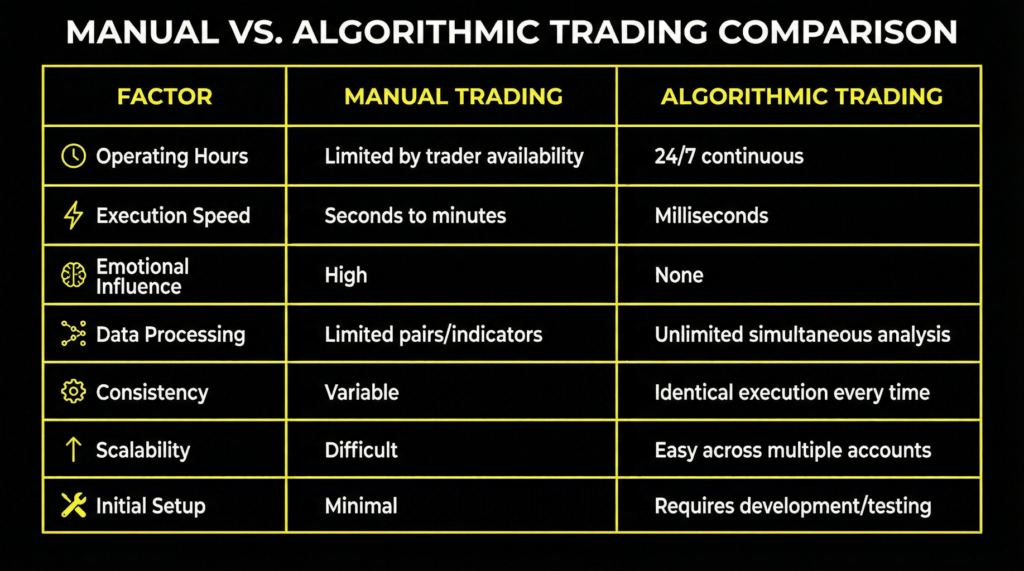
Begin by clarifying exactly what your algorithm will do. Document your entry conditions, exit rules, position sizing logic, and risk parameters. Decide whether you’re pursuing trend-following, mean reversion, arbitrage, or another approach. Your strategy should align with your risk tolerance, available time for monitoring, and the specific prop firm rules you’ll be trading under.
Consider questions like: What timeframes will you trade? Which cryptocurrency pairs offer the best opportunities for your approach? What’s your target win rate and risk-reward ratio? Clear answers guide every subsequent decision.
You have three main paths to obtaining a trading algorithm. First, code it yourself using languages like Python, MQL5, or JavaScript—this provides maximum customization but requires programming skills. Second, use visual bot builders on platforms like 3Commas or Cryptohopper that allow strategy creation without coding. Third, purchase or subscribe to pre-built bots, though you must thoroughly verify their performance claims and customize settings to avoid using identical parameters as other traders.
If developing custom systems, Bybit’s comprehensive API documentation and SDKs (available for Python, .NET, and other languages) simplify the integration process. Crypto Fund Trader’s Bybit partnership ensures your custom bots connect to institutional-grade infrastructure.
Backtesting reveals how your strategy would have performed across various market conditions. Use extensive historical data covering bull markets, bear markets, and sideways consolidation phases. Pay particular attention to maximum drawdown figures—if your backtest shows a 12% peak-to-valley drawdown but your prop firm allows only 10%, your strategy needs adjustment.
Be cautious of overfitting, where your algorithm performs brilliantly on historical data but fails in live markets because it’s capturing noise rather than genuine patterns. Techniques to avoid overfitting include out-of-sample testing (reserving a portion of data the algorithm never sees during development), walk-forward analysis, and testing across multiple market conditions and timeframes.
Deploy your algorithm in a paper trading or demo environment before risking real capital. This step validates that your bot executes correctly in real market conditions—proper order placement, accurate stop-loss triggering, and appropriate position sizing. Technical issues that didn’t appear in backtesting often emerge during paper trading, including API connection problems, order rejection handling, and latency issues.
Monitor your paper trading for at least 2-4 weeks across different market conditions before proceeding to live deployment.
Program explicit risk controls into your algorithm before going live. Essential components include:
For prop firm trading specifically, configure your bot to operate well within the firm’s drawdown limits rather than right at the edge. If the maximum allowed drawdown is 10%, design your system to target maximum drawdowns of 6-7%, providing a buffer for unexpected market events.
Once your strategy is thoroughly tested, select your prop firm account size and begin the evaluation. Crypto Fund Trader offers evaluations from $5,000 to $200,000, allowing you to match account size with your strategy’s optimal capital requirements. Start the evaluation and allow your tested algorithm to operate within established parameters.
Even automated systems require oversight. Monitor performance daily during evaluation and regularly once funded. Track key metrics including win rate, average win versus average loss, maximum drawdown, Sharpe ratio, and profit factor. Market conditions evolve, and strategies that worked six months ago may need adjustment.
Once consistently profitable, consider scaling through additional funded accounts. Crypto Fund Trader’s max allocation allows up to $300,000 across funded accounts in the standard program—for example, a $200,000 account and a $100,000 account simultaneously.
Despite significant advantages, algorithmic crypto trading carries substantial risks that every trader must understand and actively manage. Awareness of these dangers helps you implement appropriate safeguards.
A trading algorithm can perform exceptionally well on historical data but fail dramatically in live markets. This “overfitting” occurs when your algorithm captures historical noise rather than genuine, repeatable market patterns. The strategy essentially memorizes past price movements rather than learning generalizable rules.
Mitigation: Use out-of-sample testing, walk-forward analysis, and test across multiple market regimes. Be skeptical of strategies showing unrealistically high backtested returns. Simpler strategies with clear logical foundations typically prove more robust than complex systems optimized to perfection.
Algorithms depend on complex software, reliable internet connections, and functioning exchange infrastructure. Server outages, API disconnections, software bugs, and exchange maintenance can all disrupt your bot’s operation—potentially leaving positions unmanaged during volatile periods or executing unintended trades.
Mitigation: Host your bot on reliable VPS infrastructure with redundant internet connections. Implement heartbeat monitoring that alerts you when your bot stops functioning. Program graceful error handling that closes positions safely rather than leaving them exposed during system failures.
Strategies that profit in one market regime may lose money when conditions shift. A mean reversion bot thrives during consolidation but hemorrhages capital during strong trends. A momentum system captures trending moves but whipsaws during choppy sideways action. Markets evolve constantly, and your algorithm’s edge can decay without warning.
Mitigation: Include regime detection logic in your algorithm that identifies when conditions have changed. Consider running multiple uncorrelated strategies to smooth returns across different market environments. Monitor strategy performance metrics continuously and be prepared to pause or adjust when edge deteriorates.
Backtests often assume perfect order fills at expected prices. Real trading involves slippage—the difference between expected and actual execution prices—especially during volatile crypto markets or when trading less liquid pairs. Exchange fees and spreads further erode returns. A strategy that appears profitable in backtesting may become unprofitable after accounting for realistic execution costs.
Mitigation: Build conservative slippage assumptions into backtesting. Use limit orders where appropriate rather than market orders. Focus on liquid trading pairs with tight spreads. Monitor actual execution quality and adjust expectations based on real performance.
Connecting trading bots via API creates potential security risks. Compromised API keys could allow unauthorized access to your trading accounts. Malicious code in third-party bots could steal funds or execute unwanted trades.
Mitigation: Never grant withdrawal permissions to trading API keys—only enable trading access. Use IP whitelisting where available. Only use bot software from trusted, verified sources. Store API credentials securely and rotate them periodically.
Automated systems make it easy to take on excessive leverage or concentrated positions. Multiple positions in correlated assets (like several altcoins that all follow Bitcoin) can combine into dangerous effective exposure during market-wide moves.
Mitigation: Implement portfolio-level risk controls that account for correlation. Limit maximum leverage and total exposure across all positions. Ensure your bot calculates total risk rather than just individual trade risk.
Ironically, one risk of automated trading is human intervention. Watching your bot experience drawdowns can trigger emotional decisions to override your system—often at the worst possible moments. Stopping your bot during a drawdown, then restarting it after it would have recovered, destroys the statistical edge your backtesting revealed.
Mitigation: Trust your testing process and allow your system to operate as designed. Define specific, objective criteria for when human intervention is appropriate (such as technical malfunctions) versus when you should let the algorithm work through normal variance.
The algorithmic trading landscape continues evolving rapidly, with several emerging trends poised to reshape how automated systems operate in cryptocurrency markets.
Artificial intelligence is transforming algorithmic trading from rule-based systems to adaptive, learning algorithms. Machine learning models can process vastly more data than traditional systems—analyzing price patterns, on-chain metrics, social sentiment, news feeds, and market microstructure simultaneously. These AI-enhanced systems continuously evolve their strategies based on changing market dynamics without requiring manual parameter adjustments.
By 2026, expect AI-driven bots to become more accessible to retail traders through user-friendly platforms that abstract away the complexity of model development. However, as more traders adopt similar AI tools, market efficiency may increase, narrowing opportunities and requiring ever-more sophisticated approaches to maintain edge.
Cloud platforms now enable smaller firms and individual traders to access computational power previously reserved for large financial institutions. Cloud-based deployment allows rapid backtesting of new algorithms, real-time data processing, and strategy deployment across global markets with minimal latency. This democratization of infrastructure means algorithmic traders can compete more effectively regardless of personal resources.
The cloud-based segment is projected to dominate algorithmic trading deployment, offering superior scalability as strategies become more sophisticated and require processing massive amounts of market data in real-time.
Decentralized finance protocols and decentralized exchanges provide new venues for algorithmic strategies. Smart contracts enable trustless execution of trading strategies directly on-chain, reducing counterparty risk and enabling new algorithmic approaches tailored to DeFi-specific opportunities like yield farming optimization, liquidity provision, and cross-protocol arbitrage.
As DeFi infrastructure matures, expect algorithmic systems that seamlessly operate across both centralized exchanges like Bybit and decentralized protocols, capturing opportunities across the entire cryptocurrency ecosystem.
The proliferation of user-friendly algorithmic trading apps has dramatically lowered barriers to entry. Platforms offering no-code bot builders, pre-built strategy templates, and low or no commission trading make algorithmic approaches accessible to individual investors without programming expertise. Retail traders increasingly build portfolios around automation products, seeking diversification through multiple bot strategies rather than traditional asset allocation.
As algorithmic trading grows, regulatory frameworks are adapting. Expect increased scrutiny around automated trading practices, particularly concerning market manipulation risks, consumer protection, and systemic stability. Prop firms and traders will need to ensure compliance with evolving guidelines while maintaining competitive strategies.
Future algorithms will increasingly incorporate alternative data sources—social media sentiment, satellite imagery, web traffic patterns, and developer activity metrics—to generate trading signals. The ability to process and interpret these non-traditional data sources will become a key differentiator for sophisticated algorithmic systems.
eady to deploy your algorithmic strategy with prop firm capital? Follow this action plan to launch your funded trading journey.
Week 1-2: Strategy Development and Backtesting Finalize your trading strategy and conduct comprehensive backtesting across multiple market conditions. Document performance metrics including win rate, maximum drawdown, profit factor, and average trade duration. Verify that your strategy’s drawdown characteristics fit within typical prop firm parameters.
Week 3: Paper Trading and Optimization Deploy your algorithm in a paper trading environment. Monitor execution quality, identify any technical issues, and fine-tune parameters based on live market behavior. Ensure your risk management logic functions correctly under various scenarios.
Week 4: Prop Firm Selection and Evaluation Entry Choose a prop firm aligned with your strategy’s characteristics and platform requirements. Crypto Fund Trader’s diverse platform options—MT5, MatchTrader, and the exclusive Bybit integration—accommodate virtually any algorithmic approach. Select an appropriate account size based on your strategy’s capital requirements and risk tolerance.
Ongoing: Evaluation and Funded Trading Execute your evaluation with discipline, allowing your tested algorithm to operate within established parameters. Avoid the temptation to override your system during temporary drawdowns. Once funded, maintain the same disciplined approach while monitoring for strategy decay and market condition changes that might require adjustment.
Algorithmic crypto trading with prop firm capital offers a transformative opportunity for systematic traders to scale their strategies without proportional risk. The combination of automated precision, 24/7 market coverage, and professional funding creates a powerful framework for generating consistent trading income.
Understanding the different bot types—from trend-following and mean reversion to AI-powered systems—allows you to select the right approach for your goals. Choosing the best platforms, implementing rigorous setup procedures, and actively managing the inherent risks positions you for long-term success. Meanwhile, staying attuned to future trends ensures your algorithmic edge remains sharp as markets evolve.
Crypto Fund Trader’s strategic Bybit partnership, multi-platform support across MT5, MatchTrader, and direct exchange integration, plus trader-friendly profit splits up to 90%, make it an exceptional choice for algorithmic traders ready to take their bots to the next level. With evaluations starting at $5,000, over 715 trading pairs available, and scaling potential up to $1,280,000 through the Instant Challenge pathway, ambitious algorithmic traders have clear pathways to significant funded capital.
Your algorithm represents your edge—now it’s time to give it the capital it deserves. The markets are running 24/7, opportunities are emerging every second, and your bot is ready to capture them. Start your algorithmic trading journey with Crypto Fund Trader today and transform your proven strategy into a funded trading operation.
Can you automate crypto trading?
Yes, you can fully automate crypto trading using algorithmic trading bots, Expert Advisors (EAs), and API-connected systems that execute trades based on predefined rules and technical indicators. Automated crypto trading platforms like MetaTrader 5, Bybit, and third-party bot services enable 24/7 trading without manual intervention.
Is automated crypto trading profitable?
Automated crypto trading can be profitable when using well-tested strategies with proper risk management, though profitability depends on market conditions, strategy quality, and execution efficiency. Combining algorithmic trading with prop firm capital—like accounts available through Crypto Fund Trader—allows traders to scale profitable bots while keeping 80-90% of profits and limiting personal risk to evaluation fees.
Can I use AI to trade crypto?
Yes, AI-powered trading bots use machine learning algorithms to analyze market data, detect patterns, and execute trades with adaptive decision-making that evolves based on changing conditions. AI crypto trading systems can process price action, social sentiment, and on-chain metrics simultaneously, offering advantages over traditional rule-based algorithms.
Is AI crypto trading illegal?
AI crypto trading is legal in most jurisdictions, though traders must comply with local regulations regarding automated trading, tax reporting, and exchange terms of service. Certain strategies like market manipulation or exploiting exchange vulnerabilities remain prohibited regardless of whether execution is manual or algorithmic.
Which crypto trading bot is best?
The best crypto trading bot depends on your strategy, technical skills, and trading goals—popular options include 3Commas for DCA and grid strategies, Cryptohopper for AI-powered automation, and custom bots built via exchange APIs like Bybit’s V5 API. For funded algorithmic trading, Crypto Fund Trader supports multiple platforms including MT5, MatchTrader, and direct Bybit integration with access to 715+ trading pairs.
What is the 1% rule in crypto?
The 1% rule in crypto trading states that you should never risk more than 1% of your total account equity on a single trade, protecting your capital from significant drawdowns during losing streaks. This risk management principle is especially critical for algorithmic trading bots operating on prop firm accounts where strict drawdown limits determine whether you remain funded.
-
© 2026 - All Rights Reserved.
SWISS RLCRATES AG is a provider of educational services, all information available on our site is intended solely for the study purposes related to trading on financial markets. Accordingly, we do not offer financial, investment, tax, brokerage or other advice and/or services. Trading in financial markets is a high-risk activity, past performance do not guarantee future ones. It is highly advised not to risk more, than you can afford to lose. Brokers and operators of trading platforms are persons or entities that are separate from SWISS RLCRATES AG and their own terms and conditions will apply when you use their services and products. Neither SWISS RLCRATES AG nor RLCRATES, S.L. (as MT5 license holder) operate in countries where crypto or CFD’s activity is not allowed. The content in our platform is applicable to the extent local laws and/or regulations permit.