
If you’ve been trading crypto for any amount of time, you’ve probably traded on an exchange. Binance, Bybit, Coinbase, these platforms are the default entry point for most people exploring digital asset markets. But a growing number of skilled traders are asking a very different question: why am I using my own money at all?
That question is what separates a crypto exchange from a crypto prop firm, and understanding that gap could fundamentally change how you approach your trading career.
This guide breaks down exactly what makes these two paths different, who each is built for, and what the tradeoffs look like in practice.
A crypto exchange is a marketplace where traders buy and sell digital assets using their own capital. Exchanges like Binance, Coinbase, Kraken, and Bybit provide direct access to spot markets, derivatives, perpetual contracts, and more, all using personal funds that the trader deposits and controls.
At their core, exchanges are neutral infrastructure. They match buyers and sellers, collect fees on transactions, and provide the liquidity rails the broader crypto market runs on. The trader’s profit or loss is entirely their own responsibility, in both directions.
Key characteristics of crypto exchanges:
The appeal of exchanges is straightforward: total freedom, total ownership, total control. The challenge is equally clear, total financial exposure.
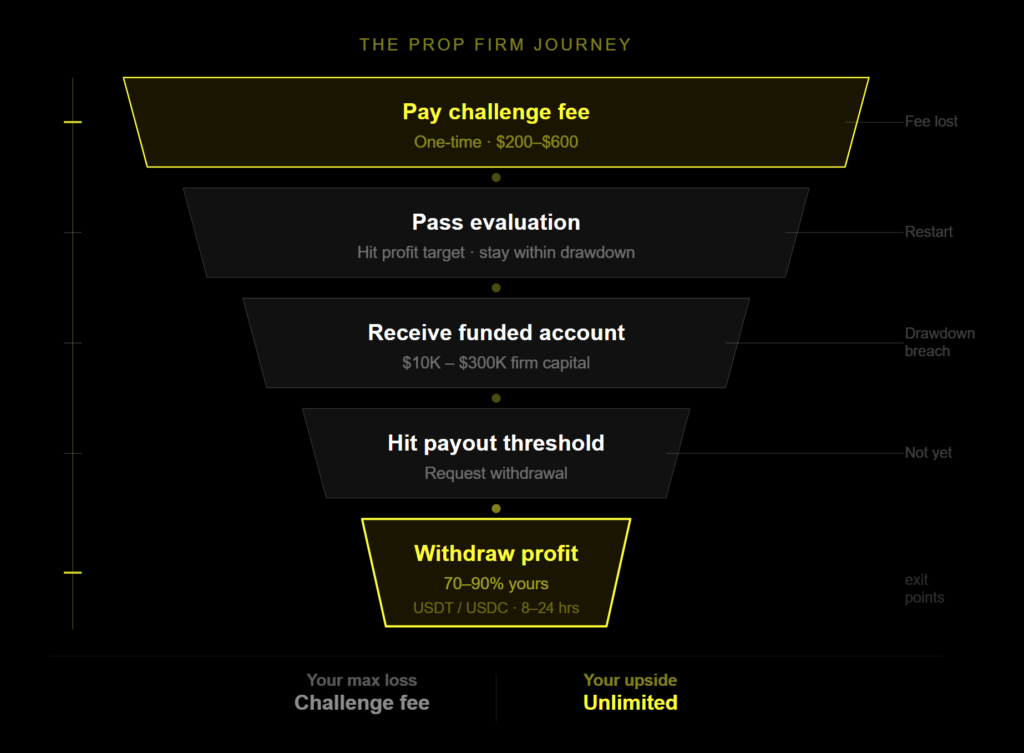
A crypto prop firm (short for proprietary trading firm) provides funded trading accounts to skilled traders, allowing them to access firm capital rather than personal savings. Traders don’t own the funds they trade, instead, they earn a share of the profits they generate, typically between 70% and 90%.
The defining feature of a prop firm is the evaluation process. Traders typically pay a one-time challenge fee and must demonstrate they can hit a profit target while staying within defined drawdown limits. Pass the evaluation, and the firm provides a funded live account ranging from a few thousand dollars up to $300,000 or more, depending on the firm and program.
Key characteristics of crypto prop firms:
The prop firm model essentially offers a trade: give up asset ownership and a percentage of profits in exchange for access to far more capital than most retail traders could accumulate, without carrying downside risk beyond an evaluation fee. Platforms built specifically around crypto futures trading, for instance, now offer funded accounts up to $300,000, profit splits reaching 90%, and payouts processed within 8–24 hours — a far cry from the early prop firm models that barely acknowledged digital assets existed.
The fundamental distinction between a crypto prop firm and a crypto exchange comes down to one thing, who bears the financial risk of the trades you make.
On an exchange, every dollar of loss is your dollar. At a prop firm, the firm absorbs the trading losses if your account hits its drawdown limit; the worst that happens to you is losing the challenge fee and your funded account.
The table below maps out how the two models compare across every dimension that matters to an active trader:
| Feature | Crypto Exchange | Crypto Prop Firm |
|---|---|---|
|
Capital used
|
Your own money
|
Firm's capital
|
|
Downside risk
|
100% personal exposure
|
Limited to challenge fee
|
|
Profit retention
|
100% (minus fees/tax)
|
70–90%+ profit split
|
|
Asset ownership
|
Yes, withdraw, stake, hold
|
No, speculative trading only
|
|
Starting capital
|
Limited to personal savings
|
$10,000–$300,000+ funded
|
|
Evaluation required
|
No (open access)
|
Yes (challenge/assessment phase)
|
|
Trading rules
|
Set your own parameters
|
Firm-imposed risk limits
|
|
Market access
|
Spot, futures, DeFi, NFTs
|
Futures, perpetuals, some spot
|
|
Trading hours
|
24/7
|
24/7 (crypto-native firms)
|
|
Platform options
|
Exchange-native UI
|
MT5, MatchTrader, exchange platforms
|
|
Payout speed
|
Immediate (your funds)
|
8–24 hours (leading firms) |
|
Regulatory environment
|
Licensed exchanges (MiCA, CFTC)
|
Largely unregulated industry
|
|
DeFi participation
|
Yes (full blockchain access)
|
No
|
|
Scalability
|
Limited by personal capital
|
Scaling programs up to $1M+
|
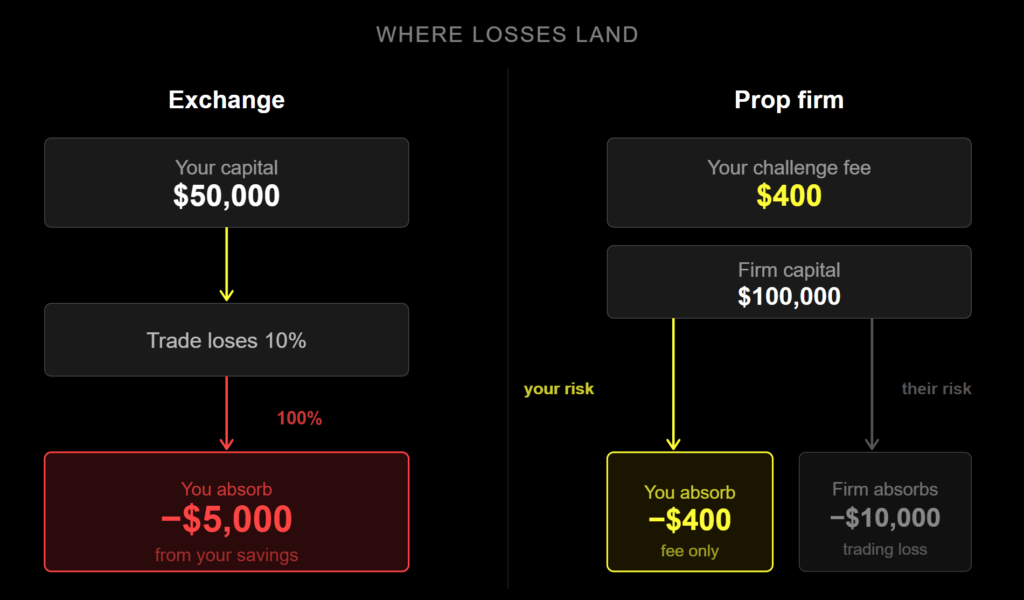
On a crypto exchange, every trade draws from your personal capital. A 10% drawdown on a $50,000 exchange account means you’ve personally lost $5,000. That’s real money, money that affects your life outside of trading.
At a crypto prop firm, the loss structure works differently. If you hold a $100,000 funded account and hit the firm’s maximum drawdown limit, typically 8–12%, the account is closed. Your personal loss is the challenge fee you paid, often $300–$600. The firm absorbs the trading losses themselves.
This asymmetric risk structure is what makes prop trading philosophically distinct from exchange trading. It also explains why prop firms impose strict risk rules: they need traders to manage drawdown carefully because the firm’s capital is genuinely on the line.
Risk comparison at a glance:
Neither structure eliminates risk. But they distribute it very differently.
One area where exchanges have a clear and unchallenged advantage is actual asset ownership. When you buy Bitcoin on Coinbase or Kraken, you own that Bitcoin. You can withdraw it to a hardware wallet, use it as collateral in DeFi protocols, participate in staking, earn yield, or hold it as a long-term store of value.
Crypto prop firms don’t offer this. Traders at prop firms are speculating on price movements, they’re typically trading futures contracts, perpetuals, or CFD-style instruments. There’s no underlying asset to withdraw, stake, or hold. The position closes, the profit or loss is calculated, and that’s the end of it.
This isn’t a flaw in the prop firm model, it’s simply a different tool. A prop firm account is optimized for active trading, not for building a crypto portfolio or participating in the broader blockchain ecosystem. If owning and holding digital assets is part of your strategy, an exchange is the appropriate venue. If generating trading profits from price movements is the objective, the prop firm’s lack of asset ownership is a non-issue.
Both exchanges and prop firms provide access to the same underlying crypto markets, but the instruments available differ significantly.
A major crypto exchange like Binance or Bybit offers spot trading (buying and selling actual assets), futures and perpetual contracts, margin trading, options (on select platforms), and in many cases, access to DeFi protocols and token launches. The breadth of the exchange ecosystem is genuinely vast, Bitget, for instance, supports over 1,300 spot tokens.
Crypto prop firms concentrate their offering on the instruments most suited to active trading: perpetual futures and derivatives. Leading crypto-native prop firms, however, have expanded pair coverage dramatically. Crypto Fund Trader’s partnership with Bybit, for example, provides access to over 715 trading pairs, a selection that includes not just major coins like BTC and ETH but deep altcoin exposure that most prop firm programs historically couldn’t offer.
The practical implication: if your strategy requires trading obscure altcoin pairs or low-liquidity tokens, an exchange remains the more flexible option. If you’re trading the major and mid-cap pairs that capture the bulk of market volume, a well-integrated prop firm can match the exchange’s depth.
The fee structures of exchanges and prop firms look very different on the surface but converge in interesting ways when you examine the economics carefully.
Crypto exchange costs:
Crypto prop firm costs:
The evaluation fee is the most visible cost of prop trading, but it’s a one-time expense, not an ongoing drag on every trade. Traders who pass evaluations quickly and generate consistent profits can recover that fee in a single payout. The profit split is the ongoing cost, but 80% of $50,000 in profits is still $40,000, and that $50,000 was made on the firm’s capital, not the trader’s.
By contrast, exchange traders keep 100% of their gains but bear 100% of the risk on their own capital. The “free” profit retention of an exchange comes at the cost of complete personal downside exposure.
Crypto exchanges now operate in an increasingly structured regulatory environment. In the European Union, MiCA (Markets in Crypto-Assets Regulation) came into full effect at the end of 2024, establishing mandatory asset segregation, consumer protections, and licensing requirements for centralized exchanges. In the United States, the CFTC’s “Crypto Sprint” initiative and ongoing SEC guidance are bringing greater clarity to how crypto platforms are supervised.
The crypto prop firm industry, by contrast, operates largely outside formal regulatory frameworks. This doesn’t make prop firms inherently illegitimate, many are credible, well-capitalized businesses, but it means traders face a due diligence burden that doesn’t exist when using a regulated exchange.
The 2024–2025 period saw significant consolidation in the prop firm space, with numerous firms collapsing and failing to honor payouts. The firms that survived that period generally demonstrated stronger institutional foundations: verifiable payout histories, exchange partnerships that provide external credibility, and transparent operations reviewable on independent platforms like Trustpilot and Reddit.
When evaluating a prop firm, look for:
There’s no universal right answer here. Both models have legitimate uses, and many serious traders use both, an exchange for spot holdings and long-term positions, a prop firm for their active futures trading.
A crypto exchange is likely the better fit if you:
A crypto prop firm is likely the better fit if you:
The critical prerequisite for prop trading is genuine, demonstrable skill. Prop firms don’t fund speculation, they fund performance. If your edge isn’t consistent enough to pass an evaluation under defined rules, the prop firm model will cost you evaluation fees without delivering funded capital. Be honest with yourself about where your trading actually stands before committing to that path.
The clearest sign that the crypto prop firm space has matured is how deeply integrated the best firms have become with the exchange infrastructure they once merely simulated.
Early prop firm models often used synthetic or demo-environment execution, traders passed evaluations and received “funded” accounts that didn’t actually interact with live markets. That model created trust problems and, in several cases, outright fraud.
Leading crypto prop firms today take a different approach. Direct exchange integration means traders execute in real market conditions, with real liquidity, at real prices. The prop firm’s reliability is backed by the exchange partner’s infrastructure, and for traders evaluating which firms to trust, that partnership is now a primary signal of operational legitimacy.
This convergence matters because it narrows the practical gap between exchange trading and prop trading. When a funded account connects directly to Bybit’s order book, the execution quality, price discovery, and liquidity depth are equivalent to trading on the exchange directly. The difference isn’t the market, it’s whose capital is funding the position.
The choice between a crypto prop firm and a crypto exchange isn’t really a choice between two trading tools. It’s a choice between two different relationships with capital and risk.
Exchanges are infrastructure, they give you market access and let you deploy your own resources, keeping everything you earn. Prop firms are a capital partnership, they front the funds, you provide the skill, and you split the proceeds.
Neither model is inherently superior. An exchange is the right venue for owning assets, building a portfolio, and accessing the full breadth of the crypto ecosystem. A prop firm is the right venue for a skilled trader who wants to scale their strategy beyond the limits of personal savings, without the downside exposure that comes with trading on personal capital.
The traders who build serious careers in crypto often learn to distinguish between these purposes clearly: exchanges hold their wealth; prop firms amplify their trading. When each tool is used for what it’s actually designed to do, the combination is more powerful than either alone.
About Crypto Fund Trader: Crypto Fund Trader is a crypto prop trading platform operating since November 2022, providing funded accounts to traders through partnerships with institutional-grade exchanges. Learn more at cryptofundtrader.com.
Why use a prop firm instead of just trading on Binance with my own money and keeping 100% of profits? On your own exchange account, you keep 100% of profits but absorb 100% of losses — and your account size caps at what you’ve saved. A prop firm lets you trade $100K–$300K in firm capital after a $300–$600 evaluation fee. Eighty percent of $10,000 in monthly profits beats 100% of $500. The model only makes sense if your edge scales — if it does, trading a small personal account means leaving serious money on the table.
Do funded accounts trade real markets, or is it all just simulated demo nonsense? The better firms execute through direct exchange integration — a Bybit or Binance partnership means your trades hit a real order book. Early prop firms ran purely synthetic environments where payouts came from other traders’ fees, not market profits. Always ask whether execution goes through an actual exchange or a CFD/simulated layer. The answer tells you whether your fills are real and whether payouts have genuine backing.
What happens if crypto crashes 30% overnight while I’m in a funded position — do I owe the firm money? No. If your account hits the maximum drawdown limit — typically 8–12% — it gets closed. You lose the challenge fee and the funded account. That’s it. The firm absorbs the trading losses. Unlike a leveraged position on your own Bybit account that can liquidate and wipe you out entirely, the prop firm model puts a hard floor on your personal downside.
Aren’t the drawdown rules basically designed to fail you? A 5% daily loss limit seems impossible on crypto. Some rules are genuinely trader-hostile and do inflate failure rates to protect challenge fee revenue — that’s a fair criticism. But the core logic is sound: the firm’s capital is on the line, so they enforce risk limits. The key variables are how drawdown is calculated — balance-based is far more forgiving than equity-based — and whether there’s a time limit on the evaluation. Read those terms specifically before you pay.
Can I actually hold or stake crypto through a prop firm, or am I just trading derivatives? Prop firm accounts are derivatives only — futures, perpetuals, CFDs. You don’t own any underlying Bitcoin or ETH, and there’s nothing to withdraw to a wallet, stake, or use in DeFi. Exchanges are for owning assets; prop firms are for generating trading income. Many serious traders use both: long-term positions on a regulated exchange, active trading through a funded account.
Why pay $400–$600 for a “chance” at their money when I could just save that cash and trade it myself? Four hundred dollars in your own account gives you $400 of trading power. The same $400 as a challenge fee gives you a shot at $100,000 in firm capital. The expected value only works if you have a real, tested edge — if you don’t, you’re funding the firm’s revenue model. Be honest about your actual win rate and drawdown history before paying anything.
Am I liable for taxes if it’s not technically my money? Yes. You’re taxed on the profit share you receive because that’s income — typically paid in USDT. The firm absorbed the trading losses, which means those losses aren’t yours to deduct. Tax treatment of prop trading income differs from trading your own capital, and the rules vary by jurisdiction. Get advice from an accountant who understands crypto before payouts scale.
This article is for educational and informational purposes only. It does not constitute financial or investment advice. Trading cryptocurrencies and participating in prop firm challenges involves risk. Always conduct your own research and consult with qualified professionals before making financial decisions.
-
© 2026 - All Rights Reserved.
SWISS RLCRATES AG is a provider of educational services, all information available on our site is intended solely for the study purposes related to trading on financial markets. Accordingly, we do not offer financial, investment, tax, brokerage or other advice and/or services. Trading in financial markets is a high-risk activity, past performance do not guarantee future ones. It is highly advised not to risk more, than you can afford to lose. Brokers and operators of trading platforms are persons or entities that are separate from SWISS RLCRATES AG and their own terms and conditions will apply when you use their services and products. Neither SWISS RLCRATES AG nor RLCRATES, S.L. (as MT5 license holder) operate in countries where crypto or CFD’s activity is not allowed. The content in our platform is applicable to the extent local laws and/or regulations permit.