
The promise is seductive: trade crypto with someone else’s capital, keep up to 90% of the profits, and never risk your own savings. But how much do crypto prop firm traders actually earn and what does the road to those payouts really look like?
This guide breaks down real crypto prop firm earnings using industry data, payout statistics, and documented trader outcomes. No hype. No affiliate bait. Just numbers you can plan around.
Crypto prop firm earnings are the profits a trader keeps after generating returns on capital provided by a proprietary trading firm. Most firms offer profit splits between 80% and 90%, meaning a trader who generates $10,000 in profit on a funded account takes home $8,000–$9,000.
Unlike a salaried trading desk role, prop firm income is entirely performance-based. There’s no base pay, no benefits package, and no guaranteed monthly check. Your earnings are a direct function of three variables: the size of your funded account, your monthly return percentage, and the firm’s profit-split terms.
Here’s where things get interesting. The crypto prop trading industry surpassed $20 billion in total market value in 2025, according to multiple industry analyses. Firms like Crypto Fund Trader offer evaluations from $5,000 to $200,000 in account sizes, with funded allocations reaching up to $300,000 — and Instant Funding accounts that can scale to $1,280,000 through consistent performance. That means even a modest monthly return on a large account can translate into meaningful income.
But the flip side is equally important: data from FPFX Technology covering over 300,000 prop accounts found that only 7% of all traders who purchase a challenge ever receive a payout. The earnings potential is real, but so is the failure rate.
A funded crypto prop trader generating consistent returns of 3–5% monthly on a $100,000 account can realistically earn $2,400–$4,500 per month after the firm’s profit split. That’s the middle of the bell curve — not the headline-grabbing outlier, and not the blown account that never sees a withdrawal.
The math is straightforward, but worth walking through at different account sizes and performance levels.
| Account Size | Monthly Return | Gross Profit | Net Earnings (80% Split) | Net Earnings (90% Split) |
|---|---|---|---|---|
|
$25,000
|
3%
|
$750
|
$600
|
$675
|
|
$25,000
|
5%
|
$1,250
|
$1,000
|
$1,125
|
|
$50,000
|
3%
|
$1,500
|
$1,200
|
$1,350
|
|
$50,000
|
5%
|
$2,500
|
$2,000
|
$2,250
|
|
$100,000
|
3%
|
$3,000
|
$2,400
|
$2,700
|
|
$100,000
|
5%
|
$5,000
|
$4,000
|
$4,500
|
|
$200,000
|
3%
|
$6,000
|
$4,800
|
$5,400
|
|
$200,000
|
5%
|
$10,000
|
$8,000
|
$9,000
|
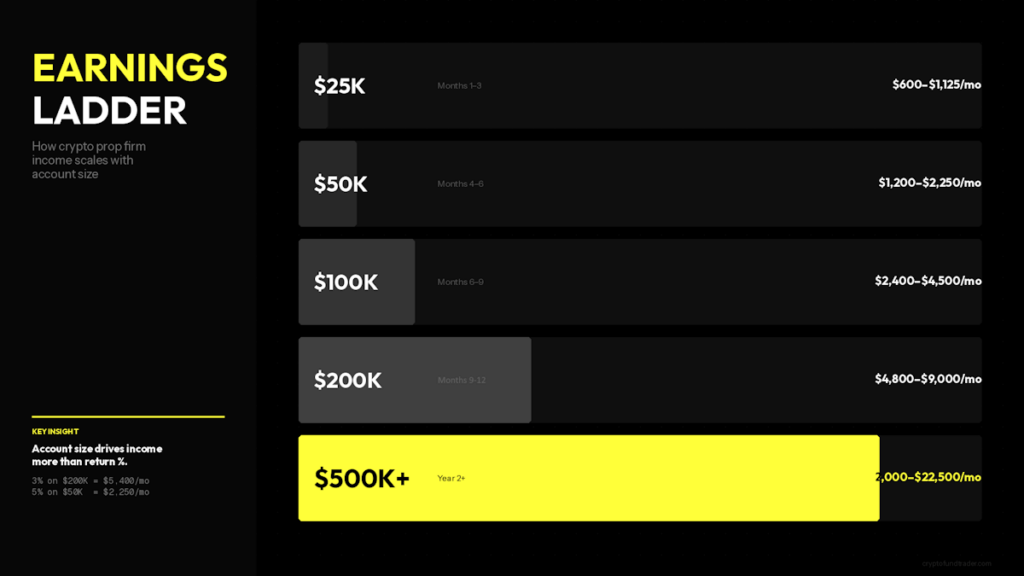
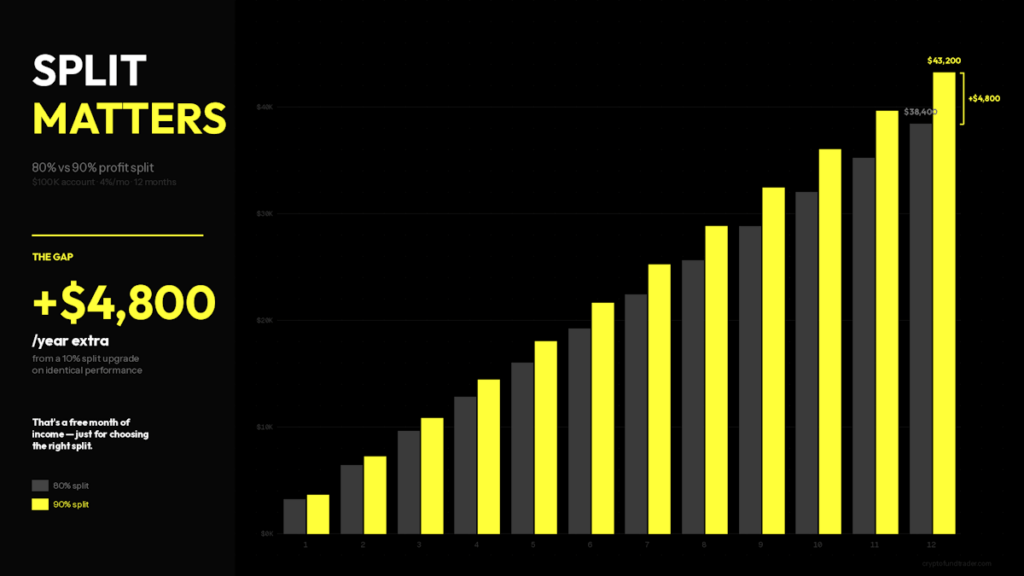
A few things stand out from this table. First, the difference between an 80% and 90% profit split compounds significantly over time — choosing a firm or add-on that offers the higher split is one of the easiest ways to boost annual earnings. Second, account size matters more than heroic returns. A disciplined 3% month on a $200,000 account pays better than a risky 5% month on a $50,000 account.
Industry data from multiple prop firms supports these estimates. Average payouts tend to hover around 4% of funded account size, according to the FPFX Technology study. On a $50,000 account, that’s roughly $2,000. On a $100,000 account, approximately $4,000. These aren’t life-changing sums on their own, but they represent the realistic baseline for funded traders who are managing risk properly.
The ceiling on crypto prop firm earnings is significantly higher than the average — but reaching it requires exceptional consistency, not just a single lucky month.
Across the broader prop trading industry, top-tier firms have distributed staggering sums. One major futures prop firm reported over $598 million in cumulative payouts since 2022, with individual traders occasionally pulling six-figure withdrawals. In the crypto space specifically, firms offering scaling programs create a clear path for high earners to compound their edge.
Here’s what the upper end of the spectrum looks like:
The critical nuance: these earnings come from traders who survived the evaluation, maintained discipline through drawdown periods, and scaled over time. They didn’t arrive at six-figure annual income on day one.
Crypto prop firm earnings don’t start from zero — they start from a negative number. Every trader pays an evaluation fee before they ever see a funded account, and that cost directly impacts the real return on investment.
Evaluation fees across the industry typically range from $55 for a $5,000 account to $1,200 or more for a $200,000 account. At Crypto Fund Trader, for example, a $25,000 two-phase evaluation costs around $230, while a $200,000 one-phase challenge runs approximately $1,199. Many firms refund this fee with the first successful payout, effectively making the evaluation free for traders who pass.
But here’s the catch that most marketing materials omit: the average trader attempts three challenges before passing, according to industry research. The average total challenge spend across all attempts is roughly $4,270. That’s not a sunk cost for everyone — traders who pass on the first try spend far less — but it’s an important figure to plan for.
A realistic ROI calculation looks like this:
Compare that to trading the same $500 as personal capital on an exchange. To generate $3,200 in profit from $500, you’d need a 640% return — virtually impossible without reckless leverage. The capital efficiency of prop trading is what makes it compelling, even after accounting for evaluation costs and failure rates.
The sobering reality is that most people who purchase a prop firm challenge will never receive a payout. Only about 5–10% of traders pass evaluations on their first attempt, and just 7% of all challenge purchasers ever reach a withdrawal, based on data from FPFX Technology’s study of 300,000+ accounts.
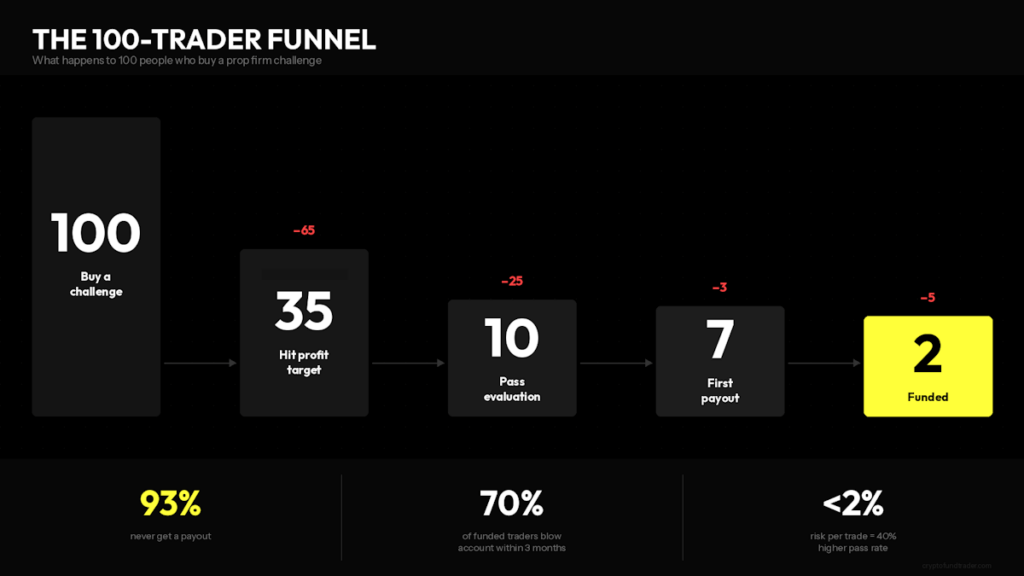
Of those who do get funded, roughly 70% lose their account within three months. Only 1–2% of traders remain consistently profitable and funded for over 12 months.
These are not numbers designed to discourage you — they’re designed to inform your preparation. The data also reveals why traders fail, and it’s rarely because their strategy lacks an edge.
The top reasons funded traders lose accounts:
The encouraging counterpoint: traders who risk less than 2% per trade during evaluations are 40% more likely to pass, according to industry analysis. Discipline is a learnable skill, and it’s the single biggest differentiator between the 7% who get paid and the 93% who don’t.
Your profit split isn’t a fixed number — it’s a variable that evolves as you prove consistency, and it’s one of the most important factors in long-term crypto prop firm earnings.
Most reputable firms start funded traders at an 80% profit split. Through consistent performance and account scaling, that share typically increases to 85% and eventually 90%. Some firms offer 90% splits from the start through add-on purchases or premium challenge tiers.
Scaling programs amplify this effect. Here’s how the progression typically works at firms like Crypto Fund Trader:
The compounding effect is significant. A trader who starts with a $50,000 account at 80% split and scales to $200,000 at 90% split has effectively quadrupled their income potential — not by trading better, but by trading consistently enough to unlock the next tier.
Multiple funded accounts offer another path. Most firms allow traders to hold several funded accounts simultaneously, provided the total allocation stays within the firm’s limits. Running two $100,000 accounts instead of one $200,000 account offers a built-in hedge: if one account experiences a drawdown, the other continues generating income.
For traders weighing the decision between prop trading and self-funded trading, the comparison is less about which approach is “better” and more about which matches your current situation.
| Factor | Crypto Prop Firm | Self-Funded Trading |
|---|---|---|
|
Capital required
|
$55–$1,200 (evaluation fee)
|
$5,000–$100,000+ (your own money)
|
|
Capital at risk
|
Evaluation fee only
|
Entire trading balance
|
|
Profit split
|
80–90% to trader
|
100% to trader
|
|
Earning potential (on $100K)
|
$2,400–$4,500/month
|
$3,000–$5,000/month
|
|
Drawdown rules
|
Firm-imposed (4–10%)
|
Self-imposed (often ignored)
|
|
Scaling path
|
Built-in programs up to $1M+
|
Limited by personal capital
|
|
Psychological pressure
|
Rule-based framework
|
Unstructured, often emotional
|
|
Payout frequency
|
Bi-weekly or on-demand |
Anytime
|
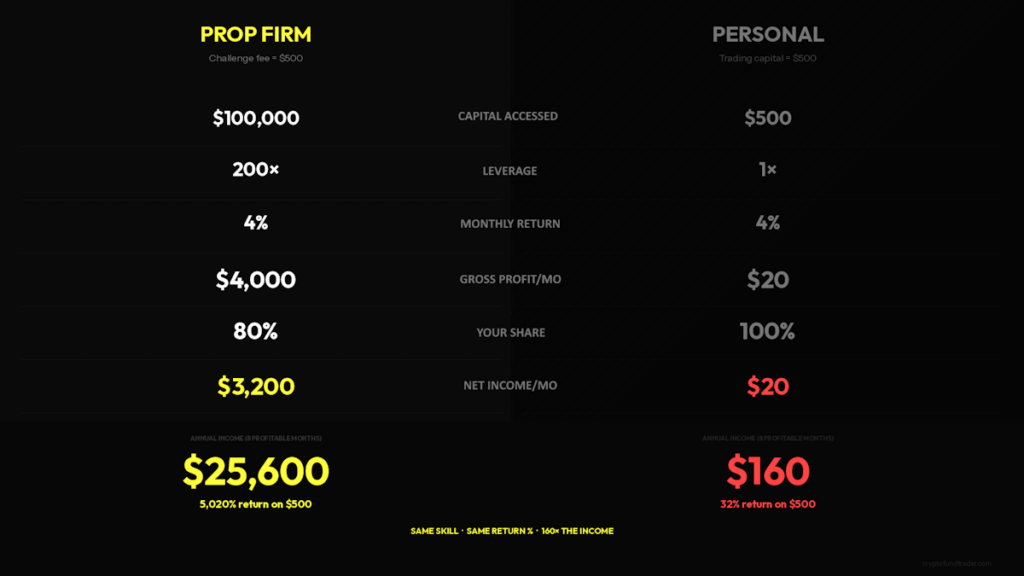
The real advantage of prop trading isn’t the profit split — it’s the leverage on limited capital. A trader with $500 to invest can access $100,000 in trading capital through a prop firm evaluation. Generating the same returns on $500 of personal capital would require returns that are mathematically unrealistic.
The trade-off is structure. Prop firms impose drawdown limits, minimum trading days, and risk parameters that restrict total freedom. For many traders, though, that structure is actually a benefit — it enforces the discipline that self-funded traders often struggle to maintain.
Not all crypto prop firm earnings opportunities are created equal. The 2024–2025 period saw 80–100 prop firms collapse, taking millions in trader payouts with them. Choosing the right firm isn’t just about profit splits — it’s about whether your payouts will actually arrive.
Five due diligence pillars before paying any evaluation fee:
Here’s what a disciplined, realistic first year of crypto prop trading might look like — based on the data, not the dream.
Months 1–2 (Evaluation Phase): You spend $230 on a $25,000 two-phase evaluation. You pass on the first attempt by targeting 1–2% weekly gains and risking no more than 1.5% per trade. Total investment: $230.
Months 3–4 (Early Funded Trading): You receive your funded account and begin trading conservatively. Monthly returns average 3%. At an 80% split on $25,000, you earn roughly $600/month. Your first payout covers the evaluation fee.
Months 5–8 (Building Consistency): You maintain 3–4% monthly returns. You qualify for account scaling and your balance grows to $50,000. Monthly earnings rise to $1,200–$1,600. You begin a second evaluation for an additional funded account.
Months 9–12 (Scaling Phase): You now manage two funded accounts totaling $100,000. Monthly earnings reach $2,400–$3,600. Your annualized income from prop trading sits at roughly $20,000–$30,000 — a meaningful supplemental income stream, with potential to grow significantly in year two.
This isn’t a get-rich-quick trajectory. It’s a professional development plan. And for a trader who started with less than $500 in total investment, the return on capital is extraordinary.
The realistic earning range for a disciplined crypto prop trader runs from $600 per month on a small account to $10,000+ per month for scaled, experienced traders — with exceptional outliers earning far more. The median is closer to $2,000–$4,000 monthly for traders who survive the evaluation and maintain funded accounts.
The path to those numbers requires treating prop trading as a skill-based profession, not a lottery. The 7% who earn payouts aren’t luckier than the other 93% — they’re more disciplined, more patient, and more realistic about what consistent 3–5% monthly returns actually look like in practice.
Whether you’re exploring your first evaluation or scaling toward a seven-figure funded allocation, the numbers don’t lie: crypto prop firm earnings are real, accessible, and growing. But only for traders willing to earn them.
Why pay $500 for a challenge when I could just trade my own $500? A $500 challenge unlocks a $100K funded account. Trading $500 of your own capital at 4% monthly earns ~$20. The same return on $100K earns $3,200. The leverage on limited personal capital is the entire point.
Do “90% profit split” claims actually hold up? The splits are real, but 90% is rarely the default. Most firms start at 80% and let you upgrade to 90% for an additional fee. The gap between 80% and 90% on a $100K account compounds to ~$5K annually on identical performance — worth checking before you choose a firm on headline numbers alone.
What actually kills most funded accounts? Drawdown violations are the primary cause of account termination — specifically ignoring daily loss limits during volatile sessions. Oversizing, revenge trading, and gradual rule drift account for most of the rest. Firm-side payout denials do happen, which is why verifying Trustpilot and Discord payout histories before paying any fee is non-negotiable.
These drawdown rules feel designed to kick you out during normal crypto volatility. Strict drawdown rules exist because crypto moves 5–20% daily — without hard limits, a single session can wipe a six-figure account. Between 2024 and 2025, 80–100 prop firms collapsed — the ones with loose risk controls led that list. Tight rules are the reason payouts from surviving firms actually arrive.
Why not trade on Bybit with my own money and keep 100%? Keeping 100% of profits only beats the prop model if you already have significant personal capital. A 10–20% profit split is the cost of accessing 20–40x more trading capital than most people can fund themselves. For traders without that capital, the math strongly favors the prop firm structure.
If my funded account blows, do I lose everything? Your maximum loss is the challenge fee — typically $55 to $1,200. The funded account itself uses firm capital, not yours. Many firms refund the fee with the first payout, making a successful evaluation effectively free. The downside is capped; the upside scales with the account.
Is this ever a real income or always just a side hustle? Crypto prop trading is a viable primary income for traders who scale consistently. Scaling programs allow accounts to grow from $2,500 to over $1,000,000, with profit splits rising to 90% along the way. Year-one earnings realistically land at $20–30K. Year two, with multiple funded accounts and compounding scale, that figure increases substantially.
This article is for informational purposes only and does not constitute financial advice. Trading involves significant risk of loss. Past performance and industry statistics do not guarantee future results.
-
© 2026 - All Rights Reserved.
SWISS RLCRATES AG is a provider of educational services, all information available on our site is intended solely for the study purposes related to trading on financial markets. Accordingly, we do not offer financial, investment, tax, brokerage or other advice and/or services. Trading in financial markets is a high-risk activity, past performance do not guarantee future ones. It is highly advised not to risk more, than you can afford to lose. Brokers and operators of trading platforms are persons or entities that are separate from SWISS RLCRATES AG and their own terms and conditions will apply when you use their services and products. Neither SWISS RLCRATES AG nor RLCRATES, S.L. (as MT5 license holder) operate in countries where crypto or CFD’s activity is not allowed. The content in our platform is applicable to the extent local laws and/or regulations permit.