

The question isn’t just which model makes more money — it’s which model gives you the best shot at making money consistently, without blowing up your account along the way. In 2026, that distinction matters more than ever.
Crypto markets have matured dramatically. Bitcoin ETF inflows, stablecoin expansion, and the tokenization of real-world assets have layered new liquidity and structure onto what was once a purely speculative free-for-all. But volatility hasn’t disappeared — and for traders, volatility is the whole point. The real debate has shifted: should you be trading your capital or someone else’s?
This guide breaks down funded crypto trading versus personal trading across every dimension that actually affects your bottom line — capital efficiency, risk exposure, psychological pressure, and long-term earning potential.
Funded crypto trading means you trade using capital allocated by a proprietary (prop) trading firm, not your own savings — keeping 70–90% of any profits you generate. Personal trading means you deploy your own money directly into crypto markets, keeping 100% of gains but absorbing 100% of losses yourself.
That single distinction cascades into every aspect of how you trade: your position sizes, your psychology, your risk tolerance, and ultimately how much you can realistically earn.
How Personal Trading Works
In personal trading, your account size is your ceiling. A trader with $5,000 in capital operates in a fundamentally different universe than one with $100,000 — not just in absolute returns, but in strategy access, diversification ability, and psychological sustainability.
Key characteristics of personal trading:
The freedom is real. So is the risk. Research consistently shows that the majority of retail crypto day traders lose money over time — not necessarily because they lack skill, but because undercapitalization, emotional trading, and the slow erosion of spreads and fees quietly compound against them.
How Funded Crypto Trading Works
Funded trading flips the capital equation. A trader pays a one-time evaluation fee (typically a few hundred dollars), passes a structured trading challenge — hitting a profit target while respecting strict drawdown limits — and receives access to a funded account ranging from $5,000 to well over $1,000,000 at firms like Crypto Fund Trader.
Key characteristics of funded trading:
The crypto prop trading market has grown to an estimated $20 billion as of 2026, a figure that reflects just how many skilled traders have concluded the funded model better matches their goals than grinding personal accounts upward from small balances.
Funded trading dramatically outperforms personal trading in capital efficiency — the ratio of earning potential to personal money at risk. A skilled trader executing the same strategy on a $100,000 funded account versus a $10,000 personal account isn’t just earning 10x more in dollar terms; they’re doing so while risking only a fraction of the capital.
Consider this illustration:
| Scenario | Account Size | Monthly Return (5%) | Personal $ at Risk | Net Monthly Profit |
|---|---|---|---|---|
|
Personal Trading
|
$10,000
|
$500
|
$10,000
|
$500
|
|
Personal Trading
|
$50,000
|
$2,500
|
$50,000
|
$2,500
|
|
Funded Account (80% split)
|
$50,000
|
$2,500
|
~$300–$500 (fee)
|
$2,000
|
|
Funded Account (80% split)
|
$200,000
|
$10,000
|
~$500–$800 (fee)
|
$8,000
|
|
Funded Account (85% split)
|
$500,000
|
$25,000
|
~$1,000–$1,500 (fee)
|
$21,250
|
Figures are illustrative. Returns in crypto trading are variable and not guaranteed.
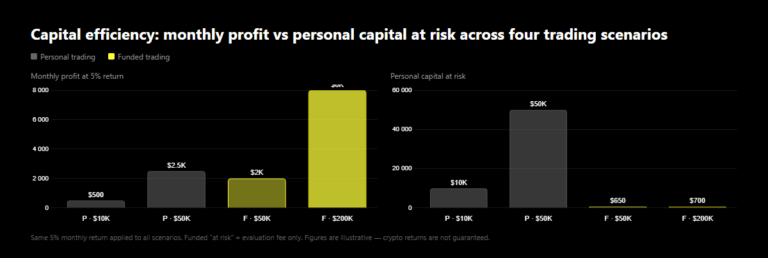
The funded trader accessing a $200,000 account risks only their evaluation fee in personal capital — typically $500–$800 — while generating potential monthly earnings that would require $200,000 of personal savings to replicate independently. For most traders, accumulating that kind of capital organically takes years. The funded model compresses that timeline dramatically.
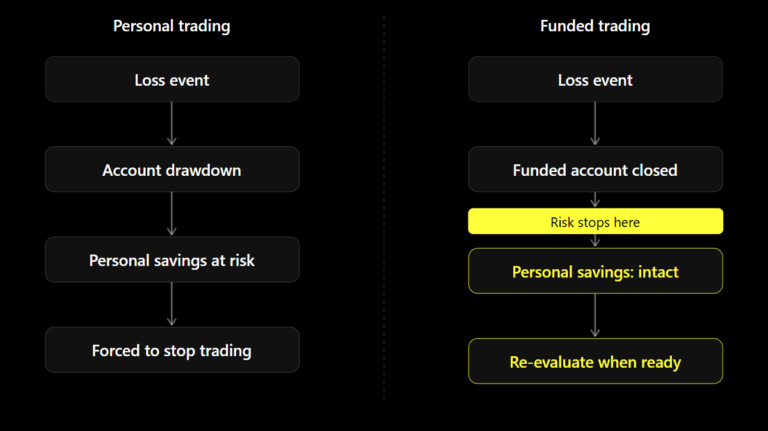
Funded trading limits personal financial risk to the cost of the evaluation challenge. In personal trading, every losing streak directly erodes the capital you need to keep trading.
This structural difference is more significant than it first appears.
The Psychology of Trading Your Own Money
Loss aversion — the well-documented cognitive tendency to feel losses more acutely than equivalent gains — hits harder when it’s your personal savings on the line. A 10% drawdown in a personal $20,000 account isn’t just a number; it’s rent, emergency savings, or money you told yourself you wouldn’t touch. That emotional weight changes decision-making in measurable ways: tighter stops that get triggered too early, hesitation on valid setups, and the destructive pattern of “revenge trading” to recover losses quickly.
Funded accounts carry a different psychological burden. Losing a funded account means losing access to firm capital — frustrating, but you simply reapply, often at a reduced re-evaluation fee. You don’t lose your rent money.
Risk Rules as a Feature, Not a Constraint
Many traders initially resist prop firm rules — daily loss limits, maximum drawdown thresholds, position sizing restrictions. In practice, these same rules are what professional risk desks at institutional trading firms impose on their own traders.
The structure they enforce tends to produce better outcomes:
Over time, trading within these guardrails tends to build better habits than unrestricted retail trading — where nothing stops a bad day from becoming a blown account.
Funded crypto trading can be more profitable than personal trading for skilled traders, primarily because it provides access to significantly larger capital bases without requiring proportional personal investment. However, it introduces profit-sharing and requires passing an evaluation — factors that affect the overall math.
Where Personal Trading Has the Edge
Personal trading does retain genuine advantages in specific scenarios:
For traders with substantial personal capital — say, $50,000 or more — and a long-term investment thesis (not pure day trading), personal trading may genuinely produce better outcomes. A trader holding Bitcoin through a full market cycle doesn’t need a funded account; they need conviction and patience.
Where Funded Trading Has the Edge
For active traders — those running defined strategies with measurable edges — the funded model typically produces superior risk-adjusted returns:
The passive income angle deserves emphasis. A funded trader who passes their evaluation once and maintains consistent profitability can generate ongoing monthly income with no further personal capital at risk. That’s a fundamentally different financial model than personal trading, where every withdrawal reduces your future earning capacity.
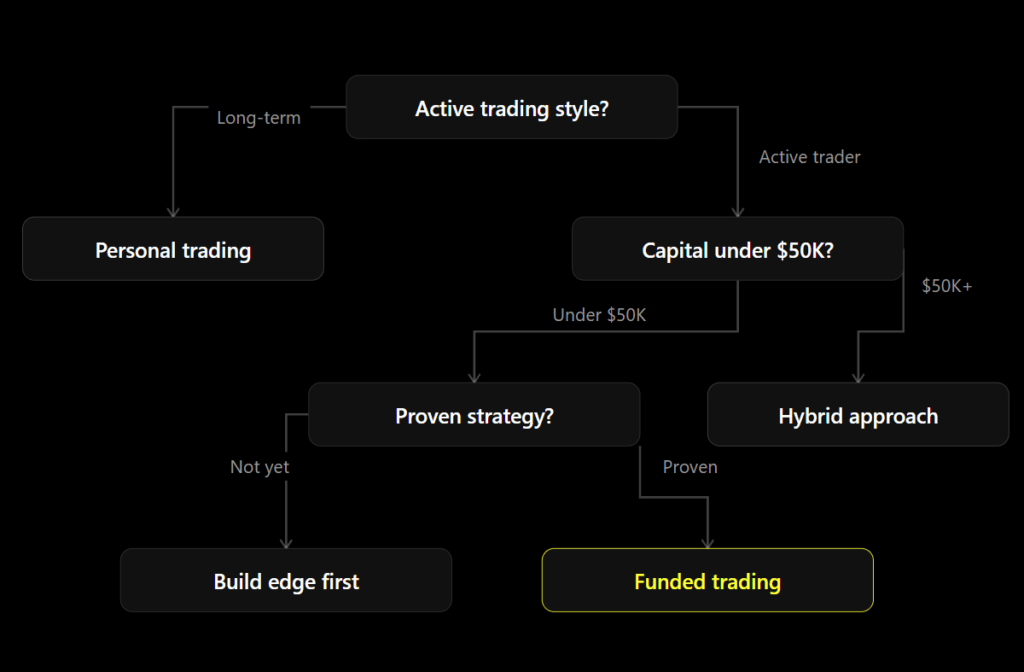
Funded trading is best suited for traders who have a proven, repeatable strategy and are constrained by capital size rather than skill. If your edge works on a $10,000 account, it will work on a $100,000 funded account — and earn 10x more in the process.
Strong candidates for funded trading:
Signs funded trading may not be the right fit:
Personal trading remains the better model for investors (as opposed to active traders), long-term holders, and those who prioritize total control over strategy and asset custody.
Strong candidates for personal trading:
The most sophisticated traders in 2026 don’t see this as an either/or decision. A growing number run funded accounts as their primary income vehicle while maintaining a smaller personal account for long-term holds and speculative positions they wouldn’t risk firm capital on.
A common hybrid structure:
This approach captures the capital efficiency and passive income potential of funded trading while preserving the full ownership benefits and strategy freedom of personal accounts.
Not all prop firms are created equal. Before paying an evaluation fee, traders should assess each firm across these dimensions:
Operational transparency matters. Look for firms with verifiable exchange relationships, published trader performance data, and clear, documented terms — not fine print designed to disqualify funded accounts on technicalities.
Case Study: How Crypto Fund Trader Structures the Funded Model
Crypto Fund Trader is a useful benchmark for what a well-structured prop firm looks like in practice — and a good illustration of how far the funded model has evolved from its early, forex-centric origins.
The firm offers three evaluation paths — 1-Phase, 2-Phase, and Instant Funding — which matters because different trading styles suit different challenge structures. A swing trader comfortable with a slower, lower-risk build suits a 2-phase model; a trader with a sharp, proven edge may prefer the speed of a 1-phase or instant route. Accounts scale up to $1,280,000 with profit splits reaching 90%, and there are no time limits on evaluations — a meaningful distinction from firms that impose 30-day deadlines and force traders into low-quality setups just to hit a target before the clock runs out.
On the execution side, Crypto Fund Trader connects directly to Tier-1 exchanges Bybit and Broctagon, which addresses one of the more significant quality gaps in the prop firm market: firms that advertise crypto trading but route orders through generic CFD liquidity providers rather than actual exchange infrastructure. Direct connectivity means tighter spreads, real order book depth, and execution quality that holds up during high-volatility events — exactly when it matters most.
The platform supports MetaTrader 5, Match Trader, and direct Bybit access, covering most serious trading setups. Leverage runs up to 1:100 for crypto, news trading is permitted, and the asset universe spans over 715 cryptocurrency pairs alongside forex, indices, and commodities. For traders who want a single funded environment rather than managing separate accounts for different asset classes, that breadth is operationally convenient.
None of this means Crypto Fund Trader is automatically the right choice for every trader — firm selection should always hinge on how well a specific firm’s rules align with your specific strategy. But it represents a clear example of what the funded model looks like when it’s built around trader performance rather than evaluation fee revenue.
If you’re currently trading personal capital and considering the funded route, the transition doesn’t require abandoning what you’re doing — it requires validating it first.
Step 1: Document your edge. Track at least 50–100 trades with consistent strategy application. Calculate win rate, average risk-reward, and maximum drawdown. If the numbers support a funded model, proceed.
Step 2: Backtested review against prop rules. Run your historical trades through the drawdown limits and daily loss rules of your target firm. Would you have violated any rules? Adjust position sizing if needed.
Step 3: Start with a challenge size that matches your current capital. If you trade $15,000 personally, a $25,000 funded account is a natural fit. Don’t start at maximum size hoping bigger capital will help — discipline scales, not capital desperation.
Step 4: Trade the evaluation exactly as you’d trade a funded account. Treat the challenge as live. Traders who pass do so by being patient and managing risk carefully — not by swinging for the profit target.
Step 5: Build the pipeline. Consistent traders often run multiple evaluations simultaneously, building toward several funded accounts across different tiers. Each successful account is a recurring income stream.
The crypto market in 2026 is structurally different from the retail-dominated landscape of earlier cycles. Institutional participation has grown, regulatory clarity has improved in key markets, and volatility — while still substantial — is increasingly captured by disciplined, systematic strategies rather than speculative gambling.
This environment benefits funded traders disproportionately. Institutional traders succeed because of structured strategies with long-term horizons and strict risk controls — exactly the environment prop firms are designed to replicate for individual traders. Retail traders chasing breakouts with high leverage and ignoring funding fees continue to face liquidation cascades, particularly in futures markets where open interest has reached record highs.
For traders with genuine edges, the 2026 market rewards those with access to scale. Funded trading provides that scale. Personal trading, for most people, does not.
Funded trading typically offers:
Personal trading typically offers:
The bottom line: For active traders with a proven edge but limited capital, funded trading is almost certainly the higher-leverage path to income in 2026. For long-term investors building positions over years, personal accounts remain the more appropriate vehicle. The smartest traders are increasingly running both.
This article is intended for educational and informational purposes only. Nothing in this content constitutes financial or investment advice. Crypto trading involves substantial risk of loss. Past performance does not guarantee future results. Always conduct your own research and consider your personal financial situation before making any trading decisions.
-
© 2026 - All Rights Reserved.
SWISS RLCRATES AG is a provider of educational services, all information available on our site is intended solely for the study purposes related to trading on financial markets. Accordingly, we do not offer financial, investment, tax, brokerage or other advice and/or services. Trading in financial markets is a high-risk activity, past performance do not guarantee future ones. It is highly advised not to risk more, than you can afford to lose. Brokers and operators of trading platforms are persons or entities that are separate from SWISS RLCRATES AG and their own terms and conditions will apply when you use their services and products. Neither SWISS RLCRATES AG nor RLCRATES, S.L. (as MT5 license holder) operate in countries where crypto or CFD’s activity is not allowed. The content in our platform is applicable to the extent local laws and/or regulations permit.