


Crypto markets never sleep, and neither do scalpers. While long-term holders ride out months of volatility hoping for the next bull run, scalpers do something radically different: they slice the market into seconds. A 0.3% move on Bitcoin? That’s a payday. Repeated forty times before lunch? That’s a strategy.
In 2026, the crypto scalping strategy has evolved from a niche tactic for keyboard-fast day traders into a mainstream approach embraced by retail traders and prop firm candidates alike. With deeper liquidity in BTC and ETH, ETF-driven order flow, and 24/7 derivatives markets, scalping has never been more accessible — or more competitive. This guide breaks down what crypto scalping actually is, the strategies that work, the indicators that matter, and how scalping fits into a funded trading career.
A crypto scalping strategy is a high-frequency trading method where traders open and close positions within seconds to minutes, aiming to capture small price movements that compound into meaningful daily returns. Instead of waiting for a coin to “moon,” scalpers stack dozens — sometimes hundreds — of micro-wins across a session.
The mechanics are simple in theory:
The challenge is that the market is unforgiving at this speed. According to industry coverage of 2026 scalping conditions, success depends less on bold predictions and more on speed, discipline, and razor-tight risk control. Crypto’s elevated volatility — driven by macro uncertainty and rapid sentiment shifts — creates the price churn scalpers feed on, but it also amplifies losses when traders get sloppy.
Scalping sits at the most aggressive end of the trading spectrum. Understanding where it fits relative to day trading and swing trading helps you decide whether it suits your temperament and schedule.
Two forces are compressing prices in 2026: dozens of newer firms competing on entry fees, and refundable fee structures that return the evaluation cost with your first payout. The result is a market where the financial barrier is lower than it has ever been. What separates traders now is preparation and discipline, not capital.
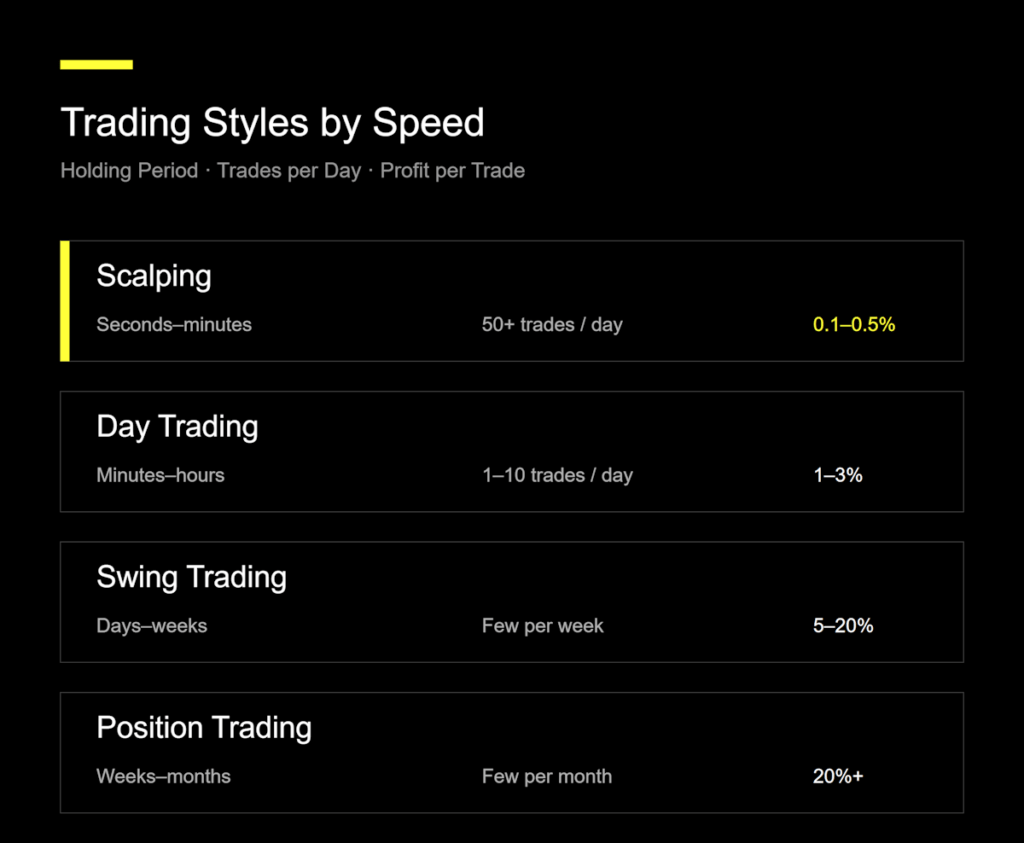
| Feature | Scalping | Day Trading | Swing Trading |
|---|---|---|---|
|
Holding period
|
Seconds to minutes
|
Minutes to hours (intraday)
|
Days to weeks
|
|
Trades per day
|
Dozens to hundreds
|
1 to 10
|
0 to a few per week
|
|
Primary analysis
|
Technical, order flow
|
Technical + intraday catalysts
|
Technical + fundamentals
|
|
Profit per trade
|
Very small (~0.1–0.5%)
|
Moderate (~1–3%)
|
Larger (~5–20%+)
|
|
Stress level
|
Very high
|
Moderate to high
|
Low to moderate
|
|
Best for
|
Disciplined, fast decision-makers
|
Active traders with screen time
|
Patient, part-time traders
|
If you can’t sit at a chart for hours making split-second decisions without flinching, scalping probably isn’t for you. If that environment energizes you, it can be one of the most rewarding styles in the crypto market.
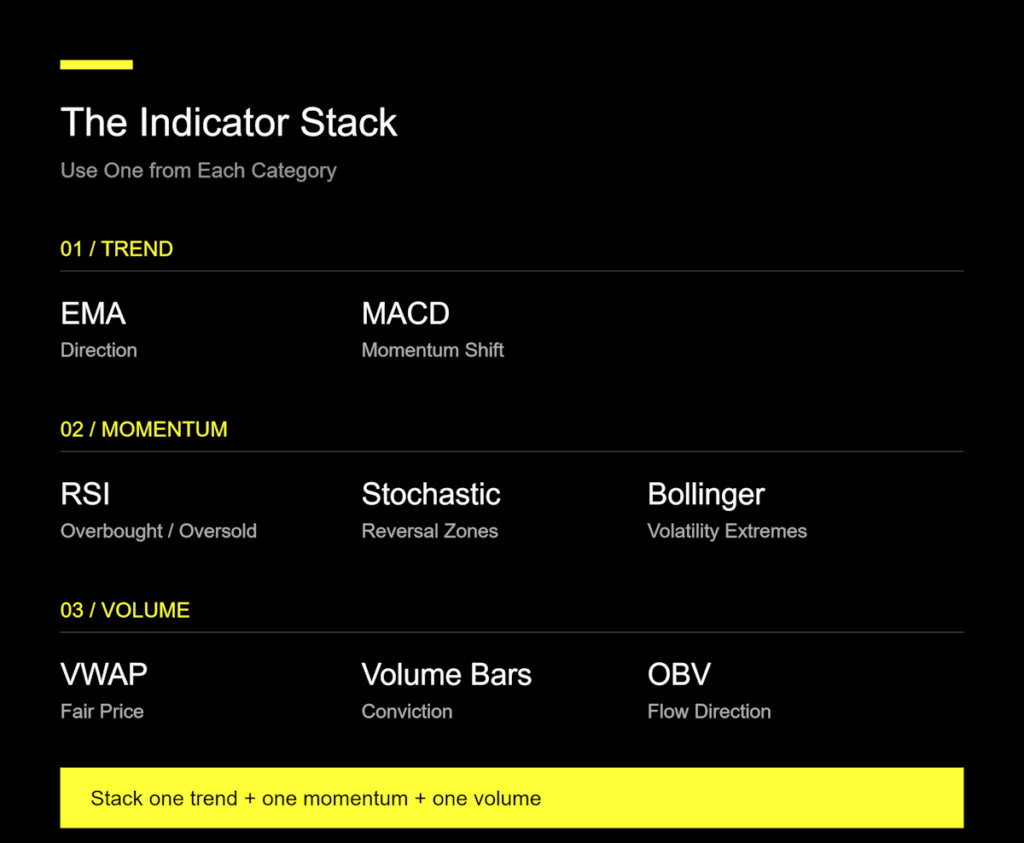
The best indicators for crypto scalping are those that respond quickly to short-term price action without flooding the chart with noise. No single indicator wins on its own — most professional scalpers stack two or three across different categories: trend, momentum, and volume.
Here are the workhorses that show up across virtually every credible 2026 scalping playbook:
The common rule of thumb among experienced traders is to use one indicator from each category — trend, momentum, and volume — rather than stacking five oscillators that all say the same thing.
There’s no single “right” way to scalp, but five core strategies dominate the 2026 landscape. Each suits a different market condition, so disciplined scalpers learn to recognize which environment they’re in before they enter.
1. Range Trading
In sideways markets, price oscillates between defined support and resistance. Scalpers buy near support, sell near resistance, and place stops just outside the range. According to a recent BingX scalping breakdown, even tight ranges on BTC/USDT can produce favorable risk-to-reward ratios when stops are placed correctly — sometimes as high as 1:7.
2. Breakout Scalping
When price breaks out of a consolidation zone on rising volume, scalpers ride the initial thrust. The key is volume confirmation; without it, breakouts often turn into fakeouts that trap impatient traders.
3. EMA Pullback Strategy
The 5-EMA scalping setup is a fan favorite. When price pulls back to the 5-EMA in a trending market and then resumes direction, scalpers enter with tight stops just beyond the moving average and target a 1:2 or 1:3 risk-reward ratio.
4. Bollinger Band Mean Reversion
Price riding the upper or lower Bollinger Band in a non-trending market often snaps back toward the middle band. Confirmed with RSI divergence, this becomes a clean reversal scalp.
5. Bid-Ask Spread Scalping
In less liquid altcoins, scalpers can occasionally profit from wider bid-ask spreads — buying at the bid, selling at the ask. It’s lower-volume but higher-precision, and slippage risk is real.
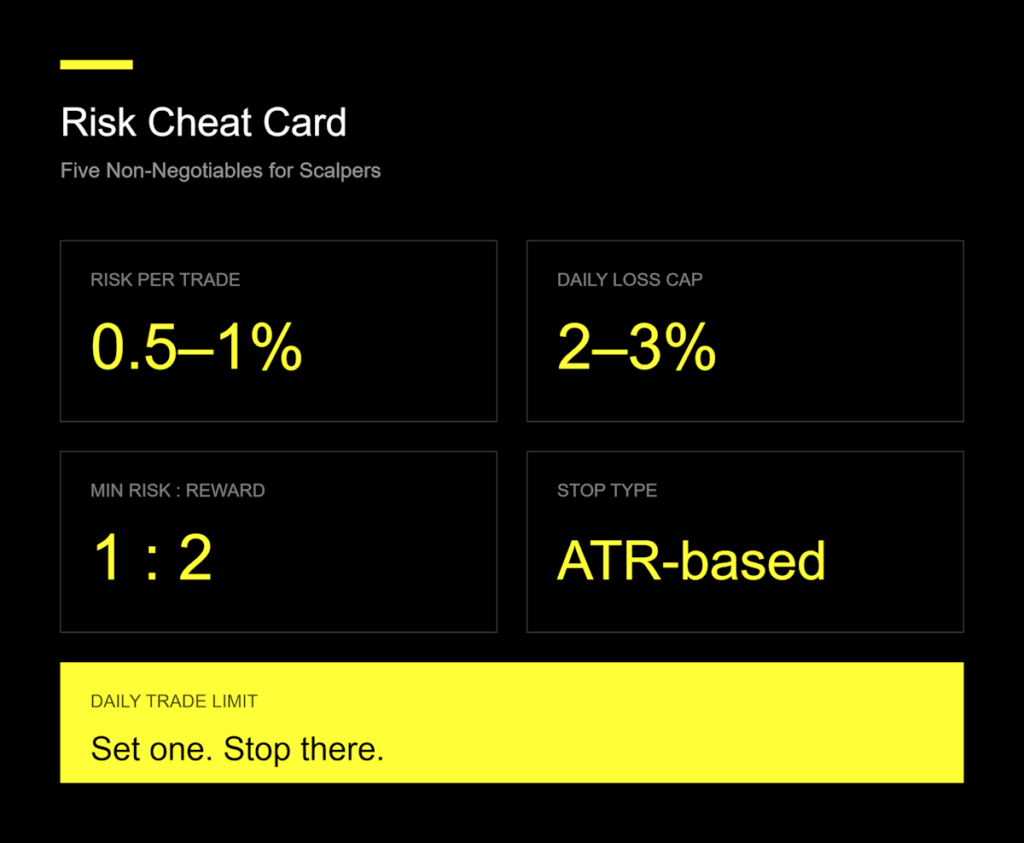
Risk management is what separates profitable scalpers from those who blow up their accounts in a week. Strategy gives you opportunities; risk control determines whether you survive long enough to use them.
The principles aren’t complicated, but they are non-negotiable:
A trading journal is the underrated tool here. Logging every trade — entry, exit, reasoning, mistakes — turns chaotic activity into measurable improvement.
Scalping is one of the most prop-firm-compatible strategies in crypto — but only if you respect the rules. Prop firms don’t reward genius; they reward consistent rule-followers. A scalping approach that ignores daily drawdown limits or position sizing rules is a strategy designed to fail an evaluation, no matter how profitable it might be on a personal account.
Most reputable crypto prop firms in 2026 — including Crypto Fund Trader, which offers Bybit integration and access to 715+ trading pairs — allow scalping, but candidates should always confirm the specifics. Common rules to verify before starting any challenge:
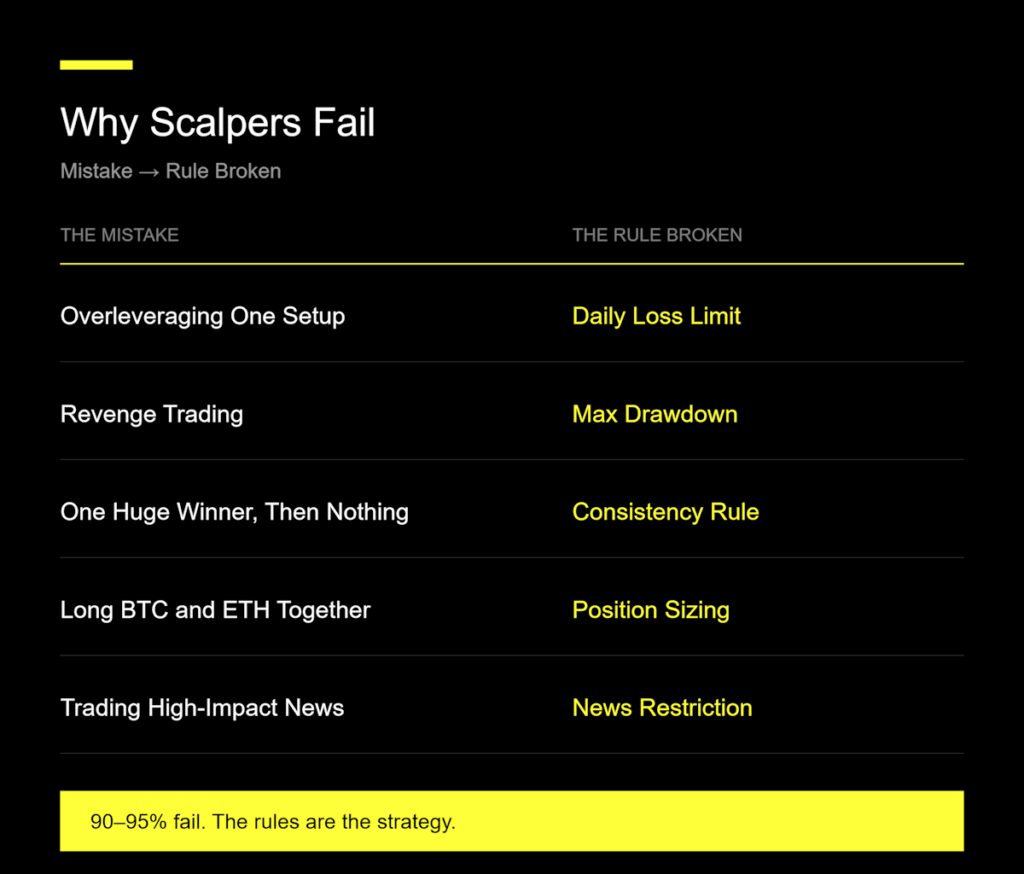
Scalpers tend to thrive in firms with tight execution, deep liquidity, generous leverage on majors, and flexible rules around position frequency. The strategy itself becomes a fit problem: pair the right method with the right firm, and the path to a funded account becomes a question of execution rather than luck. According to industry data referenced across 2026 prop firm reporting, only 5–10% of traders pass evaluations — and the ones who do treat the rulebook as part of the strategy.
Crypto scalping is fast, demanding, and unforgiving — but for traders who thrive on speed and precision, it remains one of the most engaging styles in the market. The 2026 environment, with its deep liquidity and persistent volatility, gives prepared scalpers more opportunity than ever, while still punishing the unprepared without mercy.
The traders who succeed don’t chase every candle. They master two or three setups, run them with disciplined risk management, and keep a journal to refine their edge over hundreds of trades. Whether you’re scalping your own account or aiming for a funded one, the playbook is the same: small risk, consistent execution, ruthless rule-following.
The market gives plenty of small opportunities every day. The only question is whether you’ve built the system — and the discipline — to capture them.
Do fees eat all your profits in crypto scalping?
Fees are the primary reason scalpers fail without ever making a bad trade. If your average win is 0.2% and round-trip fees are 0.1%, half your edge is gone before you close. Use maker orders, pick low-fee exchanges, and calculate your break-even fee threshold before going live.
Is crypto scalping actually profitable or just influencer hype?
Scalping is profitable for traders who run it as a precision system, not a shortcut. Research shows only ~12% of micro-spread opportunities survive fees and slippage. The consistent earners keep a journal, master two or three setups, and cut losers fast. Everyone else is trading on vibes.
Why not just swing trade instead? Less stress, similar returns.
Swing trading is the better fit for most people. Scalping gives faster feedback and exploits crypto’s 24/7 volatility in ways swing trading can’t. But if hours of screen time drains you, swing trading wins by default.
Can I scalp with a $500 account or am I wasting my time?
A $500 account is a training ground, not a career. Its real value is proving you can trade profitably under live psychological pressure. Once you have a verified edge, prop firm evaluations let you apply it to $50K–$100K of funded capital. That’s the actual path.
Is a crypto prop firm challenge worth it for scalpers?
Prop firms are worth it when their rulebook matches your strategy. Before paying for a challenge, run your last 30 trades against the firm’s rules and count the violations. More than two or three means either your style doesn’t fit that firm — or you’re not ready for evaluation conditions yet.
This article is for informational and educational purposes only and does not constitute financial advice. Trading cryptocurrencies and prop firm challenges involve significant risk; trade only with capital you can afford to lose.
-
© 2026 - All Rights Reserved.
SWISS RLCRATES AG is a provider of educational services, all information available on our site is intended solely for the study purposes related to trading on financial markets. Accordingly, we do not offer financial, investment, tax, brokerage or other advice and/or services. Trading in financial markets is a high-risk activity, past performance do not guarantee future ones. It is highly advised not to risk more, than you can afford to lose. Brokers and operators of trading platforms are persons or entities that are separate from SWISS RLCRATES AG and their own terms and conditions will apply when you use their services and products. Neither SWISS RLCRATES AG nor RLCRATES, S.L. (as MT5 license holder) operate in countries where crypto or CFD’s activity is not allowed. The content in our platform is applicable to the extent local laws and/or regulations permit.