
On October 10, 2025, crypto markets recorded the largest liquidation event in their history. Roughly $19 billion in leveraged positions were wiped out in 24 hours, and about 1.6 million traders were liquidated. Almost none of those traders owned the coins they were betting on. They held futures contracts, and a sharp move in the wrong direction closed those contracts automatically and took their margin with it.
That single day captures both halves of this market. Futures are how a relatively small amount of money can control a large position, and they are also how accounts vanish in minutes. If you are asking what is futures trading crypto really means before you put money near it, this guide walks through the definitions, a couple of plain examples, how futures differ from spot, and the risks that catch beginners first.
A futures contract is an agreement to buy or sell an asset at a set price, with the profit or loss settled based on where the price actually goes. In crypto, you are not buying Bitcoin or Ethereum itself. You are trading a contract that tracks the price, and you put down a fraction of the position’s value as collateral, called margin.
Two features make crypto futures different from a normal purchase. First, leverage: your margin controls a position several times larger than the cash you posted. Second, direction: you can profit when price falls, not only when it rises, by opening a short position. Spot trading, by contrast, means buying the actual asset and owning it.
So the plain-language version of what is futures trading crypto is this: a way to bet on price movement, up or down, using borrowed exposure, without owning the underlying coin. That borrowed exposure is the source of every advantage and every danger that follows.
The fastest way to understand futures is to set them next to spot trading, which most beginners already grasp.
| Factor | Spot Trading | Futures Trading |
|---|---|---|
|
What you hold
|
The actual crypto
|
A contract tracking the price
|
|
Capital required
|
Full position value
|
A fraction (margin)
|
|
Direction
|
Profit only if price rises
|
Profit from rising or falling prices
|
|
Maximum loss
|
The amount invested
|
Margin, lost faster, plus fees
|
|
Liquidation risk
|
None |
Yes, and central to the product
|
|
Ongoing costs
|
None |
Funding fees on perpetuals
|
With spot, if you buy $500 of Ethereum and it drops 40 percent, you have $300 left and you can wait. With futures at high leverage, that same 40 percent move would have closed your position long before, and your collateral would already be gone. Spot is patient. Futures are not.
Here is the mechanism, with crypto futures explained step by step rather than as jargon.
You start with margin, the collateral you post to open a position. If you put up $100 and choose 10x leverage, you control a $1,000 position. A 1 percent move in your favor produces roughly $10, which is a 10 percent return on your $100. A 1 percent move against you costs the same $10. The leverage multiplies the percentage move on your collateral in both directions equally.
There are two ways to allocate that margin. Isolated margin ties a fixed amount to one trade, so the most you can lose on that position is what you assigned to it. Cross margin lets a position draw on your whole account balance to stay alive, which can keep a trade open longer and can also wipe out everything. Beginners should use isolated margin, because the maximum loss is defined before the trade opens.
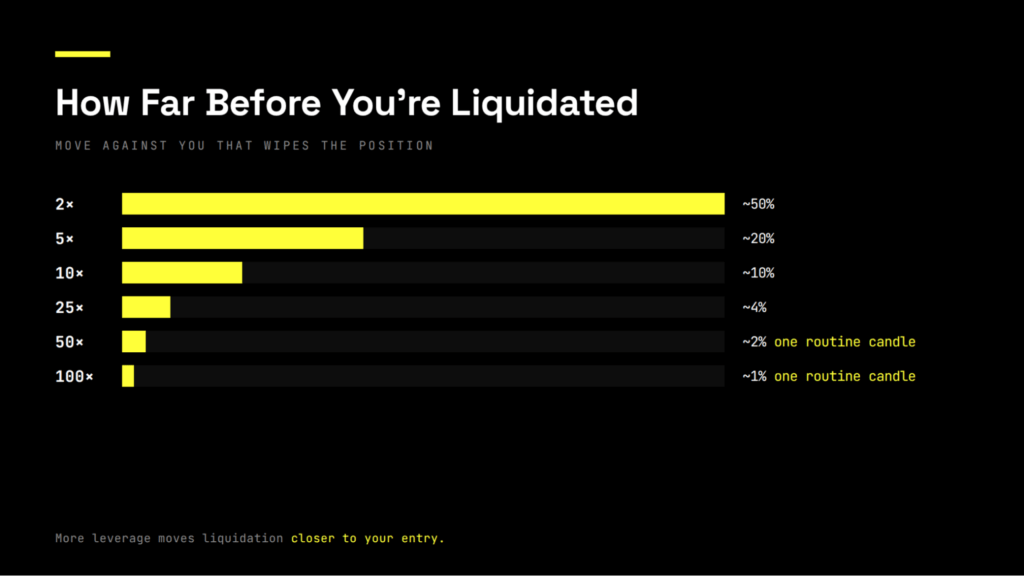
A position has a liquidation price, the level at which your margin can no longer cover the loss and the exchange closes the trade for you. Higher leverage moves that price closer to your entry. At 10x, a move of roughly 10 percent against you triggers liquidation. At 50x, it takes only about 2 percent, which is a routine candle on a quiet day.
Two short examples make this concrete.
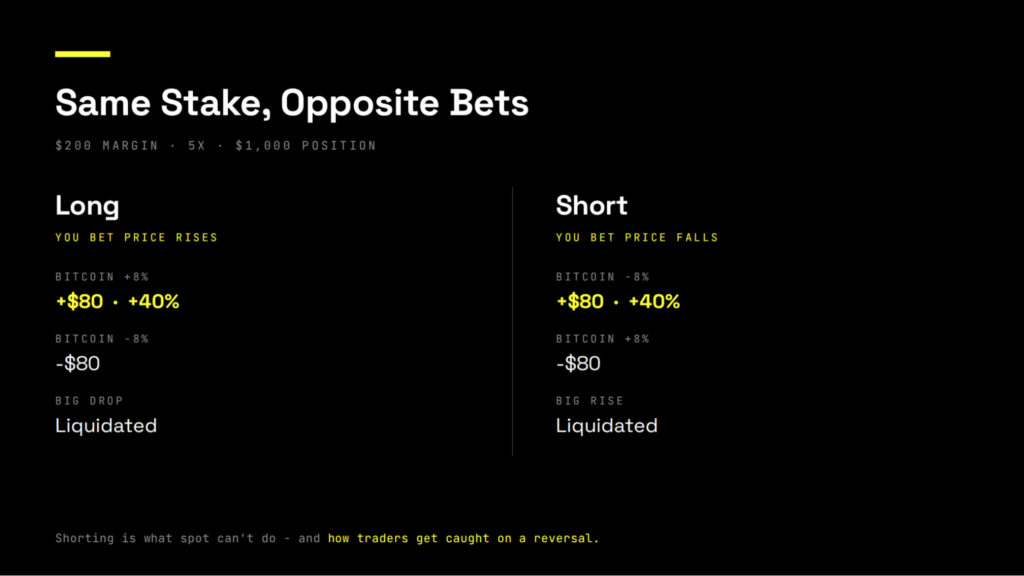
Going long. You expect Bitcoin to rise. You open a long with $200 of margin at 5x leverage, controlling a $1,000 position at an entry of $62,000. Bitcoin climbs 8 percent. Your position gains about $80, a 40 percent return on your $200. Had Bitcoin instead fallen 8 percent, you would be down about $80, and a deeper drop toward your liquidation level would have closed the trade and cost you most or all of the $200.
Going short. You expect a drop. You open a short with the same $200 at 5x. Bitcoin falls 8 percent, and you gain about $80, because a short profits when price declines. If Bitcoin had risen instead, you would lose, and a large enough rise would liquidate you. Shorting is the feature spot trading does not offer, and it is also how traders get caught when a falling market suddenly reverses.
Most crypto futures volume sits in perpetual futures, often called perps. Unlike traditional futures, they have no expiry date, so you can hold a position indefinitely as long as your margin survives. That convenience comes with a cost beginners often miss.
To keep a perpetual’s price tethered to the spot price, exchanges use a funding rate, a small payment exchanged between longs and shorts, usually every eight hours. When more traders are long and the perp trades above spot, longs pay shorts. When the crowd is short, shorts pay longs. The rate looks tiny per payment, often a fraction of a percent, but it compounds.
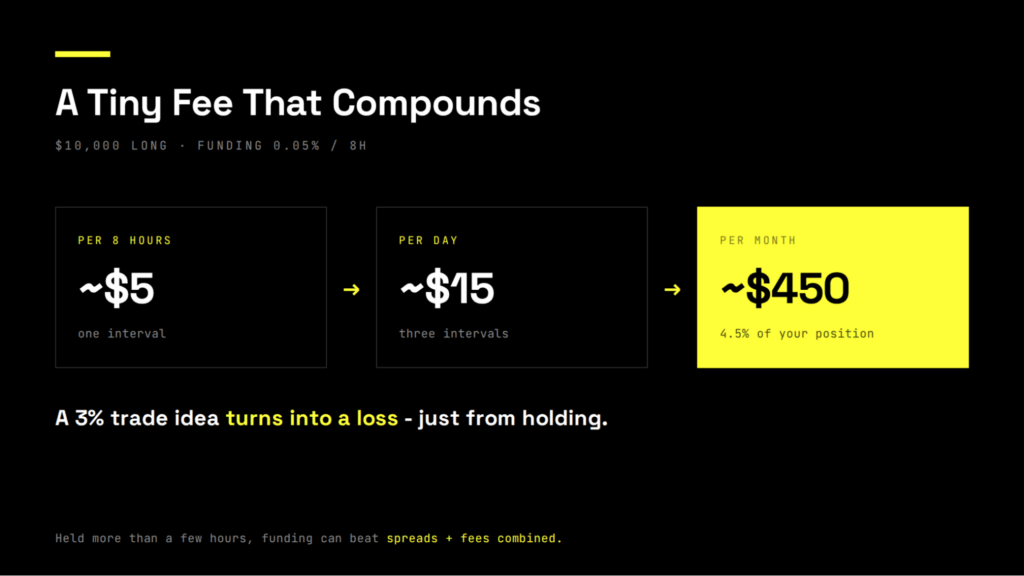
A worked figure shows why it matters. Hold a $10,000 long during a strongly bullish stretch with funding at 0.05 percent per 8-hour interval, and you pay about $5 each interval, $15 a day, roughly $450 over a month. That is 4.5 percent of your position paid simply to hold it. If your trade idea only delivers a 3 percent gain in that time, the funding cost turned a winner into a loser. For anything held longer than a few hours, funding can cost more than spreads and commissions combined.
Liquidation is the part that separates futures from every gentler way of trading. When the market hits your liquidation price, the exchange’s engine closes your position automatically, and you do not get a vote.
The price that matters here is the mark price, a blended figure drawn from several exchanges rather than the last trade on one venue. Exchanges use it specifically so that a brief wick on a single platform does not liquidate everyone unfairly. Even so, in fast markets, positions can close below the level where your equity hit zero, and in extreme cascades some exchanges use auto-deleveraging, which can close even profitable opposite positions to absorb the shortfall. The takeaway for a beginner is simpler than the machinery: at high leverage, ordinary volatility is enough to end the trade.
The pattern that destroys most accounts is not the first loss. It is what comes after. A trader watches a position move against them, adds margin to push the liquidation price further away, adds more on the next dip, and converts a small defined loss into a large one. The discipline that prevents this is decided before the trade, not during it.
Futures concentrate several risks that spot trading either softens or removes entirely.
There is a version of futures trading that looks nothing like the liquidation screenshots, and it is built on rules rather than adrenaline. Proprietary trading firms give traders access to firm capital after an evaluation, then enforce strict limits: a daily loss cap, often around 5 percent, and a maximum drawdown, often around 10 percent. Inside those guardrails a trader can use leverage, but the rules make oversizing and revenge trading fail the account quickly. The structure pushes a trader toward exactly the discipline this guide describes.
Crypto Fund Trader is one example of this model in the crypto space. It has operated since November 2022 under a Swiss-registered company, offers funded accounts with leverage up to 1:100, and routes part of its evaluation through a Bybit integration so orders execute on real exchange infrastructure. The appeal for a careful beginner is that the firm’s own limits do the risk management that is hard to maintain alone, and the downside on failing is capped at the evaluation fee rather than personal savings.
For most people in their first months, the honest answer is not yet. Futures reward preparation and punish improvisation faster than any other corner of crypto. The sensible path is to learn spot trading first, build the habit of placing a stop on every position, and size trades by risk rather than by available margin. Once that behavior is automatic, low leverage on isolated margin, with a stop and a known liquidation buffer, is a reasonable next step.
Futures are a specialist tool. In skilled hands they offer capital efficiency and the ability to profit in falling markets. In unprepared hands they are mostly a faster route to the outcome that liquidated 1.6 million traders in a single October day.
Crypto futures are a contract on price movement, settled in cash, powered by leverage, and capable of profiting in either direction. That definition sounds neutral, and the tool is neutral. What is not neutral is how it behaves under pressure, where a 2 percent move can end a 50x position and a month of funding can quietly outweigh a winning trade.
Treat futures as something to grow into, not start with. Learn the mechanics on small spot positions, respect liquidation as a feature rather than an accident, and size every trade by what you can afford to lose. The traders who last in this market are rarely the ones with the biggest leverage. They are the ones who were still solvent after the days that cleared everyone else out.
What is futures trading in crypto in simple terms?
It is trading a contract that tracks a coin’s price, using borrowed exposure called leverage, without actually owning the coin. You can profit whether the price rises or falls, and you can lose your collateral just as fast.
What is the difference between crypto futures and spot trading?
With spot you buy and own the asset, and your worst case is the amount you invested; with futures you hold a leveraged contract that can be liquidated well before that. Spot lets you wait out a dip, while futures can close your position automatically.
Can I lose more than I put into a futures trade?
On most major exchanges using isolated margin, your loss is capped at the margin assigned to that position, not your whole balance. Cross margin removes that safety, which is why beginners should stick to isolated margin.
What are perpetual futures and funding rates?
Perpetual futures are contracts with no expiry date, so you can hold them indefinitely while your margin lasts. The funding rate is a small recurring payment between longs and shorts that keeps the contract near the spot price, and it adds up over time.
Is crypto futures trading good for beginners?
Generally not in the first several months, because leverage and liquidation punish small mistakes far faster than spot trading does. Most people are better off learning on spot first, then trying low leverage once their risk habits are solid.
How much leverage should a beginner use?
As little as possible, and ideally none at all early on, since higher leverage moves your liquidation price dangerously close to your entry. Many experienced traders rarely go above 5x, and beginners have no reason to exceed that.
This article is for informational and educational purposes only and does not constitute financial advice. Trading cryptocurrencies and prop firm challenges involve significant risk; trade only with capital you can afford to lose.
-
© 2026 - All Rights Reserved.
SWISS RLCRATES AG is a provider of educational services, all information available on our site is intended solely for the study purposes related to trading on financial markets. Accordingly, we do not offer financial, investment, tax, brokerage or other advice and/or services. Trading in financial markets is a high-risk activity, past performance do not guarantee future ones. It is highly advised not to risk more, than you can afford to lose. Brokers and operators of trading platforms are persons or entities that are separate from SWISS RLCRATES AG and their own terms and conditions will apply when you use their services and products. Neither SWISS RLCRATES AG nor RLCRATES, S.L. (as MT5 license holder) operate in countries where crypto or CFD’s activity is not allowed. The content in our platform is applicable to the extent local laws and/or regulations permit.