


In the first week of June 2026, Bitcoin slipped under $63,000, sentiment sat in the extreme fear zone, and the market churned through more than a billion dollars in liquidations inside a day. For a long-term holder, weeks like that are noise to wait out. For a day trader, they are the entire opportunity. Volatility is the raw material day trading runs on, and right now there is plenty of it.
That is also why most people who try this lose money. A bitcoin day trading strategy is not a magic entry signal. It is a defined set of conditions for getting in, a pre-decided point for getting out when wrong, and a position size that survives a bad streak. This guide lays out three concrete strategies with real entry and exit examples, then spends as much time on risk management as on entries, because that is where the survivors separate from the statistics.
Day trading means opening and closing positions within the same day, capturing short moves rather than holding for weeks. You are not predicting where Bitcoin will be next year. You are reading where it is likely to go in the next few hours and acting on a plan.
This matters because BTC trades 24 hours a day, seven days a week, with no closing bell to force discipline. The market never stops, which means you have to stop yourself. Successful btc day trading depends less on finding more setups and more on trading only the clean ones, then walking away. A trader who takes three high-quality trades a day will usually outperform one who takes fifteen impulsive ones.
Two timeframes do most of the work for day traders: the 5-minute and 15-minute charts for entries, and the 1-hour or 4-hour chart for context. You read the higher timeframe to know the direction and the major levels, then drop down to execute. Trading a lower timeframe without checking the higher one is like sprinting through a building you have never seen the floor plan of.
A day trader does not need a screen full of indicators. A few well-understood tools beat a cluttered chart every time.
That is enough. Price levels, volume, VWAP, and one momentum read cover the three strategies below.
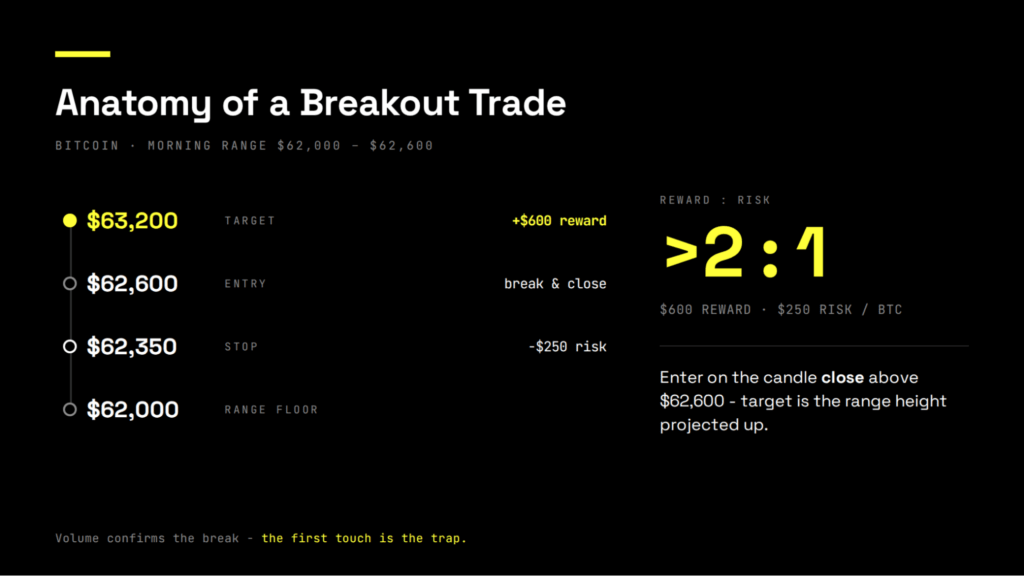
The breakout is the most intuitive day trading setup. Bitcoin coils in a tight range, pressure builds, and price eventually breaks out of the range with force. You trade the break in the direction it goes.
The trap is the false breakout, where price pokes past a level, triggers buyers, then reverses and stops them out. Volume is the filter that separates a real break from a fake one.
A concrete example. Bitcoin spends the morning ranging between $62,000 and $62,600. The upper edge at $62,600 has rejected price twice. On the third approach, a 15-minute candle closes decisively above $62,600 on volume clearly higher than the prior candles.
The discipline here is waiting for the candle to close above the level. Entering as price first touches $62,600 is how traders get caught by the fake break. The close, on volume, is the signal.
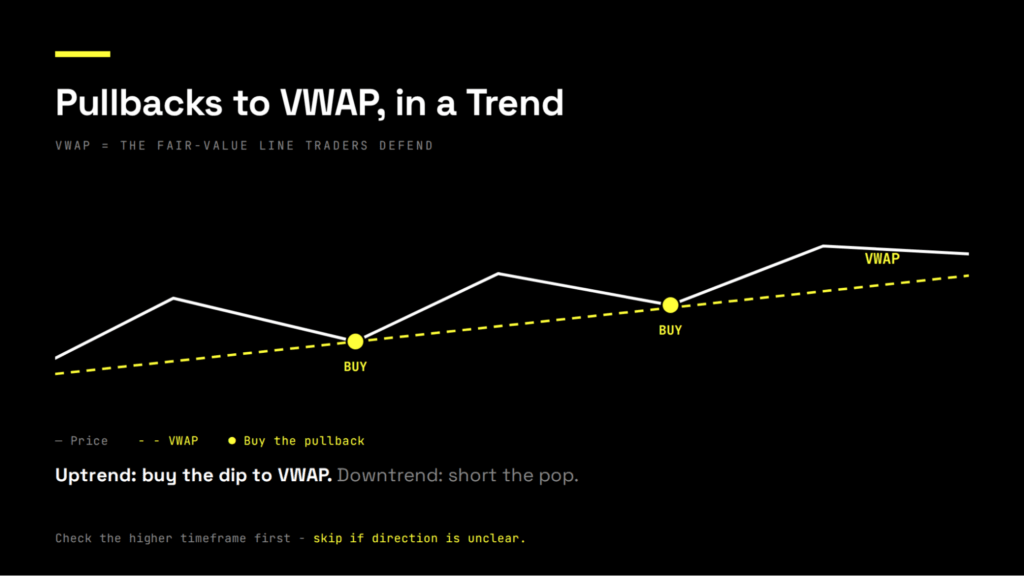
This strategy suits the more common intraday condition: Bitcoin is trending modestly, not exploding, and price keeps pulling back to VWAP before continuing. You buy the pullback in an uptrend, or short the pullback in a downtrend, using VWAP as the reference.
A long example. The 1-hour chart shows Bitcoin in a mild uptrend, making higher lows since the open. On the 5-minute chart, price pulls back to VWAP near $62,400 and prints a small reversal candle with RSI lifting off a low reading.
VWAP reversion works because intraday traders and algorithms genuinely use that line as fair value, so pullbacks to it attract buyers in an uptrend. The setup fails when the broader trend flips, which is why you check the higher timeframe first and skip the trade if direction is unclear.
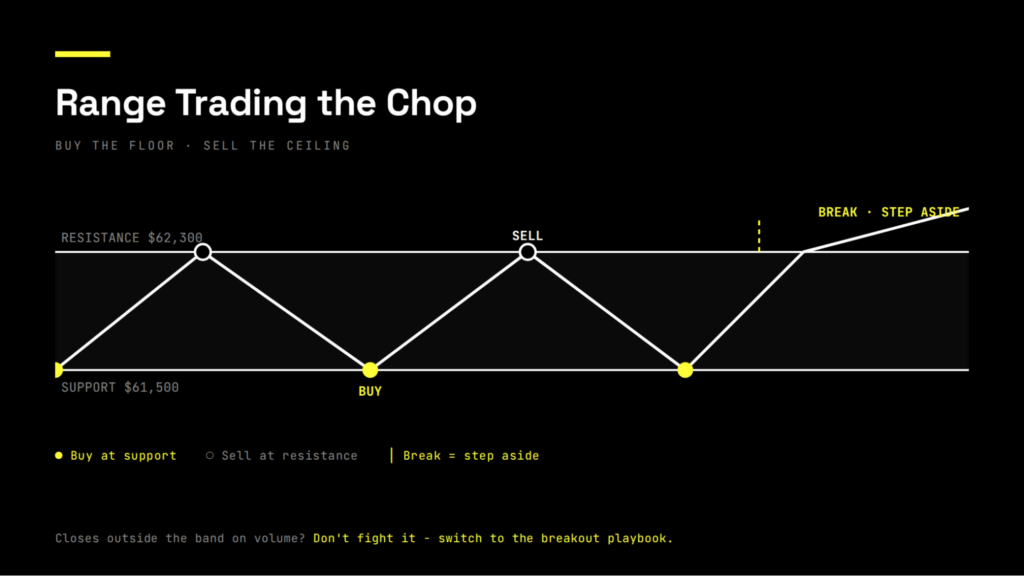
Bitcoin spends a surprising amount of time going nowhere, oscillating between a floor and a ceiling. Trend strategies bleed money in these conditions. Range trading turns the chop into the edge.
You identify a clear range, buy near the bottom, and sell near the top, doing the opposite of a breakout trader until the range actually breaks.
An example. For several hours Bitcoin bounces between roughly $61,500 support and $62,300 resistance. Price drifts back down toward $61,500 and holds, with a 15-minute candle refusing to close below it and RSI near oversold.
The key rule: range trading stops the moment the range breaks. If price closes firmly outside the band on volume, you do not fight it. You step aside, and the breakout strategy becomes the relevant playbook instead.
Entries are the part beginners obsess over. Risk management is the part that actually determines whether you are still trading in six months. A profitable strategy with poor risk control still ends in a blown account, because one oversized loss erases many good trades.
Risk a Fixed Small Percentage Per Trade
Professionals typically risk a small fixed fraction of the account on any single idea, often 1 percent. The point is not to maximize one trade. It is to survive the losing streaks every strategy produces.
On a $5,000 account risking 1 percent, your maximum loss per trade is $50. That figure, not the leverage your platform offers, sets your position size.
Size the Position From the Stop, Not the Leverage
Position size is a calculation, not a feeling. Take your dollar risk and divide it by the distance to your stop.
Using the breakout example: entry $62,600, stop $62,350, a $250 stop distance per BTC. With $50 of risk allowed, your position size is $50 divided by $250, or 0.2 BTC of exposure, about $12,520 notional. Whether you fund that with leverage or not, the risk stays exactly $50 if the stop hits. Leverage changes only how much margin you park, not how much you risk. Traders who blow up use leverage to oversize a position. Traders who last use it to free up margin on a correctly sized one.
Set a Daily Loss Limit and Honor It
Decide before the session how much you are willing to lose in a day, for example 3 percent of the account, and stop when you hit it. The fastest way to turn a normal red day into a disaster is revenge trading after two losses. The daily stop exists to remove that decision from a frustrated version of you.
Define the Trade Fully Before Entering
Every trade needs an entry, a stop, and a target written down before you click. If you cannot state your maximum loss in dollars before entering, you are not sizing a trade, you are placing a bet. A stop placed where it “feels okay” gets hit constantly. A stop placed below a level that would actually prove your idea wrong has a reason to exist.
| Rule | Practical Version |
|---|---|
|
Risk per trade
|
1 percent of account, fixed
|
|
Position size
|
Dollar risk divided by stop distance
|
|
Daily loss limit
|
Stop trading at 3 percent down
|
|
Reward to risk
|
Aim for 2 to 1 or better
|
|
Trade plan
|
Entry, stop, target set before entry
|
Strategies work inside a routine, not in isolation. A workable session looks calmer than most people expect.
Before the session, mark the higher timeframe trend and the key levels for the day: overnight high and low, major support and resistance, and the day’s VWAP once it forms. Decide which of the three setups fits the current condition. A trending day favors breakouts and VWAP reversion; a flat day favors range trading.
During the session, wait for one of your defined setups to appear at one of your marked levels. Take the trade only when the conditions line up, including volume confirmation. Place the stop and target immediately, then leave them alone. Most damage happens when traders move a stop further away to avoid being stopped out, which converts a planned small loss into an unplanned large one.
After the session, journal every trade: the setup, why you entered, where you exited, and how you felt. Over a few weeks the journal reveals your real edge and your recurring mistakes far better than any indicator.
A common wall appears once a trader becomes consistent. The strategy works, the risk control is solid, but the account is too small for the returns to matter. Risking 1 percent of $2,000 is good discipline and also $20 per trade.
This is where crypto proprietary trading firms enter the picture. A prop firm gives access to its capital after an evaluation, then enforces strict limits, typically a daily loss cap near 5 percent and a maximum drawdown near 10 percent. Those rules map almost exactly onto the risk framework above, which is why a disciplined day trader often fits the model well. The firm keeps a share of the profit, the trader keeps the rest, and the downside of failure is the evaluation fee rather than personal savings.
Crypto Fund Trader is one example operating in the crypto-native space. It has run since November 2022 under a Swiss-registered company, offers funded accounts with leverage up to 1:100, and routes part of its evaluation through a Bybit integration so orders execute on real exchange infrastructure rather than synthetic feeds. For a day trader who already sizes by risk and respects a daily stop, the firm’s own rules reinforce habits that are hard to hold alone.
Most day traders fail through the same handful of habits, not through bad luck.
Day trading Bitcoin is a skill built on a few clean setups, executed inside firm risk rules, repeated with patience. The three strategies here, breakout, VWAP reversion, and range trading, cover most intraday conditions, but none of them matter without the position sizing and daily stop that keep one bad trade from undoing a month of good ones.
The market gave traders exactly what they need in 2026: volatility, and plenty of it. Whether that volatility funds your account or empties it comes down to preparation. The traders who survive weeks like early June are not the boldest. They are the ones who sized small, set their stops, and were still at the desk when the next clean setup appeared.
What is the best bitcoin day trading strategy for beginners?
The simplest reliable starting point is range trading or a confirmed breakout, because both rely on clear price levels rather than complex indicators. Whichever you choose, a sound bitcoin day trading strategy matters less than consistent position sizing and a stop on every trade.
How much money do I need to start btc day trading?
You can begin practicing btc day trading with a few hundred dollars on a major exchange, though small accounts make meaningful returns slow. Treat your first capital as tuition and size every position by risk, not by what the account or leverage allows.
How many trades should a day trader take per day?
Usually only a handful of high-quality setups rather than constant activity, since overtrading is one of the most common ways accounts bleed out. Three clean trades that fit your plan beat fifteen impulsive ones.
Do I need leverage to day trade Bitcoin?
No, you can day trade spot Bitcoin with no leverage and avoid liquidation risk entirely. If you do use leverage, keep it low and let it free up margin on a correctly sized position rather than inflate the position itself.
What timeframes are best for day trading BTC?
Most day traders execute on the 5-minute and 15-minute charts while using the 1-hour or 4-hour chart for direction and key levels. Reading the higher timeframe first stops you from trading against the dominant trend.
Can day trading Bitcoin be profitable in 2026?
It can be, because the volatility that defines BTC in 2026 creates the moves day traders need, but the same volatility punishes poor risk control fast. Profitability comes from disciplined sizing and exits far more than from any single entry signal.
This article is for informational and educational purposes only and does not constitute financial advice. Trading cryptocurrencies and prop firm challenges involve significant risk; trade only with capital you can afford to lose.
-
© 2026 - All Rights Reserved.
SWISS RLCRATES AG is a provider of educational services, all information available on our site is intended solely for the study purposes related to trading on financial markets. Accordingly, we do not offer financial, investment, tax, brokerage or other advice and/or services. Trading in financial markets is a high-risk activity, past performance do not guarantee future ones. It is highly advised not to risk more, than you can afford to lose. Brokers and operators of trading platforms are persons or entities that are separate from SWISS RLCRATES AG and their own terms and conditions will apply when you use their services and products. Neither SWISS RLCRATES AG nor RLCRATES, S.L. (as MT5 license holder) operate in countries where crypto or CFD’s activity is not allowed. The content in our platform is applicable to the extent local laws and/or regulations permit.