

Most funded-account comparisons start with account size and profit split, then stop there. That is the least useful place to begin, because two firms can share a 90 percent split and still be built for completely different traders. The CFT vs Topstep question is a clean example: one funds crypto traders, the other funds futures traders, and the rules underneath reflect those two different worlds.
This comparison skips the surface numbers and digs into what actually decides whether you pass and keep an account: the evaluation model, the drawdown mechanics, and whether the rules suit a scalper or a swing trader. The crypto fund trader vs Topstep decision is really a decision about your market and your style, and the right answer changes completely depending on both.
Crypto Fund Trader (CFT) is built for crypto traders, with Bybit-routed execution, hundreds of crypto pairs, and 24/7 markets. Topstep is built for futures traders, funding CME products like the E-mini S&P and Nasdaq through a model refined since 2012. Neither is better in the abstract. If you trade crypto, CFT is the natural fit; if you trade futures, Topstep is, and no rule comparison overrides that basic market split.
What follows matters most when you are genuinely torn, or when you trade both and want to understand how the rule sets differ.
| Feature | Crypto Fund Trader | Topstep |
|---|---|---|
|
Market
|
Crypto, Bybit integration, 24/7
|
CME futures, session-based
|
|
Evaluation
|
1-phase or 2-phase, one-time fee, instant option
|
1-step Trading Combine, monthly fee
|
|
Drawdown
|
Fixed 5% daily / 10% max (2-phase); 6% trailing on 1-phase
|
Trailing Max Loss Limit, locks at start, resets after payout
|
|
Style fit
|
Swing and intraday crypto; HFT and tick scalping restricted
|
Intraday futures; trailing limit rewards early profit-taking
|
|
Profit split
|
80%, up to 90% via add-on
|
Up to 90%, 90/10 from dollar one on new accounts
|
|
Profit cap
|
$10,000 daily and per-trade cap
|
Per-payout caps, no single-trade cap
|
|
Track record
|
Since 2022, Swiss-registered (verify current status)
|
Since 2012, FCM-backed live funding
|
Figures are approximate and current as of mid-2026. Verify the latest rules on each firm’s own materials before paying.
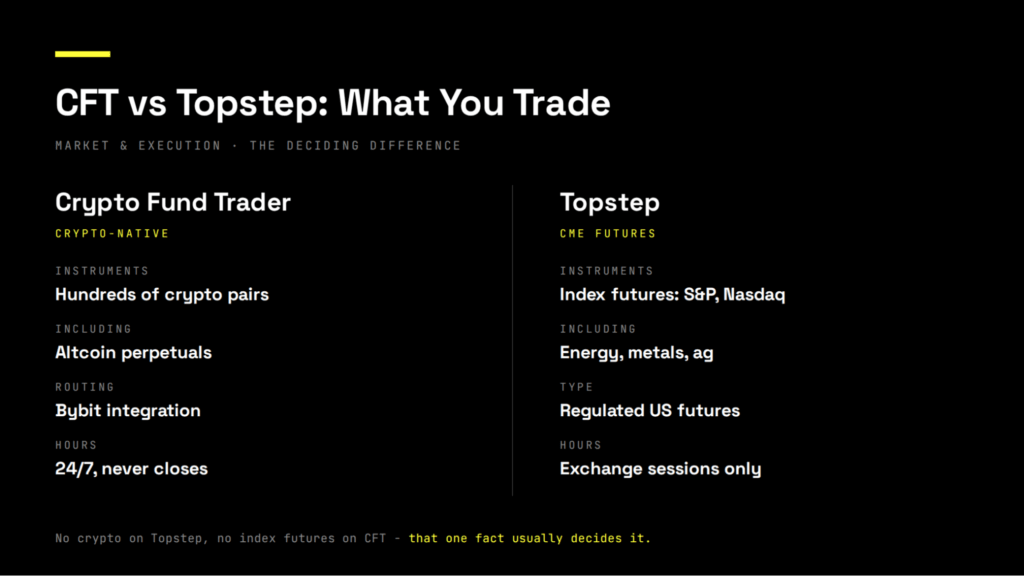
This is the difference that frames everything else. CFT is crypto-native. Its evaluations route through a Bybit integration, giving access to hundreds of crypto pairs including altcoin perpetuals, on a market that never closes. If your edge is in BTC, ETH, or smaller-cap crypto, that infrastructure is the point.
Topstep funds CME futures: index futures like the E-mini S&P and Nasdaq, plus energy, metals, and agricultural contracts. These markets run on exchange sessions rather than around the clock, and they are regulated US futures with deep institutional liquidity. A futures trader gets exactly the instruments they want, with none of crypto’s weekend gaps.
You cannot trade crypto on Topstep, and you cannot trade index futures on CFT. For most readers, that single fact resolves the CFT vs Topstep choice before any other rule matters.
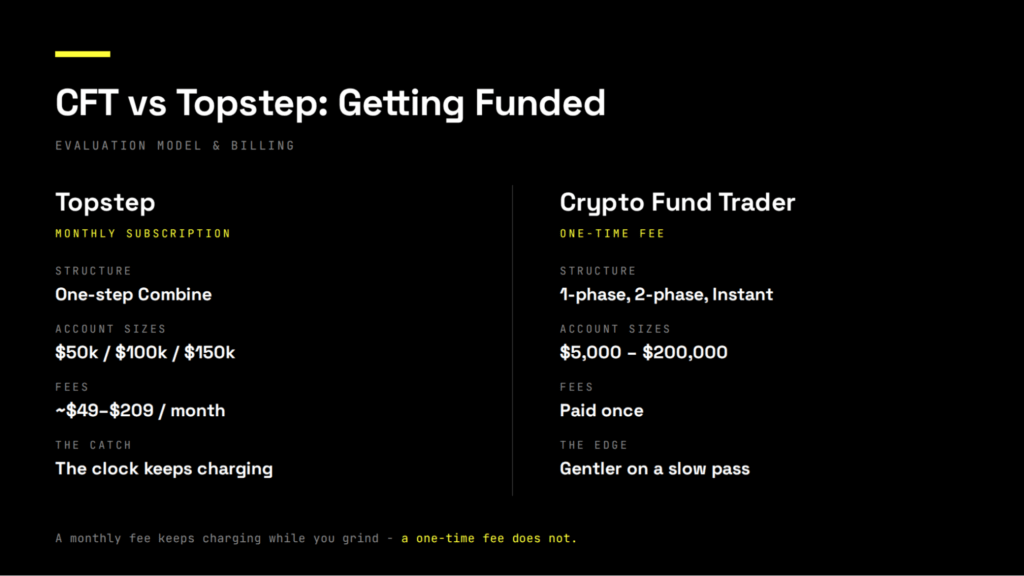
Both use a relatively simple path to funding, but the structure and the billing differ.
Topstep runs a one-step Trading Combine on a monthly subscription, with account sizes of $50,000, $100,000, and $150,000 and fees roughly in the $49 to $209 range per month. You hit a profit target near 6 percent while staying above your loss limit, then move to an Express Funded Account and eventually a Live Funded Account on real capital. The monthly billing works against you on a long evaluation, since the clock keeps charging.
CFT charges a one-time evaluation fee rather than a subscription, with 1-phase and 2-phase formats from $5,000 to $200,000, plus an Instant Challenge track that skips evaluation. For traders who take a while to pass, a one-time fee is gentler than a recurring one.
This is where the two firms diverge most, and where most accounts are actually lost.
Topstep’s defining rule is a trailing Maximum Loss Limit. It starts below your balance (for example, $2,000 under a $50,000 account), trails upward as your balance grows, then locks once it reaches the starting balance. The mechanic that catches traders is the post-payout reset: after you withdraw, the limit resets to zero buffer, leaving the account fragile until you rebuild profit. It rewards locking in gains and punishes letting a winner round-trip.
CFT uses more conventional limits on its 2-phase accounts: a fixed 5 percent daily loss and 10 percent maximum, which stay put rather than trailing. Its 1-phase format uses a 6 percent trailing drawdown that locks at the starting balance. CFT also imposes a $10,000 daily and per-trade profit cap, which Topstep does not, trimming outsized single-day gains.
The takeaway: Topstep’s trailing-and-reset model demands constant attention to your high-water mark, while CFT’s fixed daily and max limits are easier to plan around but capped on the upside per day.
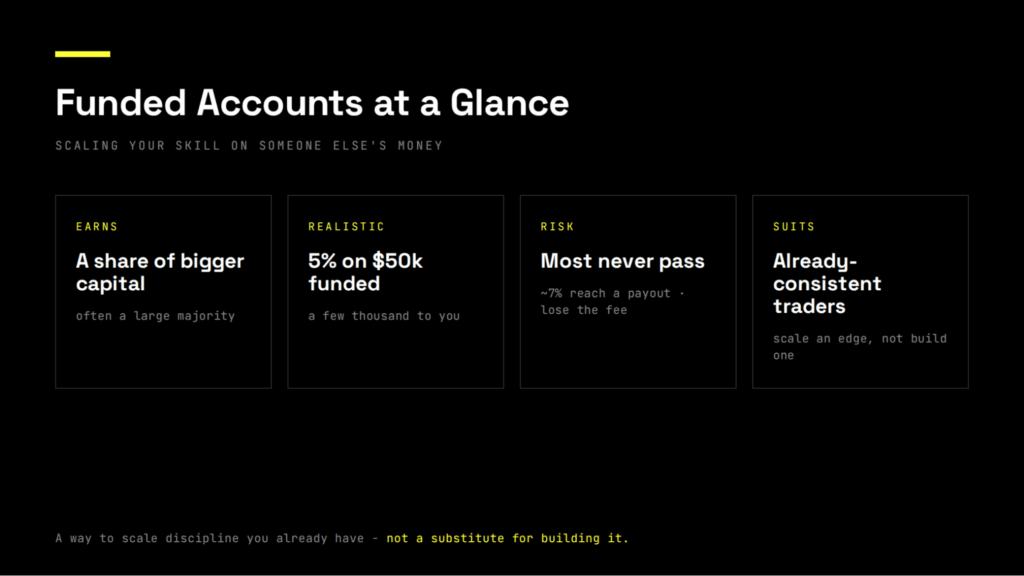
The rule sets favor different styles, which is more decisive than the split for many traders.
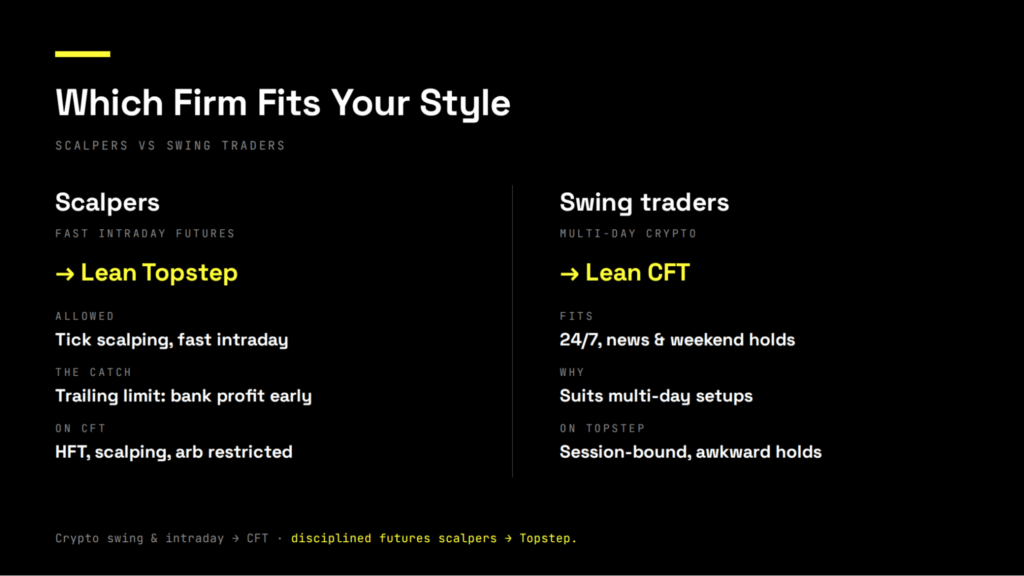
For scalpers, Topstep is the more permissive home in one sense: it does not ban tick scalping or fast intraday trading the way many crypto firms do. The catch is that its trailing limit, especially during the Combine, demands tight discipline and early profit-taking, since giving back an intraday gain can pull you toward a breach. It suits high-conviction intraday traders who size strictly and pull profits rather than letting them run. CFT, by contrast, restricts HFT, tick scalping, and arbitrage, and adds a reverse-trading rule, so ultra-fast crypto scalping does not fit it well.
For swing traders, CFT is the friendlier option. Crypto runs 24/7, and CFT permits news trading and holding positions over days and weekends, which suits multi-day crypto setups. Topstep’s futures focus is more session-bound and intraday in character, and holding through long stretches sits awkwardly with a trailing limit that reacts to your equity highs.
In short, the crypto fund trader vs Topstep style question splits cleanly: crypto swing and intraday traders lean CFT, while disciplined intraday futures scalpers lean Topstep.
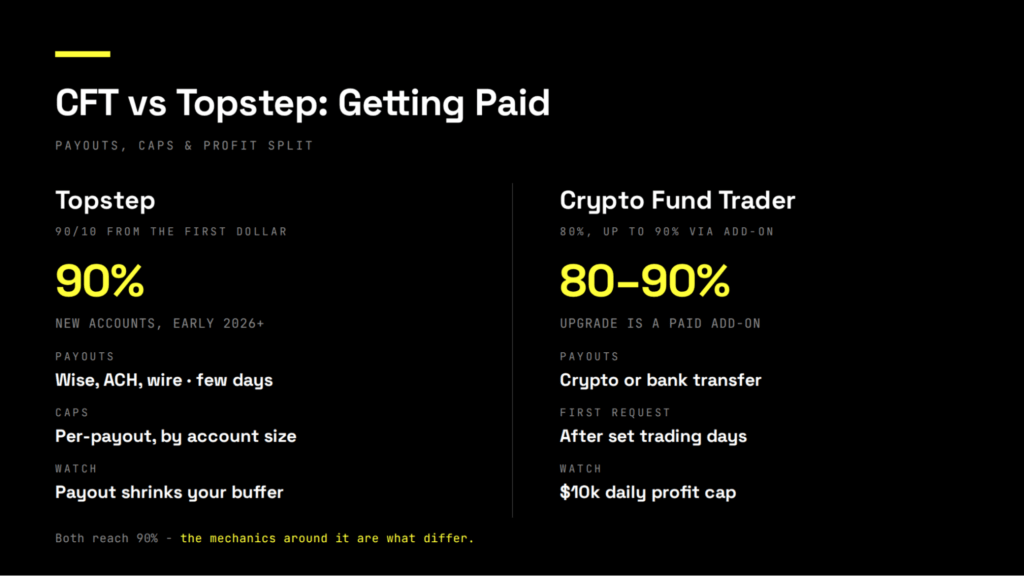
Both reach up to a 90 percent split, so the split itself is close to a wash. The mechanics around it differ.
Topstep moved to a 90/10 split from the first dollar on new accounts created after early 2026, with payouts processed in a few business days via methods like Wise, ACH, and wire, and per-payout caps that vary by account size. Its post-payout drawdown reset, covered above, effectively ties payout sizing to how much buffer you are willing to surrender.
CFT starts at an 80 percent split, upgradable toward 90 percent through a paid add-on, with payouts available in crypto or bank transfer and a first request typically after a set number of trading days. Its $10,000 daily profit cap shapes how fast a large account can compound on any single day.
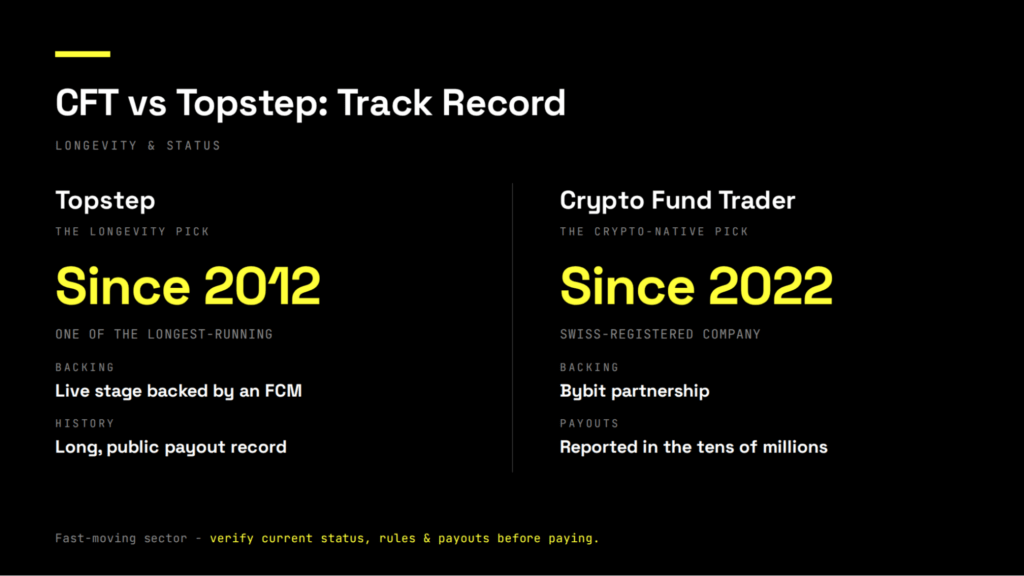
Topstep is one of the longest-running firms in the space, operating since 2012, with a live funded stage backed by an FCM and a long, public payout history. That longevity is a genuine point in its favor for traders who weight stability heavily.
CFT has operated since November 2022 under a Swiss-registered company, with a Bybit partnership and reported payouts in the tens of millions. As with any firm in this fast-moving sector, verify CFT’s current operational status, rules, and payout reports directly before paying, since conditions and standing can change quickly. You can review its current programs at Crypto Fund Trader and cross-check recent independent reviews before committing.
Choose Topstep if you trade CME futures, want a firm with more than a decade of history and FCM-backed live funding, and your style is disciplined intraday trading where you take profits early rather than holding through chop. Its trailing limit suits traders who manage risk tick by tick.
Choose CFT if your edge is in crypto, you want exchange-native execution on Bybit with access to altcoin perpetuals, and you trade swing or intraday setups on a 24/7 market with the freedom to hold over weekends. Just confirm the firm’s current status first.
The CFT vs Topstep comparison is less a contest than a fork based on what you trade. Topstep is the established futures specialist with a trailing-drawdown model that rewards intraday discipline. CFT is the crypto-native option with 24/7 markets and swing-friendly rules, paired with the standard caution to verify a young firm’s current standing.
Match the firm to your market and your style rather than to the headline split. In the crypto fund trader vs Topstep decision, the trader who picks based on which rule set fits how they actually trade will get far more from a funded account than the one chasing a slightly higher percentage on the wrong market.
Is CFT or Topstep better for beginners?
Topstep’s single Maximum Loss Limit is simple to understand, while CFT’s fixed daily and max drawdown are also beginner-friendly, so the better fit depends on whether you want to learn futures or crypto. Pick the firm whose market you actually intend to trade.
What is the main difference in the CFT vs Topstep evaluation?
Topstep uses a one-step Trading Combine billed monthly, while CFT charges a one-time fee for a 1-phase or 2-phase evaluation plus an instant option. A one-time fee favors traders who take longer to pass.
Which firm is better for scalping?
Topstep does not ban tick scalping, but its trailing limit demands early profit-taking and tight risk, while CFT restricts HFT and tick scalping outright. Fast scalpers generally find futures firms like Topstep more accommodating than crypto-native ones.
Which is better for swing trading?
CFT suits swing trading better, since crypto runs 24/7 and it permits multi-day and weekend holds, whereas Topstep’s futures model is more session-bound and intraday. In the crypto fund trader vs Topstep matchup, swing traders usually lean CFT.
Does Topstep offer crypto trading?
No, Topstep funds CME futures only, so crypto traders need a crypto-native firm instead. This single fact resolves most comparisons before rules even come into play.
Are these firms safe and legitimate?
Topstep has operated since 2012 with FCM-backed live funding and a long payout record, while CFT has run since 2022 under a Swiss-registered company. Verify either firm’s current rules and operational status directly before paying an evaluation fee.
This article is for informational and educational purposes only and does not constitute financial advice. Trading cryptocurrencies and prop firm challenges involve significant risk; trade only with capital you can afford to lose.
-
© 2026 - All Rights Reserved.
SWISS RLCRATES AG is a provider of educational services, all information available on our site is intended solely for the study purposes related to trading on financial markets. Accordingly, we do not offer financial, investment, tax, brokerage or other advice and/or services. Trading in financial markets is a high-risk activity, past performance do not guarantee future ones. It is highly advised not to risk more, than you can afford to lose. Brokers and operators of trading platforms are persons or entities that are separate from SWISS RLCRATES AG and their own terms and conditions will apply when you use their services and products. Neither SWISS RLCRATES AG nor RLCRATES, S.L. (as MT5 license holder) operate in countries where crypto or CFD’s activity is not allowed. The content in our platform is applicable to the extent local laws and/or regulations permit.