
Two names keep coming up when crypto traders compare evaluation firms in 2026: Crypto Fund Trader, which runs its evaluation on Bybit, and the Breakout prop firm Kraken bought outright. Both quote a profit split in the 80s. Both advertise six-figure capital after a paid evaluation. On the marketing pages, they look almost interchangeable.
They aren’t, and the gap isn’t about which brand feels more trustworthy. Kraken’s balance sheet answers that for Breakout, and Bybit’s exchange standing answers it for CFT. Any CFT vs Breakout Kraken comparison actually comes down to something narrower: where does the trade go once you’re evaluated? Crypto Fund Trader connects a trader’s own Bybit sub-account by API and settles against Bybit’s live order book. Breakout’s own Evaluation Agreement tells a different story about its funded stage, and that’s the axis everything else here sits on.
| Crypto Fund Trader | Breakout | |
|---|---|---|
|
Execution
|
Trader's own Bybit sub-account, connected by API: trades fill against Bybit's own liquidity
|
Funded trades run through Payward Oceanic Ltd.'s own book, "at its sole discretion" (Breakout's own Evaluation Agreement)
|
|
Evaluation paths
|
Six: 2-Phase, 1-Phase, 3-Phase, Instant, Ascend, Break
|
Three fixed shapes, one step each: Classic, Pro, Turbo
|
|
Maximum simulated allocation
|
$300,000 standard ceiling; the Instant line scales to $1,280,000
|
Up to $200,000 combined across accounts
|
|
Reward eligibility
|
May become eligible to receive up to 80% of simulated profits (add-on raises eligibility to 90%)
|
Advertises keeping up to 80% of profits, upgradable to 90% at checkout
|
|
Reward processing
|
~8 hours average; up to 48 business hours
|
On-demand, 24/7; $50 minimum, paid in USDC on Ethereum
|
|
Backing
|
Independent evaluation firm, operated by SWISS RLCRATES AG
|
Breakout Trading Group, LLC, wholly owned by Kraken since September 2025; the funded stage runs through Payward Oceanic Ltd.
|
Verdict: on the evidence both firms publish about themselves, CFT’s link to Bybit is the more transparent execution model.
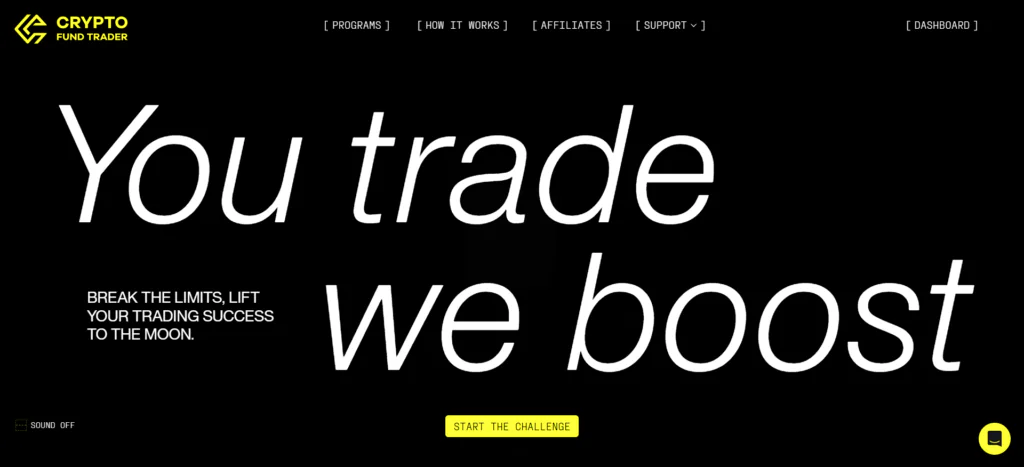
Crypto Fund Trader’s evaluation runs through a trader’s own Bybit account, linked by API rather than routed through a CFT-run book. CFT states this plainly: “On Bybit, spreads and slippage depend entirely on Bybit’s liquidity and market conditions. Crypto Fund Trader does not add any markup, artificial spread, or fictitious slippage to the provider’s price.” The Bybit evaluation itself doesn’t require KYC; any scholarship reward does.

Breakout is more specific about its own funded stage than most competitors bother to be. Its Evaluation Agreement states that once a trader passes, Payward Oceanic Ltd. (“POL,” the entity running Breakout’s funded stage) carries out market-facing transactions “for POL’s own principal account and at its sole discretion.” A funded trader’s submitted idea may, per the same document, be “recorded as an internal, administrative book entry” or “routed to a market maker or exchange.” That choice belongs to POL alone; the trader has no “control over, or visibility into, the method POL selects.” Running a funded book this way is common industry-wide, and Breakout discloses it plainly rather than burying it. But it means a Breakout trader’s fill may or may not touch a live market, by design, while a CFT trader’s fill on Bybit is Bybit’s own market price, every time. If execution transparency is the deciding factor, that’s the structural difference to weigh.
Verdict: CFT trades program complexity for choice; Breakout trades choice for speed.
CFT runs six separate evaluation lines. 2-Phase is the default (8%/5% profit targets, 5% daily loss, 10% fixed overall loss); 1-Phase drops the second stage (10% target, 4% daily, 6% trailing loss); 3-Phase splits the target into three smaller stages and opens the first scholarship request after only 5 traded days. Instant skips the profit-target evaluation and scales an account up to $1,280,000 through repeated “Withdrawal & Upgrade” milestones. Ascend pays one fixed scholarship on completion, then converts to a redeemable ticket. Break charges an activation fee to reach its Final Stage, then allows requests on demand. CFT states there is “no maximum time limit to complete the evaluation” and, on the main lines, “no minimum number of trading days required.”
The Breakout prop firm Kraken owns now takes the opposite approach: one step, in one of three fixed shapes. Classic targets 10% profit against 6% static drawdown; Pro targets 12% against 5%; Turbo targets 9% against 3%. All three cap the daily loss at 3%, and drawdown is static throughout: set once at account creation and never moving as profit builds, unlike CFT’s 1-Phase trailing loss. There’s no second phase, and no minimum trading days. Pick one risk shape and go: that’s the advantage for a trader who’s already settled on a strategy. A trader who wants more variety (trailing vs. static drawdown, a fixed reward vs. ongoing eligibility, an instant-start account with no profit target) has more to choose from with CFT’s six lines.
Verdict: the percentages are close to a wash; the ceiling favors CFT once Instant scaling is in play.
CFT’s standard evaluation caps simulated funded allocation at $300,000 per user. That ceiling doesn’t apply to the Instant line, which scales a starting demo account up to $1,280,000 through incremental upgrades. On reward share, CFT frames it as eligibility rather than a guarantee: traders may become eligible to receive up to 80% of simulated profits at the Live Stage, and the 90% Bonus Performance add-on raises that eligibility ceiling further.
Breakout’s own pages state a comparable structure: up to $200,000 in live trading capital, keeping up to 80% of profits standard and up to 90% on a higher-cost tier. On percentage, the two are functionally tied. The gap is the ceiling: CFT’s $300,000 starting point already exceeds Breakout’s $200,000 combined cap, and Instant’s scaling pushes that further for traders who stay active.
Verdict: close. Breakout removes the wait to request; CFT moves faster once you do.
CFT’s average scholarship reward processing time is approximately 8 hours, though the company notes its team “may take up to 48 business hours to review the request, verify the information, and send the payment.” First requests open after 15 traded days on the 1-Phase and 2-Phase lines (or every 7 traded days with the Weekly Scholarship Request add-on); Break and Instant allow requests on demand once their own thresholds are met.
Breakout advertises payouts on demand, 24/7, with a $50 minimum after the profit split, paid in USDC on Ethereum. There’s no 15-traded-day wait like CFT’s standard track. Both still gate money on identity checks: CFT’s KYC is mandatory before any scholarship reward, and Breakout’s Evaluation Agreement requires the same “know-your-customer” documentation to run its funded stage compliantly. For a trader frustrated by request windows, Breakout’s cadence is the more flexible one. CFT counters with a faster typical turnaround once a request is filed.
The Breakout prop firm Kraken owns best suits a trader who wants the shortest path to a funded-style account and doesn’t need to trade outside crypto. One evaluation step, one risk shape picked up front, a recognizable Kraken backstop, and on-demand payouts make it low-friction for someone who already knows their strategy and just wants to clear a single bar.
CFT suits a trader who wants more control over the evaluation shape or access outside crypto. Beyond Bybit, CFT’s Match-Trader and MetaTrader 5 platforms cover forex, indices, commodities and stocks (over 720 instruments combined), alongside more than 550 crypto futures pairs on Bybit. Six evaluation lines let a trader pick trailing vs. static drawdown, a fixed scholarship vs. ongoing eligibility, or an instant-start account. And for anyone who wants fills from a live order book rather than an internal one, CFT’s Bybit link is the more direct route.
This CFT vs Breakout Kraken comparison doesn’t produce a single winner: the two firms are built for different things. Breakout is the faster, simpler product, built on Kraken’s name, one step, and one risk shape. CFT is the broader one, with more evaluation paths, more instruments, a higher capital ceiling, and an execution model that traces every fill to a named exchange’s own order book. A trader chasing speed and simplicity in crypto alone will likely prefer Breakout; a trader who wants to choose their risk structure, trade more than crypto, or know exactly whose order book their price came from has more reason to look at CFT.
Does Breakout actually send my trades to the market or not?
Not necessarily, and Breakout says so in its own agreement. Once you’re funded, Payward Oceanic Ltd. decides whether your trade gets routed to an exchange or just logged as an internal entry, and that choice is entirely theirs. You have no way to check which one happened to any given trade. It’s a common setup across the industry, but if seeing your fill hit a real order book matters to you, CFT’s Bybit link is the more verifiable route.
Is Breakout legit now that Kraken owns it, or is that just marketing?
Kraken completing the acquisition in September 2025 is real and confirmed, not a rebrand stunt. That gives Breakout an actual balance sheet behind it instead of an anonymous LLC, which matters if you’re worried about a firm vanishing with your payout. It doesn’t change how the funded stage executes trades, though. Kraken’s name backs the company; it doesn’t make POL’s order routing any more transparent.
What happens if I pass the challenge and they still deny my payout?
Both firms can still deny a payout if you technically broke a rule, even one you didn’t notice, and that risk doesn’t disappear just because you passed the profit target. Read the drawdown definitions closely: CFT’s 1-Phase uses a trailing loss that tightens as you profit, while Breakout’s drawdown is static from day one. Static is easier to track in your head, but trailing can punish you for a big open profit you never realized. Neither structure is a trap by design, but you need to know which one you’re trading before you fund the account, not after.
Why does CFT need my KYC if the evaluation itself doesn’t?
CFT separates the two on purpose: the Bybit evaluation runs without identity checks, but any real payout requires KYC before money moves. That’s standard for both firms — Breakout’s funded stage requires the same documentation to stay compliant. If you’re trying to trade anonymously, neither of these gets you there once you want to withdraw. The anonymity only covers the practice stage.
How long do payouts really take, on-demand vs the 8-hour average?
Breakout’s “on-demand, 24/7” claim means you can request anytime, not that it lands instantly — there’s still a $50 minimum and a KYC check standing between the request and the money. CFT’s 8-hour average sounds fast, but their own terms allow up to 48 business hours if something needs review. Neither number is a guarantee. If speed after you request is what matters, CFT tends to win.
Is there any version of this where I keep 90%, or is that just an upsell?
Both firms treat 90% as a paid upgrade, not a default. CFT calls it the Bonus Performance add-on; Breakout prices it as a higher checkout tier. Standard on both is up to 80%, and “up to” is doing real work in that sentence — it’s eligibility, not a flat guarantee on every dollar. If the upgrade price is small relative to the size of your account, it usually pays for itself fast; if you’re trading a small account, the extra 10% may not cover what you paid for it.
This article is for informational and educational purposes only and does not constitute financial advice. Trading cryptocurrencies and prop firm challenges involve significant risk; trade only with capital you can afford to lose.
-
© 2026 - All Rights Reserved.
SWISS RLCRATES AG is a provider of educational services, all information available on our site is intended solely for the study purposes related to trading on financial markets. Accordingly, we do not offer financial, investment, tax, brokerage or other advice and/or services. Trading in financial markets is a high-risk activity, past performance do not guarantee future ones. It is highly advised not to risk more, than you can afford to lose. Brokers and operators of trading platforms are persons or entities that are separate from SWISS RLCRATES AG and their own terms and conditions will apply when you use their services and products. Neither SWISS RLCRATES AG nor RLCRATES, S.L. (as MT5 license holder) operate in countries where crypto or CFD’s activity is not allowed. The content in our platform is applicable to the extent local laws and/or regulations permit.