

Crypto trading psychology is the set of behavioral habits that decides whether a trader survives an evaluation’s drawdown rules or breaks them: accepting a stop, sizing the next trade the same after three losses as after three wins, not chasing a move you missed. It matters more in crypto than in most markets, because the exchange never closes.
Crypto markets trade around the clock, and a double-digit move can happen in an afternoon. That makes crypto trading psychology different from the version built for stocks or forex, where the session ends and a trader’s exposure to their own impulses ends with it. A crypto evaluation account sits open on a Saturday night the same as a Tuesday morning, and every hour it’s open is an hour a trader can override their own plan.
Evaluation firms can’t measure discipline on a form, so they measure proxies for it instead: drawdown limits, daily loss caps, consistency rules. Each one asks the same question: does this trader behave the same way after a loss as after a win? A trader rarely fails an evaluation because the strategy was wrong. They fail because a losing streak changed their behavior, and the account’s rules caught it before that streak became a blown account.
Crypto trading psychology is judged by rule compliance under stress, not by any single winning trade.
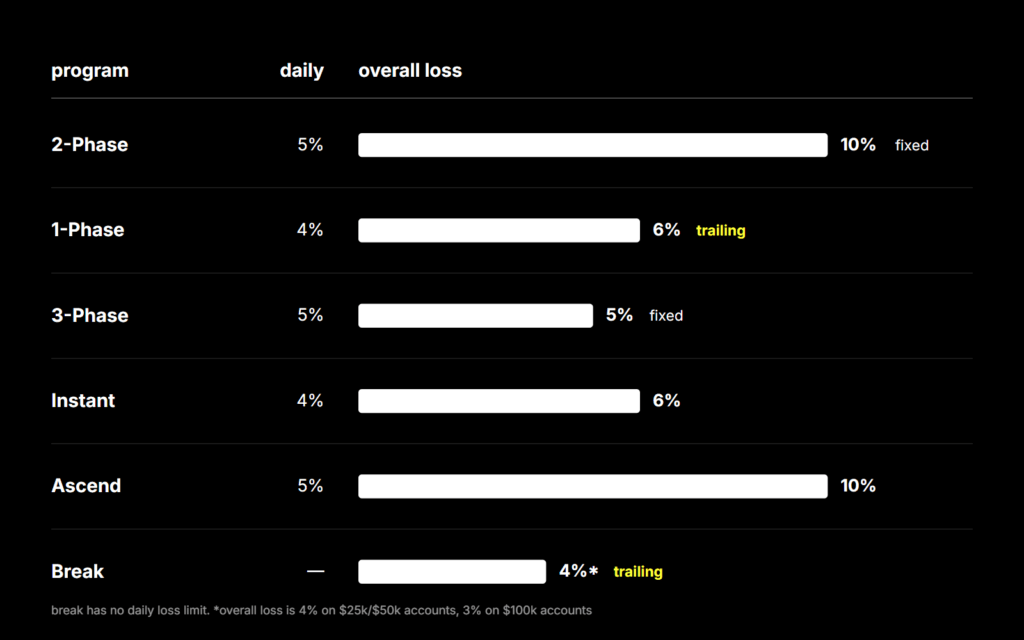
An evaluation’s profit targets are rarely the hard part. On a 2-Phase program, clearing 8% in Phase 1 and 5% in Phase 2 is realistic for a trader with an edge and enough time, and Crypto Fund Trader removes the clock from the equation: its FAQ states there is “no maximum time limit to complete the evaluation” and “no minimum number of trading days required.” What actually fails traders is the 5% daily loss and 10% fixed overall loss sitting underneath those targets: limits calculated on equity, so an open loss counts against the trader immediately, not only once a position closes. That single design choice removes the option of “waiting it out.” A losing position has to be managed the moment it goes against plan. That’s the moment psychology, not analysis, does the work.
Losses register more strongly than equivalent gains, and crypto’s speed compresses that effect into minutes instead of days.
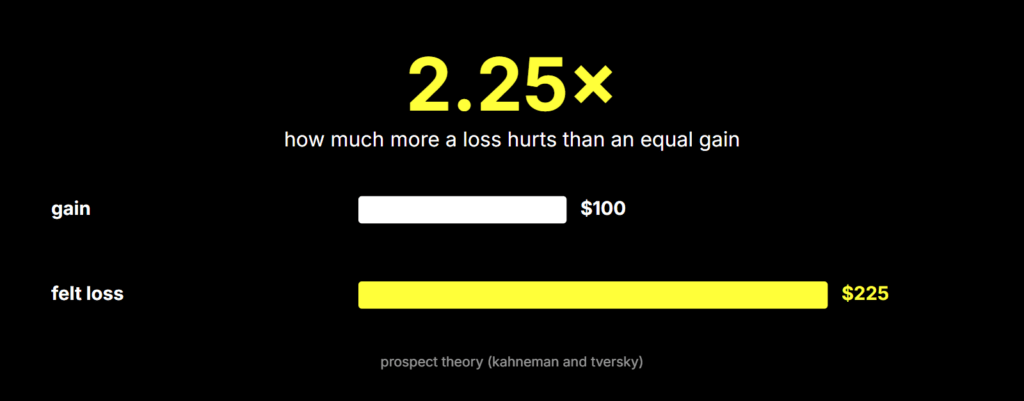
The underlying bias is loss aversion, first described in Daniel Kahneman and Amos Tversky’s prospect theory. The commonly cited estimate puts the loss-aversion coefficient around 2.25: a loss feels roughly twice as intense as an equivalent gain (The Decision Lab). The same bias cuts the other way too. Research from CFA Institute’s Enterprising Investor found that stops set too tight, out of loss aversion and regret avoidance rather than a defined plan, tend to hurt long-term returns more than wider, more consistent ones. In a market that can move 5% before a trader finishes their coffee, loss aversion shows up fast either way: a red trade doesn’t just cost money, it triggers an outsized urge to make it back immediately, often with a bigger position than the one that just lost.
Evaluation rules exist partly to catch that exact reaction. On CFT’s Break program, the Final Stage consistency rule reads: “No single trading day may account for more than 40% of the total profits generated on the account.” A trader chasing back a loss with one oversized trade is precisely the pattern that rule is built to flag. Even a profitable oversized day can disqualify a reward request if it dominates the account’s results.
A single oversized trade taken to recover a loss is the fastest way to turn a manageable drawdown into a failed evaluation.
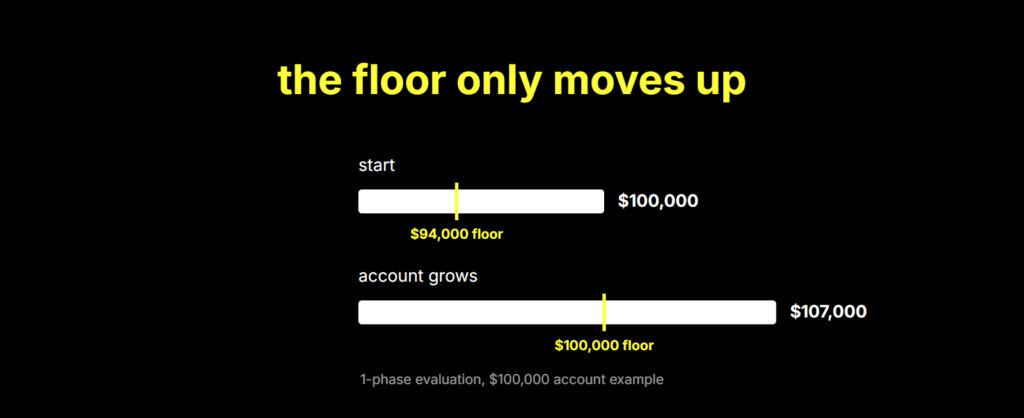
Daily loss caps compound the problem for anyone tempted to “get it back” inside the same session. CFT calculates the daily maximum loss “based on your account balance at 12:05 AM UTC each day.” That’s a hard reset point, not a rolling window a trader can negotiate with. On the 1-Phase program, the overall loss limit is trailing rather than fixed, which changes the psychology further: profit itself moves the danger line closer. CFT’s own example: “If you start with a $100,000 account, your initial trailing drawdown limit is $94,000. If your account grows to $107,000, the trailing drawdown reaches $100,000.” A trader who gets loose with risk after a hot streak, rather than tightening it, is the person a trailing limit is designed to stop.
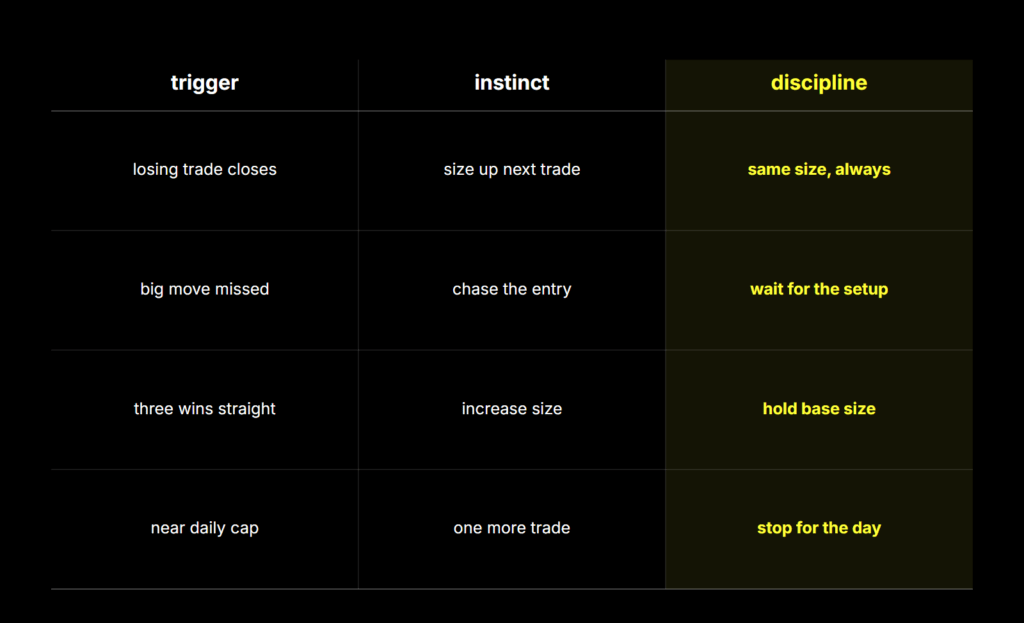
| Trigger | Typical reaction | Disciplined response |
|---|---|---|
|
A losing trade closes
|
Widen the next stop, or size up the next trade
|
Keep the next trade at the same planned risk regardless of the last outcome
|
|
A big move is missed
|
Chase the entry at a worse price
|
Wait for the next setup that matches the plan
|
|
Three wins in a row
|
Increase size beyond the original plan
|
Hold base size until a new equity high resets the baseline
|
|
Daily loss cap is close
|
Take one more trade to recover it
|
Stop trading for the day, because the cap exists to force this
|
Prop firm evaluations reward the trader who treats every trade the same way, not the trader who had one great week.
That’s the trading mindset prop firm rules are designed to select for: identical behavior across different emotional states, verified over enough trades that a lucky streak can’t fake it. CFT removes the deadline entirely across its main programs, and that cuts the same way. A trader racing a calendar is more likely to abandon a plan under pressure; a trader with no minimum trading days and no maximum time limit has room to let the process, not the clock, set the pace. The mindset a prop firm evaluation is actually testing is patience applied consistently, not talent applied occasionally.
A handful of written rules, checked before every trade, close most of the gap between knowing the psychology and living it.
Crypto Fund Trader’s programs test the same three things: drawdown, consistency, and pacing, not one lucky trade.
Crypto Fund Trader is a simulated trading evaluation firm running six evaluation lines, each testing a slightly different risk regime: 2-Phase, 1-Phase, 3-Phase, Instant, Ascend, and Break. The Instant line looks like it skips evaluation altogether. It doesn’t. Instant removes the profit-target phase, so there’s no percentage to clear before a trader gets demo capital to trade on. But the 4% daily and 6% overall loss limits apply from the first trade, up to three Instant accounts can run at once, and reaching 10% simulated profit triggers a “Withdrawal & Upgrade” step that doubles the demo account size, with room to scale up to $1,280,000. The profit-target gate is gone; the drawdown discipline that actually tests crypto trading psychology is not.
CFT’s evaluations also run on a trader’s own Bybit account, connected by API. Bybit sets the spreads and slippage directly. CFT’s own language: “does not add any markup, artificial spread, or fictitious slippage to the provider’s price.” That matters for psychology specifically: the discipline a trader builds during evaluation is calibrated against real exchange conditions, not an internal pricing engine. Those habits carry over unchanged if the trader passes and may become eligible to receive up to 80% of simulated profits at the Live Stage.
Crypto trading psychology isn’t a mindset traders either have or don’t: it’s a set of habits that evaluation rules are built to surface. Daily loss caps, trailing drawdowns, and consistency requirements aren’t obstacles layered on top of a trading strategy; they’re a direct test of whether a trader’s behavior stays constant across a losing streak and a winning one. The traders who pass tend to be the ones who treat every trade like the hundredth one in a sample, not the one that has to fix everything. Evaluation firms like Crypto Fund Trader build their programs around that distinction: the fixed drawdown on 2-Phase, the ongoing loss limits on Instant. The evaluation itself is a reasonable place to find out whether the habit is actually there.
Is this just gambling with the firm’s money instead of my own? It can turn into that if you treat the low entry fee as low stakes. A $50,000 simulated account behind a $100 fee doesn’t feel like real risk, and that gap is exactly what makes people overtrade, revenge-trade, and blow accounts without flinching. Breach the drawdown rule and the account is gone regardless of how little you paid for it: the consequence doesn’t shrink just because the entry fee did. Treat the size on screen as the size you’re actually risking, not the size of the fee, or the psychology works against you before you place a trade.
Why does my mindset change once it’s not my own money? Because the consequences feel smaller, so the discipline gets smaller too. People who trade cautiously with personal savings will take trades on a simulated funded account they’d never take otherwise, since a loss just means paying for another evaluation. If your entries change once it’s not your own money on the line, that’s a signal your risk process was never solid to begin with.
Does a fixed or trailing drawdown limit actually matter for how I trade? Yes, and it changes your mindset more than most traders expect going in. A trailing drawdown moves the danger line up as your account grows, so a winning streak buys you less room than it looks like it should, and that pushes people into tighter, more anxious trading right when they should be building confidence. A fixed limit set from day one is more predictable and easier to plan around psychologically. Know which one you’re under before you scale up your size, because the two require different risk mindsets.
Does buying a new evaluation after failing fix the underlying problem? Not by itself. Buying another evaluation without changing what caused the breach just gives the same mistake a new account to happen on. If a trader is on a third or fourth attempt with the same drawdown rule catching them each time, the fix isn’t a new evaluation, it’s reviewing the specific decision that triggered the breach: the size, the entry, the moment discipline slipped. A low re-entry cost makes retrying easy, which is exactly why it’s worth pausing to diagnose the pattern before paying for another attempt.
Does a firm’s advertised profit split tell the whole story? No, not on its own. A profit split percentage is only meaningful once you know where the underlying price comes from. A firm offering 90% of a price it sets internally on its own feed can still leave a trader worse off than one offering 80% of a real exchange fill, because the reward is only ever a share of whatever the price actually was. Before comparing split percentages across firms, check whether execution routes to a named exchange, since that’s what determines whether the profit being split reflects the market or the firm’s own pricing.
This article is for informational and educational purposes only and does not constitute financial advice. Trading cryptocurrencies and prop firm challenges involve significant risk; trade only with capital you can afford to lose.
-
© 2026 - All Rights Reserved.
SWISS RLCRATES AG is a provider of educational services, all information available on our site is intended solely for the study purposes related to trading on financial markets. Accordingly, we do not offer financial, investment, tax, brokerage or other advice and/or services. Trading in financial markets is a high-risk activity, past performance do not guarantee future ones. It is highly advised not to risk more, than you can afford to lose. Brokers and operators of trading platforms are persons or entities that are separate from SWISS RLCRATES AG and their own terms and conditions will apply when you use their services and products. Neither SWISS RLCRATES AG nor RLCRATES, S.L. (as MT5 license holder) operate in countries where crypto or CFD’s activity is not allowed. The content in our platform is applicable to the extent local laws and/or regulations permit.