

[ RANK ]
Crypto Risk Management for Prop Traders: Drawdown Rules & Position Sizing

Crypto risk management for prop traders: drawdown rules & position sizing

Crypto risk management for prop trading starts with one question most traders skip: which drawdown regime governs this account, and does every position size respect its tightest limit? A fixed cap, a trailing cap, and a size-tiered trailing cap are three different math problems, not three names for one rule.

The mistake is easy to make because the vocabulary looks identical across programs. "Daily loss," "overall loss," and "drawdown" show up on every evaluation’s fact sheet, but the number behind each word, and whether that number moves as the account grows, changes by program and sometimes by add-on. A trader who sizes a 1-Phase account the way they sized a 2-Phase account is applying yesterday’s math to a different rule, and that habit is the most common failure pattern in evaluation trading. It isn’t a strategy problem. It’s what happens when the drawdown management crypto evaluation firms enforce turns out less standardized than traders assumed.

Fixed and trailing limits demand different position sizing, and the tightest constraint on an account (not the friendliest one) is the one to size against. Crypto Fund Trader’s own published rules make a clean working example, since it runs all three regimes side by side.

How drawdown is measured on a crypto evaluation account

Drawdown on a simulated evaluation account is calculated on equity, so an open loss counts against the limit before a trader closes the position.

Standard risk-management theory defines drawdown as the decline from an account’s peak value to its lowest point before a new peak is reached (Corporate Finance Institute). Crypto Fund Trader tightens that definition: its FAQ states that "drawdown breaches are calculated based on equity." That single design choice removes the option of letting a losing position run while telling yourself it’s still "just unrealized." The daily loss component works on a separate clock: CFT calculates it "based on your account balance at 12:05 AM UTC each day," meaning the daily limit resets from a fixed balance snapshot rather than a rolling 24-hour window. A trader who opens a position at 11:50 PM UTC and holds it past midnight is measuring that trade’s risk against tomorrow’s daily allowance, not today’s. That distinction alone is enough to blow a limit a trader thought they respected.

This is the foundation every position-sizing decision sits on. Get the measurement wrong (assume a rolling window, assume realized-only losses count) and the size that felt safe on paper isn’t safe against the actual rule.

Three drawdown regimes, one firm: the trap of conflating them

One of the costliest risk-management errors in crypto prop trading is assuming a firm applies one drawdown rule across every program. Crypto Fund Trader operates six evaluation lines, and the three most commonly confused sit on genuinely different math:
Program Profit target Daily loss limit Overall loss limit
2-Phase Phase 1: 8%, Phase 2: 5% 5% 10%, fixed
1-Phase 10% 4% 6%, trailing
Break 5% ($25k) / 6% ($50k, $100k) none 4% trailing ($25k, $50k) or 3% trailing ($100k)
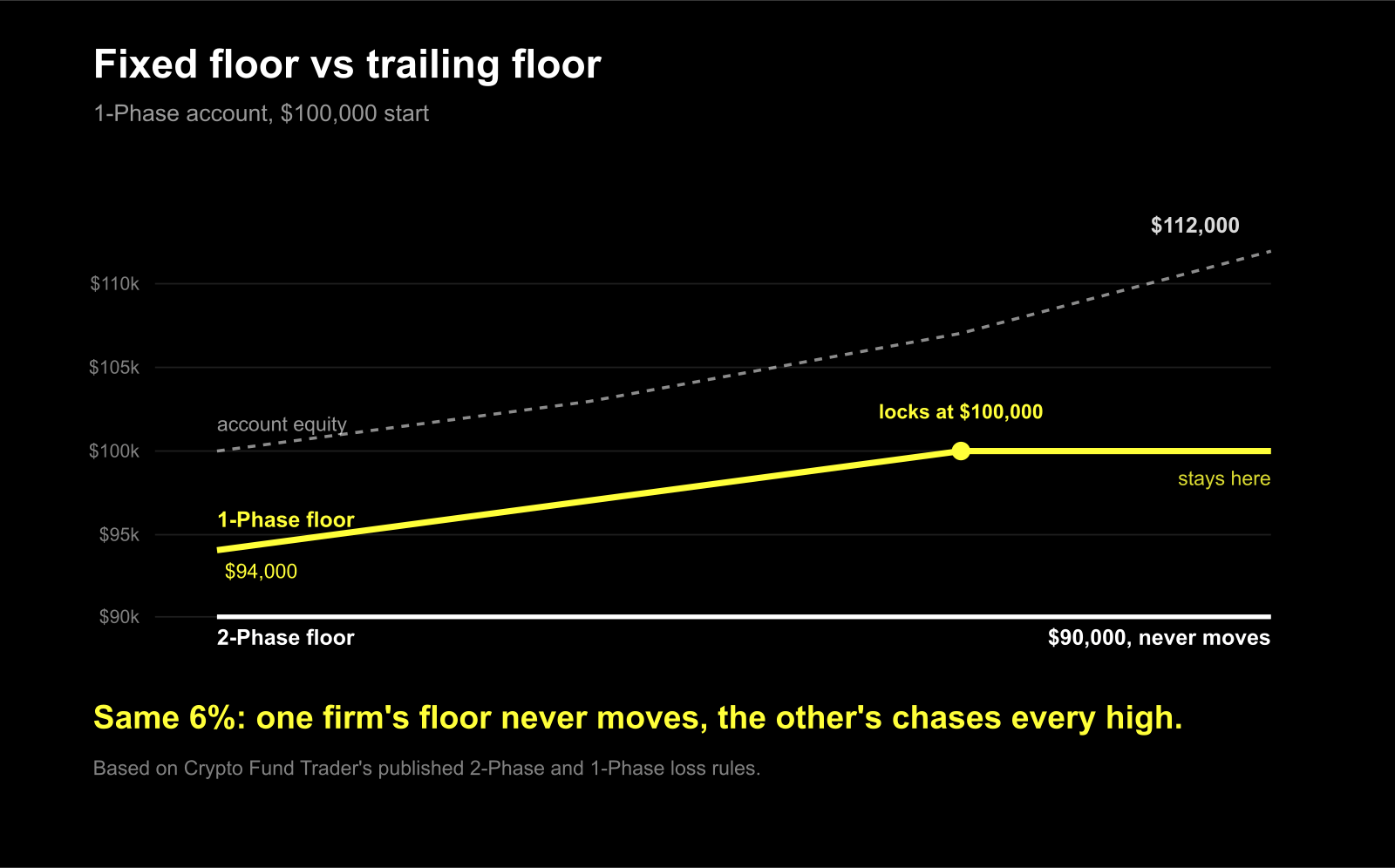
A fixed limit is anchored to the starting balance and never moves. A trailing limit moves upward as the account posts new equity highs, then locks once it reaches the starting balance. CFT’s own worked example for the 1-Phase program shows the mechanic: “If you start with a $100,000 account, your initial trailing drawdown limit is $94,000. If your account grows to $107,000, the trailing drawdown reaches $100,000. From that point, it no longer trails and remains fixed at the initial account balance.” A trader who treats that 6% the same way they’d treat 2-Phase’s fixed 10% is sizing against a limit that’s been moving closer the whole time their account was winning. Line chart comparing Crypto Fund Trader's 2-Phase fixed drawdown floor at $90,000 against the 1-Phase trailing drawdown floor, which rises from $94,000 to $100,000 as account equity grows from $100,000 to $112,000, then locks.

Add-ons make the trap worse. Two are available on 2-Phase, and a trader can buy either or both:

  • Daily Drawdown 6%: 15% of the evaluation price, raises the daily cap from 5% to 6%.
  • Max Drawdown 12%: 25% of the price, raises the overall cap from 10% to 12%.

But CFT’s FAQ is explicit that "if your cart includes a 1-Phase Evaluation, drawdown add-ons will not be available." The same shopping cart can produce up to four different 2-Phase risk profiles depending on which add-ons are checked, and zero variants for 1-Phase. Crypto risk management for prop trading means reading the specific account’s fact sheet every time, not the program name.

Break adds a third layer that isn’t a drawdown rule at all but gets mistaken for one: its Final Stage consistency requirement states "no single trading day may account for more than 40% of the total profits generated on the account." That rule doesn’t stop trading and isn’t checked against a running balance; it’s checked only when a trader requests a scholarship reward. Confusing it with a drawdown limit makes traders under-size a genuinely good day, or assume the rule applies to programs that don’t carry it. It’s the only consistency rule in CFT’s product set; the other lines don’t carry an equivalent.

Position sizing that survives the tightest limit, not the average one

Size every position against the tightest applicable loss limit on the specific account, not a comfort level carried over from a different program. This is the part of crypto risk management for prop trading that a strategy backtest never tests, because the constraint isn’t the market: it’s the firm’s own rulebook.

A common baseline in retail and prop risk management caps the loss on any single trade at 1% of account equity: position size equals account risk divided by stop distance (Trade That Swing). Applied to a $100,000 2-Phase account with a 5% daily loss limit, that 1% baseline caps a single trade’s risk at $1,000, leaving room for roughly five losing trades in a day before the $5,000 daily limit is even in reach, rather than one trade sized to eat the whole allowance. On the same account size under 1-Phase’s 4% daily limit ($4,000), that budget is tighter, and it gets tighter still as the trailing overall limit climbs toward the starting balance.

Sizing has an upper bound too, one traders size for less often: CFT caps simulated profit at $10,000 per day and per trade, and states that any equity above that threshold "may be closed" and the excess "may be deducted." A trade sized so large that a normal winning move blows past $10,000 in profit doesn’t just risk a capped gain. It’s usually also a trade whose stop-loss distance implies far more risk than a 1% baseline would allow. The profit cap and the loss limit check the same oversized position from opposite directions.

Program Profit target Daily loss / Overall loss
2-Phase
Phase 1: 8%, Phase 2: 5%
5%
1-Phase
10%
4% / 6%, trailing
Break
5% ($25k) / 6% ($50k, $100k)
none / 4% trailing ($25k, $50k) or 3% trailing ($100k)

Daily loss vs. overall loss: why the two limits move independently

A daily loss breach and an overall drawdown breach are separate failure conditions, and a trader can get uncomfortably close to one without touching the other.

Because the daily limit resets from a fresh balance snapshot at 12:05 AM UTC, a trader who has a genuinely bad day, losing close to the full 5% daily allowance on a 2-Phase account, starts the next day with a full daily budget again. The overall equity drawdown, though, has now moved several percentage points closer to the 10% ceiling. The reverse also happens: a trader can stay well inside every daily limit for weeks and still grind an account toward its overall cap through a string of moderate, individually-compliant losing days. Managing drawdown on a crypto evaluation account means tracking both numbers on separate timelines: a clean daily record doesn’t mean the account is safe overall.
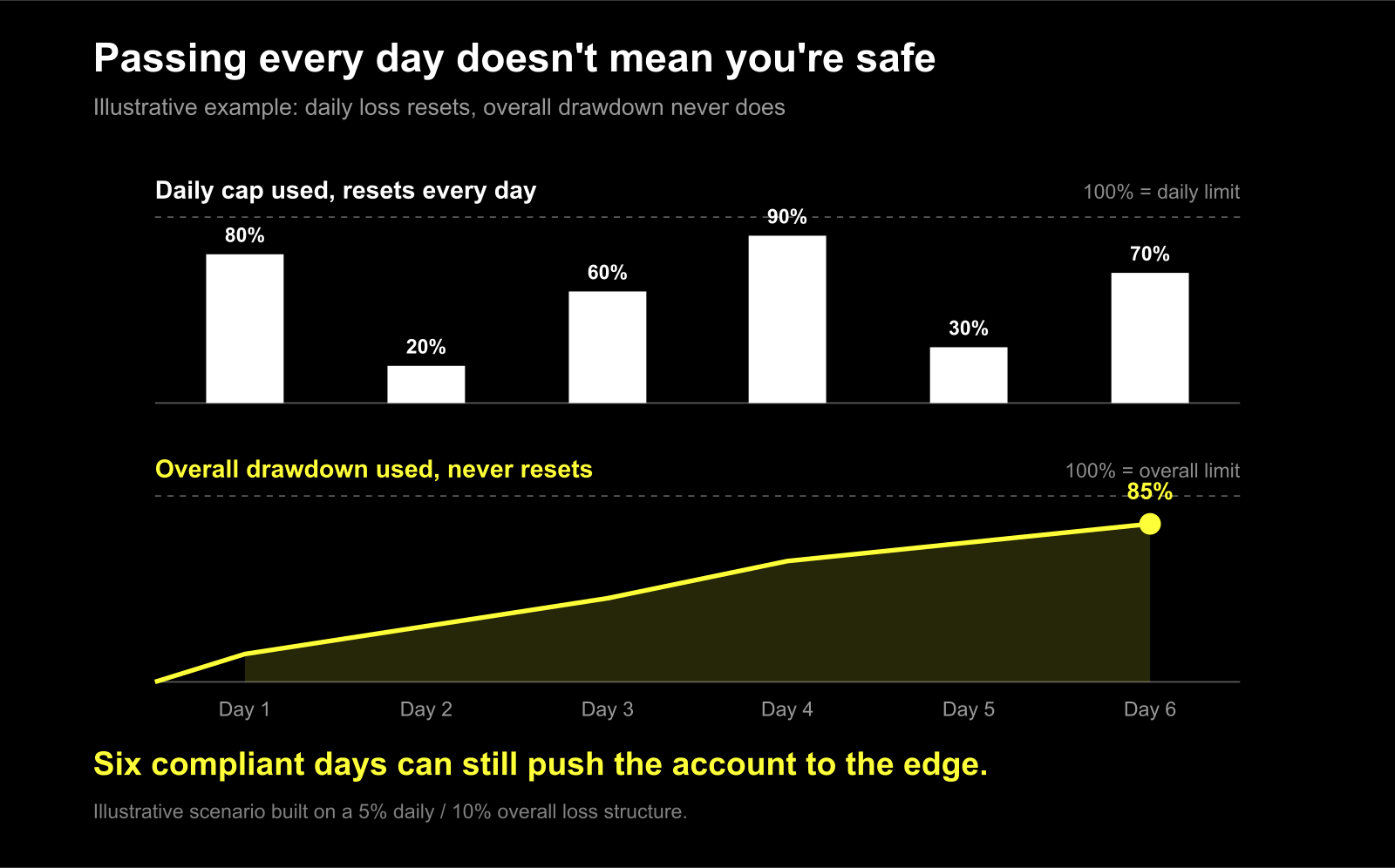
Illustrative six-day chart contrasting a daily loss limit that resets every day with an overall drawdown that accumulates across all six days and reaches 85% of its limit despite no single day breaching its cap.

This is also where fixed and trailing overall limits diverge most sharply. On a fixed 10% overall cap, a string of profitable days buys no cushion beyond the starting number. The ceiling never moves. On a trailing 6% cap, the same profitable string moves the ceiling with it, so the account’s margin for error is tighter after a winning streak than after a flat one, since a give-back now eats into gains the trailing limit has already locked in as the new floor.

A worked example: sizing the same $100,000 account three ways

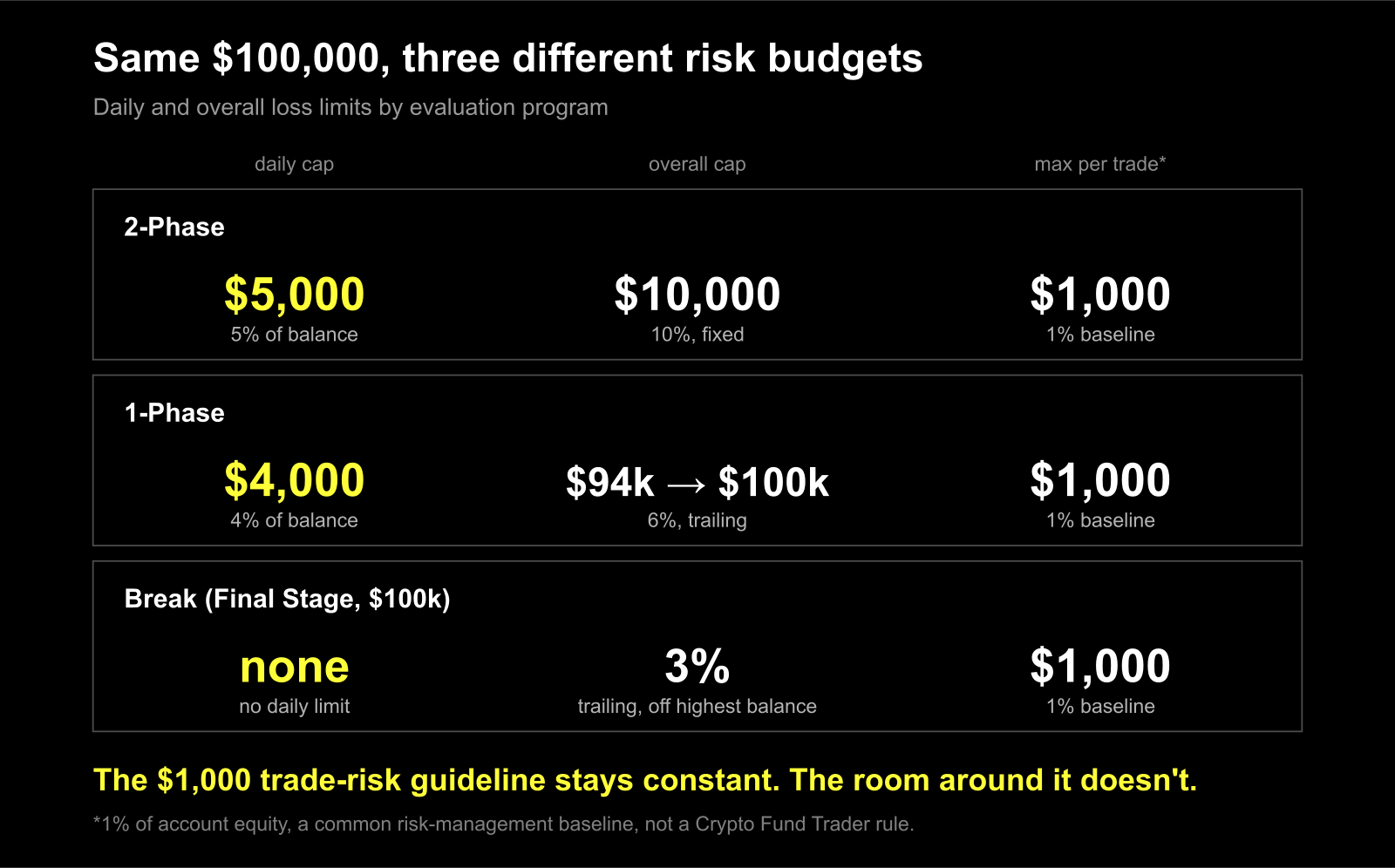
The same $100,000 balance implies three different position sizes, depending on which program it sits inside.
Program Daily budget Overall budget What changes
2-Phase, $100,000, no add-ons $5,000 (5%) $10,000, fixed (10%) A 1% per-trade baseline ($1,000) leaves five trades’ worth of daily room, and the ceiling never moves no matter how high the account climbs.
1-Phase, $100,000 $4,000 (4%) Starts at a $94,000 floor (6%), trails up to a $100,000 ceiling once the account reaches $107,000 The same $1,000 baseline now has to account for a ceiling that keeps closing the gap as the account performs well.
Break, $100,000 Final Stage None 3%, trailing off the highest balance reached Also carries the 40%-of-total-profit consistency check, applied only at reward-request time, so sizing has to satisfy the trailing loss while avoiding one outsized day.
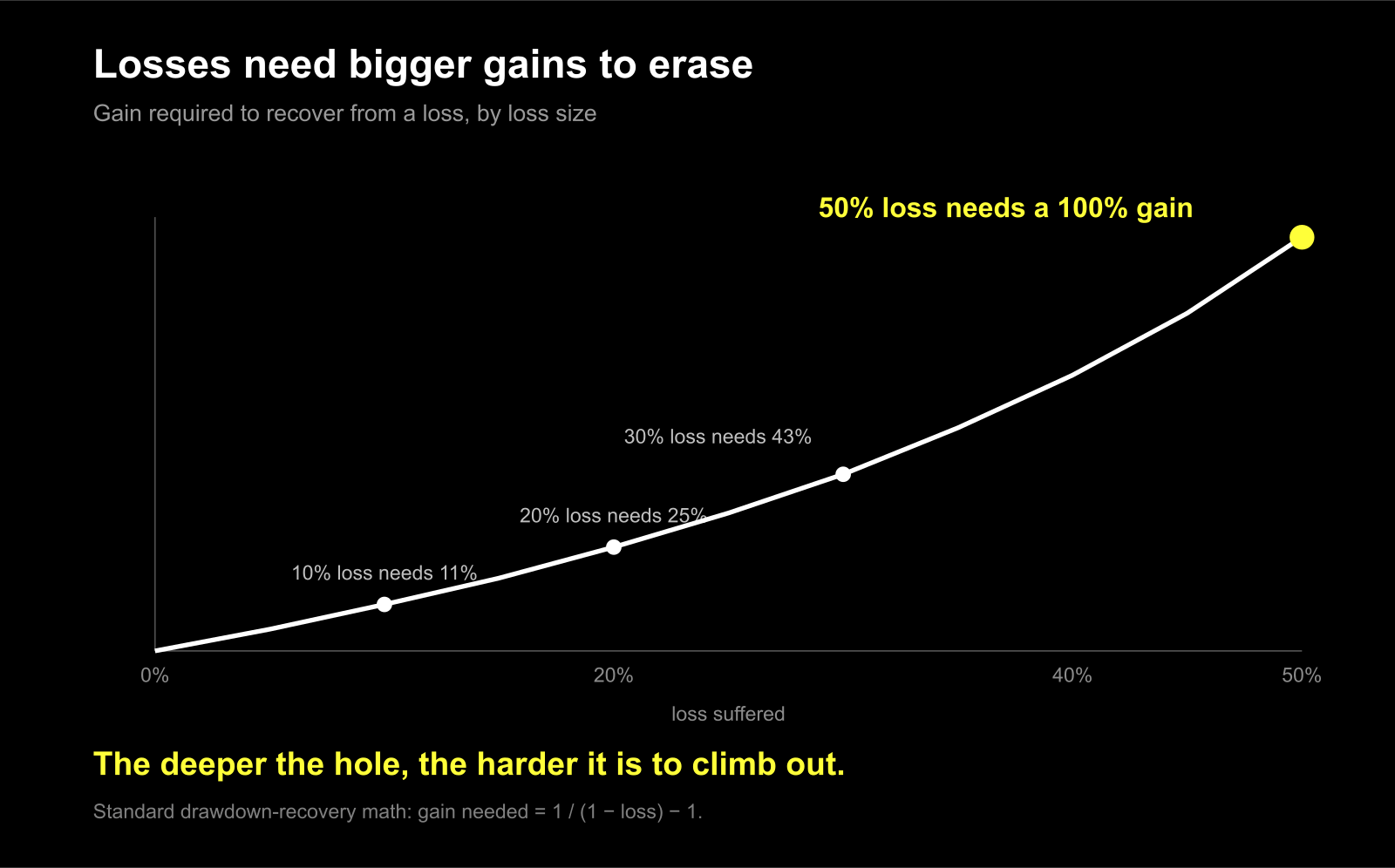
Reference table comparing a $100,000 account across three Crypto Fund Trader evaluation programs: 2-Phase's $5,000 daily and $10,000 fixed overall caps, 1-Phase's $4,000 daily cap and $94,000-$100,000 trailing overall cap, and Break's no daily cap with a 3% trailing overall cap. The drawdown management crypto evaluation accounts demand isn’t optional bookkeeping: it’s why the raw percentages above matter more than they look. Recovering from a drawdown always requires a larger percentage gain than the loss itself, since the math runs off a smaller base. A 20% drawdown needs a 25% gain just to get back to even, and a 30% drawdown needs closer to 43% (Tradezella). Curve showing the gain percentage required to recover from a trading loss: a 10% loss needs an 11% gain, 20% needs 25%, 30% needs 43%, and 50% needs a full 100% gain to break even. An evaluation account that breaches its limit doesn’t get the chance to attempt that recovery at all. The account closes. Staying inside the drawdown, at any size, is cheaper than trying to trade back out of a breach that isn’t coming.

Where execution quality removes risk that sizing can't

Position sizing controls the risk a trader chooses to take; execution quality controls the risk a trader didn’t choose.

Crypto Fund Trader runs its Bybit evaluations directly on a trader’s own Bybit account, connected by API, rather than through an internal dealing engine. CFT states that on Bybit, "spreads and slippage depend entirely on Bybit’s liquidity and market conditions" and that it "does not add any markup, artificial spread, or fictitious slippage to the provider’s price." For a risk model built on precise stop distances and defined position sizes, that matters: a sizing calculation is only as good as the fill it assumes, and real-exchange execution means the number a trader calculated is closer to the number they actually get. KYC isn’t required to start the Bybit evaluation itself, though CFT requires its own KYC before it processes any scholarship reward.

The firm also removes a pressure that pushes traders toward oversized positions: CFT’s evaluations carry no maximum time limit and no minimum number of trading days. A trader racing a deadline is a trader more likely to abandon a sizing plan to force a result. Without that clock, the same discipline that keeps a position inside its drawdown budget on day one can hold on day ninety. Traders who complete a program and stay compliant with its rules may become eligible to receive up to 80% of simulated profits generated at the Live Stage: proof that the same drawdown discipline has to hold after passing, not just during the evaluation.

The takeaway

The crypto risk management prop trading firms reward isn’t one skill: it’s matching position size to the drawdown regime governing that account, that day. A fixed limit, a trailing limit, and a size-tiered trailing limit are three different budgets. An evaluation firm running several programs at once (the way Crypto Fund Trader does) is running several risk-management problems at once, under very similar-sounding names. The trader who reads each program’s fact sheet as its own rulebook, sizes to its tightest constraint, and treats a winning streak as a reason to size tighter rather than looser is the trader who’s still trading when the evaluation ends.

Frequently asked questions

Why does my daily limit reset from balance, not my actual 24 hours? Because most firms snapshot your balance at a fixed clock time, not from when you opened a trade. If you open a position at 11:50 PM and it’s still running past midnight, you’re now measuring that trade against tomorrow’s allowance instead of today’s. This catches people who assume "daily" means a rolling window like a bank statement. Check the exact reset time and time zone before you hold anything overnight; it’s usually buried in the FAQ, not the headline rules.

Trailing drawdown moved even though I closed the trade in profit: is that a bug? No, that’s the mechanic working as designed, and it’s the single most common source of "wait, what just happened" moments. On intraday trailing accounts, the floor locks to your highest equity point the instant it prints, including unrealized profit, not the price you actually closed at. So a trade that ran to +$1,500 before you took +$400 still drags your floor up by the full $1,500. You end up green on the day with a tighter cushion than when you started, which feels backwards until you understand it’s tracking the peak, not your P&L.

Is a 10% "fixed" limit actually easier than a 6% "trailing" one? Not automatically. It depends how far your account has run. A fixed limit never moves, so a $100k account with a 10% cap always fails at $90k, no matter how much you’ve made. A trailing 6% cap starts tighter but locks once your account climbs enough, and until then it keeps closing the gap as you win. Early on, fixed gives you more room. After a strong stretch, trailing can leave you with less breathing room than the "tighter" number suggested on day one.

Why did I get flagged for a rule I didn’t even know existed? Usually because it’s a consistency rule, not a drawdown rule, and it only gets checked at reward-request time, not during trading. A common version caps how much of your total profit can come from one single day (some firms set it around 30-40%). It won’t stop you mid-trade or show up on a dashboard warning. It just quietly disqualifies a reward after the fact if one day carried the account. Read the reward terms, not just the trading rules, before you assume you’re clear.

I stayed under my daily limit every day: how did I still blow the account? Because daily loss and overall drawdown are two separate clocks, and staying inside one says nothing about the other. A string of moderate, individually compliant losing days can walk your equity right up to the overall cap even though you never touched a single daily limit. People fixate on the daily number because it’s the one they see reset every morning, but the overall drawdown is the one quietly accumulating in the background. Track both, not just the one that resets.

Why did my account get flagged after I made money, not after I lost it? Because oversized wins get checked from the other direction: most firms cap simulated profit per trade or per day (often around $10k), and anything past that threshold can get closed or clawed back. If a single trade blows past the cap, it usually means your position was sized for far more risk than a standard 1% baseline would ever allow. The profit cap and the loss limit are catching the same oversized trade from opposite sides. It’s a signal to check your sizing, not proof the firm is finding excuses not to pay you.

This article is for informational and educational purposes only and does not constitute financial advice. Trading cryptocurrencies and prop firm challenges involve significant risk; trade only with capital you can afford to lose.

Categories:

Follow us on