

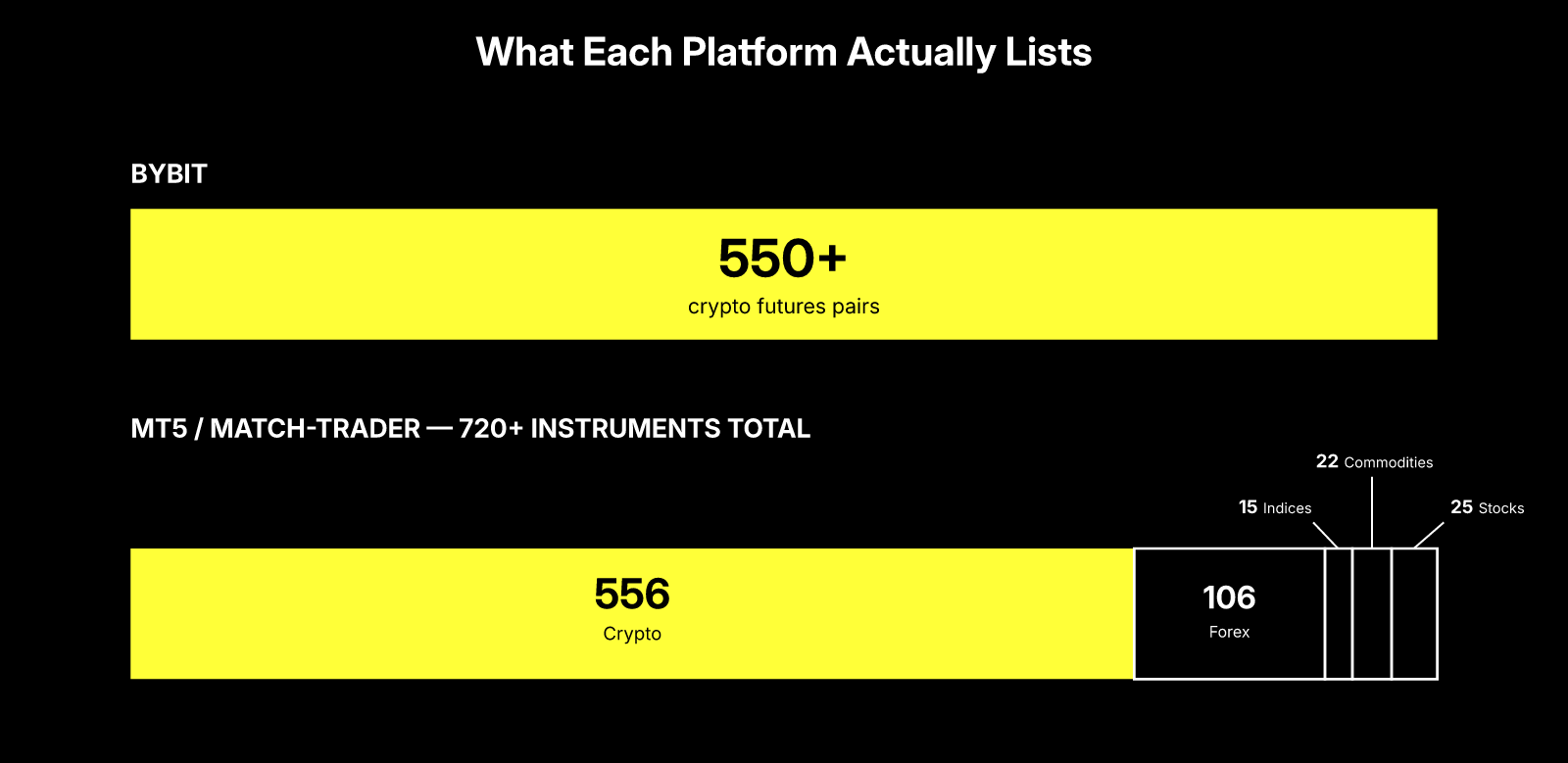
The best crypto pairs to trade on an evaluation account are the ones with the deepest liquidity and the most predictable volatility relative to your account’s loss limit, not the ones topping a “most volatile coins” list. BTC/USDT and ETH/USDT still anchor most trading plans because they’re the hardest pairs to get a bad fill on. Higher-volatility names like SOL, XRP, or DOGE can earn a place too, but only once a trader has matched their movement to the drawdown regime sitting underneath the account.
That distinction gets skipped in most roundups, which rank pairs purely by how much they moved last week. On a simulated funded account, a pair that moves fast and gets you stopped out at a worse level than you planned isn’t a good pair to trade, whatever its 24-hour change says. This guide ranks the top cryptocurrency pairs prop trading accounts give access to, using Crypto Fund Trader’s own published trading conditions as the working example.
Three things decide whether a pair belongs in a trading plan built around a fixed loss limit: liquidity, spread, and how its typical volatility compares to the account’s drawdown.
Liquidity is the standard finance concept: how quickly a position can be closed without moving the price against you (Corporate Finance Institute). On a live exchange feed, thin liquidity shows up as slippage: the fill you get differs from the price you saw when you clicked. Crypto Fund Trader’s own trading conditions quote spreads “from 1 pip” on BTC/USDT and “from 0 pips” on EUR/USD, figures that only hold when there’s enough depth behind the quote to fill a position at it. On Bybit-based evaluations specifically, the firm states it “does not add any markup, artificial spread, or fictitious slippage to the provider’s price.” Spreads and slippage there depend entirely on Bybit’s own liquidity. No smoothing layer sits between your pair choice and your fill.
Volatility-to-drawdown fit is the part most pair rankings ignore entirely. A pair that regularly swings 8% in a session is a reasonable choice on an account with a 10% fixed overall loss limit and room to spare. The same pair on an account already close to a trailing drawdown floor is a different risk. The best crypto pairs to trade aren’t fixed: they change with how much room the account has left.
For most of a trading plan, the best crypto pairs to trade are still the two with the deepest order books on every major exchange: BTC/USDT and ETH/USDT.
Binance held 39.2% of centralized-exchange spot volume across all of 2025, with Bybit second at 8.1%, and “the Bitcoin/USDT [pair] remains the single highest-volume trading pair across the top CEX venues,” according to a 2026 market-share breakdown (CoinLaw). That concentration of volume is what keeps spreads tight and fills predictable: the two qualities an evaluation account depends on more than raw price movement. ETH/USDT trades a step behind BTC/USDT in depth but still clears far more volume than any altcoin pair on the same venues.
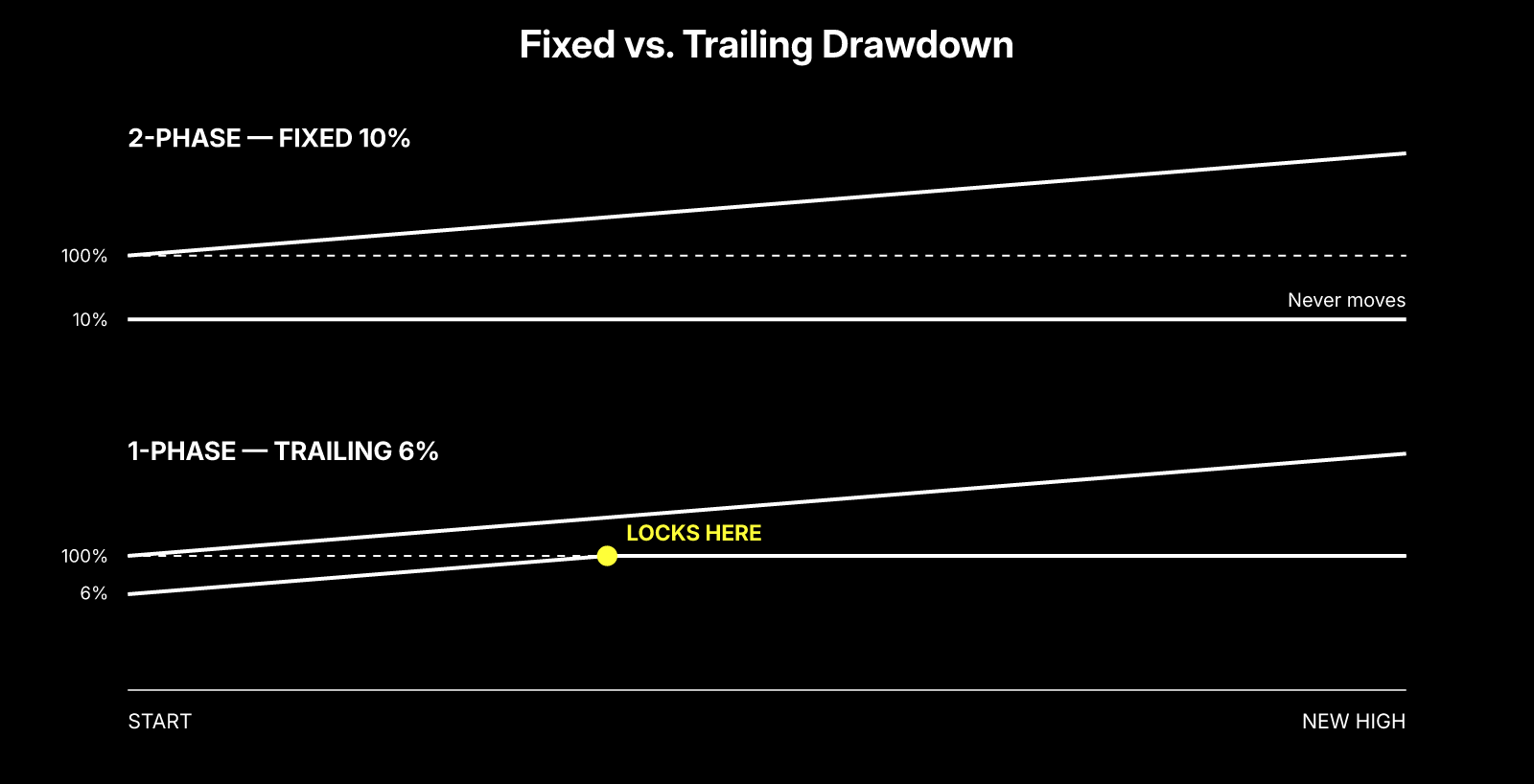
That depth matters most on the tighter drawdown regimes. CFT’s 1-Phase program runs a trailing 6% overall loss limit that locks once the account reaches its starting balance. A pair that gaps or gets illiquid at the wrong moment can turn a manageable pullback into a limit breach before a trader has a chance to react. BTC/USDT and ETH/USDT are the pairs least likely to do that, which is why they anchor most trading plans on an evaluation account rather than showing up as an afterthought.
Beyond the two core pairs, the best crypto pairs to trade for a strategy that needs more movement are the large-cap altcoins with genuine daily volume behind them, not the names topping a raw volatility chart.
Dogecoin is a useful example of the distinction: one 2026 market analysis describes DOGE as a “high-liquidity meme coin” that still trades billions of dollars in daily exchange volume despite its price swings (CryptoNews). That combination (real volatility plus real liquidity) is what separates a usable pair from a dangerous one. Compare that to a live “most volatile” ranking on a platform like TradingView, which is dominated by illiquid micro-cap tokens moving hundreds or thousands of percent in a day; the same source that lists them warns that “you can lose money as fast as you can make it” trading them. Those tokens aren’t available on Crypto Fund Trader’s platforms. A headline volatility number with no depth behind it is the opposite of what an evaluation account can absorb.
SOL, XRP, AVAX, and ETH round out the tier of large-cap pairs that combine real daily movement with enough volume to fill a position without excessive slippage. A 2026 market analysis attributes that movement to specific, ongoing catalysts rather than random noise: Solana’s volatility tracks its futures-market activity and ETF speculation, XRP “reacts very quickly to headlines” tied to US regulatory developments, and Avalanche has posted gains “exceeding 17% during several 2026 rallies” on DeFi and tokenization news (AnalyticsInsight). Named catalysts are what make a pair’s volatility tradeable rather than just loud: a move with an identifiable driver behaves differently than a thinly-traded token spiking on nothing. The tradeoff traders take on with any of them is CFT’s $10,000 daily and per-trade simulated profit cap: a fast-moving pair reaches that ceiling faster than BTC/USDT does on the same position size, and equity above the cap “may be closed” with the excess “may be deducted.” Faster movement cuts both ways: toward the cap and toward the loss limit, depending on which side of the trade goes wrong first.
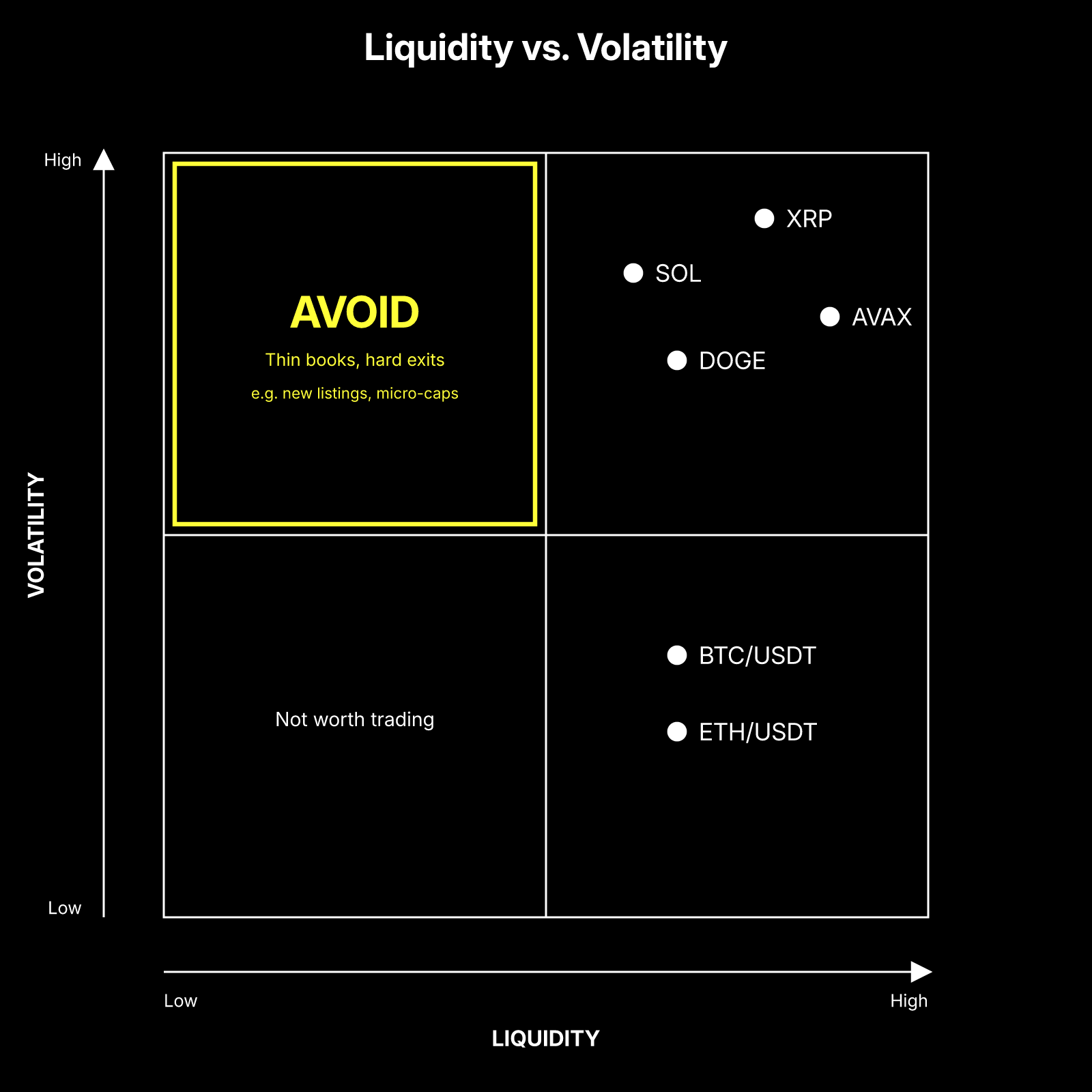
Which pairs a trader can even choose from depends on the platform the evaluation runs on, and Crypto Fund Trader’s three platforms don’t offer the same list.
| Platform | Pair access | Country note |
|---|---|---|
| Bybit | More than 550 crypto futures pairs, trader’s own sub-account connected by API | No country restriction imposed by CFT; traders are fully responsible for complying with Bybit’s own Terms of Service and jurisdictional restrictions |
| MetaTrader 5 | Part of more than 720 total instruments (crypto, forex, indices, commodities, stocks) | Not available to US residents |
| Match-Trader | Part of the same 720-plus instrument set | No country restrictions |
Source: Crypto Fund Trader FAQ
Bybit has the deepest pure-crypto pair count of the three, but platform-specific rules shape which of those pairs are usable. Traders must use USDT pairs, since “trades placed on USDC pairs will not be counted,” and spot trading is “strictly prohibited.” Every position has to run through the futures side of the account. MT5 and Match-Trader instead spread crypto access across a broader multi-asset instrument list rather than a dedicated futures pair count, which is a different shape of access, not a smaller one.
The top cryptocurrency pairs for prop trading change depending on which program you’re trading, because the loss limit underneath each one is different.
| Program | Overall loss limit | Best fit |
|---|---|---|
| 2-Phase | 10%, fixed | More room for volatility-tier pairs since the ceiling never moves |
| 1-Phase | 6%, trailing | Favors the core tier: a trailing floor gives less room to absorb a fast-moving pair’s pullback |
| Instant | 6% | Core tier early on; the account’s fixed percentage limits apply at every doubled size |
A fixed limit stays put regardless of how well the account performs, so a string of good trades on a volatility-tier pair doesn’t tighten the room available for the next one. A trailing limit does the opposite: it closes in as equity climbs, right when a fast-moving altcoin pair’s normal pullback is most likely to eat into a floor that’s already moved up. Sizing a position on SOL/USDT the same way as BTC/USDT, on the same account, is applying one risk budget to two different volatility profiles: the mismatch shows up as a breach, not a bad trade.
Pair choice gets more important, not less, as a simulated account grows, because the same percentage move now sits behind a larger position size.
Crypto Fund Trader’s standard evaluation lines cap simulated allocation at $300,000 per user; the Instant line scales independently, doubling on a 10% profit trigger up to a $1,280,000 ceiling. Both are hard stops, not projections. A position sized against a $10,000 account barely tests a pair’s depth. The same percentage position sized against $300,000, or against an Instant account several doublings into its ladder, needs enough order-book depth behind the pair to fill without moving the price against the trade. That gap between the price a trader expects and the price a trade actually fills at is slippage, and it grows with order size in a thin book (Wikipedia). BTC/USDT and ETH/USDT absorb that scale without much trouble; a thinner altcoin pair that filled cleanly at $10,000 can start showing real slippage at $100,000 and up. The pair that was fine on a small account isn’t automatically fine on a larger one.
Picking good pairs individually isn’t the whole job: some pair combinations are prohibited outright, regardless of how liquid or well-matched to the drawdown they are.
Reverse trading rules mean a trader can’t hold opposite positions on the same underlying asset at once for 60 seconds or longer: a long and a short on BTC/USD and BTC/EUR simultaneously breaks the rule, since it’s the same asset against two quote currencies. Opposite positions on genuinely different assets (a long on ETH/USD and a short on BTC/USD) are allowed, since they’re different pairs, not a hedge against the same rule. The same restriction applies across accounts, including accounts held by the same person under different emails. Separately, CFT’s prohibited-strategy list rules out high-frequency trading, tick scalping, and latency arbitrage on any pair: strategies built around exploiting a fast-moving pair’s momentary inefficiencies, rather than trading its price direction, aren’t permitted no matter how liquid the pair is.
Before choosing a pair, run through the following checks:
What are the best crypto pairs to trade if I’m new to evaluation accounts? Start with BTC/USDT and ETH/USDT. They carry the deepest liquidity of any pair on Bybit, MT5, or Match-Trader, which means the price you see is closer to the price you get filled at. A new trader learning how a specific account’s daily and overall loss limits behave doesn’t need a fast-moving altcoin adding execution risk on top of that learning curve. Add volatility-tier pairs once you’ve traded a full drawdown cycle on the core pairs first.
Does a pair being “the most volatile” make it one of the best crypto pairs to trade? No, and conflating the two is the most common mistake in pair selection. The tokens topping a live volatility ranking are almost always illiquid micro-caps that can swing hundreds of percent in a day specifically because there’s so little volume behind them. That same thinness makes the move possible and makes it hard to exit at a fair price. A pair worth trading needs volatility and liquidity together; either one without the other is a worse setup, not a better one.
Why do CFT’s three platforms list different numbers of crypto pairs? Because they’re built differently. Bybit runs more than 550 crypto futures pairs since it’s a crypto-native exchange connected by API to a trader’s own sub-account. MT5 and Match-Trader spread crypto access across a broader instrument list (more than 720 total, covering forex, indices, commodities, and stocks too), so crypto is one slice of a multi-asset offering rather than the entire platform. Neither number is “better.” They reflect different platform designs.
Should I trade the same pairs on a fixed drawdown account and a trailing drawdown account? Not with the same position sizing. A fixed limit like 2-Phase’s 10% never moves, so a volatility-tier pair has consistent room to work with regardless of how the account has performed so far. A trailing limit, like 1-Phase’s 6%, closes in as the account posts new highs, so the same pair’s normal pullback eats into a floor that’s already moved closer. Match your pair choice, and your position size, to which regime the specific account runs.
Can I trade a hedge across two crypto pairs on the same account? Only if the pairs are genuinely different assets. A long on ETH/USD and a short on BTC/USD is fine since they’re different underlying instruments. A long and a short on BTC/USD and BTC/EUR at the same time isn’t allowed, because it’s the same asset against two quote currencies, which the reverse-trading rule treats as a single opposing position rather than two separate ones.
All trading at Crypto Fund Trader is simulated. Rewards are based on simulated performance and do not represent actual market profits, investment returns, or real financial exposure.
SWISS RLCRATES AG is a provider of educational services, all information available on our site is intended solely for the study purposes related to trading on financial markets. Accordingly, we do not offer financial, investment, tax, brokerage or other advice and/or services. Trading in financial markets is a high-risk activity, past performance do not guarantee future ones. It is highly advised not to risk more, than you can afford to lose. Brokers and operators of trading platforms are persons or entities that are separate from SWISS RLCRATES AG and their own terms and conditions will apply when you use their services and products. Neither SWISS RLCRATES AG nor RLCRATES, S.L. (the company that provides services with MT5) operate in countries where crypto or CFD’s activity is not allowed. The content in our platform is applicable to the extent local laws and/or regulations permit. SWISS RLCRATES AG acts as a payment/marketing agent for RLCRATES SL. SWISS RLCRATES AG is not authorized or licensed in Switzerland and does not offer any trading services with MT5 neither conducts any regulated activities.
Crypto Fund Trader has exactly two routes to a bigger simulated account, and they do not combine into a third.
| Route | How size increases | Ceiling |
|---|---|---|
| Standard evaluations (2-Phase, 1-Phase, 3-Phase) | Pass more than one evaluation; account sizes run $5,000 to $200,000 each | $300,000 total simulated allocation per user |
| Instant | Automatic doubling at a profit milestone, no new evaluation purchase required | $1,280,000, with up to three active Instant accounts |
The standard route caps individual accounts at $200,000, so reaching the $300,000 per-user ceiling means holding more than one passed evaluation at once. The Instant route works differently: the account itself grows without a second purchase, up to a ceiling more than four times higher.
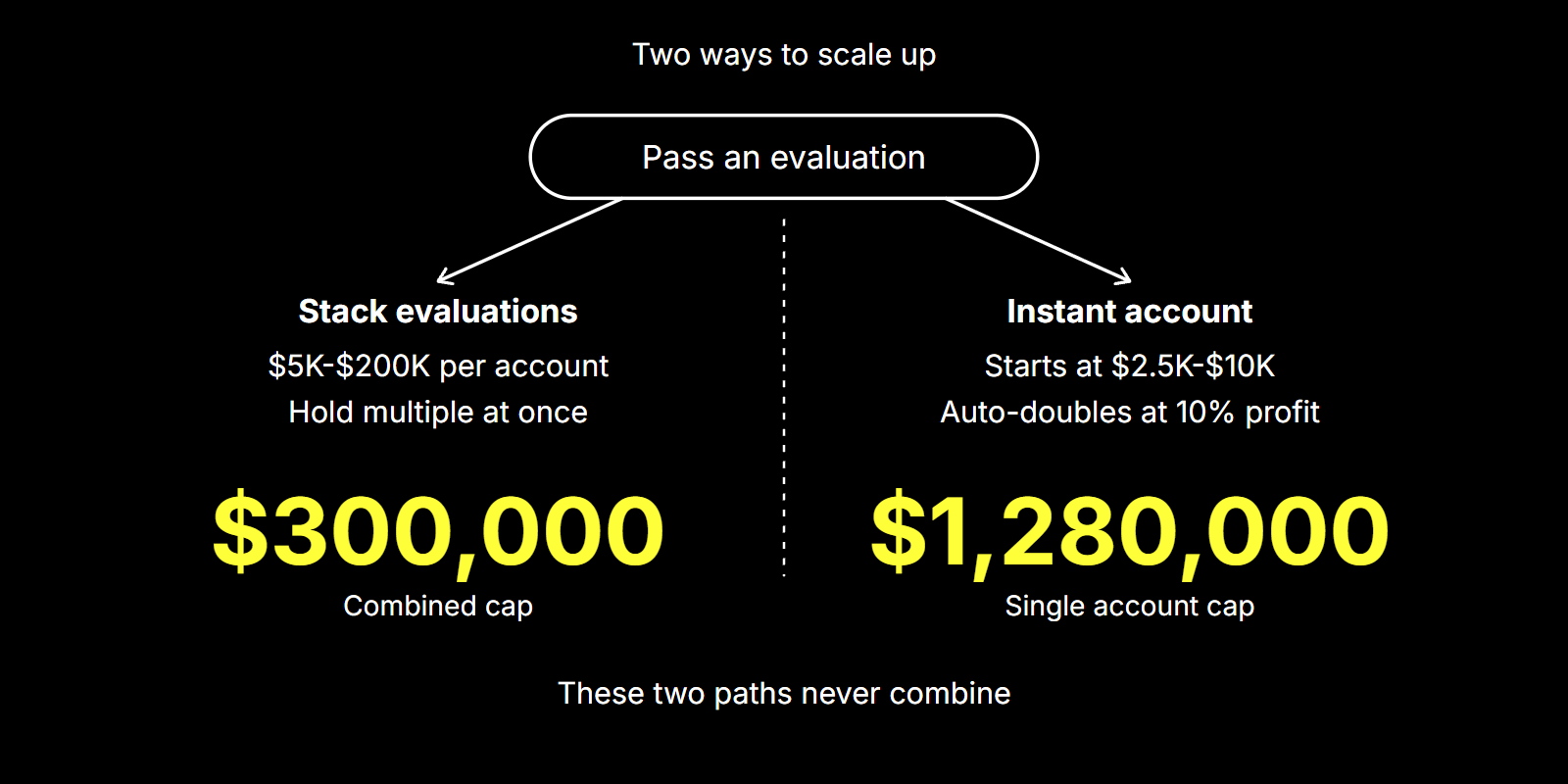
Crypto prop firm scaling on the Instant line runs on a single trigger: reach 10% simulated profit, and the account size doubles.
Crypto Fund Trader calls this the “Withdrawal & Upgrade” step. A trader starts an Instant evaluation at $2,500, $5,000, or $10,000, with no profit target to clear first, only the standing 4% daily and 6% overall loss limits from the first trade. Hitting 10% simulated profit on the current balance triggers the upgrade, which doubles the account’s demo size. Because each step doubles the previous balance, the ladder from a $10,000 starting account is fixed math, not a forecast:
$10,000 → $20,000 → $40,000 → $80,000 → $160,000 → $320,000 → $640,000 → $1,280,000
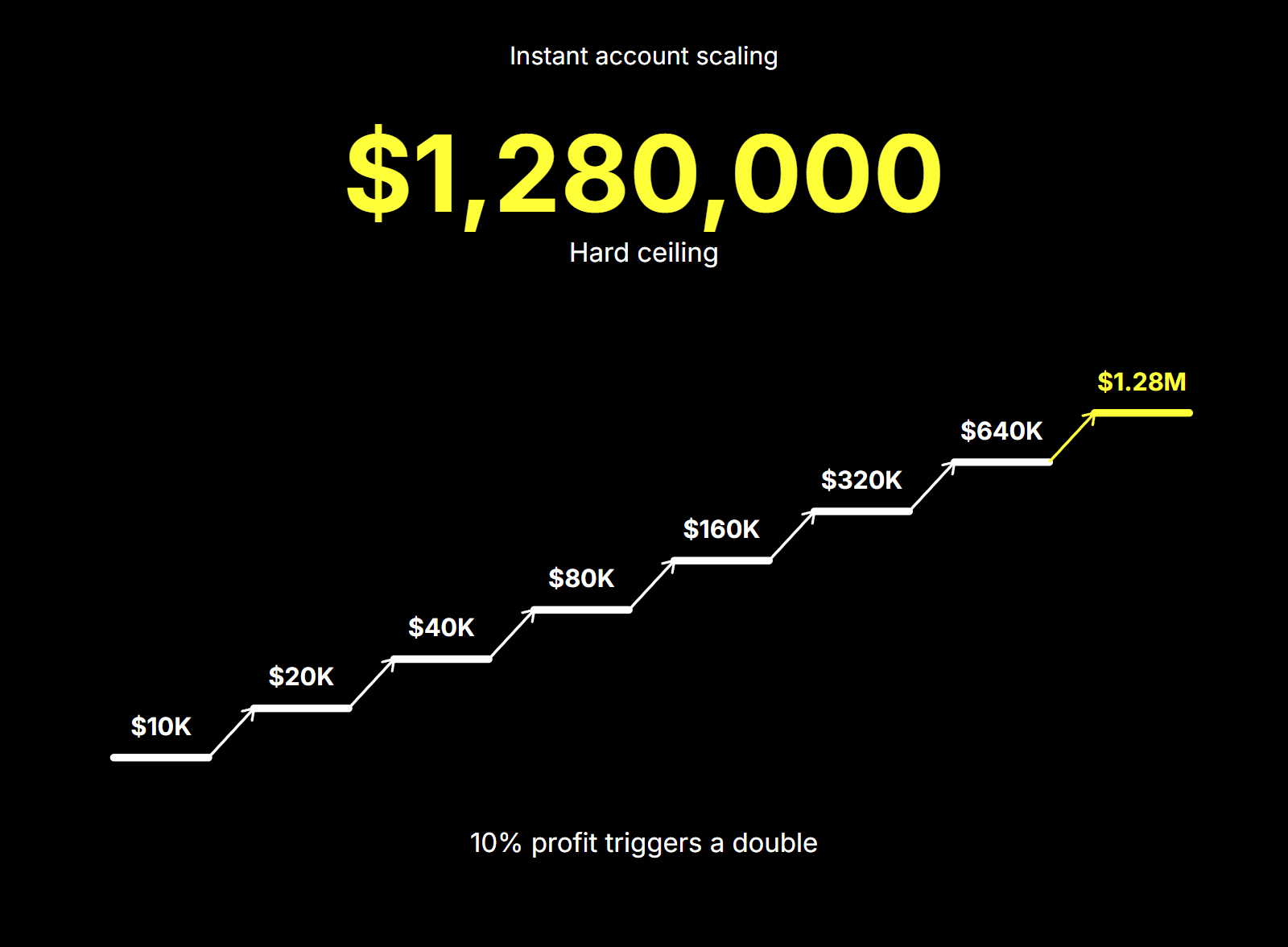
That’s seven doublings to reach the ceiling: arithmetic, not a promise about how fast or whether any account gets there. A trader can also run up to three Instant accounts at once.
A bigger account inherits the same drawdown regime as a smaller one: scaling changes the balance, not the rulebook.
Drawdown on every account is calculated on equity, so an open loss counts against the limit before a position closes, and the daily loss figure resets from the account balance at 12:05 AM UTC each day. A doubled Instant account is still governed by the same 4% daily and 6% overall loss limits it started with. The dollar amounts scale with the balance; the percentages do not. Simulated profit is also capped at $10,000 per day or per trade; equity above that threshold may be closed and the excess deducted.
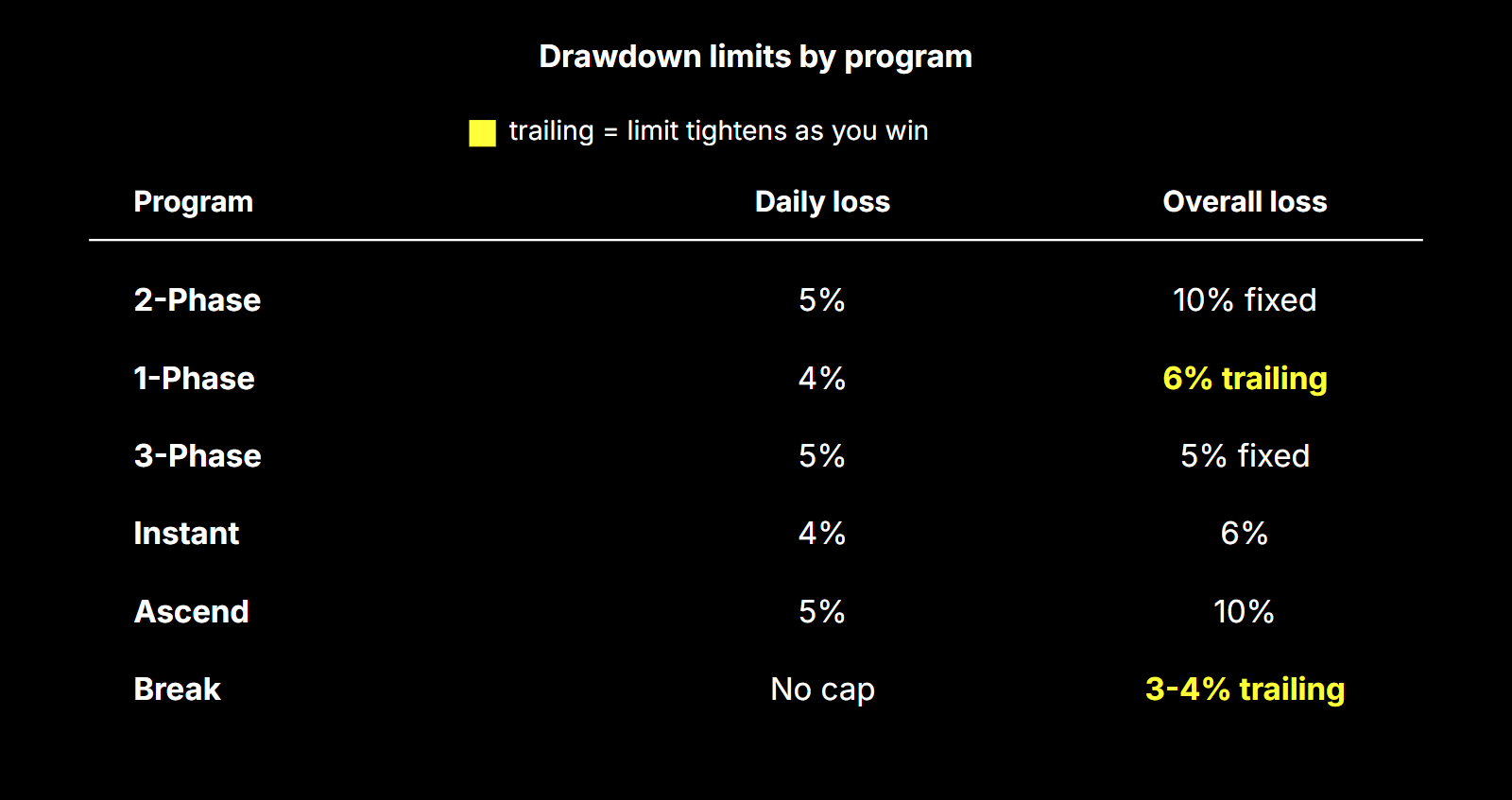
One rule that does not travel across the product line is the Final Stage consistency requirement on Break: no single trading day may account for more than 40% of total profits. It applies only at reward-request time. Reverse trading, account sharing, copy trading restrictions, and KYC requirements also apply regardless of account size.
KYC is a separate gate that scaling does not skip: before any scholarship reward can be processed, KYC must be completed and approved.