Search “crypto tools” and you drown instantly. Hundreds of platforms, every one branded as essential, AI-powered, and the only thing standing between you and profit. The result for most traders is a browser with fifteen open tabs and no actual edge, because owning a tool is not the same as using it well.
This guide cuts the noise. The best crypto trading tools fall into three jobs: seeing the market clearly (charting), acting on it without sitting at the screen all day (bots), and understanding what is happening underneath the price (analytics). Below are twelve platforms that earn their place in 2026, sorted by category, with honest notes on pricing and who each one actually suits. No single piece of crypto trading software does everything well, so the goal is a small toolkit that covers all three jobs without bleeding you dry on subscriptions.
A note on prices: every figure here is approximate and current as of mid-2026. Subscription tiers change often, so confirm the latest pricing on each provider’s own page before you pay.
Before the list, one principle saves money and confusion. You do not need the most powerful tool in each category. You need the one that matches your experience and your strategy.
A beginner running simple spot trades needs solid free charting and maybe one beginner bot, not an institutional on-chain terminal costing hundreds a month. An active swing trader benefits from a paid charting tier and serious analytics. A developer or quant wants automation depth and raw data. Good crypto trading software scales with you, so start at the free or cheap tier of each category and upgrade only when a specific limit starts costing you trades.
This is where most traders spend their time: reading price, drawing levels, and timing entries. Get this category right first.
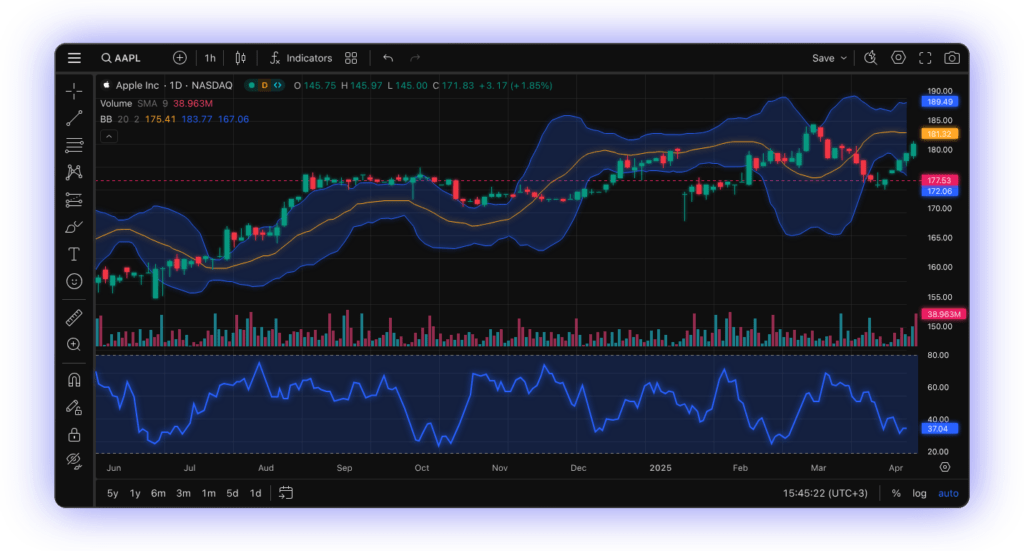
TradingView remains the default charting platform for a reason. It carries an enormous library of indicators and drawing tools, a clean interface that works across desktop and mobile, and cloud-synced layouts so your analysis follows you between devices. Its standout feature is Pine Script, a scripting language that lets you build custom indicators and strategies, plus multi-condition alerts that persist around the clock, which matters in a market that never closes.
The free tier covers the essentials and is enough for many beginners. Paid plans, roughly in the $15 to $60 per month range depending on tier, add more indicators per chart, multiple layouts, and faster data. For most traders this is the one charting subscription worth paying for eventually.
Best for: everyone from beginners to professional technical analysts.
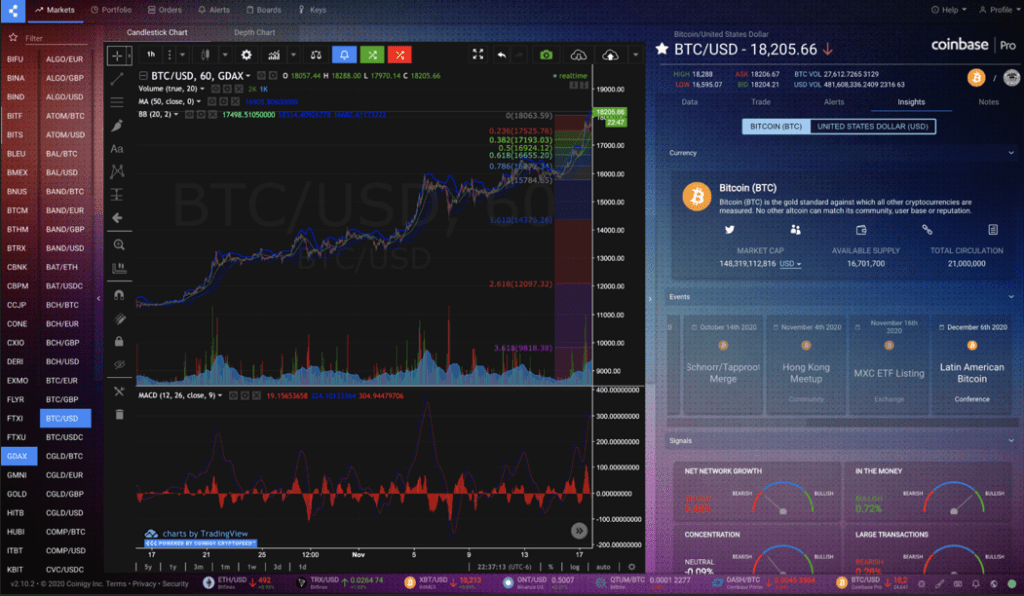
Coinigy solves a specific problem: trading across many exchanges from one screen. It connects to dozens of crypto exchanges and aggregates their charts and order books into a single interface, which is valuable given how fragmented crypto liquidity is across venues. It includes a deep set of technical indicators and lets you trade directly from the charts via API.
Pricing runs as a tiered subscription up to around $100 per month, with a short free trial. It is overkill for someone on a single exchange, but for active multi-venue traders it earns the cost.
Best for: active traders managing accounts on several exchanges.
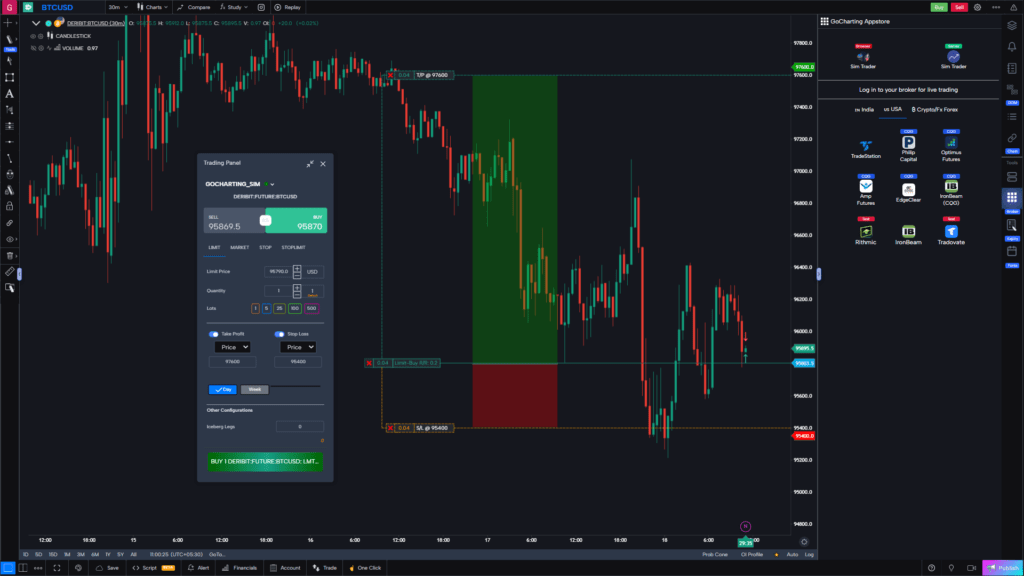
GoCharting leans toward the advanced end, with order-flow and footprint charting that most retail platforms do not offer natively. Tools like volume profile, footprint candles, and market depth visualization appeal to traders who read order flow rather than just price patterns. It is crypto-friendly and increasingly popular with intraday traders who want microstructure detail.
It offers a free tier with paid plans for the advanced features. The learning curve is steeper, so it suits traders who already know why order flow matters to them.
Best for: intraday and order-flow traders who have outgrown basic candlesticks.
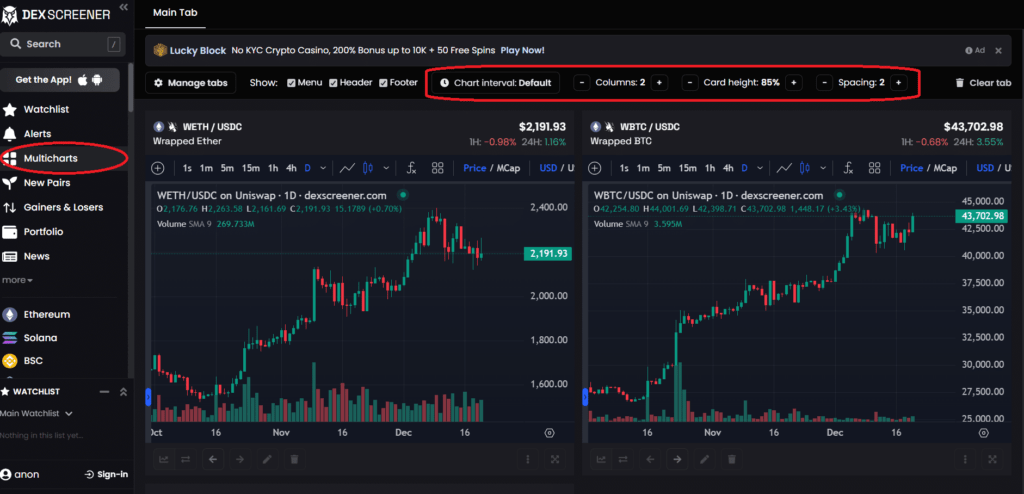
If your trading happens on decentralized exchanges, DEX Screener is close to indispensable, and it is free. It tracks token prices, liquidity, and trading activity across countless DeFi pairs in real time, which is exactly the data that disappears from mainstream charting tools the moment you leave the major coins. For anyone hunting newer tokens on-chain, it is the quickest way to see what is actually trading and where the liquidity sits.
Best for: DeFi and on-chain traders working with newer or smaller tokens.
Crypto runs 24 hours a day, and no human can watch it all. Bots execute rules you define (grid, dollar-cost averaging, signals) without emotion or sleep. One safety rule applies to every bot below: connect via API keys with withdrawal permissions disabled, so the bot can trade but never move your funds off the exchange.
Pionex is the easiest entry into automation because the bots are built directly into its own exchange and cost nothing beyond trading fees. It offers 16 free built-in bots, including grid and DCA strategies, with a low 0.05 percent trading fee and no monthly subscription. The trade-off is that the bots only run on Pionex itself, so you cannot point them at an outside exchange.
Best for: beginners who want zero-cost automation with no setup headache.
3Commas is the most widely used bot platform for traders who want detailed control across multiple exchanges. It supports DCA, grid, and signal bots across more than 15 exchanges including Binance, Coinbase, Kraken, and Bybit, with precise entry and exit conditions, trailing stops, and a SmartTrade terminal. It also integrates with TradingView, so an alert on your chart can trigger a bot action.
Pricing typically starts free for limited use, with paid tiers around $29 to $49 per month. The interface has a learning curve, so budget a weekend to understand how its DCA logic works before going live.
Best for: intermediate traders wanting strategy control across several exchanges.
Cryptohopper is strongest on strategy customization and copying. Its visual strategy builder, AI strategy designer, and a marketplace where you can subscribe to other traders’ setups make it a hub for people who want to follow or sell strategies rather than code their own. It connects to a wide range of exchanges and supports a no-code workflow.
Paid plans generally start around $29 per month, with a free trial. The flexibility is the draw, and also the risk, since copied strategies are only as good as the trader behind them.
Best for: traders who want copy trading and visual, no-code strategy building.
Bitsgap focuses on grid bots with AI-optimized parameters, wrapped in a unified terminal that manages multiple exchanges from one place. Its grid and combo bots suit range-bound and oscillating markets, where a well-tuned grid quietly profits from price swinging back and forth. It also offers portfolio and arbitrage features.
Pricing sits in the roughly $20 to $100+ per month range by tier. It is a strong pick when your edge is in choppy, sideways conditions rather than trends.
Best for: range traders who want grid automation with minimal manual tuning.
Price tells you what happened. Analytics tells you why, and sometimes what is coming. This category separates traders who react from traders who anticipate.
Glassnode is the institutional standard for on-chain analytics. It turns raw blockchain data into readable metrics: exchange inflows and outflows, holder behavior, profit and loss across the supply, and dozens of indicators that show what long-term and short-term holders are actually doing. When large amounts of Bitcoin move onto exchanges, for example, that often precedes selling, and Glassnode is where you see it.
It offers a limited free tier, with serious metrics behind paid plans that can run from tens to hundreds of dollars a month. It is depth for people who genuinely use it.
Best for: serious traders and investors who want to read the chain, not just the chart.
Nansen specializes in wallet labeling, attaching identities to on-chain addresses so you can follow what it calls smart money. If a wallet with a strong track record starts accumulating a token, Nansen surfaces it, which is powerful for spotting flows before they show up in price. It covers many chains and is a favorite among traders chasing early moves in DeFi and tokens.
Pricing is premium, generally a higher monthly cost aimed at active and professional users. The value depends entirely on whether you act on the flows it shows you.
Best for: traders tracking smart-money wallets and early token flows.
Arkham offers on-chain intelligence focused on entities and address tracking, with a usable free tier that makes it accessible to retail traders. It maps the relationships between wallets and known entities, useful for investigating where funds move and which players are involved in a token. The free access lowers the barrier compared to the heavier institutional platforms.
Best for: retail traders who want on-chain entity tracking without a steep subscription.
These two market-data sites are the unglamorous backbone of almost every trader’s routine, and both are free. They track prices, market capitalization, trading volume, and supply data across thousands of assets, with portfolio trackers, news feeds, and basic screeners layered on top. Neither replaces a charting or on-chain tool, but for quick reference, watchlists, and sanity checks they are hard to beat.
Best for: every trader, as a free baseline for market data and tracking.
| Tool | Category | Best For | Pricing (approx.) |
|---|---|---|---|
|
TradingView
|
Charting
|
All traders
|
Free / $15 to $60 mo
|
|
Coinigy
|
Charting
|
Multi-exchange traders
|
Up to ~$100 mo
|
|
GoCharting
|
Charting
|
Order-flow traders
|
Free / paid tiers
|
|
DEX Screener
|
Charting
|
DeFi token traders
|
Free
|
|
Pionex
|
Bots |
Beginners
|
Free (0.05% fee)
|
|
3Commas
|
Bots |
Multi-exchange control
|
Free / $29 to $49 mo
|
|
Cryptohopper |
Bots |
Copy and no-code strategies
|
From ~$29 mo
|
|
Bitsgap |
Bots |
Range and grid traders
|
~$20 to $100+ mo
|
|
Glassnode
|
Analytics |
On-chain depth
|
Free / paid tiers
|
|
Nansen |
Analytics
|
Smart-money tracking
|
Premium
|
|
Arkham |
Analytics |
Entity tracking
|
Free / paid
|
|
CoinGecko / CMC
|
Analytics |
Market data baseline
|
Free |
Alt text: Comparison table of twelve crypto trading tools in 2026 grouped into charting, bots, and analytics categories, listing the ideal user and approximate pricing for each.
Tools handle execution and data. They do not solve the two things that most limit a developing trader: the size of the account and the depth of the trader’s understanding. Software can sharpen a strategy, but it cannot fund it or teach it.
On the capital side, this is the gap crypto proprietary trading firms address. A prop firm gives access to its capital after an evaluation, then enforces strict limits, usually a daily loss cap near 5 percent and a maximum drawdown near 10 percent. A trader who already uses the tools above to size by risk and trade a defined plan often fits that structure well, because the firm’s rules demand the same discipline. The firm shares the profit, and the downside of failing is the evaluation fee rather than personal savings.
Crypto Fund Trader is one example in the crypto-native space, operating since November 2022 under a Swiss-registered company, with funded accounts offering leverage up to 1:100 and evaluations that can route through a Bybit integration. On the knowledge side, the firm also publishes a free trading theory resource covering technical analysis concepts, which pairs naturally with the charting and analytics tools above for traders who want to study the reasoning behind the signals, not just the signals themselves.
One honest caution that applies across the sector. Prop firms can change their rules, terms, or standing quickly, and some have shut down with little warning. Before paying any evaluation fee, verify a firm’s current status, read the rulebook in full, and check recent independent reviews and payout reports rather than relying on headline numbers.
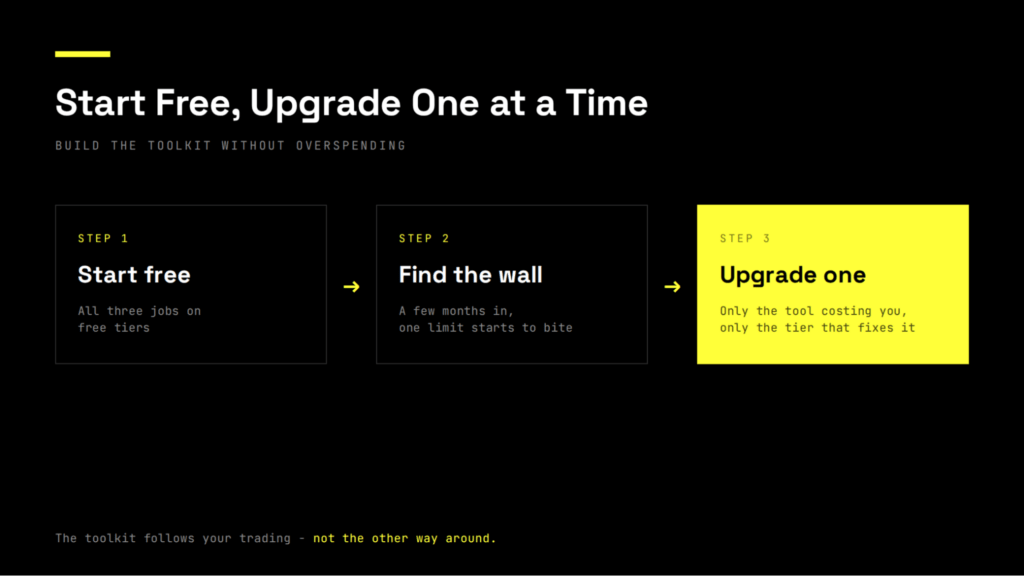
The mistake beginners make is subscribing to everything at once. A leaner path works better.
Start free across all three categories: TradingView’s free tier for charting, Pionex for automation if you want it, and CoinGecko plus a free analytics tier for data. Trade with that setup for a few months and notice where you actually hit a wall. Maybe you need more charts per layout, or alerts you cannot get on free, or on-chain metrics you keep wishing you had. Upgrade only the specific tool whose limit is costing you, and only to the tier that fixes it.
A common, balanced paid stack for an active trader might be a TradingView paid plan, one bot subscription if automation suits the strategy, and one analytics tool. That covers all three jobs for a sensible monthly cost, far below the bill from collecting every tool in this guide. The toolkit should follow your trading, not the other way around.
The right toolkit is not the longest one. It is the smallest set that lets you see the market clearly, act on it consistently, and understand what drives it. Charting, automation, and analytics are the three jobs, and the twelve tools here cover all of them at every budget from free upward.
Pick one strong option per category, learn it properly, and resist the urge to chase every new platform that promises an edge. The traders who get the most from the best crypto trading tools are rarely the ones with the most subscriptions. They are the ones who turned a couple of well-chosen tools into a repeatable process, then put real capital and real study behind it.
What are the best crypto trading tools for beginners?
Start with TradingView’s free charting, CoinGecko for market data, and Pionex if you want simple automation, since all three are free or near-free. The best crypto trading tools for a beginner are the ones you will actually learn, not the most expensive ones.
Do I need to pay for crypto trading software to be profitable?
No, you can build a complete free stack across charting, data, and basic bots, and many profitable traders do exactly that. Paid crypto trading software is worth it only once a specific free-tier limit starts costing you trades.
Are crypto trading bots safe to use?
They are reasonably safe if you connect them through API keys with withdrawal permissions disabled, so the bot can trade but never move your funds off the exchange. Established platforms like Pionex, 3Commas, and Cryptohopper are widely used, but a bot only executes your rules, so a poor strategy still loses money.
What is the difference between charting and on-chain analytics tools?
Charting tools like TradingView show price and technical indicators, while on-chain analytics tools like Glassnode and Nansen read blockchain activity such as wallet flows and holder behavior. Price tells you what happened; on-chain data often hints at why and what large players are doing.
Which crypto trading software is best for automated trading?
For beginners, Pionex offers free built-in bots with no subscription, while 3Commas and Cryptohopper give more control across multiple exchanges for a monthly fee. The best fit depends on whether you trade on one exchange or several and how much manual control you want.
Can these tools guarantee profitable trades?
No tool guarantees profit, and any that claims to should be treated as a warning sign. Charting, bots, and analytics improve your information and execution, but the strategy, risk management, and discipline behind them decide the outcome.
This article is for informational and educational purposes only and does not constitute financial advice. Trading cryptocurrencies and prop firm challenges involve significant risk; trade only with capital you can afford to lose.
-
© 2026 - All Rights Reserved.
SWISS RLCRATES AG is a provider of educational services, all information available on our site is intended solely for the study purposes related to trading on financial markets. Accordingly, we do not offer financial, investment, tax, brokerage or other advice and/or services. Trading in financial markets is a high-risk activity, past performance do not guarantee future ones. It is highly advised not to risk more, than you can afford to lose. Brokers and operators of trading platforms are persons or entities that are separate from SWISS RLCRATES AG and their own terms and conditions will apply when you use their services and products. Neither SWISS RLCRATES AG nor RLCRATES, S.L. (as MT5 license holder) operate in countries where crypto or CFD’s activity is not allowed. The content in our platform is applicable to the extent local laws and/or regulations permit.