

The crypto prop trading space has matured fast. Two years ago, traders compared payout speeds and profit splits. Today the conversation has shifted toward execution quality, exchange partnerships, and whether a firm is genuinely built for crypto — or simply tacks crypto onto a CFD platform designed for forex traders.
That is where the Crypto Fund Trader vs FundedNext debate lives. One is a Swiss-registered, crypto-native firm built around a Bybit integration that has paid more than $19.5M to its traders. The other is one of the most-searched prop firms on the planet, a UAE-headquartered multi-asset giant with over $150M paid out across 125,000+ accounts. Both are legitimate. Both have real track records. But they are not the same product — and treating them as interchangeable is how traders end up paying evaluation fees on a firm that does not fit their strategy.
Crypto Fund Trader (CFT) is the stronger choice for traders whose primary edge is in crypto markets, while FundedNext is the stronger choice for multi-asset CFD and futures traders who want a single dashboard across forex, indices, commodities, and crypto. That is the short version, and most of the longer analysis flows from it.
CFT’s defining feature is its Bybit partnership, which routes evaluations through more than 715 USDT crypto futures pairs on actual exchange infrastructure. FundedNext’s defining features are breadth and operational scale: simulated accounts up to $300,000 across four “Stellar” account types, a 24-hour reward guarantee backed by $1,000 compensation, and a documented long-term scale-up path. Neither is “better” in absolute terms — they optimize for different traders.
Crypto Fund Trader has operated since November 2022 under Swiss RLCRATES AG, headquartered at Bahnhofstrasse 21, 6300 Zug, Switzerland, with additional offices in Pamplona, Spain and Dubai, UAE. The firm describes itself as the first crypto prop firm in the industry and structures its product around crypto-first evaluations across MetaTrader 5, Match-Trader, and a direct Bybit integration.
Figures on the official CFT homepage put cumulative payouts above $19.5 million, with more than 53,000 traders educated and $391,314 paid out in the most recent month. Evaluations run from $5,000 up to $200,000, with a $300,000 maximum funded allocation across simultaneous accounts. A separate Instant Challenge track at $2,500, $5,000, and $10,000 sits outside that cap and scales independently to $1,280,000. CFT was featured in Investing.com, Business Insider, Benzinga, and MarketWatch around the Bybit announcement.
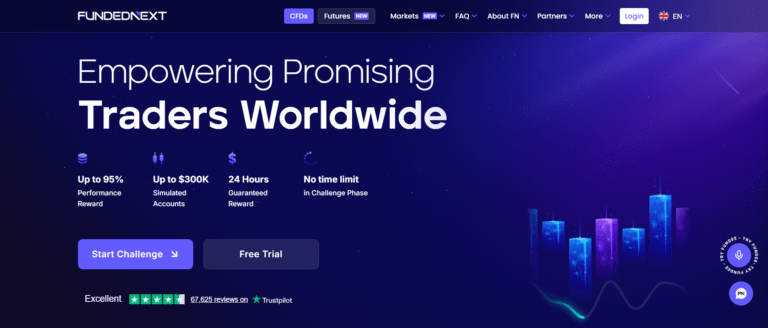
FundedNext is operated by GrowthNext F.Z.E., a UAE-registered company (No. 28831) headquartered at Al Robotics Hub, Ajman Free Zone, with a regional office in Limassol, Cyprus. The firm launched in March 2022 and has grown into one of the most-searched prop brands globally.
The official FundedNext site publishes its scale plainly: $150M+ total rewarded, 50,000+ rewarded traders, and 125,000+ FundedNext accounts. The firm has been recognized by Deloitte’s Tech Fast 50 Middle East, named Prop Firm of the Year at the Finance Magnates Awards 2025, and won “Best Trading Experience” and “Highest Verified Payout” at the Prop Firm Match Awards 2025. The product line was consolidated in 2025 around the Stellar family — 2-Step, 1-Step, Lite, and Instant — alongside a separate FundedNext Futures suite.
The cleanest way to read the CFT vs FundedNext matchup is side-by-side. The table below uses figures pulled directly from each firm’s official site and FAQ as of May 2026.
| Feature | Crypto Fund Trader (CFT) | FundedNext |
|---|---|---|
|
Founded
|
November 2022
|
March 2022
|
|
Legal Entity
|
Swiss RLCRATES AG (Zug, CH)
|
GrowthNext F.Z.E. (Ajman, UAE)
|
|
Offices
|
Zug, Pamplona, Dubai
|
Ajman + Limassol (Cyprus)
|
|
Primary Focus
|
Crypto-native, multi-asset on MT5/Match-Trader
|
Multi-asset CFDs + Futures
|
|
Exchange / Broker
|
Bybit partnership (715+ crypto pairs)
|
FNmarkets in-house broker
|
|
Trading Platforms
|
MT5, Match-Trader, Bybit
|
Match-Trader (CFDs); futures platforms separately
|
|
Account Sizes
|
$5K – $200K eval, $300K max funded
|
$6K – $200K Stellar 2-Step ($300K headline)
|
|
Instant Funding
|
$2.5K – $10K, scales to $1.28M |
Stellar Instant (no challenge)
|
|
Reward Split
|
80% base, up to 90% via add-on
|
Up to 95% + 15% from challenge phase
|
|
Payout Speed
|
Verification up to 48 business hours + 24h delivery
|
Avg. 5h, 24h guarantee + $1,000 if missed
|
|
Daily / Max Loss (2-step)
|
5% / 10% (fixed) |
5% / 10% (fixed)
|
|
Leverage
|
Up to 1:100
|
Up to 1:100
|
|
News Trading
|
Allowed |
Allowed |
|
Refundable Fees
|
No (one-time evaluation fee)
|
Yes — "full price refund" per site
|
|
Reported Payouts
|
$19.5M+
|
$150M+
|
A few things jump off the page. FundedNext’s scale advantage is real — five-figure rewarded trader count and a substantially larger cumulative payout total. CFT’s per-trader execution stack — Bybit access, 715+ crypto futures pairs, 900+ total instruments — is purpose-built for crypto-focused traders. The two firms run near-identical drawdown limits on their headline 2-step programs but diverge sharply on what you actually trade and where your orders execute.
Both firms offer competitive reward structures starting at 80% and reaching the upper 80s and 90s, but they get there differently — and so does the cash.
CFT’s base “Live Stage” reward share is 80%, with up to 90% available through the “90% Bonus Performance” add-on that costs 20% of the evaluation price. The Instant Challenge track has its own scaling ladder where the share starts at 50% at the smallest tier and rises to 90% at higher account sizes. Scholarship requests can be submitted after 15 trading days, or alternatively every 30 calendar days, with payment by bank transfer (EUR/USD) or crypto wallet (USDT ERC20/TRC20, BTC, ETH). The CFT FAQ states verification takes up to 48 business hours and the user typically receives funds within 24 hours after sending — and user reviews on the firm’s homepage reference payouts received in under 8 hours.
FundedNext goes higher on the headline number: rewards up to 95%, plus a feature no other major firm replicates — a 15% performance reward from the evaluation phase itself, paid out with the first funded withdrawal. The published 24-hour reward guarantee is backed by a $1,000 compensation clause if processing exceeds the window for reasons not tied to incorrect trader information. Average disbursement time is listed at 5 hours. FundedNext also publishes a full-price refund clause on Stellar plans, which is a meaningful differentiator from firms where evaluation fees are sunk costs.
CFT caps funded allocation at $300,000 across simultaneous accounts, while FundedNext also headlines a $300,000 simulated ceiling — with a documented but conditional path further out via its long-term scale-up plan.
CFT offers two main paths into the funded stage:
FundedNext consolidated its CFD product in 2025 around four Stellar plans:
Stellar 2-Step pricing on the official site runs from $59.99 for a $6K account up to $1,099.99 for a $200K account. Industry reviews reference a long-term scale-up plan documented in FundedNext’s help center, reviewed every four months and requiring sustained 10% growth across consecutive months to unlock further allocation. Most traders never reach the top of that ladder.
This is the single most important difference in the entire Crypto Fund Trader vs FundedNext comparison: CFT was built for crypto traders, while FundedNext is a multi-asset firm. If your edge is in BTC/USDT, ETH/USDT, or altcoin perpetuals, that distinction shapes everything from spreads to slippage to where your orders actually execute.
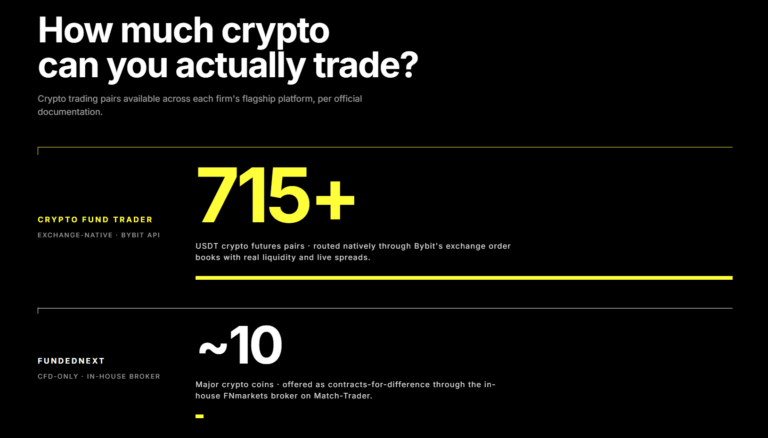
CFT’s instrument coverage, per its FAQ, breaks down as 556 cryptocurrencies, 106 forex pairs, 15 indices, 22 commodities, and 25 stocks on Match-Trader and MT5 — plus 715+ USDT crypto futures pairs on Bybit. Evaluations on the Bybit track route through traders’ own personal Bybit accounts via API, meaning orders execute on actual Bybit order books. BTC/USDT spreads start at 1 pip on the non-Bybit platforms; Bybit’s native fee schedule applies on the exchange track. Leverage runs up to 1:100 on Advanced accounts, with lower tiers on Student and Instant accounts.
FundedNext’s CFD product is broader by asset class but narrower on crypto. The firm operates through its in-house FNmarkets broker on Match-Trader, with crypto offered alongside forex, indices, commodities, and metals. Public materials reference roughly 10 major coins rather than CFT’s hundreds of pairs and direct exchange execution. The futures side is a separate product tied to CME contracts.
For a trader whose strategy lives in altcoin perpetuals or low-cap pairs, that gap is structural. For a trader running forex/indices strategies with occasional BTC exposure, FundedNext’s setup is more than sufficient.
Both firms publish similar 5% daily / 10% maximum drawdown limits on their flagship 2-step programs, but the rule density underneath those headlines differs.
CFT’s 1-Phase evaluation uses a 10% profit target, 4% daily loss, and a 6% trailing drawdown that locks at the starting balance once the account exceeds 6% profit. The 2-Phase format uses 8% and 5% profit targets with a fixed 5%/10% drawdown structure. Notable mechanics include a $10,000 daily and/or per-trade simulated profit cap (excess is trimmed at 12:10 AM UTC), a reverse-trading rule prohibiting simultaneous opposite positions on the same pair for 60 seconds or more, and prohibitions on HFT, tick scalping, and arbitrage. CFT also sells paid drawdown add-ons — a 6% daily drawdown extension (15% of eval price) and a 12% max drawdown extension (25%) on 2-Phase accounts.
FundedNext’s Stellar rule set is comparable on the headline numbers (5%/10% drawdown, 8%/5% targets, 5 minimum trading days, first withdrawal at 21 days), but the broader rulebook is denser. Independent reviewers count roughly three dozen prohibited strategies across the platform, alongside a consistency framework on funded accounts. Both firms allow news trading and weekend positions, including swing trades on crypto.
Neither rule set is unreasonable. The practical question is which set you can trade inside without tripping a rule you did not fully read.
FundedNext leads on raw scale and award recognition, while Crypto Fund Trader leads on niche reputation within the crypto-specific trader community. Both firms maintain strong Trustpilot footprints and verifiable payout histories.
FundedNext’s external validation is unusually deep: Deloitte Tech Fast 50 Middle East recognition, the Finance Magnates Prop Firm of the Year 2025 award, and Prop Firm Match’s “Best Trading Experience” and “Highest Verified Payout” 2025 awards. Common critiques in community discussions focus on rule density and the prohibited-strategies list.
CFT’s review base is smaller but the firm has operated continuously since November 2022, survived the 2022–2023 prop firm shakeout that wiped out dozens of competitors, and built a distributed footprint across Switzerland, Spain, and the UAE with a 50+ person team. The Bybit partnership has been picked up across major financial press, and trader testimonials on the firm’s site cite sub-8-hour payout examples — though traders should always cross-check with independent review aggregators.
The decision usually comes down to one question: is crypto your primary market, or one of several?
Lean toward Crypto Fund Trader if:
Lean toward FundedNext if:
Neither firm is right for every trader. Read both firms’ rule documentation in full before purchase, and verify any figure that materially affects your trading — drawdown methods, profit caps, and payout policies do change.
The Crypto Fund Trader vs FundedNext comparison is less a contest and more a fork in the road. FundedNext is the larger, broader, multi-asset operation with deep award recognition and a refundable-fee structure few competitors match. Crypto Fund Trader is the specialized, crypto-native option, built around an exchange-grade Bybit integration and a $10K daily profit cap that maps cleanly onto how serious crypto traders work.
The crypto prop trading market crossed $20 billion in 2025, and the trajectory continues to favor firms investing in genuine exchange infrastructure rather than thin CFD wrappers. Both CFT and FundedNext sit on the credible side of that line — at different points on it.
The smart move is the same as always: match the firm to your strategy, not your strategy to the firm. The fee on a mismatched evaluation is not just the entry cost — it is the months you spend learning a rulebook that was never designed for the way you trade.
FundedNext has 10x the payouts of CFT — why would anyone pick the smaller firm?
Total payout figures reflect the size and age of a firm’s trader base, not how good the trading conditions are for any individual. FundedNext has been running longer, has a broader multi-asset product, and has attracted far more traders — so of course the aggregate payout number is larger. CFT’s $19.5M figure comes from a narrower, crypto-focused user base across roughly three years. The relevant question is which firm’s execution infrastructure, pair count, and rulebook fits your strategy — not whose leaderboard is bigger.
FundedNext keeps closing accounts “for no reason” right before payout. Is this a pattern?
Verified complaints on ForexPeaceArmy and Quora describe accounts terminated for rule violations that traders say were minor or miscalculated. This happens at nearly every large prop firm and is not unique to FundedNext, but it is more likely to occur at firms with dense rulebooks — and FundedNext’s Stellar platform has roughly three dozen prohibited strategies. The protection is simple: read the full rule documentation before you buy, and trade a strategy that clearly stays inside it. Assuming you understand the rules from the headline numbers is how most of these terminations happen.
Why pay an evaluation fee at all? Why not just trade spot with my own $500?
A funded evaluation gives you access to $50K–$200K in capital that you could not self-fund, and your downside on failure is capped at the evaluation fee. If you have a genuine edge, the leverage on that edge is the entire point. The honest tradeoff: only about 7% of prop firm challenge takers ever reach a payout, so the expected value calculation only works if your win rate is meaningfully above that base rate. If you’re still figuring out your edge, trading your own small account first is the lower-cost way to find out.
Can I trade altcoin perps on FundedNext, or is crypto basically just BTC/ETH CFDs?
FundedNext’s crypto offering is roughly 10 major coins via its in-house FNmarkets CFD broker, not exchange-native perpetuals. If your strategy depends on altcoin liquidity, low-cap pairs, or exchange-grade order execution, FundedNext is not the right fit. CFT offers 556 cryptocurrencies and 715+ USDT futures pairs via Bybit, which is a structurally different product. Choosing FundedNext for an altcoin perpetuals strategy is like choosing a forex broker for equity options trading — the asset class support simply isn’t there.
What actually happens when FundedNext misses the 24-hour payout guarantee?
FundedNext’s policy states you receive $1,000 in compensation if payout processing exceeds 24 hours for reasons not tied to incorrect trader information. This guarantee applies to Stellar accounts and is documented on their official site. The practical catch: “incorrect trader information” is a broad carve-out, and if your KYC or wallet details have any issue, the clock doesn’t start. Average processing is listed at 5 hours. The guarantee is a genuine differentiator in the prop space — just read the conditions attached to it before treating it as unconditional.
This article is for educational and informational purposes only and does not constitute financial, investment, or trading advice. All figures are sourced from each firm’s official website and FAQ as of May 2026 and are subject to change. Trading carries substantial risk of loss; verify all current rules, fees, and conditions directly with each firm before purchasing an evaluation.
-
© 2026 - All Rights Reserved.
SWISS RLCRATES AG is a provider of educational services, all information available on our site is intended solely for the study purposes related to trading on financial markets. Accordingly, we do not offer financial, investment, tax, brokerage or other advice and/or services. Trading in financial markets is a high-risk activity, past performance do not guarantee future ones. It is highly advised not to risk more, than you can afford to lose. Brokers and operators of trading platforms are persons or entities that are separate from SWISS RLCRATES AG and their own terms and conditions will apply when you use their services and products. Neither SWISS RLCRATES AG nor RLCRATES, S.L. (as MT5 license holder) operate in countries where crypto or CFD’s activity is not allowed. The content in our platform is applicable to the extent local laws and/or regulations permit.