
If you’re searching for a funded crypto trading account in 2026, two names keep appearing in every serious comparison thread: Crypto Fund Trader (CFT) and E8 Markets. Both offer simulated funded accounts, competitive profit splits, and a pathway to significant capital, without risking your own money. But they are built around fundamentally different visions of what a prop firm should be, and for traders whose primary market is crypto, that difference matters more than almost any other variable.
This guide breaks down exactly how CFT and E8 Markets compare across evaluation structure, trading conditions, crypto access, payout speed, and platform quality, so you can make a clear, informed decision about where your challenge fee will work hardest for you.
Crypto Fund Trader and E8 Markets are both proprietary trading firms that provide simulated funded accounts to traders who pass structured evaluation challenges. Neither firm requires you to deposit personal trading capital, you pay a one-time evaluation fee, prove your skill, and earn a share of simulated profits.
E8 Markets launched in 2021 (originally as E8 Funding, rebranded in 2024) and is headquartered in Dallas, Texas. The firm was built by professional traders seeking a cleaner prop firm model, and it covers a broad range of asset classes, forex, futures, indices, commodities, and crypto. In 2024, the firm underwent a deliberate strategic rebranding that shifted its product focus primarily toward forex and futures, a direction that has continued into 2026.
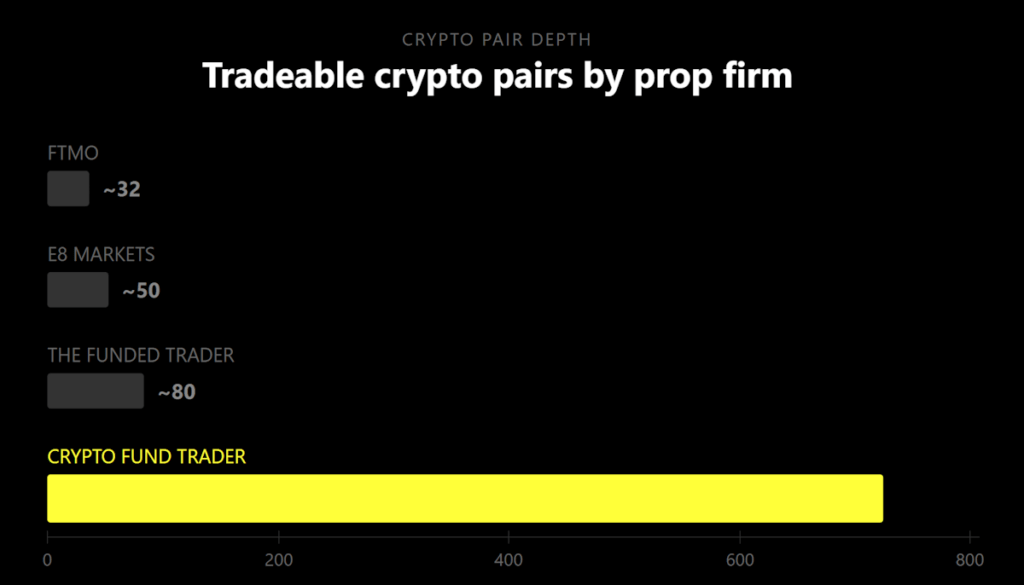
Crypto Fund Trader (CFT) was founded in November 2022 and is headquartered in Zug, Switzerland. It was built from the ground up as a crypto-first prop firm, every feature, from its 715+ cryptocurrency pairs to its Bybit integration announced in April 2025, is designed specifically around digital asset trading. CEO Alan Sánchez has positioned CFT as the premier destination for traders whose primary market is crypto, and the firm has paid out over $16.67 million to traders since launch.
The core difference is right there from the start: E8 Markets is a generalist that includes crypto. CFT is a crypto specialist, full stop.
| Feature | Crypto Fund Trader (CFT) | E8 Markets |
|---|---|---|
|
Founded
|
2022
|
2021
|
|
Headquarters
|
Zug, Switzerland
|
Dallas, Texas / Prague
|
|
Primary Focus
|
Crypto
|
Forex & Futures
|
|
Max Funded Account
|
$300,000 (up to $1.28M via Instant)
|
Up to $500,000 (forex/crypto)
|
|
Evaluation Models
|
1-phase, 2-phase, Instant, Ascend
|
1-step, 2-step, 3-step; Signature & One
|
|
No Time Limit
|
Yes |
Yes |
|
Phase 1 Profit Target
|
8%
|
8–10%
|
|
Max Drawdown
|
10%
|
4–14% (varies by configuration)
|
|
Crypto Leverage
|
Up to 1:100
|
~1:2
|
|
Crypto Pairs Available
|
715+ (via Bybit)
|
Limited CFD pairs
|
|
Profit Split
|
80% (up to 90% with add-ons)
|
80% base (up to 100% with conditions)
|
|
Payout Processing Speed
|
8–24 hours
|
24–48 hours
|
|
Instant Funding Option
|
Yes (Ascend)
|
No
|
|
Platforms
|
MT5, Bybit Terminal, CFT Platform, Match-Trader
|
TradeLocker, cTrader, MT5, Match-Trader
|
|
Free Trial
|
No |
Yes (2 free trials)
|
|
Trustpilot Rating
|
4.5+/5
|
4.4/5
|
Both CFT and E8 Markets use a challenge-based model where you trade a simulated account until you hit predefined profit targets without breaching drawdown limits. The structure of that challenge shapes your day-to-day experience more than almost anything else.
E8 Markets’ Evaluation Paths
E8 offers three evaluation formats, with the flagship options being:
The configurability of E8 One is a genuine selling point, but it comes with a caveat worth noting: the 100% profit split tier carries a consistency rule on funded accounts, and the higher challenge fee required to unlock it means the net earnings advantage over a standard 80% split is narrower than the headline figure suggests. For many traders, the simpler math of a lower-cost challenge and reliable 80% split produces better real-world outcomes.
CFT’s Evaluation Paths
CFT offers four distinct routes to funded status, all with no time limits:
CFT’s evaluation structure is deliberately straightforward. There are no complex configuration matrices, no decisions that trade off one cost against another, and no scenarios where the advertised profit split comes attached to conditions that reduce its practical value. What you see is what you trade.
For traders whose primary market is crypto, no comparison point matters more than this one, and it is where the gap between these two firms is widest.
E8 Markets: Crypto as a Secondary Asset Class
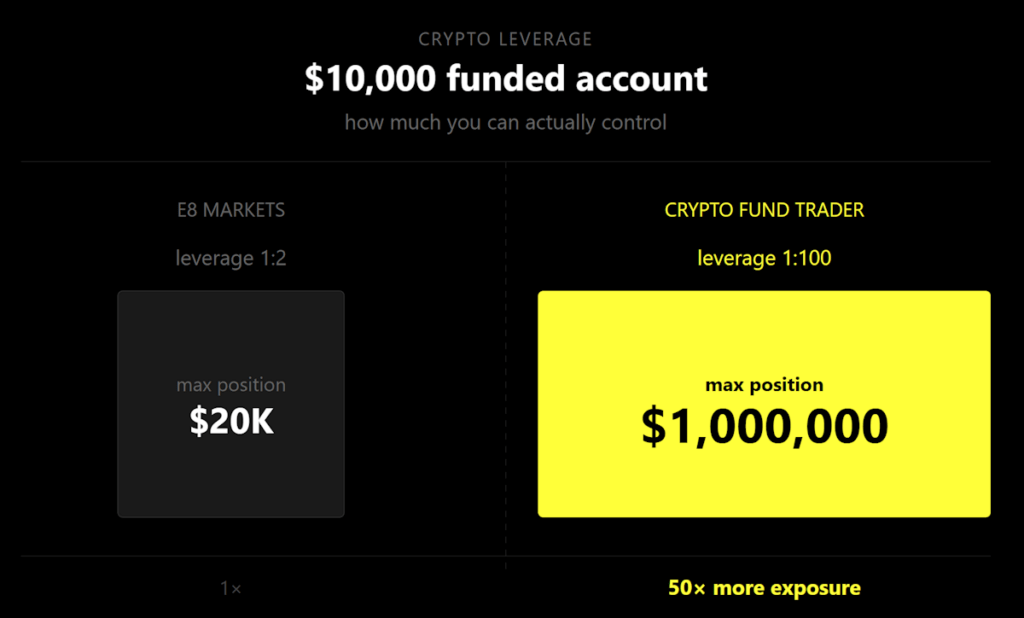
E8 Markets offers crypto trading, but context is important. The platform’s crypto pairs are traded as CFDs, leverage is capped at approximately 1:2 across most crypto accounts, and spreads on crypto run noticeably wider than those available through a crypto-native exchange environment. One detailed practitioner review noted spreads of 50–100 basis points on BTC/USD at E8 versus 10–20 basis points on a dedicated crypto exchange. E8’s 2024 rebrand explicitly moved the firm’s strategic emphasis toward forex and futures, the crypto offering exists but is not where E8 invests its product development energy.
For a trader whose strategies depend on altcoin momentum, DeFi token volatility, or the full breadth of the crypto market, E8’s offering is a secondary feature built on a generalist infrastructure, not a purpose-built environment.
CFT: Built for Crypto, Infrastructure and All
Following the Bybit partnership in April 2025, CFT provides access to over 715 cryptocurrency trading pairs through institutional-grade exchange infrastructure. This is not just pair breadth, it is execution quality. Traders operate through the same infrastructure trusted by millions of retail and professional participants globally, with exchange-level spreads and fast order routing.
CFT’s crypto leverage reaches up to 1:100. To put that in context: E8 caps crypto leverage at approximately 1:2, meaning a trader with a $10,000 funded account at CFT can take positions that a trader at E8 with the same account size simply cannot replicate. For volatility-based strategies, momentum plays on emerging altcoins, or any approach that depends on meaningful position sizing in crypto markets, this leverage differential is not a minor detail, it fundamentally determines what strategies are even viable.
The Bybit terminal integration completes the picture. Multiple CFT traders report that trading on a funded account feels nearly identical to trading with personal capital on a major exchange, seamless execution, familiar interface, and none of the friction that comes from a prop firm platform trying to approximate a crypto exchange environment. That experience is hard to put a number on, but any experienced crypto trader who has used Bybit knows exactly what it means.
Profit Splits
E8 Markets advertises a 100% profit split on its E8 One model, a number that stands out in any comparison. The full picture: this tier requires paying a higher upfront challenge fee (some configurations exceed $2,000–$4,000), and funded accounts using the 100% split are subject to a consistency rule that restricts how traders can distribute profits across trading days. For traders who can meet those conditions, it is a real benefit. For most active crypto traders, the additional cost and rule overhead means the practical advantage over CFT’s 80–90% structure is narrower than the headline implies.
CFT’s 80% base split, rising to 90% through add-ons and performance milestones, is clean, predictable, and applies without consistency conditions attached. For traders running multiple challenge cycles or scaling across several accounts, that simplicity compounds over time.
Critical Difference: FTMO refunds evaluation fees with your first profit withdrawal after successfully passing both phases. CFT’s fees are non-refundable regardless of outcome. This creates different risk-reward calculations—FTMO’s higher upfront costs become recoverable upon success, while CFT offers lower entry points but treats fees as one-time educational investments.
Payout Speed
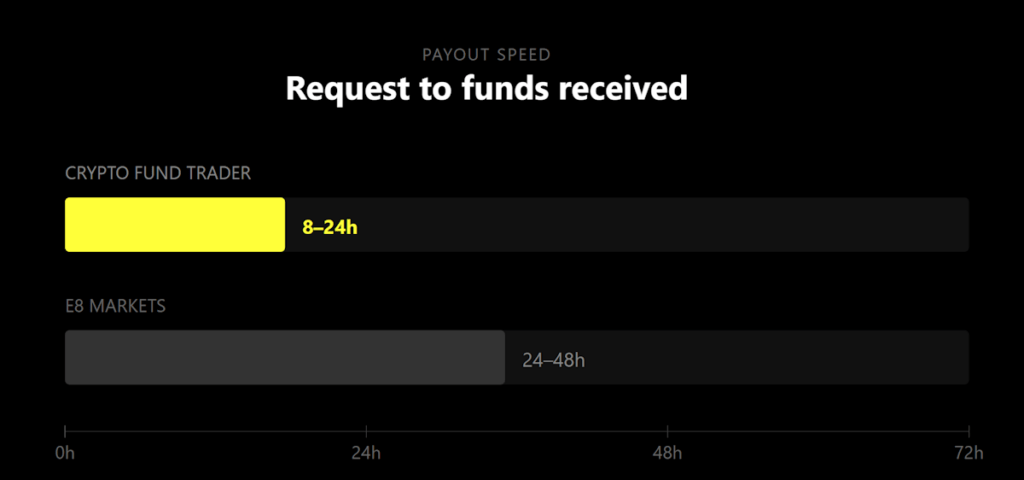
This is one of CFT’s clearest competitive advantages. Payout processing times of 8–24 hours place CFT among the fastest-paying firms in the entire prop trading industry. Verified Trustpilot reviews document payouts processed in 26 hours or under, with some traders receiving funds in under an hour. For active crypto traders managing multiple accounts or reinvesting profits into additional challenges, this speed is a genuine cash flow advantage, not a minor convenience.
E8 Markets processes payouts in 24–48 hours after approval, with first payouts eligible after 8–14 days of funded trading depending on the account model. That is a competitive processing window by industry standards. But against CFT’s 8–24 hour benchmark, there is a clear and consistent gap, and in crypto markets, where conditions shift fast and capital redeployment timing matters, that gap has practical consequences.
E8 Markets’ Platform Ecosystem
E8 Markets has built a strong multi-platform setup, with TradeLocker as its headline offering. TradeLocker delivers clean execution, TradingView-native charting, and fast order processing, it is one of the better execution environments available in prop trading and has attracted meaningful attention among price action traders. E8 also offers cTrader, Match-Trader, and MT5 (with regional restrictions), plus its proprietary E8X Analytics Dashboard, which provides real-time drawdown and profit tracking. E8 also provides a 14-day free trial, a meaningful option for traders who want to evaluate the platform before committing to a challenge fee.
For forex and futures traders, E8’s platform ecosystem is genuinely strong.
CFT’s Platform Ecosystem
CFT traders can choose from MetaTrader 5, Match-Trader, the proprietary CFT Platform, and, the standout, the Bybit Terminal. The Bybit Terminal is not an approximation of a crypto exchange interface. It is the actual Bybit trading environment, integrated directly into CFT’s funded account infrastructure. For traders who already use Bybit, or who want the execution quality and UX of a leading global crypto exchange applied to their prop firm account, this is a qualitatively different experience from anything a generalist platform can provide.
The CFT Platform itself receives consistent praise for its TradingView integration: visually clean, fast to navigate, and accessible to traders at any experience level. The real-time challenge dashboard keeps progress metrics visible without the guesswork that can creep into longer evaluation periods.
For crypto traders, platform selection often comes down to this: do you want a trading environment built around crypto markets, or one adapted from forex infrastructure? CFT answers that question with the Bybit Terminal.
E8 Markets
E8 Markets has been operating since 2021 and has accumulated over 3,200 Trustpilot reviews at a 4.4/5 rating. The firm’s live chat support is noted for responsiveness, and it runs an active community ecosystem including an annual E8 Summit and trader referral programs. For multi-asset traders who value long operational history and community infrastructure, E8’s track record reflects four years of accumulated experience.
Crypto Fund Trader
CFT operates a 24/7 Discord with a responsive support team, a structure well-suited to crypto markets, which don’t keep business hours. Trustpilot reviews consistently highlight fast response times, transparent rule communication, and straightforward payout processes. The firm has paid out over $16.67 million to traders since its 2022 launch, establishing a verified track record in under three years of operation. Its Swiss registration and Bybit partnership add institutional credibility layers that distinguish it from less-established entrants in the crypto prop space.
For crypto traders, CFT’s 24/7 support cadence and community-first structure match the around-the-clock nature of digital asset markets in a way that business-hours support models simply cannot.
E8 Markets is the right choice for a specific trader profile:
E8 Markets is a well-run, legitimate prop firm with a strong multi-asset infrastructure. For the trader it is built for, it does its job well.
CFT is the right choice for traders who take crypto seriously:
The honest answer is that these two firms are not really competing for the same trader.
E8 Markets is a solid multi-asset prop firm built for traders whose edge lives in forex and futures, who want platform variety and a high headline profit split, and who treat crypto as one instrument among many. For that trader, it does what it promises.
Crypto Fund Trader is built for traders who have decided that crypto is the market, not a feature, not a checkbox, but the actual arena where their edge lives. The 715+ pairs, 1:100 leverage, Bybit Terminal integration, $16.67M in verified payouts, and 8–24 hour payout processing are not individual selling points. They are components of a coherent infrastructure designed specifically to give crypto traders the best possible environment in which to operate with funded capital.
Prop trading is fundamentally about one question: does your firm’s infrastructure amplify your edge, or work against it? For dedicated crypto traders, the answer between these two firms is clear.
If I trade mostly BTC and ETH, why would I even need 715 pairs? Pair count matters less than leverage. E8’s crypto leverage tops out at 1:2 on standard accounts and drops to 1:1 on E8 One crypto. CFT runs up to 1:100. That gap determines whether your position sizing strategy is viable, not how many pairs are listed.
Is CFT actually legit or will they ghost me at payout time? CFT has a documented payout track record. Multiple verified reviews show payouts processed in under 26 hours, with some traders receiving funds in under an hour. The firm has distributed over $16.67M since launch. Start with a smaller challenge account to verify before scaling.
Why does E8 cap crypto leverage at 1:2? That seems like it kills any real crypto strategy. E8’s leverage restrictions mean spreads matter more at the position-sizing level, especially on smaller altcoins where wider quoted spreads increase the effective cost of entry. E8 is built around forex and futures, crypto is a secondary asset class. For volatility-based crypto strategies, that infrastructure works against you structurally.
I saw a review saying CFT can deny payouts any time and calls them “scholarships.” Is that real? This language exists in most prop firm agreements, including FTMO and E8. The relevant question is whether payouts actually get denied, and community evidence at CFT says no, with documented payout proofs across thousands of reviews. Vague terms are industry-wide, not CFT-specific.
If I blow the evaluation, do I lose everything? Yes, challenge fees are non-refundable at both firms if you breach drawdown limits or miss profit targets. This is standard across the prop firm industry. Traders who fail the evaluation lose their registration fee entirely. Treat the fee as a business cost: start small, prove the process, then scale.
I’m a US-based trader. Does that affect which firm I can use? US traders face platform restrictions at E8. MT5 and cTrader are unavailable for US users, leaving TradeLocker as the only option for forex and crypto accounts, which breaks any workflow built on MT5 custom indicators or EAs. CFT’s Swiss registration covers most jurisdictions, but verify your country is supported before purchasing.
This article is intended for informational purposes only. All trading involves risk. Evaluate any prop firm carefully against your own trading strategy and financial situation before purchasing an evaluation.
-
© 2026 - All Rights Reserved.
SWISS RLCRATES AG is a provider of educational services, all information available on our site is intended solely for the study purposes related to trading on financial markets. Accordingly, we do not offer financial, investment, tax, brokerage or other advice and/or services. Trading in financial markets is a high-risk activity, past performance do not guarantee future ones. It is highly advised not to risk more, than you can afford to lose. Brokers and operators of trading platforms are persons or entities that are separate from SWISS RLCRATES AG and their own terms and conditions will apply when you use their services and products. Neither SWISS RLCRATES AG nor RLCRATES, S.L. (as MT5 license holder) operate in countries where crypto or CFD’s activity is not allowed. The content in our platform is applicable to the extent local laws and/or regulations permit.