
Choosing the right crypto prop firm in 2026 comes down to one thing above all else: how reliably and quickly you get paid. Flashy marketing and headline profit splits mean nothing if your hard-earned profits sit in limbo for weeks — or worse, never arrive. This crypto prop firm payout comparison breaks down the three firms serious traders are evaluating right now — Crypto Fund Trader (CFT), FTMO, and E8 Markets — across the metrics that actually hit your bank account.
Whether you’re a seasoned funded trader comparing your next move or a beginner researching which firm deserves your evaluation fee, this guide delivers the verified data, side-by-side breakdowns, and honest analysis you need to make a confident decision.
Payout reliability is the single most important trust signal in crypto prop trading today. The industry has matured rapidly since 2022, but so have the risks: firms vanishing overnight, denying withdrawals on technicalities, and hiding behind opaque corporate structures have all eroded trader confidence. In a market now exceeding $20 billion, separating trustworthy firms from risky ones demands a data-driven approach.
A crypto prop firm payout comparison isn’t just about finding the highest percentage on paper. It’s about understanding the complete payout ecosystem — processing speed, payout frequency, withdrawal methods, hidden conditions, and whether a firm can actually back its promises with verifiable reserves. In 2026, traders who skip this step risk losing both their evaluation fees and their profits.
The three firms in this comparison represent distinct approaches to the market. CFT is the crypto-native specialist built on exchange infrastructure. FTMO is the industry’s established veteran expanding into digital assets. E8 Markets is the flexible multi-asset platform offering customizable evaluations. Each has strengths — but only one consistently leads across the payout metrics that matter most to crypto traders.
A direct comparison reveals meaningful differences in how each firm structures trader payouts. The table below consolidates verified data from Prop Firm Match (PFM), official firm disclosures, and independent reviews current through early 2026.
| Payout Metric | Crypto Fund Trader (CFT) | FTMO | E8 Markets |
|---|---|---|---|
|
Base Profit Split
|
80%
|
80% (2-Step) / 90% (1-Step)
|
80% (customizable)
|
|
Maximum Profit Split
|
Up to 90% (with add-on)
|
90% (via Scaling Plan)
|
Up to 100% (at higher fee)
|
|
Payout Processing Speed
|
8–24 hours
|
1–2 business days (~8hr avg)
|
24–48 hours (36hr avg reported)
|
|
Payout Frequency
|
On-demand after first cycle
|
Every 14–60 days (trader selects)
|
Every 14 days after first payout
|
|
First Payout Eligibility
|
After minimum trading days met
|
14 days after first trade
|
8–14 days after first trade
|
|
Total Verified Payouts
|
$18M+ reported
|
$200M+ annually (all assets)
|
$65M+ since launch
|
|
PFM Median Payout Time
|
~34 minutes
|
Not crypto-specific
|
~21 hours
|
|
Payout Methods
|
Crypto (native)
|
Bank wire, Skrill, Crypto
|
Rise (crypto), Plane (bank)
|
|
Withdrawal Fees
|
None reported
|
None
|
Third-party fees may apply
|
|
Min. Withdrawal
|
Low threshold
|
$20 (bank) / $50 (crypto)
|
$50 (Plane) / $250 (Rise)
|
|
Fee Refund on First Payout
|
No |
Yes (full challenge fee)
|
No (non-refundable)
|
|
Proof of Reserves
|
Yes (via Bybit partnership audits)
|
Not publicly disclosed
|
Indirect (regulated LPs)
|
|
Corporate Registration
|
Switzerland (Zug)
|
Czech Republic (Prague)
|
United States (Dallas, TX)
|
This table reveals a critical insight: while FTMO leads in total payout volume and brand trust built over a decade, CFT dominates crypto-specific speed and infrastructure. E8 Markets offers the most customizable split structure but lacks the crypto depth that specialist traders need.
The profit split determines how much of every winning trade lands in your pocket versus the firm’s. An 80% split means you keep $800 of every $1,000 in profit — but the real story involves how you qualify, what add-ons cost, and how quickly those percentages scale.
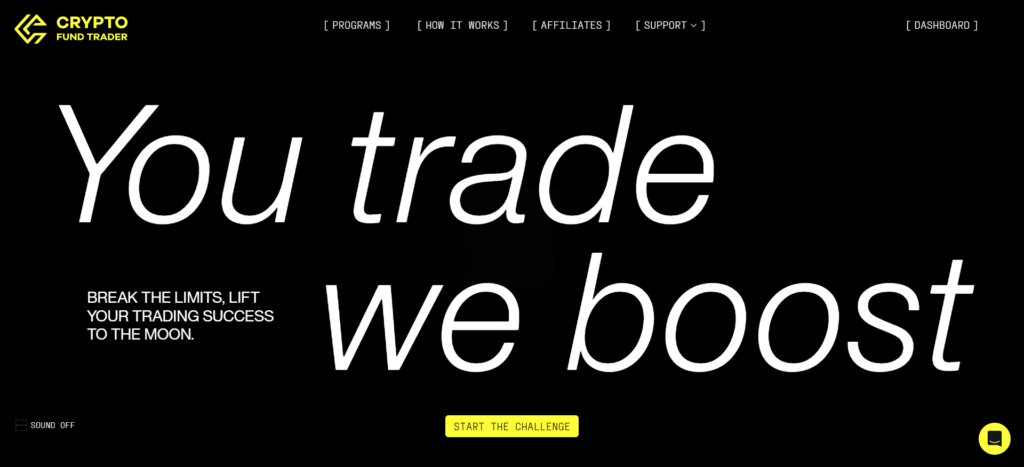
Crypto Fund Trader starts every funded trader at an 80% profit split, with an optional add-on available at checkout to reach 90%. This structure rewards traders who know their edge and want maximum take-home from day one, without needing to qualify through months of performance milestones. The simplicity is the advantage here — no scaling plans to navigate, no performance tiers to track.
The 90% add-on model is transparent: you pay a small premium upfront, and every payout from your first withdrawal forward reflects the higher split. For traders confident in their strategy, this front-loaded approach can be significantly more profitable over time compared to firms that gate their best splits behind extended performance requirements.
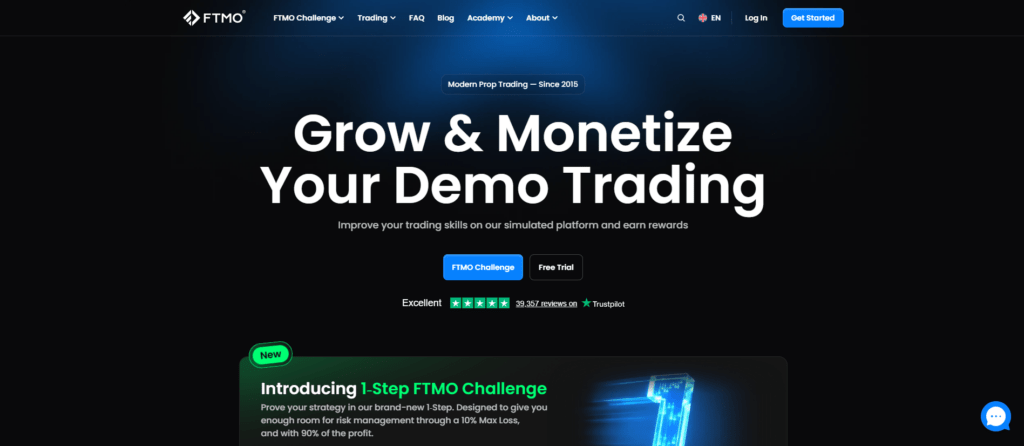
FTMO starts 2-Step challenge traders at 80% and offers 90% only after qualifying for the Scaling Plan, which requires consistent profitability across multiple payout cycles. The 1-Step challenge grants 90% immediately but carries different evaluation parameters. FTMO also refunds the full challenge fee with your first profit withdrawal — a meaningful advantage that effectively makes the evaluation free for successful traders.
The trade-off is time. Most traders spend weeks or months meeting Scaling Plan criteria before accessing the top-tier split. For crypto traders operating in fast-moving 24/7 markets, this delayed gratification can translate into thousands of dollars left on the table during the scaling period.
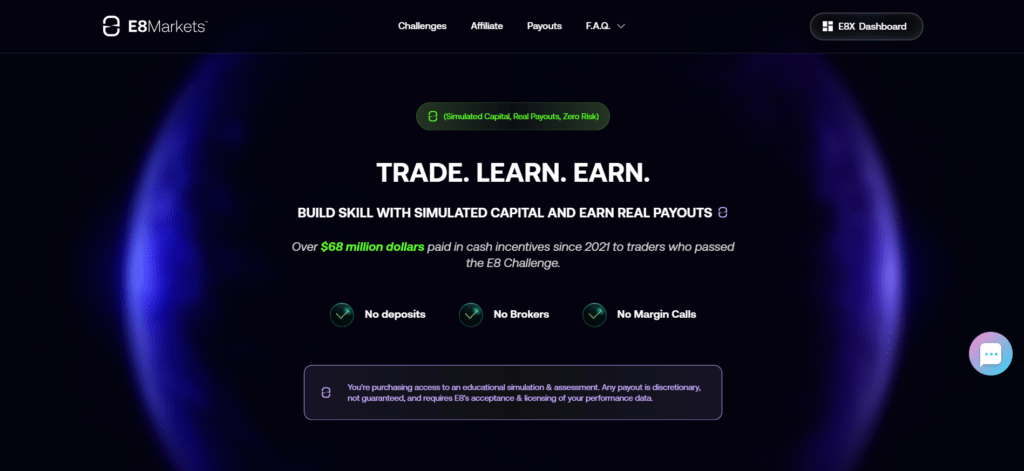
E8 Markets takes a radically different approach, letting traders customize their profit split at checkout. Options range from 80% to 100%, with the split choice directly impacting your evaluation fee — higher splits cost more upfront. This “build your own evaluation” model appeals to experienced traders who understand exactly how to price their edge.
However, the 100% split comes with trade-offs. Higher evaluation fees, stricter consistency rules on funded accounts (including a 35% Best Day rule on some account types), and the added complexity of understanding which drawdown model applies to your specific configuration all create friction. For crypto traders who value clarity, this level of customization can become a liability when the rules aren’t fully understood before purchase.
Processing time from withdrawal request to funds in your account is the metric most prop firms would rather you not compare. CFT’s crypto-native settlement infrastructure processes payouts in 8–24 hours, with PFM data showing a median time of approximately 34 minutes — the fastest among the three firms analyzed.
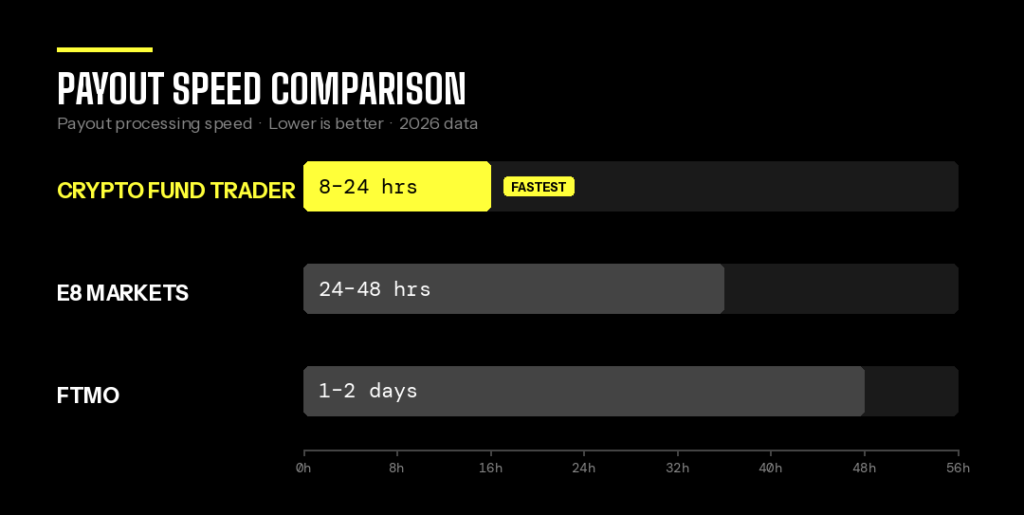
This speed advantage isn’t just about convenience. Faster payouts allow traders to reinvest profits sooner, validate their funded status through real withdrawals, and maintain the psychological momentum that drives consistent performance. In volatile crypto markets, capital sitting idle in a firm’s processing queue is capital that isn’t compounding.
FTMO processes payouts within 1–2 business days after invoice confirmation, with an internal average of approximately 8 hours. This is competitive by industry standards, particularly for a firm handling payouts across all asset classes — not just crypto. However, the bi-weekly payout cycle (minimum 14 days between withdrawals) creates a bottleneck that crypto traders accustomed to 24/7 settlement may find frustrating.
E8 Markets sits in the middle, with verified processing times averaging around 36 hours across multiple user reports. Payouts run through two processors — Rise for crypto and Plane for bank transfers — each with different minimum withdrawal thresholds. The $250 minimum for Rise (crypto) payouts is notably higher than both CFT and FTMO, potentially disadvantaging traders with smaller accounts or those who prefer frequent, smaller withdrawals.
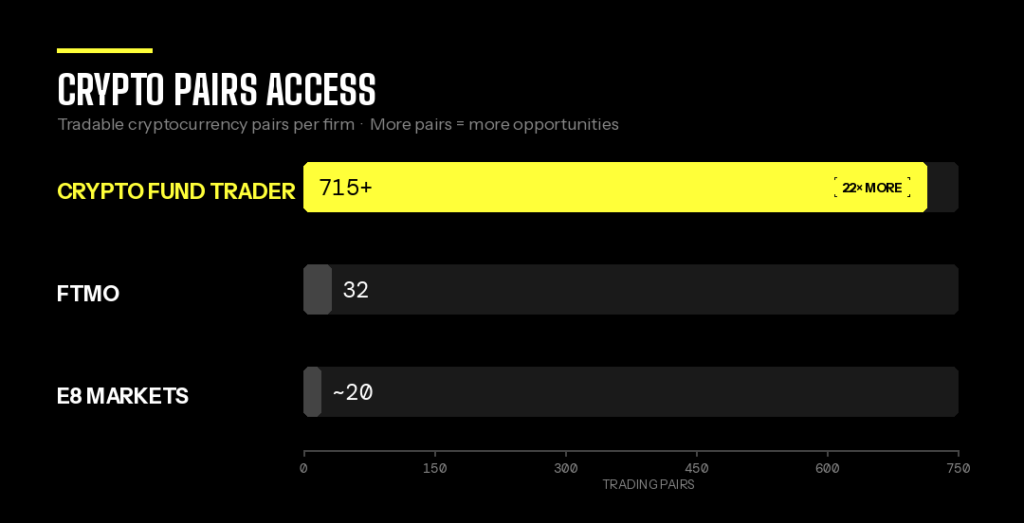
The number of tradable crypto assets directly impacts your earning potential as a funded trader. CFT’s strategic Bybit partnership delivers access to over 715 cryptocurrency trading pairs, including majors like BTC and ETH, mid-caps like SOL and AVAX, DeFi tokens, meme coins, and new listings that other firms simply don’t offer.
FTMO added 22 new altcoin pairs in July 2025, bringing its total to roughly 32 cryptocurrency pairs. While this expansion was welcome, the coverage remains heavily weighted toward major cryptocurrencies and operates through CFD contracts rather than direct exchange execution. Crypto leverage on FTMO standard accounts is limited to 1:3, and standard account holders must close positions before weekends — a significant restriction for a market that never sleeps.
E8 Markets offers crypto as a dedicated account type (separate from their forex and futures accounts), with leverage capped at just 1:2 on crypto assets. The firm trades through Virtual Markets as its broker backbone for forex and crypto — functional but not comparable to direct exchange integration. Crypto traders on E8 are limited to the pairs available through this infrastructure, which pales in comparison to CFT’s 715+ pair count.
For traders whose edge depends on altcoin volatility, early listings, or DeFi token momentum, the difference between 715+ pairs and 32 pairs isn’t incremental — it’s transformational.
Prop Firm Match (PFM) has emerged as the industry’s leading independent verification platform, using measurable performance indicators, verified trader feedback, and live payout evidence to evaluate prop firms without bias. CFT’s listing on PFM provides traders with third-party validation of its payout claims and operational reliability.
PFM data confirms CFT’s payout processing with a reported median time of approximately 34 minutes — significantly faster than industry norms. The platform also tracks payout distribution by region, payout growth trends, and individual payout amounts, giving prospective traders a transparent window into CFT’s operational performance.
CFT’s PFM verification matters because it addresses the biggest concern in crypto prop trading: whether the firm actually pays. In an industry where 19 out of 26 analyzed firms provide no verifiable payout information, CFT’s willingness to submit to third-party scrutiny demonstrates operational confidence that most competitors lack. Combined with its 4.4-star Trustpilot rating across 1,100+ reviews and documented $18M+ in total payouts, the verification creates a multi-layered trust framework that traders can independently audit.
FTMO also maintains strong industry recognition, including a 4.8 Trustpilot score across 29,000+ reviews — the highest among all three firms. E8 Markets earned the “Best Payout / Credential Process” award at the 2025 PFM Awards, validating its payout execution quality. Each firm has demonstrated legitimacy through different verification channels, but CFT’s crypto-specific focus and PFM verification make it the most relevant benchmark for dedicated crypto traders.
Proof of reserves has become the baseline trust signal in crypto prop trading after high-profile collapses reminded traders that promises are only as good as the capital backing them. A firm that can demonstrate verifiable reserve access — through exchange audits, on-chain data, or regulated custodial partnerships — provides a fundamentally different risk profile than one operating behind opaque financial structures.
CFT’s strategic partnership with Bybit represents the strongest proof of reserves framework among crypto-focused prop firms. Bybit publishes regular reserve audits and is one of the few major exchanges with publicly verifiable holdings. Because CFT executes trades directly through Bybit’s infrastructure, the exchange’s audited reserves provide indirect but verifiable backing for CFT’s operational capacity. This arrangement means CFT’s liquidity is anchored to one of the most transparent exchanges in the cryptocurrency ecosystem — a distinction no other crypto-specialized prop firm can claim at this scale.
FTMO’s strength lies in its decade-long track record and massive payout volume rather than a specific proof of reserves mechanism. The firm’s $200M+ in annual payouts across all asset classes speaks to operational stability, but FTMO has not publicly disclosed a reserve audit or exchange-backed custodial arrangement. For crypto-specific traders, this creates a trust gap — the firm’s reputation is built on forex and indices reliability, not crypto infrastructure transparency.
E8 Markets integrates with regulated liquidity providers whose reserve status can be independently verified, offering an indirect proof of reserves pathway. The firm’s US registration (Dallas, Texas) adds a layer of jurisdictional accountability. However, E8 has not published a direct reserve audit, and its crypto execution runs through Virtual Markets — a less transparent infrastructure compared to direct exchange partnerships.
The proof of reserves landscape in 2026 clearly favors firms with direct exchange relationships. For traders evaluating counterparty risk, CFT’s Bybit integration represents a structural advantage that extends beyond marketing claims into verifiable infrastructure.
No comparison is complete without an honest assessment of each firm’s limitations within the crypto trading context specifically. Both FTMO and E8 Markets are respected firms with proven track records — but their architectures were not built crypto-first.
These limitations don’t make FTMO or E8 Markets bad firms — they make them suboptimal for crypto-first traders. If your strategy centers on cryptocurrency markets, you need infrastructure purpose-built for 24/7 digital asset trading, and that’s where CFT’s architecture shines.
Selecting the best crypto prop firm depends on your trading strategy, risk tolerance, and career goals. Here’s a practical framework to match your profile with the right platform.
Choose CFT if your trading is exclusively or primarily focused on cryptocurrency. The 715+ pairs, Bybit integration, 8–24 hour payouts, and up to 90% profit split create the most complete crypto prop trading ecosystem available. Traders who value speed, depth of market access, and verifiable proof of reserves will find CFT’s Swiss-registered, exchange-backed model unmatched.
Choose FTMO if you trade across multiple asset classes (forex, indices, commodities, and some crypto) and value a decade-long reputation for reliability. The Scaling Plan’s path to $2M in funded capital, fee refund on first payout, and 4.8 Trustpilot rating appeal to traders who want the safest, most established brand name — even if crypto-specific features are limited.
Choose E8 Markets if you want maximum customization over your evaluation parameters and are comfortable navigating complex rule sets. The ability to set your own drawdown, profit target, and payout split before checkout gives experienced traders granular control. However, crypto traders should understand that E8’s multi-asset flexibility comes at the cost of crypto-specific depth.
This crypto prop firm payout comparison reveals a clear pattern: while all three firms are legitimate operations with verified payout histories, they serve fundamentally different trader profiles. FTMO leads in reputation and multi-asset scale. E8 Markets leads in evaluation customization. But for traders whose focus is cryptocurrency — the market that trades 24/7, moves in hours what forex moves in weeks, and rewards those with the deepest market access — Crypto Fund Trader delivers the infrastructure, speed, and transparency that the crypto prop trading space demands.
The data is in. The comparison is clear. The only question left is whether you’re ready to put your strategy to work with the capital it deserves.
Visit cryptofundtrader.com to start your evaluation and discover why $18M+ in trader payouts, 715+ crypto pairs, and 8–24 hour processing aren’t just numbers — they’re the foundation of your next chapter as a funded crypto trader.
Disclaimer: This article is for informational and educational purposes only and does not constitute financial advice. Proprietary trading involves risk, including the loss of evaluation fees. Always conduct your own due diligence before committing capital to any prop trading firm. Data referenced in this article is current as of early 2026 and may change. Verify all figures directly with each firm before making decisions.
-
© 2026 - All Rights Reserved.
SWISS RLCRATES AG is a provider of educational services, all information available on our site is intended solely for the study purposes related to trading on financial markets. Accordingly, we do not offer financial, investment, tax, brokerage or other advice and/or services. Trading in financial markets is a high-risk activity, past performance do not guarantee future ones. It is highly advised not to risk more, than you can afford to lose. Brokers and operators of trading platforms are persons or entities that are separate from SWISS RLCRATES AG and their own terms and conditions will apply when you use their services and products. Neither SWISS RLCRATES AG nor RLCRATES, S.L. (as MT5 license holder) operate in countries where crypto or CFD’s activity is not allowed. The content in our platform is applicable to the extent local laws and/or regulations permit.