
You passed the evaluation. You hit your profit targets. You watched your funded account balance climb while managing risk like a professional. Now comes the moment every crypto prop trader works toward, actually getting paid.
But here’s the thing most guides won’t tell you: the withdrawal process is where many traders stumble. Not because it’s impossibly complex, but because small oversights, a wrong wallet address, an incomplete KYC check, a violated drawdown rule you didn’t notice, can delay your crypto prop firm payout withdrawal by days or even result in forfeited profits.
This guide walks through the entire process, from the moment you become eligible to the moment funds land in your wallet.
A crypto prop firm payout is your share of the profits generated while trading the firm’s capital. When you trade a funded account, you and the firm split the profits according to a pre-agreed ratio, typically between 70% and 90% in the trader’s favor. The firm retains the remainder as compensation for providing capital, infrastructure, and risk management.
Most crypto-focused prop firms process withdrawals in stablecoins like USDT or USDC, sent directly to your personal cryptocurrency wallet. This is one of the key advantages over traditional forex prop firms, where bank wires can take three to seven business days. Stablecoin payouts often settle within hours.
The general cycle looks like this: you generate profit, meet the firm’s eligibility requirements (minimum trading days, profit thresholds, drawdown compliance), submit a withdrawal request through your trader dashboard, pass a compliance review, and receive funds. The entire process can take anywhere from a few hours to 48 hours at most reputable firms.
However, each firm structures its payout mechanics differently. Some operate on fixed schedules, biweekly or monthly, while others allow on-demand withdrawals once minimum conditions are met. Understanding your specific firm’s rules before you even start trading is the single most important step in ensuring a smooth crypto prop firm payout withdrawal.
Before you can submit a payout request, every crypto prop firm requires you to meet specific eligibility criteria. Missing even one of these conditions is the most common reason traders experience delays.
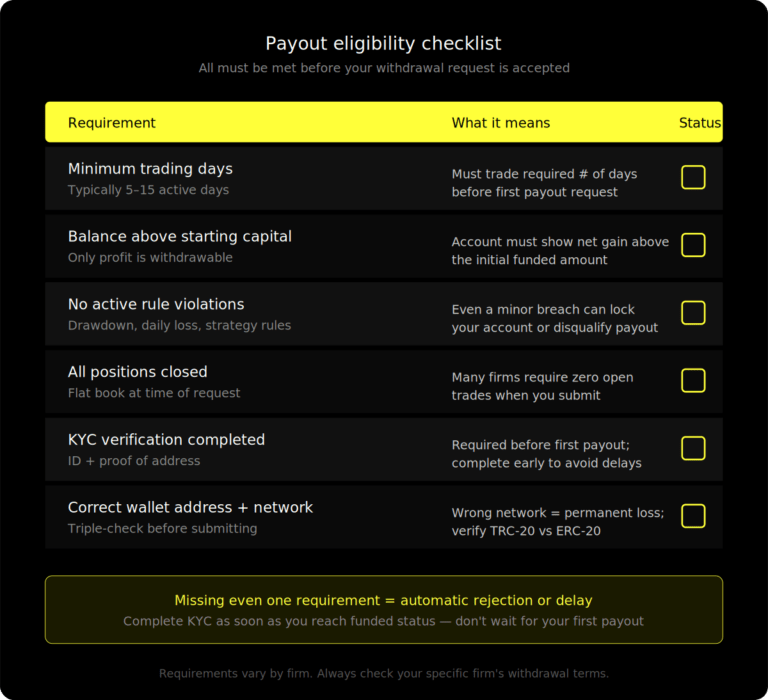
Here’s what firms generally require:
The key takeaway: eligibility isn’t just about being profitable. It’s about being profitable within the rules. A $5,000 gain means nothing if your account was in drawdown violation on day three.
The actual mechanics of a crypto prop firm payout withdrawal are straightforward once you’ve cleared eligibility. Here’s the process at most major firms, broken into actionable steps.
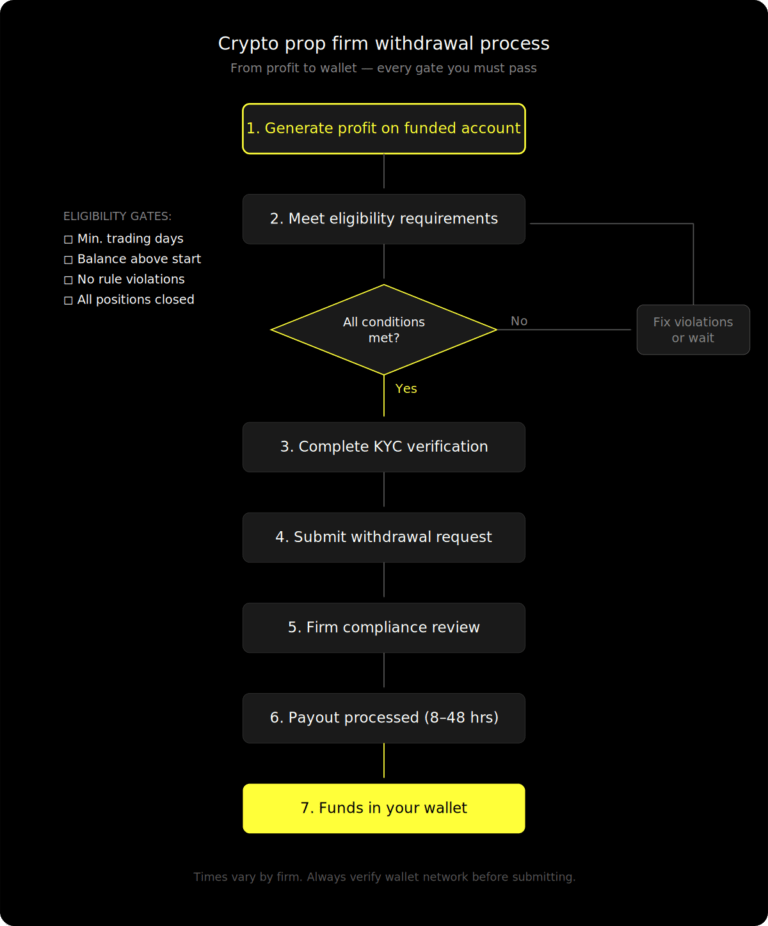
Step 1: Complete KYC Verification
If this is your first payout, you’ll need to verify your identity. This typically involves uploading a government-issued photo ID (passport or driver’s license), proof of address (utility bill or bank statement dated within the last three months), and in some cases, a signed funded trader agreement.
Most firms use automated third-party verification tools, and approval often comes within 24 to 48 hours. Some firms have streamlined this to same-day processing.
Pro tip: complete KYC as soon as you reach funded status, even before you’re ready to withdraw. This eliminates a potential bottleneck when you actually want your money.
Step 2: Navigate to the Payout Dashboard
Every prop firm provides a withdrawal interface within your trader dashboard. Log in, locate the payout or withdrawal section, and initiate a new request. You’ll see your eligible balance: the amount available for withdrawal after the firm’s profit split is applied.
Step 3: Enter Your Wallet Details
For crypto payouts, you’ll need to provide your wallet address and confirm the correct network. This is critical. If your firm pays in USDT on the TRC-20 network and you provide an ERC-20 address, the transaction will fail, or worse, funds could be lost permanently.
Always double-check three things: the wallet address itself, the blockchain network (TRC-20, ERC-20, or others), and that your receiving wallet supports the specific stablecoin being sent.
Step 4: Submit and Wait for Processing
After submission, the firm’s compliance team reviews the request. They verify that no trading rules were violated during the payout period, confirm your KYC status, and approve the transfer. Processing times vary, but industry leaders now handle this within 8 to 24 hours. Some firms advertise even faster turnaround: Crypto Fund Trader processes payouts in as little as 8 hours.
Step 5: Confirm Receipt
Once funds arrive in your wallet, verify the amount against your expected payout (profit minus the firm’s share). Keep a screenshot of the confirmation for your records. This documentation becomes important during tax season.
The method by which you receive your profits affects speed, fees, and accessibility. Here’s how the most common options compare:
| Payout Method | Typical Speed | Fees | Best For |
|---|---|---|---|
|
USDT (TRC-20)
|
Minutes to hours
|
Low (often under $1)
|
Traders wanting fast, low-cost payouts
|
|
USDC (ERC-20)
|
Minutes to hours
|
Moderate (gas fees apply)
|
Traders preferring Ethereum ecosystem
|
|
Bank Wire (USD/EUR)
|
1–5 business days
|
$15–$50+ per transfer
|
Traders who prefer fiat directly
|
|
Wise / Deel / Rise
|
1–3 business days
|
Low to moderate
|
International traders needing fiat conversion
|
|
Bitcoin / Ethereum
|
Minutes to hours
|
Variable (network-dependent)
|
Crypto-native traders
|
Stablecoin payouts, especially USDT on TRC-20, have become the industry standard for crypto prop firms because they combine speed, low cost, and stability. Unlike receiving Bitcoin, you don’t have to worry about price fluctuations between the time the firm sends and the time you convert or spend.
The profit split determines what portion of your trading gains you receive and what the firm retains. This is not a hidden fee, it’s the core business model of prop trading, and it’s agreed upon before you begin.
Most reputable crypto prop firms offer splits between 80/20 and 90/10 in favor of the trader. Some firms offer scaling programs where your split improves as you demonstrate consistency. A few even reach 100% profit retention at advanced tiers.
Here’s how that works in practice: if you generate $10,000 in profit on a funded account with an 80/20 split, you withdraw $8,000 and the firm keeps $2,000. With a 90/10 split, your share rises to $9,000.
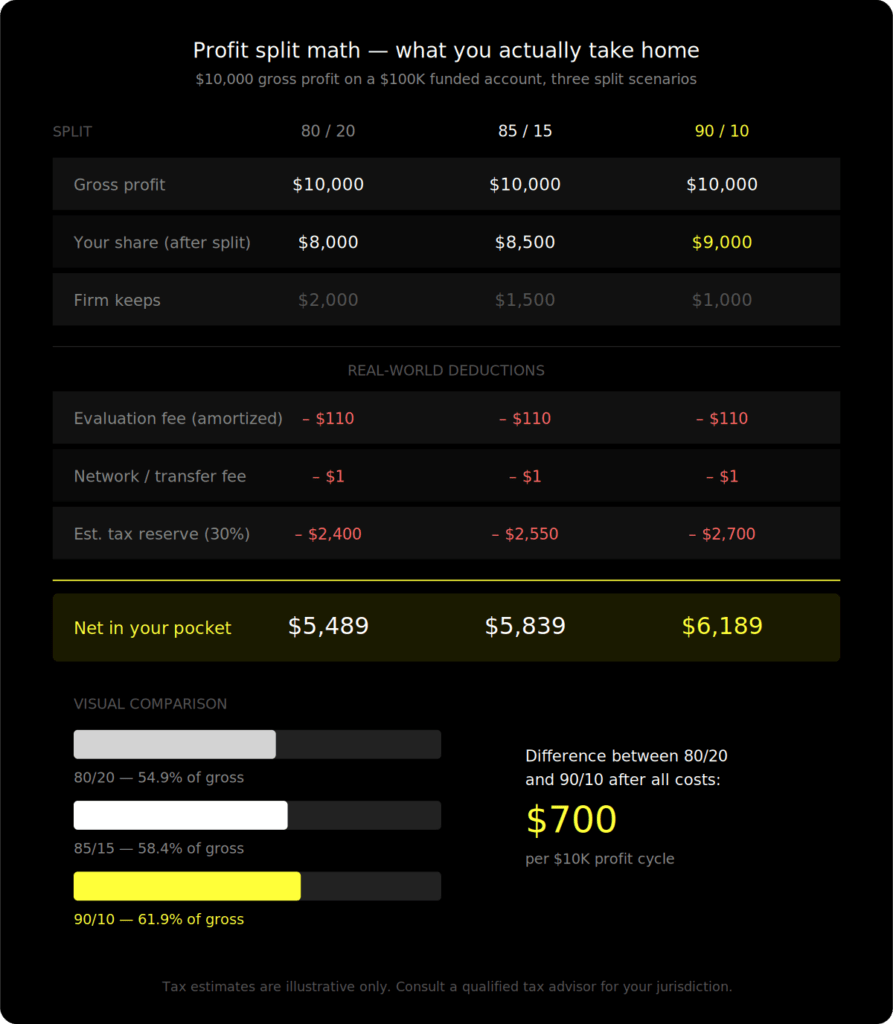
Factors that influence your split include which evaluation program you completed (one-phase versus two-phase challenges often carry different rates), optional add-ons purchased at checkout (some firms sell a profit split upgrade), your tier or scaling level within the firm, and whether you’re using an instant funding model, which typically starts at lower splits (50–70%) before scaling up.
When comparing firms, resist the temptation to chase the highest advertised split without examining the full picture. A 90% split with a $999 non-refundable evaluation fee and restrictive consistency rules may net you less over a year than an 85% split with lower fees and flexible withdrawal terms.
Understanding what goes wrong is just as important as knowing what to do right. These are the most frequent errors that cause crypto prop firm payout withdrawal delays:
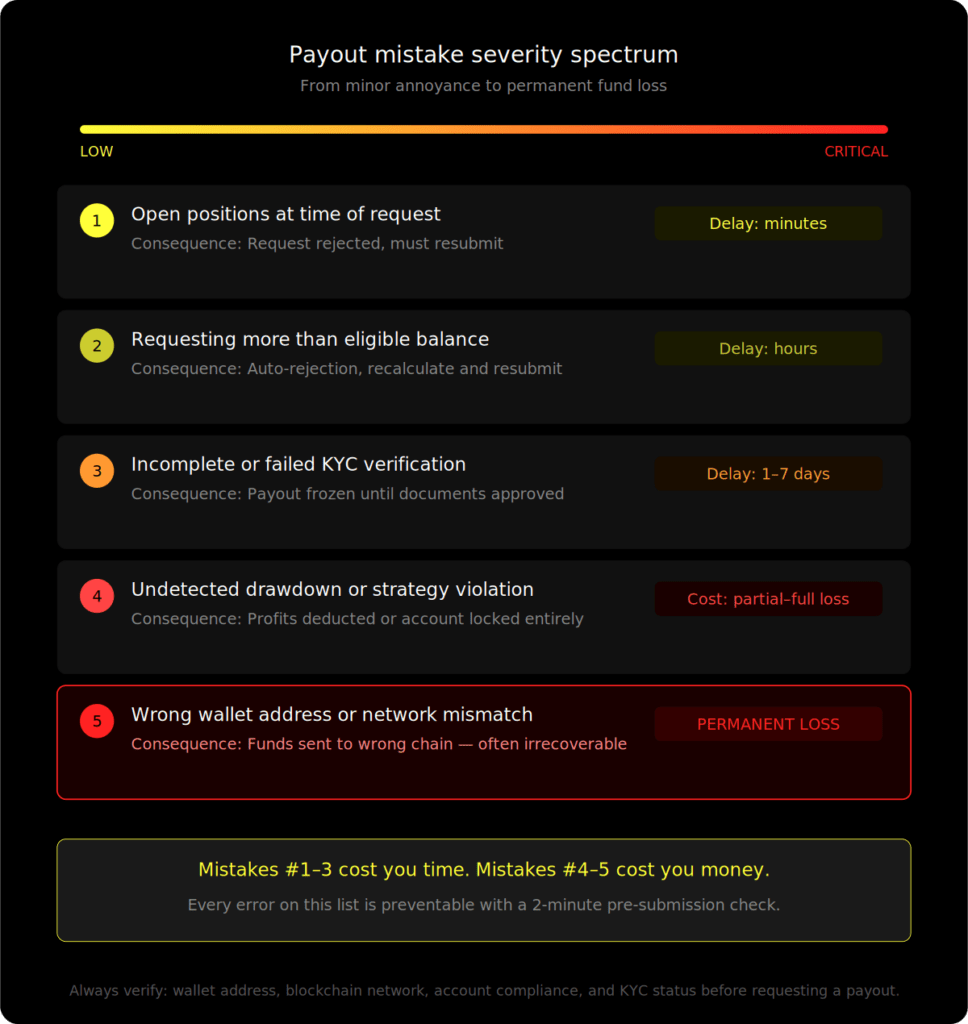
The pattern here is clear: most payout problems are preventable. They stem from rushing the process or not reading the firm’s specific withdrawal rules.
Prop firm profits are taxable income in most jurisdictions, and the tax treatment differs from personal investment gains. In the United States, the IRS generally classifies prop traders as independent contractors, which means your payouts are treated as ordinary income, not capital gains.
This distinction matters significantly. While long-term capital gains are taxed at rates between 0% and 20% in the U.S., ordinary income tax rates can reach up to 37%. Additionally, independent contractors owe self-employment tax of 15.3%, covering Social Security and Medicare contributions.
Key considerations for tax planning:
This is not financial or tax advice. Tax laws vary by country and individual circumstance. Consulting a qualified tax professional, ideally one familiar with trading income and cryptocurrency, is strongly recommended.
Not all prop firms are created equal when it comes to actually paying traders. The industry has seen firms delay payouts, impose hidden conditions, or shut down entirely with trader funds unprocessed. Here’s what to look for:
The prop trading industry is maturing rapidly, with increased regulatory attention from bodies like the CFTC and FCA. Firms that invest in compliance infrastructure today are more likely to be around, and paying traders, tomorrow.
Getting paid once is a milestone. Getting paid consistently is a career. Here are strategies that experienced prop traders use to optimize their crypto prop firm payout withdrawal cycle over time
Understand the scaling path. Most firms offer account scaling, trade profitably and consistently, and your account size (and maximum payout potential) increases. At Crypto Fund Trader, traders can scale up to $300,000 in funded capital. Higher capital means higher absolute payouts, even at the same profit percentage.
Withdraw regularly, not greedily. Taking consistent, moderate payouts is generally safer than accumulating a massive balance and requesting one large withdrawal. Smaller, frequent withdrawals reduce your exposure to account breaches and demonstrate to the firm that you’re a reliable, long-term partner.
Keep a trading journal with payout records. Track every withdrawal, including the date, amount, wallet address, profit split applied, and any fees deducted. This log becomes invaluable for tax reporting, dispute resolution, and evaluating your own performance over time.
Reinvest strategically. Some traders use a portion of their payouts to fund additional evaluations at the same or different firms, diversifying their funded account portfolio. Others allocate profits toward education, better infrastructure, or personal trading capital. The point is to have a plan for what comes after the payout, not just the payout itself.
Withdrawing profits from a crypto prop firm isn’t the hardest part of the journey, that distinction belongs to passing the evaluation and trading consistently within the rules. But the payout process is where your discipline gets rewarded in real, tangible terms.
Complete your KYC early. Understand your firm’s specific eligibility requirements. Double-check your wallet address. Know your profit split. Keep records. Plan for taxes.
The traders who treat the withdrawal process with the same precision they bring to their trading are the ones who build sustainable, long-term income from prop trading. And in an industry that’s growing more competitive and more professional every quarter, that’s exactly the kind of trader who thrives.
I passed the evaluation. Now what? Like, literally what do I click to get my money? The withdrawal process is: log into your dashboard, go to the payout section, enter your wallet address and network, submit the request, and wait for compliance review — most firms process it in 8–48 hours. The one thing that delays people is KYC. Complete it the day you get funded, not the day you want to withdraw.
What happens if I enter the wrong wallet address? Can they reverse it? Sending funds to the wrong wallet address or wrong network is permanent, no firm can reverse a crypto transaction. This is the single most costly mistake traders make. Triple-check the address and the network before you submit. TRC-20 and ERC-20 addresses look similar and are not interchangeable.
Why not just trade with your own money instead of paying eval fees to these firms? Crypto prop firms give you leveraged access to capital you likely don’t have — a $200 evaluation fee for $100,000 in funded capital is the core value proposition. If you trade profitably, the return on your skill is hard to replicate any other way. If you’re not consistently profitable yet, you’ll burn eval fees and learn that lesson expensively.
How often can I actually withdraw? Is it once a month or whenever I want? Withdrawal frequency depends entirely on the firm: some allow on-demand payouts once eligibility conditions are met, others run fixed biweekly or monthly cycles. Eligibility typically means minimum trading days completed, account in net profit, and all positions closed. Check your firm’s specific terms because this varies more than any other policy across the industry.
Do I owe taxes on this? It’s stablecoins not “real” money right? Stablecoin payouts from prop firms are taxable income regardless of the asset form. In the US, the IRS treats prop trading profits as ordinary self-employment income, meaning income tax plus 15.3% self-employment tax, not the lower capital gains rate. The upside: failed eval fees, software, VPS, and internet costs are all deductible. Talk to a tax professional who knows crypto.
What’s the actual sign a firm is going to stiff you before it happens? The clearest red flags are missing or vague payout terms on the website, no publicly reported payout totals, and patterns of delay complaints on Reddit or Trustpilot. Legitimate firms publish how much they’ve paid out in aggregate because it builds trust. If a firm won’t show that number, that absence is itself the answer.
-
© 2026 - All Rights Reserved.
SWISS RLCRATES AG is a provider of educational services, all information available on our site is intended solely for the study purposes related to trading on financial markets. Accordingly, we do not offer financial, investment, tax, brokerage or other advice and/or services. Trading in financial markets is a high-risk activity, past performance do not guarantee future ones. It is highly advised not to risk more, than you can afford to lose. Brokers and operators of trading platforms are persons or entities that are separate from SWISS RLCRATES AG and their own terms and conditions will apply when you use their services and products. Neither SWISS RLCRATES AG nor RLCRATES, S.L. (as MT5 license holder) operate in countries where crypto or CFD’s activity is not allowed. The content in our platform is applicable to the extent local laws and/or regulations permit.