
A crypto prop firm and a forex prop firm run the same basic model, on two different markets: pay for an evaluation, trade a simulated account, and become eligible for a share of the simulated profit. Which company to trust matters less than which market’s hours, volatility and execution style fit how you trade, since a growing number of evaluation firms run both categories under one roof.
Crypto Fund Trader is one of them. Search interest treats “crypto prop firm vs forex prop firm” as a choice between two kinds of business, but CFT’s own FAQ lists 106 forex pairs, 15 indices, 22 commodities and 25 stocks on MetaTrader 5 and Match-Trader, alongside more than 550 crypto futures pairs on Bybit. The comparison below is between categories, not between two firms. That’s worth knowing before picking an evaluation, because the rules that change your risk are tied to the market, not the marketing.
Crypto Fund Trader markets itself with lines like “the #1 Crypto prop firm,” its own claim, unverified by any independent source here, so treat it as marketing rather than fact. Look past the tagline: the company describes itself more precisely as a simulated trading evaluation firm. Traders buy an evaluation, trade a demo account, and, if they pass and stay within the rules, may become eligible for a simulated funded account and a performance-based scholarship reward. None of that depends on which asset class the trader picks.
That’s the trap in framing any single firm as “the crypto one” or “the forex one.” The evaluation mechanics (profit targets, drawdown limits, request cadence) are set by the firm’s program, not by whether the underlying chart is BTC/USDT or EUR/USD. What differs between a crypto prop firm and a forex prop firm is the market underneath: when it’s open, how orders fill, and what a trader can hold overnight.
| Axis | Crypto track | Forex track |
|---|---|---|
| Underlying market | Digital-asset exchanges (spot and futures) | Interbank and retail FX, roughly $9.51 trillion traded daily worldwide as of April 2025 |
| Trading hours | 24/7, including weekends | Monday to Friday; closed on weekends |
| Execution style | Can run on a live exchange (Bybit, via API), priced by that exchange’s own order book | CFD-style pricing through platforms such as MT5 or Match-Trader |
| Overnight cost | Funding rates on Bybit instead of swaps | Swaps applied to CFD positions held overnight |
| Leverage ceiling (CFT example) | Up to 1:100 on Bybit and Advanced accounts; 1:5 on Student, Ascend and Instant crypto positions | Up to 1:100 on Advanced accounts; 1:30 on Student, Ascend and Instant |
| Instrument breadth (CFT example) | 556+ cryptocurrencies; more than 550 crypto futures pairs on Bybit | 106 forex pairs, plus 15 indices, 22 commodities and 25 stocks |
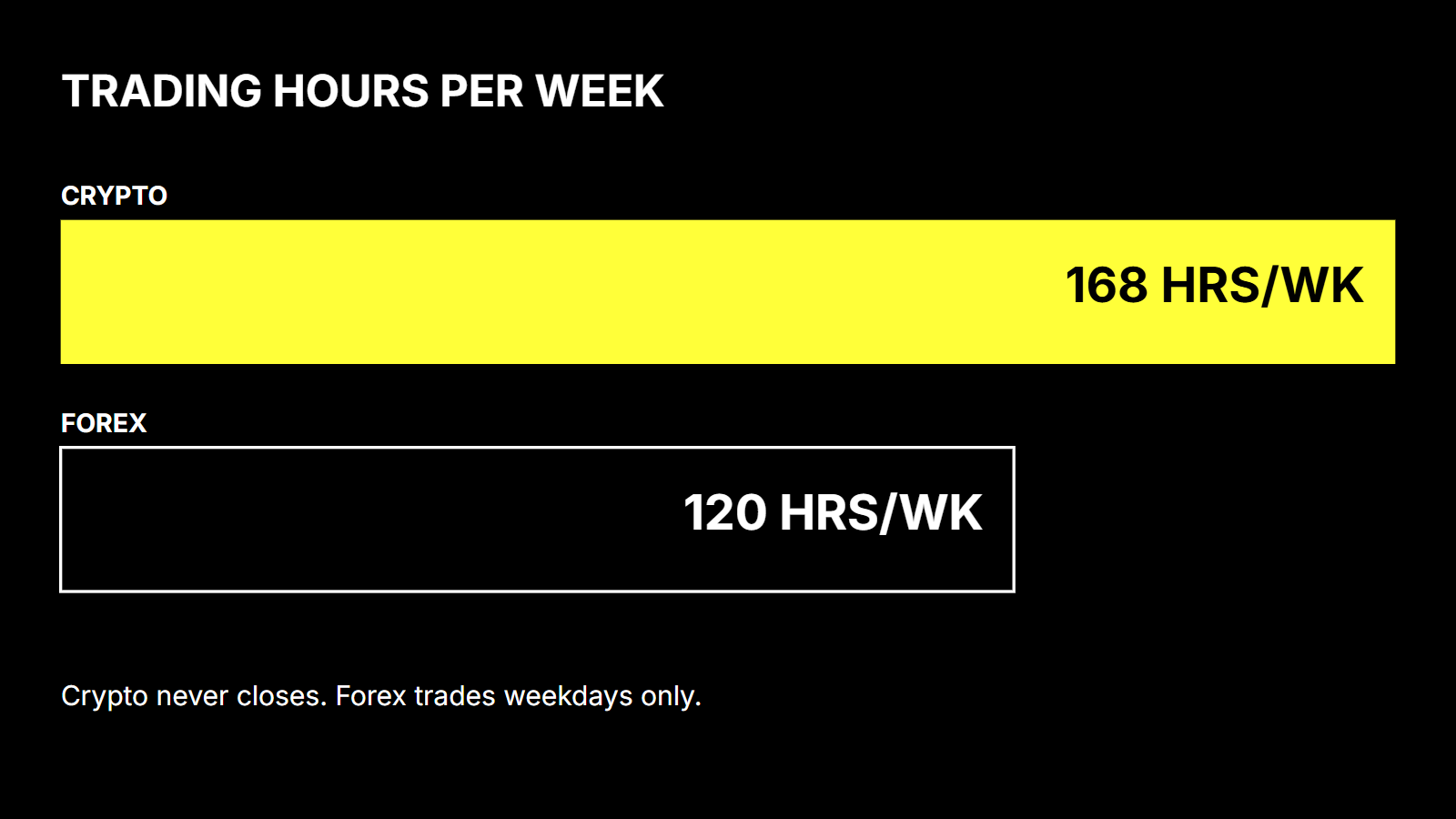
Crypto never closes; forex does. That shapes both the risk rules and the lifestyle fit of each evaluation. On Crypto Fund Trader’s own platforms, crypto trades 24/7 while forex trades Monday through Friday, so a crypto prop firm evaluation can be built, breached, or advanced on a Saturday night, while a forex prop firm evaluation sits idle until the week reopens.
Scale runs the other way. Forex remains the largest financial market in the world: the Bank for International Settlements’ April 2025 Triennial Survey put average daily turnover at $9.51 trillion, up 27% from $7.47 trillion in 2022. The total cryptocurrency market, by comparison, sat around $3 trillion as of September 2026 according to CoinMarketCap, smaller in total value and a figure that shifts by the hour, so treat it as a snapshot rather than a fixed number. A forex prop firm evaluation therefore trades a deeper, longer-established market that takes weekends off; a crypto prop firm evaluation trades a smaller but always-open one.
How an order fills can differ more between a crypto prop firm and a forex prop firm than the profit target does. CFT’s Bybit evaluations run on the trader’s own Bybit account, connected by API, and the company states that it “does not add any markup, artificial spread, or fictitious slippage.” Spreads and slippage on that leg come entirely from Bybit’s own liquidity. KYC isn’t required to start the Bybit evaluation, though CFT’s own KYC is mandatory before any reward is processed. Only USDT pairs count during the evaluation; USDC trades aren’t counted, and spot trading is prohibited.
The forex leg runs on CFD-style pricing instead, through MT5 or Match-Trader: EUR/USD spreads from 0 pips, forex commission at $2.5 per lot per side. Swaps apply to positions held overnight on both platforms (00:00 UTC on MT5, 22:00 UTC on Match-Trader). Bybit uses funding rates instead of swaps, and CFT’s marketing advertises no swap fees on that platform, accurate for Bybit specifically, not a blanket claim across the forex accounts.
Time limits are firm policy, not a law of the asset class. CFT’s FAQ states there is “no maximum time limit to complete the evaluation” and “no minimum number of trading days required,” the same rule whether the trader is on a crypto or forex account. FTMO’s 2-Step Challenge also has an unlimited trading period: its published rules list a 10% Phase 1 profit target, a 5% Verification target, a 5% daily loss cap, a 10% maximum loss, and at least four trading days in each phase (checked October 2026).
CFT’s own 2-Phase program asks for 8% in Phase 1 and 5% in Phase 2, with a 5% daily loss limit and a 10% fixed overall cap calculated on equity. Both examples allow unlimited time; the differences here are the first-phase target and minimum trading-day requirement, not a 30- or 60-day deadline. These are differences between firms’ programs, not between crypto and forex as categories.
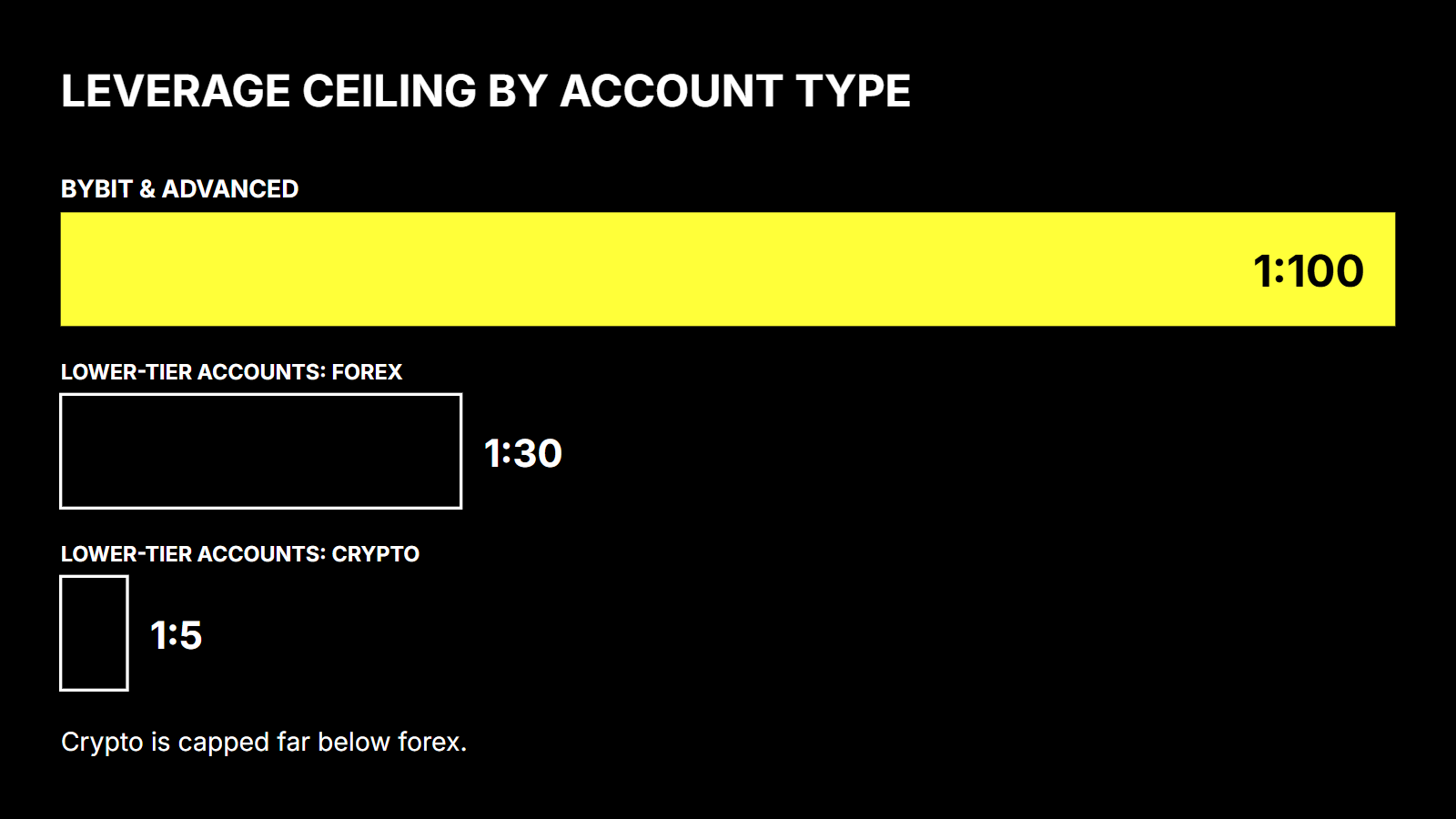
Nominal leverage looks similar on paper across both tracks; the instrument count and the conservatism built into lower-tier accounts do not. On the crypto side, Bybit and CFT’s Advanced accounts allow up to 1:100, while Student, Ascend and Instant accounts cap crypto exposure at 1:5, a sharp reduction that reflects how much more digital assets can move intraday. The forex side carries the same 1:100 ceiling on Advanced accounts but a looser 1:30 on Student, Ascend and Instant.
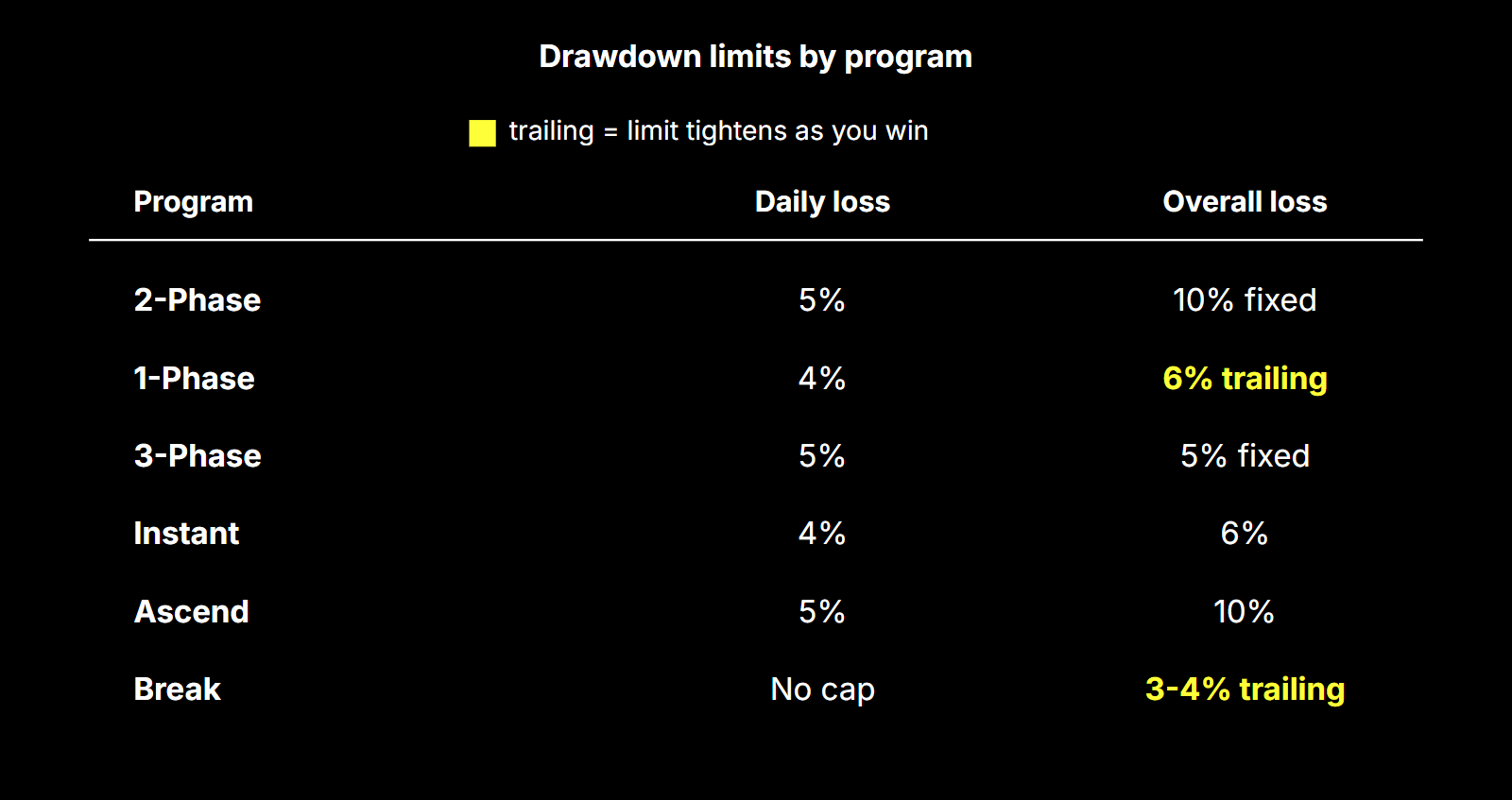
Instrument breadth tells the category story more clearly than leverage does. CFT’s Bybit evaluation covers more than 550 crypto futures pairs; its MT5 and Match-Trader catalogue adds 106 forex pairs, 15 indices, 22 commodities and 25 stocks. Drawdown rules, meanwhile, are set by the evaluation program rather than the asset class: a 2-Phase account runs the same 5% daily and 10% fixed caps whether the trader is working crypto pairs or currency pairs inside it.
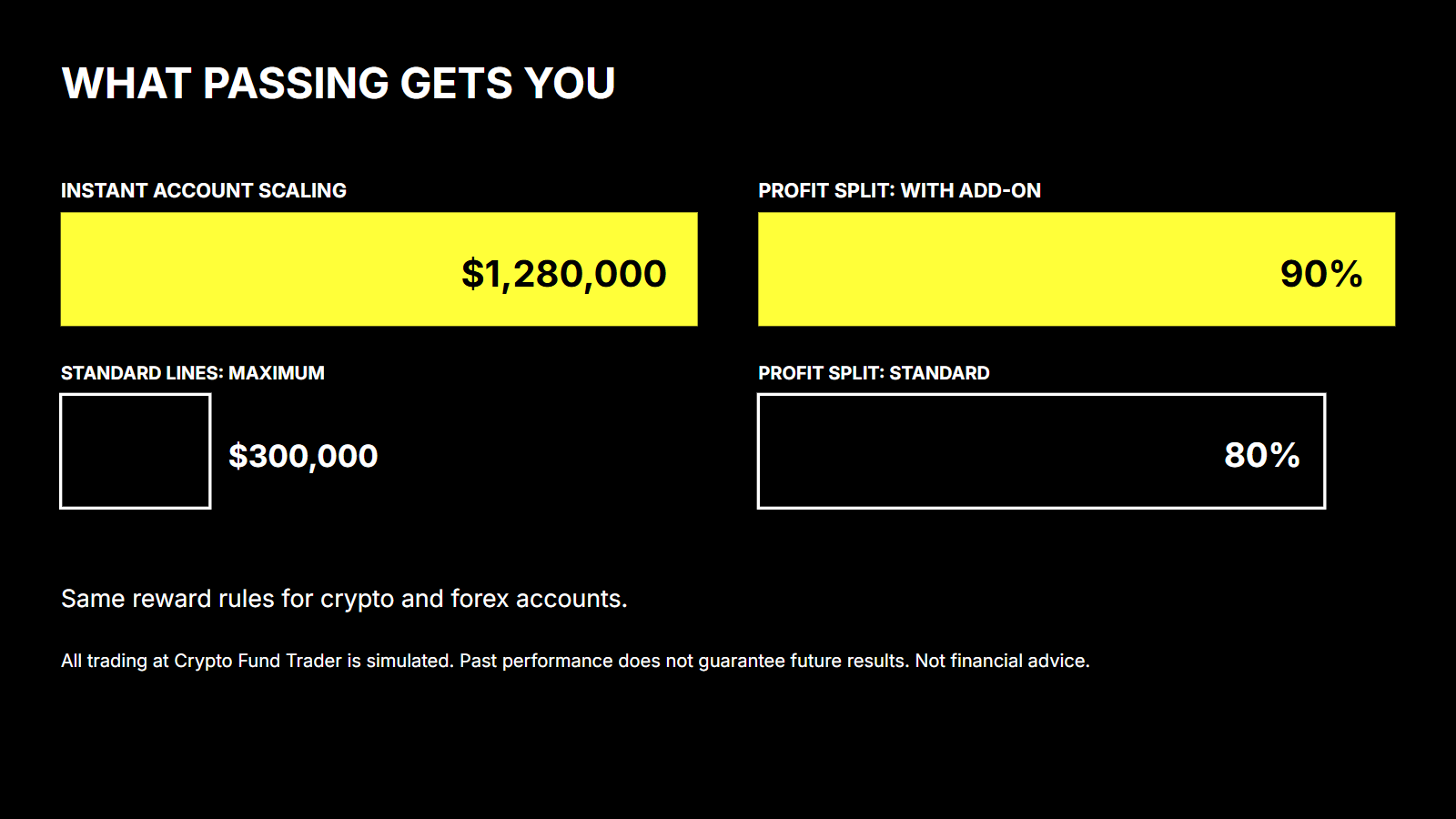
What a trader becomes eligible for looks identical regardless of which market they traded: the reward mechanism belongs to the evaluation firm’s program, not the asset class. On CFT, traders who pass may become eligible to receive up to 80% of simulated profits, or up to 90% with the Bonus Performance add-on. The maximum simulated funded allocation sits at $300,000 across the standard lines, and Instant accounts can scale to $1,280,000. CFT’s own KYC must be completed and approved before any scholarship reward is processed. That’s a separate step from the Bybit evaluation, which doesn’t require it. Processing takes about 8 hours on average, though CFT’s team may take up to 48 business hours. CFT also keeps a public reserve dedicated to scholarship rewards, updated daily, that any trader can check directly. None of this is an entitlement: CFT’s own terms allow it to withhold a scholarship reward even after a trader has met the target.
A crypto prop firm evaluation suits a trader who wants round-the-clock access, is comfortable with digital-asset volatility, and prefers execution against a live exchange order book over synthesized CFD pricing: someone who checks charts outside a 9-to-5, weekends included.
A forex prop firm evaluation suits a trader who wants the built-in break a closed weekend provides, the depth of a market moving over $9 trillion a day, and one evaluation that also opens indices, commodities and stocks rather than crypto alone. It also suits anyone trading from the United States: MetaTrader 5 isn’t available to US residents, while Match-Trader carries no country restriction and CFT imposes no additional country restriction on its Bybit offering (traders remain responsible for Bybit’s own jurisdictional terms).
Plenty of traders don’t have to pick one lane. Because CFT runs both categories on one evaluation framework, a trader can hold an Ascend account on crypto and a 2-Phase account on forex without opening a second relationship or learning a second rule set.
“Crypto prop firm vs forex prop firm” is a market-vs-market question dressed up as a company-vs-company one. Trading hours, execution model and instrument range differ between the two categories; profit targets, drawdown structure and reward eligibility are set by the evaluation firm’s program and apply the same way on either side. Crypto Fund Trader is a case in point: a single evaluation catalogue spanning 556+ digital assets and 106 forex pairs, plus indices, commodities and stocks, on MT5, Match-Trader and Bybit. The category worth choosing is the one whose market hours and execution style match how you already trade.
No, it isn’t, and you should trade knowing that going in. What you’re trading is a simulated account tied to a live price feed: your wins and losses are tracked internally, not executed with the firm’s actual capital, until a scholarship reward gets approved and sent to you. That’s not unique to crypto prop firms; most forex prop firms, FTMO included, run the same structure. The honest way to think about it: you’re not a “funded trader” with institutional backing, you’re a demo trader who becomes eligible for a real cash reward if the firm approves your results.
Because paper trading never tests what actually breaks traders: real drawdown pressure with money attached, even if it’s the firm’s simulated money and not yours. A free demo doesn’t have a profit target, a daily loss cap, or a consistency rule attached to it, so it doesn’t force the discipline an evaluation does. That said, if you’re not disciplined enough to pass a demo challenge without financial stakes, paying for another shot at the same problem isn’t going to fix it. That’s worth being honest with yourself about before you buy in.
They are worse on the entry-tier accounts, and that gap is by design, not an oversight. CFT caps crypto exposure at 1:5 on Student, Ascend and Instant accounts versus 1:30 for forex on the same tiers, matching the fact that crypto can move harder intraday. Only the Advanced account raises crypto to 1:100, the same ceiling as forex. If you’re used to trading crypto with much higher leverage on an exchange, the lower-tier evaluation leverage will feel restrictive. It’s a rule of the account tier, not something you can request around.
It doesn’t block you from starting the evaluation, but it will block your reward. CFT doesn’t require KYC to begin the Bybit evaluation itself, but its own KYC has to clear before any scholarship reward gets processed. That gap trips people up: they pass the challenge, hit the profit target, then sit waiting on KYC approval before the reward is released, which is a separate step from anything Bybit checks. Budget time for it instead of assuming a pass means an immediate reward.
Yes, and that’s stated plainly in the terms, not a hidden trick: CFT’s own rules allow it to withhold a scholarship reward even after a trader meets the target. That kind of clause is common across the industry, not specific to one firm, which is exactly why passing an evaluation and actually receiving a reward are two different things worth separating in your head. Check whether a firm publishes a live reserve page before you buy an evaluation. CFT updates its scholarship reserve page daily, which is at least a signal of transparency, even though it isn’t a guarantee.
It matters more for lifestyle than for edge. Crypto trades 24/7, so a crypto evaluation can be built or blown on a Saturday night, while a forex account just sits idle until Monday: good if you want round-the-clock access, bad if you want a built-in break from staring at charts. Forex is also a much deeper market, with $9.51 trillion traded daily versus roughly $3 trillion in total crypto market cap. Neither is “better.” Pick based on whether you want a market that never stops or one that forces you to log off.
SWISS RLCRATES AG is a provider of educational services, all information available on our site is intended solely for the study purposes related to trading on financial markets. Accordingly, we do not offer financial, investment, tax, brokerage or other advice and/or services. Trading in financial markets is a high-risk activity, past performance do not guarantee future ones. It is highly advised not to risk more, than you can afford to lose. Brokers and operators of trading platforms are persons or entities that are separate from SWISS RLCRATES AG and their own terms and conditions will apply when you use their services and products. Neither SWISS RLCRATES AG nor RLCRATES, S.L. (the company that provides services with MT5) operate in countries where crypto or CFD’s activity is not allowed. The content in our platform is applicable to the extent local laws and/or regulations permit. SWISS RLCRATES AG acts as a payment/marketing agent for RLCRATES SL. SWISS RLCRATES AG is not authorized or licensed in Switzerland and does not offer any trading services with MT5 neither conducts any regulated activities.
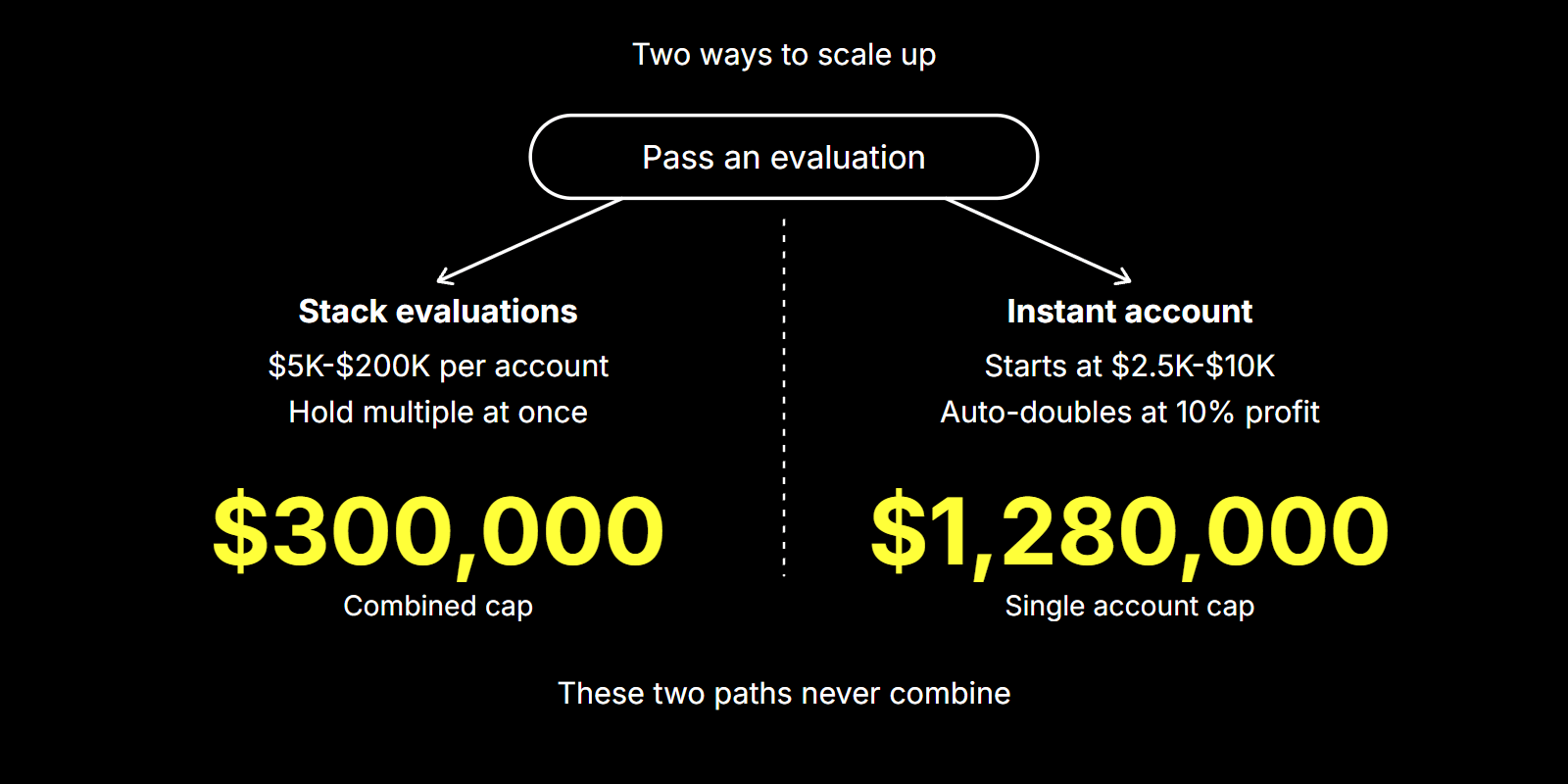
Crypto Fund Trader has exactly two routes to a bigger simulated account, and they do not combine into a third.
| Route | How size increases | Ceiling |
|---|---|---|
| Standard evaluations (2-Phase, 1-Phase, 3-Phase) | Pass more than one evaluation; account sizes run $5,000 to $200,000 each | $300,000 total simulated allocation per user |
| Instant | Automatic doubling at a profit milestone, no new evaluation purchase required | $1,280,000, with up to three active Instant accounts |
The standard route caps individual accounts at $200,000, so reaching the $300,000 per-user ceiling means holding more than one passed evaluation at once. The Instant route works differently: the account itself grows without a second purchase, up to a ceiling more than four times higher.
Crypto prop firm scaling on the Instant line runs on a single trigger: reach 10% simulated profit, and the account size doubles.
Crypto Fund Trader calls this the “Withdrawal & Upgrade” step. A trader starts an Instant evaluation at $2,500, $5,000, or $10,000, with no profit target to clear first, only the standing 4% daily and 6% overall loss limits from the first trade. Hitting 10% simulated profit on the current balance triggers the upgrade, which doubles the account’s demo size. Because each step doubles the previous balance, the ladder from a $10,000 starting account is fixed math, not a forecast:
$10,000 → $20,000 → $40,000 → $80,000 → $160,000 → $320,000 → $640,000 → $1,280,000
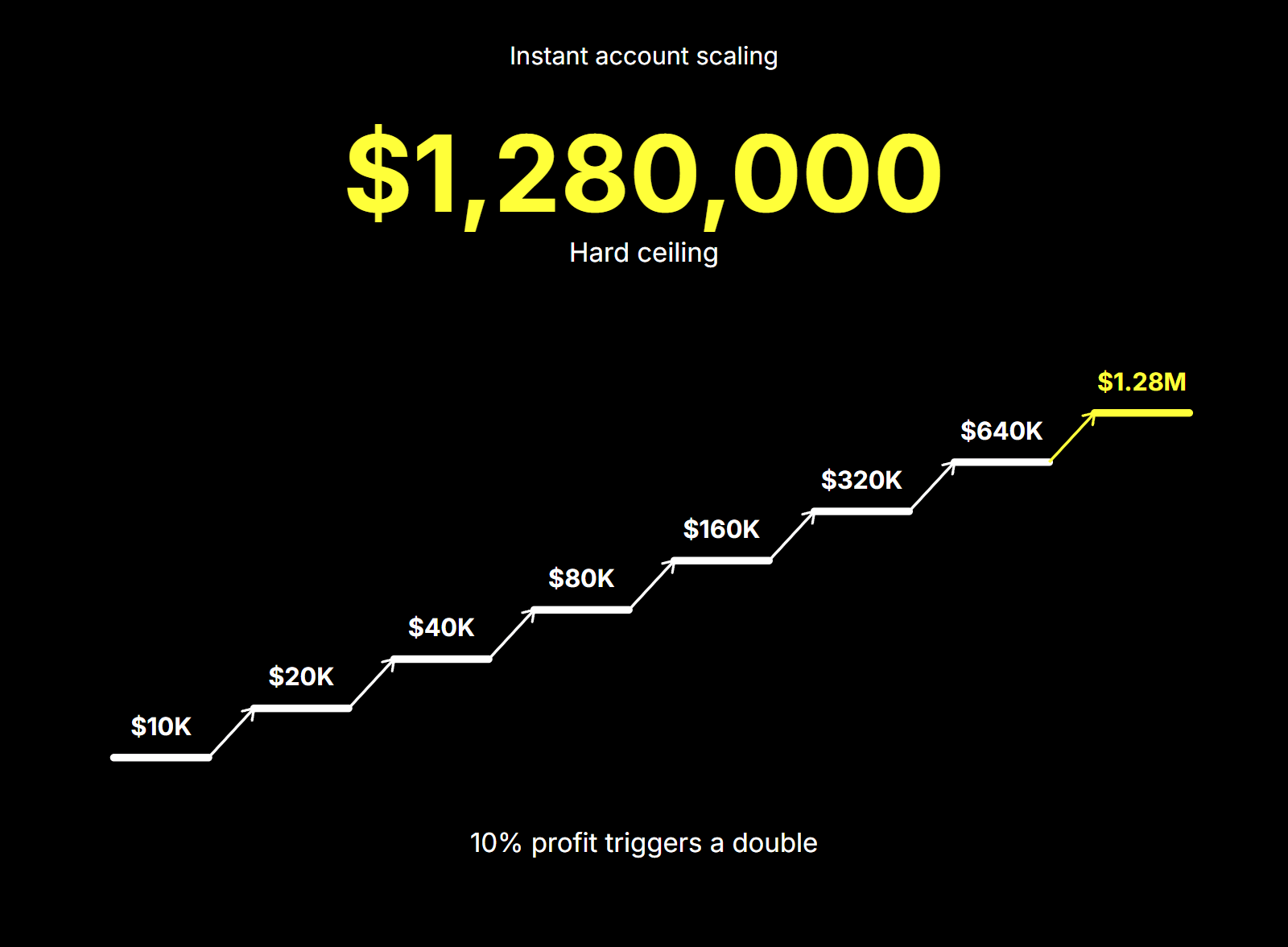
That’s seven doublings to reach the ceiling: arithmetic, not a promise about how fast or whether any account gets there. A trader can also run up to three Instant accounts at once.
A bigger account inherits the same drawdown regime as a smaller one: scaling changes the balance, not the rulebook.
Drawdown on every account is calculated on equity, so an open loss counts against the limit before a position closes, and the daily loss figure resets from the account balance at 12:05 AM UTC each day. A doubled Instant account is still governed by the same 4% daily and 6% overall loss limits it started with. The dollar amounts scale with the balance; the percentages do not. Simulated profit is also capped at $10,000 per day or per trade; equity above that threshold may be closed and the excess deducted.
One rule that does not travel across the product line is the Final Stage consistency requirement on Break: no single trading day may account for more than 40% of total profits. It applies only at reward-request time. Reverse trading, account sharing, copy trading restrictions, and KYC requirements also apply regardless of account size.
KYC is a separate gate that scaling does not skip: before any scholarship reward can be processed, KYC must be completed and approved.