


Crypto Fund Trader caps standard evaluations at $300,000 and Instant accounts at $1,280,000. Here’s how the scaling mechanics actually work, where the ceilings sit, and which rules decide whether your account gets there.
[ RANK ]

Crypto Prop Trading Taxes in 2026: Complete Guide for Funded Traders

Crypto prop trading taxes in 2026 depend on three things: how the IRS classifies your gains, whether your evaluation firm issues a US tax form, and what its new digital-asset broker reporting now shows the IRS about your wallet. There’s no single answer. That’s why this guide won’t tell you what to write on a return.


Why this filing season is more complicated than last year’s


Three things changed at once for anyone trading crypto through an evaluation account in 2026. First, Form 1099-DA now requires custodial exchanges to report cost basis, not just gross proceeds, to the IRS. Second, the crypto wash-sale loophole that lets traders realize a loss and immediately rebuy is still open, but a bill sitting in the House Ways and Means Committee could close it. Third, “funded trader” as a category has grown past forex and futures into crypto, and tax professionals still disagree about how a prop firm’s reward payments should be classified. None of this changes what you owe. It changes how much documentation you need to defend the number you file, and how easily a mismatched 1099 can trigger an IRS notice months later.


How the IRS treats crypto trading gains in 2026


The IRS taxes cryptocurrency as property, not currency, so every trade is a taxable event measured against your holding period.

A gain on a position held one year or less is short term and taxed at your ordinary income rate. A gain on a position held longer than a year is long term and taxed at the lower capital-gains rates. That distinction does most of the work in any crypto prop trading taxes conversation, because evaluation-account trading (closing positions in hours or days to hit a profit target inside a drawdown limit) sits almost entirely in short-term territory. Long-term rates rarely apply to a trader whose whole strategy is built around a fixed daily loss cap.

Filing status 0% long-term rate 15% long-term rate 20% long-term rate
Single $0-$49,450 $49,451-$545,500 $545,501+
Married filing jointly $0-$98,900 $98,901-$613,700 $613,701+

2026 federal thresholds, taxable income. Short-term gains instead follow the ordinary brackets: 10%, 12%, 22%, 24%, 32%, 35%, 37% (NerdWallet).


Funded trader tax 2026: why the evaluation firm’s structure is the real variable


The funded trader tax 2026 question that matters isn’t the rate. It’s how your firm classifies the relationship.


That classification decides everything downstream: contractor, reward recipient, or something else. US-based prop firms typically treat traders as independent contractors and issue Form 1099-NEC once payments cross $600 a year, which routes the income through Schedule C as self-employment income: ordinary tax rates plus a 15.3% self-employment tax (TraderTax.net; Green Trader Tax). Firms incorporated outside the US often skip the US tax form entirely, but that doesn’t remove the obligation. US taxpayers report worldwide income whether or not a 1099 shows up. Where a firm sits changes the paperwork, not the duty to report.
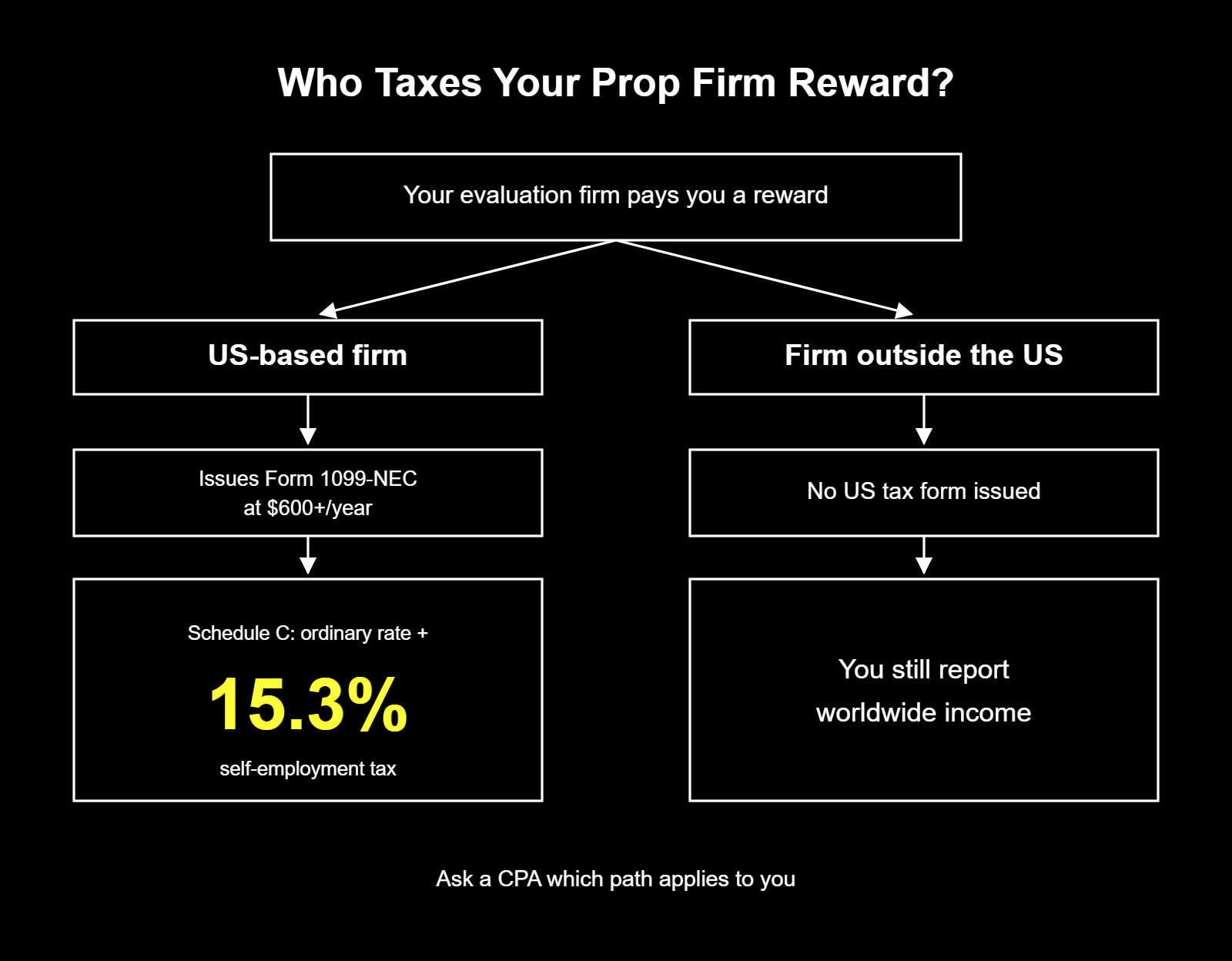
Decision tree showing how crypto prop trading taxes split by firm location: a US-based evaluation firm issues Form 1099-NEC and adds 15.3% self-employment tax on Schedule C income, while a firm outside the US issues no US tax form but the trader still reports worldwide income.

That’s also where this guide stops. How a specific firm classifies its reward payments depends on that firm’s legal structure and home jurisdiction, details that vary firm to firm and that no general guide can resolve. Crypto Fund Trader, an evaluation firm operated by SWISS RLCRATES AG, states plainly in its own terms that it doesn’t offer “financial, investment, tax, brokerage or other advice.” That’s not a hedge unique to CFT. Every firm in this category carries the same disclaimer, for good reason: the firm that pays you isn’t positioned to tell you how that payment gets taxed. A CPA who can see your account structure is.


Form 1099-DA changes what the IRS already sees


Starting this filing season, custodial exchanges must report cost basis, not just gross proceeds. That closes a gap that used to leave the IRS with half the picture.


Under the final regulations, digital asset brokers (centralized exchanges, hosted wallet providers, and certain payment processors) must issue Form 1099-DA covering sales that took place in 2025, with basis reporting becoming mandatory for transactions from January 1, 2026 onward. Non-custodial and decentralized platforms are exempt for now. The practical effect: if you trade crypto on Bybit or another centralized exchange, the IRS increasingly receives the same trade-by-trade data you’d need to reconstruct your own gains manually. That makes a mismatch between what you file and what your exchange reports far easier to flag.


The crypto wash-sale loophole: open in 2026, not permanent


The wash-sale rule that blocks stock traders from claiming a loss on a quickly-repurchased security still doesn’t apply to crypto, because the IRS treats digital assets as property, not securities.


That means a trader can sell a position at a loss and buy it back the same day while still claiming the loss on a return. That’s a real, current gap, not a rumor. It’s also not settled law forever: H.R. 9172, introduced in June 2026, would extend wash-sale treatment to digital assets, and it’s sitting in committee rather than dead (Gordon Law Group). The IRS can also invoke the economic-substance doctrine against trades that exist only to generate a tax loss with no real market risk attached, so “the rule doesn’t technically apply” isn’t the same as “any pattern of selling and immediately rebuying is safe.” Treat the loophole as current, not permanent.
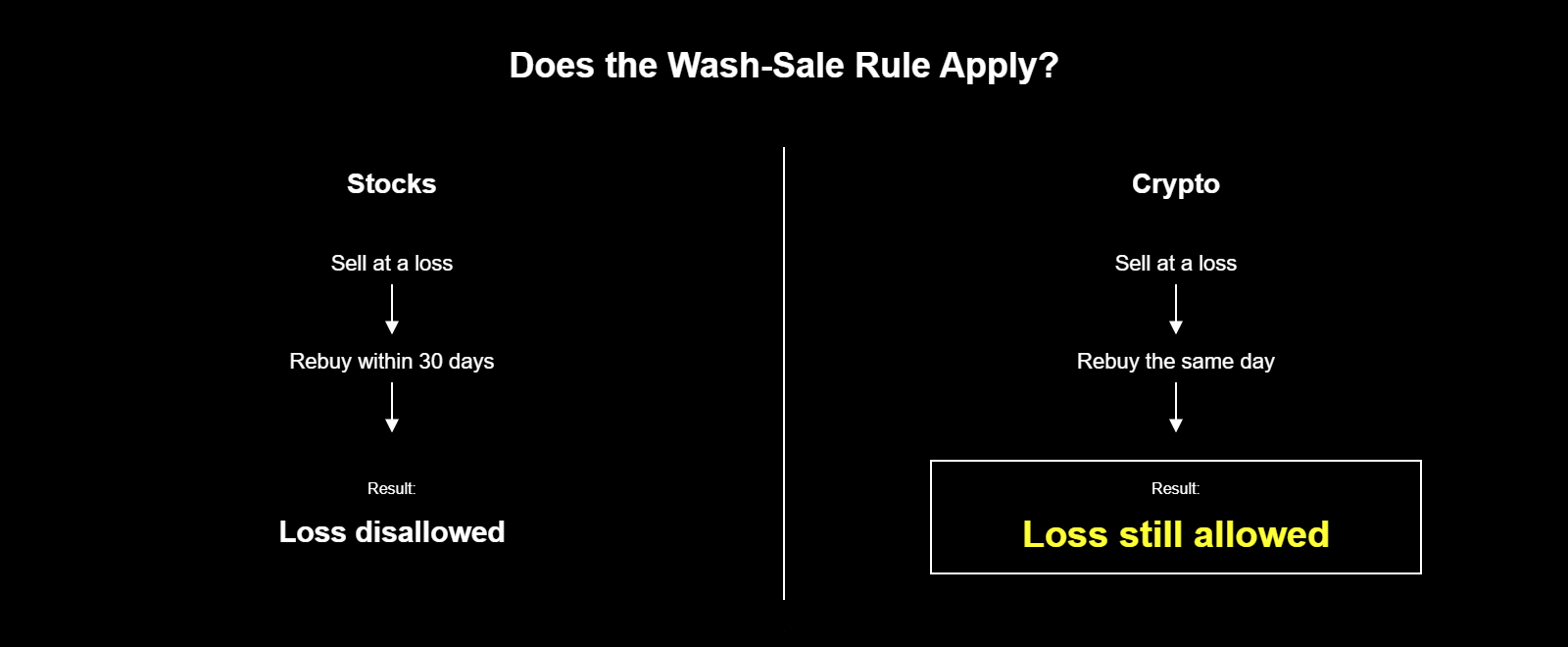
Side-by-side comparison of the wash-sale rule for stocks versus crypto: selling a stock at a loss and rebuying within 30 days disallows the loss, while selling crypto at a loss and rebuying the same day still allows it, because the IRS treats crypto as property, not a security.


A recordkeeping checklist for crypto prop trading taxes


Recordkeeping is the one part of crypto prop trading taxes every trader controls directly, regardless of how the classification questions above get resolved.


None of it matters if you can’t reconstruct what happened in your account, whichever firm you trade for.
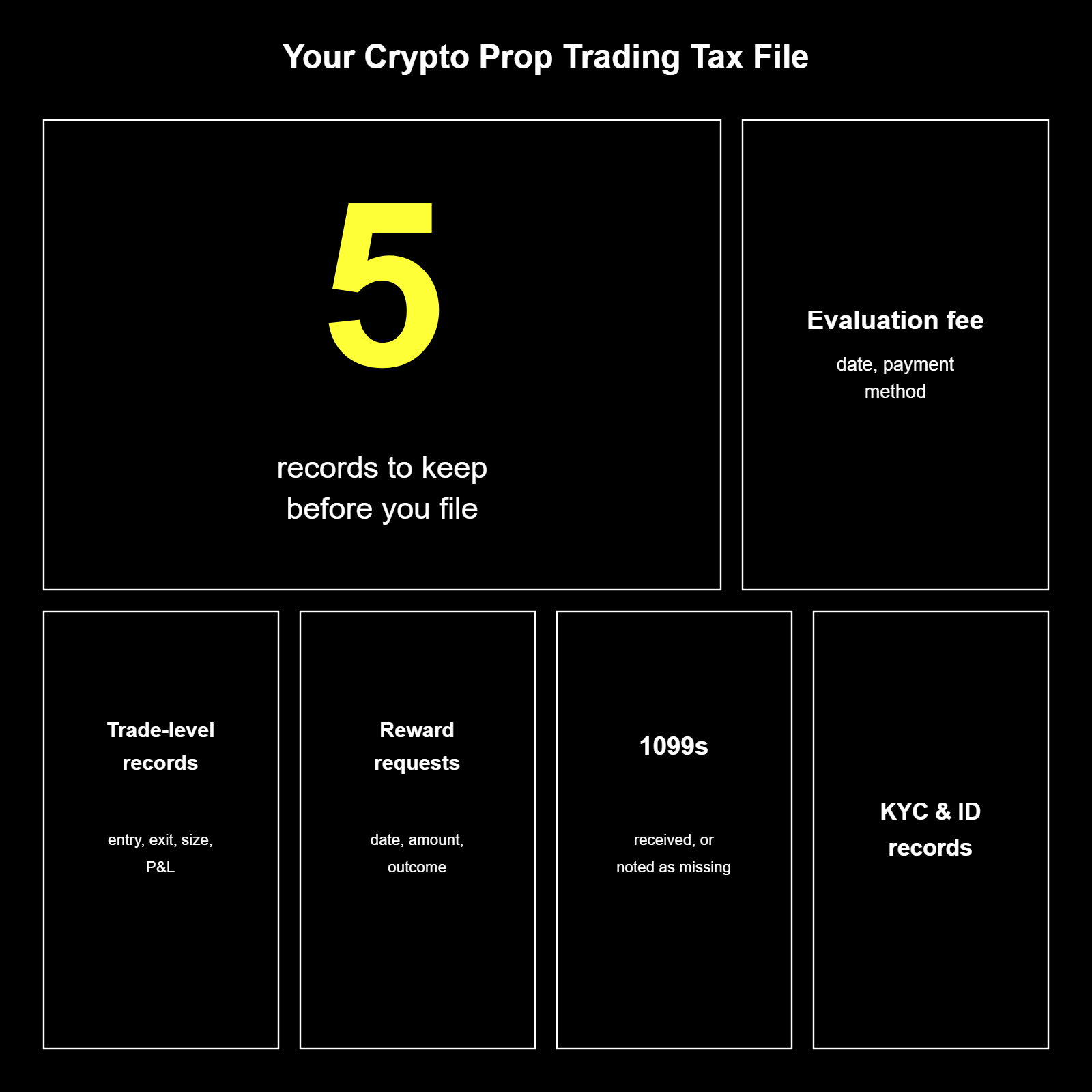
Checklist of five records crypto prop trading taxes require: evaluation fee payments, trade-level records, reward requests, 1099 forms received or missing, and KYC identity-verification records.

  • Every evaluation fee paid, with the date and payment method. Whether it’s deductible depends on your classification, a question for your accountant, not this guide.
  • Trade-level records from the platform itself: entry and exit timestamps, position size, and realized profit or loss per trade, not just a running account balance.
  • Every scholarship reward request and its outcome: date submitted, amount requested, amount received, and processing time. A gap between request and payment can matter for which tax year it falls into.
  • Any 1099 form received, and a note of which firms didn’t issue one, since the reporting obligation doesn’t disappear either way.
  • KYC and identity-verification records, since most evaluation firms (including Crypto Fund Trader) require completed KYC before any scholarship reward is processed. That paperwork often overlaps with what a tax preparer needs to confirm your identity on the account.

Crypto Fund Trader’s own structure is a useful example of what this looks like in practice, without this guide taking a position on how any of it gets taxed: a trader buys an evaluation, trades a simulated account up to a $300,000 maximum simulated funded allocation on the standard lines, or scales an Instant account up to $1,280,000 through repeated profit-triggered upgrades. On passing and staying compliant, a trader may become eligible to receive up to 80% of simulated profits generated (90% with the Bonus Performance add-on), released only after KYC is complete, with average processing around 8 hours and a stated ceiling of 48 business hours. Every one of those events (the fee, the pass, each scholarship reward request) is a date and a dollar figure worth keeping in a spreadsheet the day it happens, not reconstructed from memory the following April.


Talk to a professional before you file


Crypto prop trading taxes in 2026 come down to documentation more than any single rule.

Your specific facts answer the classification questions this guide raised, not a blog post and not the firm you trade for. An evaluation firm can tell you its rules for account size, drawdown, and reward eligibility. It can’t, and shouldn’t, tell you how the IRS will treat the payment once it lands. Keep the records this guide walked through, and take them to someone qualified to read your specific setup before you file.


Frequently asked questions


Do I owe taxes on a simulated trading account before I request a reward? That depends on what creates a taxable event under your classification, which a general guide can’t determine for you. Trading inside a simulated account and receiving a reward payment are procedurally different. Ask a tax professional which point, if any, triggers reporting for your situation.

If my evaluation firm doesn’t send me a 1099, do I still have to report the income? Yes. US taxpayers must report worldwide income regardless of whether a form arrives. Many evaluation firms sit outside the US and issue no US tax form at all, which shifts the recordkeeping burden onto the trader, not the reporting obligation.

Does the crypto wash-sale loophole apply to evaluation-account trading? The rule is about how losses are treated on a return, not which platform generated the trade, and it doesn’t currently apply to crypto because the IRS treats digital assets as property, not securities. Whether it’s relevant to you depends on how the IRS classifies your specific gains and losses. That, again, is a question for a professional.

Will Form 1099-DA change what I need to report, or just what the IRS already knows? It changes what the IRS has on file, not what you’re legally required to report. The obligation to report taxable crypto activity existed before Form 1099-DA. What changes is how easily a gap between your return and your exchange’s report gets noticed.

Why “scaling” gets oversold

Most articles about crypto prop firm scaling read like income calculators: start with $10,000, scale to six figures, imply a payday along the way. The industry’s own numbers argue against that framing. Retail prop trading generated an estimated $850 million in revenue in 2026 across roughly 2.1 million active funded traders, but only 5% to 14% of purchased challenges ever reach a funded stage, and about 7% of challenge buyers ever collect a reward, according to Track360’s 2026 industry data. Scaling is available only to traders who clear that first bar; it’s not automatic once you buy an evaluation.

This guide skips the earnings math. It covers the mechanics of how to scale up crypto prop trading capital: where the ceilings sit, and which rules decide whether an account survives long enough to reach them, using Crypto Fund Trader’s published structure as the example.

What “scaling” actually means on an evaluation account

Scaling up crypto prop trading capital means increasing the size of a simulated funded account, not depositing more of your own money.

Crypto Fund Trader describes itself as a simulated trading evaluation firm: traders buy an evaluation, trade a simulated account across crypto, forex, indices, commodities, or stocks, and, if they pass and stay compliant, may become eligible for a simulated funded account of up to $300,000 in virtual capital, plus performance-based rewards. Nothing about scaling changes that structure. A larger account is still demo capital: a bigger balance raises the notional amount a trader is evaluated against, not a transfer of real funds. Every number in this guide refers to that simulated allocation.

Two ways to scale up crypto prop trading

Crypto Fund Trader has exactly two routes to a bigger simulated account, and they do not combine into a third.

RouteHow size increasesCeiling
Standard evaluations (2-Phase, 1-Phase, 3-Phase)Pass more than one evaluation; account sizes run $5,000 to $200,000 each$300,000 total simulated allocation per user
InstantAutomatic doubling at a profit milestone, no new evaluation purchase required$1,280,000, with up to three active Instant accounts

The standard route caps individual accounts at $200,000, so reaching the $300,000 per-user ceiling means holding more than one passed evaluation at once. The Instant route works differently: the account itself grows without a second purchase, up to a ceiling more than four times higher.
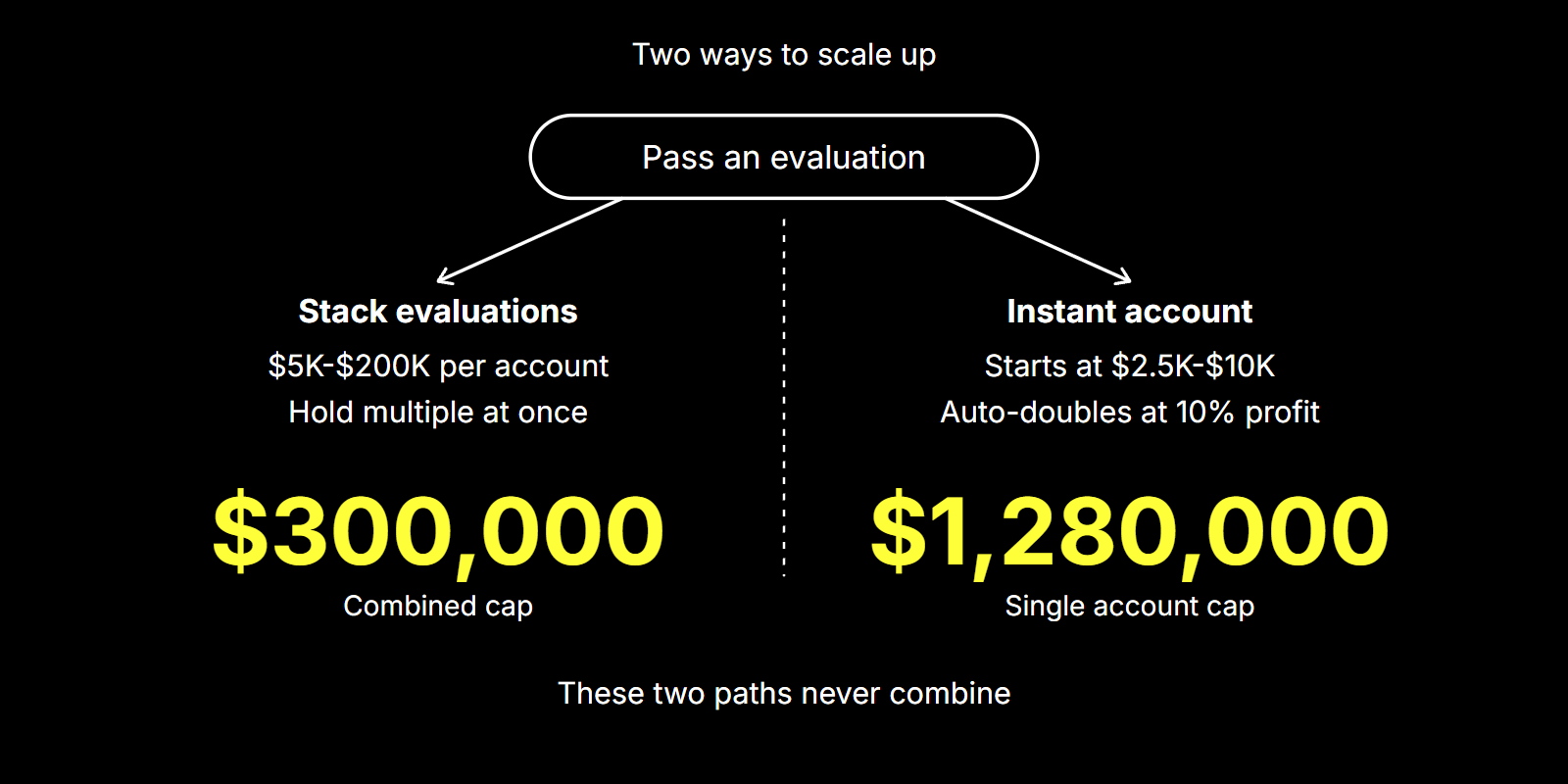
Diagram comparing two ways to scale up crypto prop trading capital: stacking evaluations up to a $300,000 combined cap, or an Instant account that auto-doubles up to $1,280,000.

Program Profit target Daily loss / Overall loss
2-Phase
Phase 1: 8%, Phase 2: 5%
5%
1-Phase
10%
4% / 6%, trailing
Break
5% ($25k) / 6% ($50k, $100k)
none / 4% trailing ($25k, $50k) or 3% trailing ($100k)

How crypto prop firm scaling works, step by step

Crypto prop firm scaling on the Instant line runs on a single trigger: reach 10% simulated profit, and the account size doubles.

Crypto Fund Trader calls this the “Withdrawal & Upgrade” step. A trader starts an Instant evaluation at $2,500, $5,000, or $10,000, with no profit target to clear first, only the standing 4% daily and 6% overall loss limits from the first trade. Hitting 10% simulated profit on the current balance triggers the upgrade, which doubles the account’s demo size. Because each step doubles the previous balance, the ladder from a $10,000 starting account is fixed math, not a forecast:

$10,000 → $20,000 → $40,000 → $80,000 → $160,000 → $320,000 → $640,000 → $1,280,000
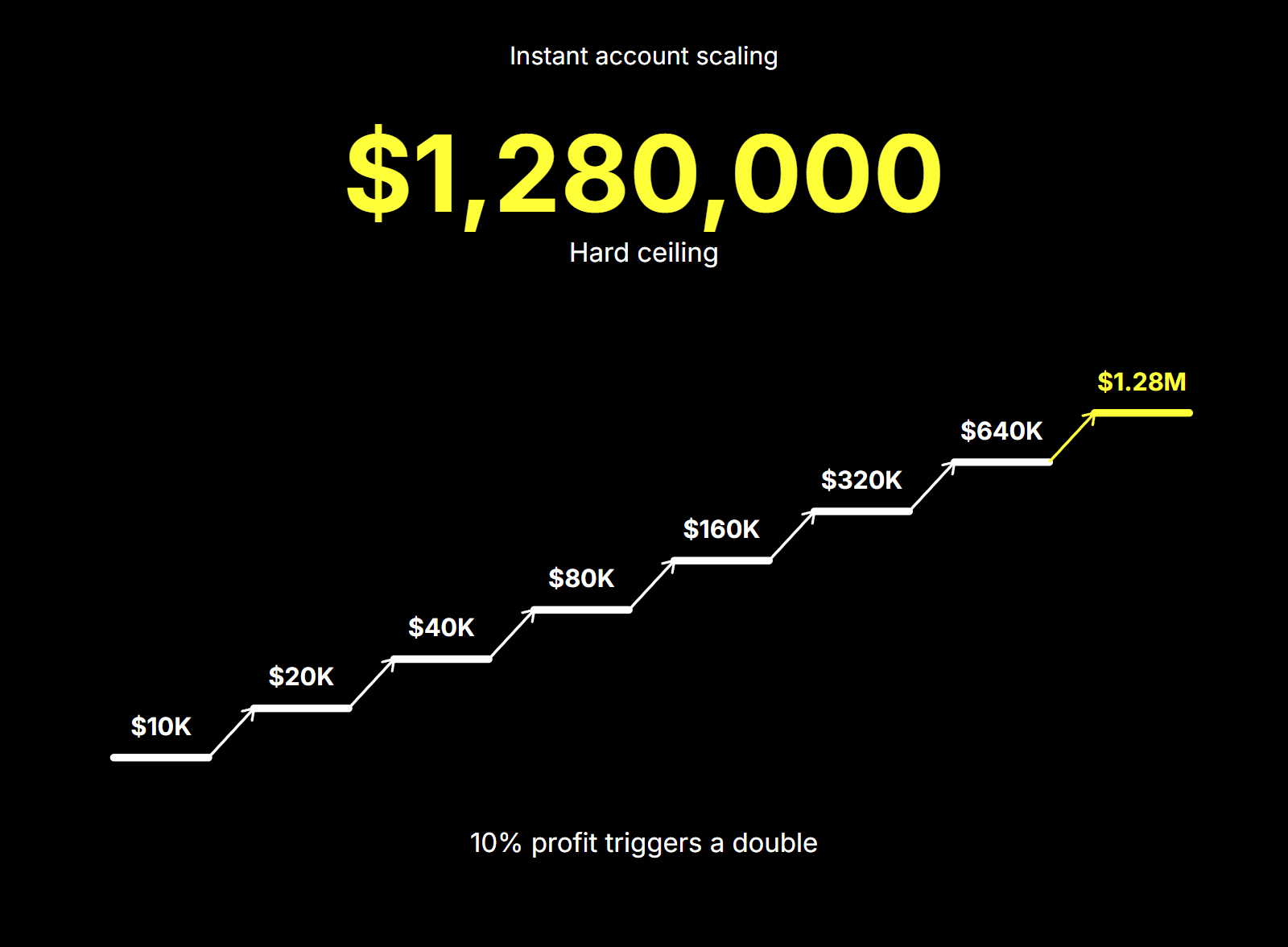
Chart showing a Crypto Fund Trader Instant account doubling from $10,000 to a $1,280,000 ceiling in seven steps, each triggered by 10% simulated profit.

That’s seven doublings to reach the ceiling: arithmetic, not a promise about how fast or whether any account gets there. A trader can also run up to three Instant accounts at once.

The ceiling: why $300,000 and $1,280,000 are hard stops

Both scaling ceilings are hard stops, not milestones a trader can negotiate past. The standard evaluation route tops out at $300,000 in combined simulated allocation per user, while the Instant route tops out at $1,280,000 across up to three active Instant accounts.

The $300,000 ceiling applies to the total of standard evaluations held by one user, not to a single account. The $1,280,000 ceiling belongs to the Instant Withdrawal & Upgrade path and is reached through the account-doubling ladder. Reaching either number does not turn simulated capital into a cash balance or remove the firm’s risk, compliance, KYC, or reward rules.

The 90% add-on is separate from account-size scaling: it can increase reward eligibility, but it does not raise either allocation ceiling.

Risk and compliance rules that decide whether you keep scaling

A bigger account inherits the same drawdown regime as a smaller one: scaling changes the balance, not the rulebook.

Drawdown on every account is calculated on equity, so an open loss counts against the limit before a position closes, and the daily loss figure resets from the account balance at 12:05 AM UTC each day. A doubled Instant account is still governed by the same 4% daily and 6% overall loss limits it started with. The dollar amounts scale with the balance; the percentages do not. Simulated profit is also capped at $10,000 per day or per trade; equity above that threshold may be closed and the excess deducted.
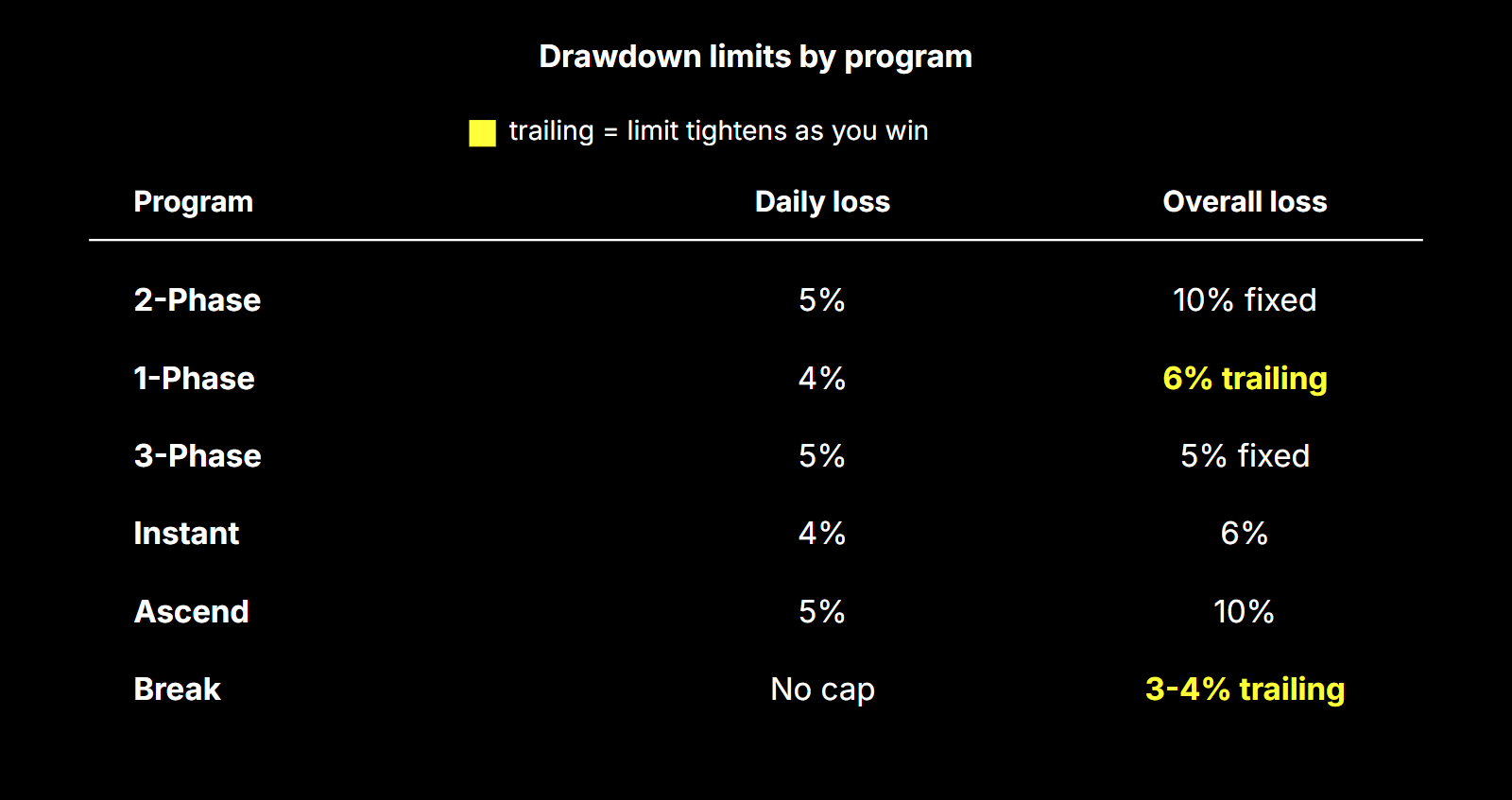
Table of daily and overall drawdown limits for Crypto Fund Trader's six evaluation programs, highlighting which use a trailing loss limit.

One rule that does not travel across the product line is the Final Stage consistency requirement on Break: no single trading day may account for more than 40% of total profits. It applies only at reward-request time. Reverse trading, account sharing, copy trading restrictions, and KYC requirements also apply regardless of account size.

KYC is a separate gate that scaling does not skip: before any scholarship reward can be processed, KYC must be completed and approved.


Choosing a path: a practical checklist

The right way to scale up crypto prop trading capital depends on which evaluation line a trader is already in: the two routes do not overlap.

  • Confirm whether the account is on the Instant line before assuming automatic doubling applies.
  • Track cumulative simulated allocation against the $300,000 ceiling when stacking standard evaluations.
  • Re-read the drawdown regime at every size tier: a $640,000 Instant account carries the same 4%/6% limits in larger dollar terms.
  • Keep KYC documentation current before requesting a reward.
  • Do not apply Break’s 40% consistency rule to other programs.
  • Treat the 90% performance add-on and account-size scaling as separate decisions.

Where this fits inside a real evaluation firm

Crypto Fund Trader runs six evaluation lines, but only Instant carries the automatic scaling mechanism described here; the other lines require holding multiple passed evaluations instead.

Bybit-based evaluations change what the account measures. Trades run on the trader’s own Bybit sub-account, connected by API, against Bybit’s live order book. CFT states it does not add markup, artificial spread, or fictitious slippage. KYC is still mandatory before any reward.

None of this changes the two hard numbers: up to $300,000 through standard lines, or up to $1,280,000 through the Instant Withdrawal & Upgrade mechanism. All of it is virtual capital in a simulated environment, with reward eligibility of up to 80% or 90% with the add-on.

Frequently asked questions

Is a doubled account actually more money? No. Doubling changes the simulated balance, not real money sitting anywhere.

Does doubling happen automatically? On Instant, reaching 10% simulated profit triggers the upgrade without buying anything new.

Do drawdown percentages get easier after scaling? No. The percentages stay fixed; only the dollar amounts scale.

Which route scales faster? Instant doubles automatically, while standard stacking requires passing multiple evaluations and has a $300,000 cap.

Does the 90% add-on affect account size? No. It changes reward eligibility, not the $300,000 or $1,280,000 ceilings.

Is Bybit different from CFD-style accounts? Yes. Bybit evaluations use a live order book through the trader’s own sub-account, but KYC is still required before rewards.

This article is for informational and educational purposes only and does not constitute financial advice. Trading cryptocurrencies and prop firm challenges involve significant risk; trade only with capital you can afford to lose.

Categories:

Follow us on