In early June 2026, Bitcoin slid below $63,000 in a single session, a fall of nearly 6 percent, while around $1.66 billion in positions were liquidated across the market in 24 hours. The same stretch capped a run where US spot Bitcoin ETFs lost roughly $4.33 billion over 13 consecutive trading days, their longest outflow streak since their 2024 launch. If that reads as intimidating, good. It also describes a fairly ordinary few weeks in this market.
That is the backdrop anyone learning crypto trading for beginners walks into. Here is the part most intro guides bury: you do not need to forecast any of it to start sensibly. You need a working account, money you can afford to lose, a couple of habits that keep you solvent, and a concrete plan for your first trade. This guide covers the full path from picking an exchange to placing and managing that first order, and it stays honest about where people actually lose money.
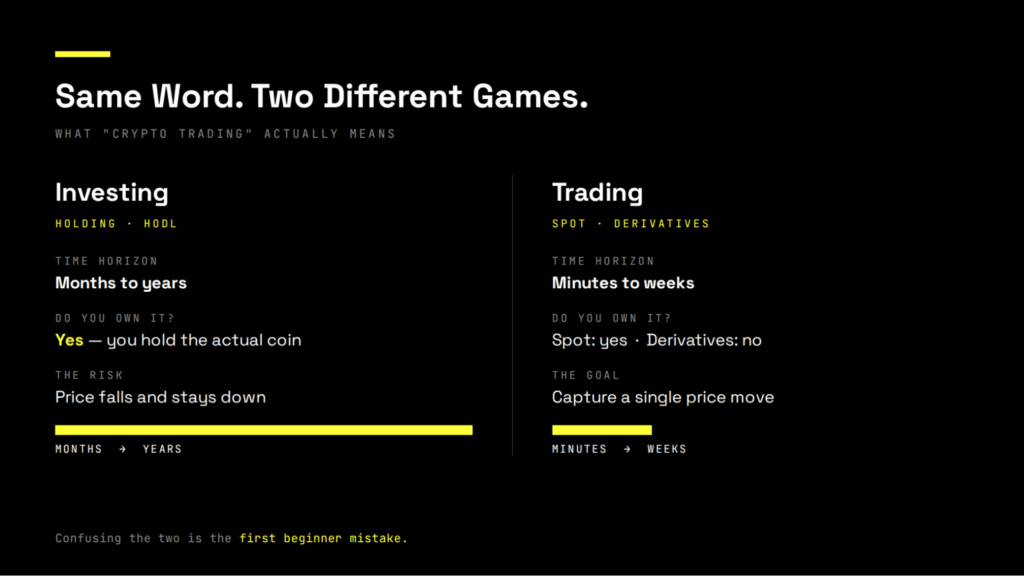
Crypto trading means buying and selling digital assets to profit from price movement. That covers two very different activities, and confusing them is the first beginner mistake.
Investing, often called holding or HODLing, means buying an asset like Bitcoin or Ethereum and keeping it for months or years. You own the coin. Your risk is that the price falls and stays down.
Trading means taking shorter positions, sometimes minutes, sometimes weeks, to capture a move. You might own the asset (spot trading) or you might hold a derivative contract that tracks its price without owning anything (futures, perpetuals). Derivatives let you use leverage, which magnifies both gains and losses. For a beginner, spot trading is the sane starting point, and the rest of this guide assumes you start there.
One number worth internalizing before you go further: industry data has long shown that the majority of retail leveraged traders lose money. Volatility is the reason crypto attracts traders and also the reason most newcomers blow up. Both things are true at once.
Three things matter before any trade, and none of them involve charts.
First, decide on risk capital. This is money whose total loss would not change how you eat, sleep, or pay rent. Crypto can drop 50 percent and keep going. Trade only with what you can genuinely afford to lose, and never with borrowed money.
Second, get your security basics in place. Most beginners lose funds not to bad trades but to hacked accounts and phishing. You will set up two-factor authentication, ideally an authenticator app rather than SMS, and you will learn to recognize fake emails and copycat websites. More on this in the steps below.
Third, accept that you are going to be wrong often. A good trader is not someone who is right most of the time. It is someone whose losing trades are small and whose winning trades are allowed to run. That mindset shapes every decision that follows, including how much you risk and where you place your exit.
Here is the practical sequence. This is the core of how to start crypto trading without skipping the parts that protect your money.
Step 1: Choose a Reputable Exchange
Your exchange is where you will register, deposit, and trade, so this choice matters more than any indicator. For most beginners in 2026, the shortlist comes down to a few well-established names.
Step 2: Register and Complete Verification
Account creation takes minutes. You provide an email, set a strong unique password, and confirm. Then comes KYC, short for Know Your Customer, where the exchange asks for ID and sometimes a selfie or proof of address. This is a legal requirement on regulated platforms, not an optional step. Verification can take anywhere from a few minutes to a couple of days during busy periods, so do this before you have money you want to deploy, not after.
Use a password manager. Reusing a password you use elsewhere is how a leak on some unrelated website becomes a drained crypto account.
Step 3: Lock Down Your Account
Before depositing a cent, secure the account properly.
Turn on two-factor authentication using an app like Google Authenticator or Authy rather than SMS, which is vulnerable to SIM-swap attacks. Set up a withdrawal address whitelist if the exchange offers one, so funds can only leave to addresses you pre-approved. Bookmark the real exchange URL and only ever log in through that bookmark, never through a link in an email or a search ad. Phishing sites that copy the login page are common and convincing.
If you ever plan to hold meaningful amounts long term, learn about hardware wallets. For active trading with small sums, a well-secured exchange account is a reasonable starting point.
Step 4: Deposit Funds
Most beginners fund with a bank transfer or card. Bank transfers are cheaper but slower; cards are instant but carry higher fees. Some users buy a stablecoin like USDC or USDT first, then trade from that, which keeps a steady unit of account while you learn.
Start small. Your first deposit is tuition, not a wealth plan. A sum you would be willing to lose entirely while learning the interface is the right size.
Step 5: Place Your First Trade
Now the actual trade. On the spot market you will see two main order types, and the difference is the single most useful thing a beginner can learn about execution.
| Order Type | What It Does | You Control | Best For |
|---|---|---|---|
|
Market order
|
Fills immediately at the best available price
|
Timing, not price
|
Getting in or out fast when price matters less than speed
|
|
Limit order
|
Fills only at your chosen price or better
|
Price, not timing
|
Entering at a specific level, avoiding overpaying
|
|
Stop / stop-limit
|
Triggers an order once price hits a set level
|
Your exit or entry trigger
|
Capping a loss or entering on a breakout
|
A simple first trade looks like this. Say you deposited $200 and want to buy Ethereum near $1,660, roughly where it traded in early June 2026 per CoinGecko data showing ETH around $1,660 on June 5. You place a limit buy at $1,650. If the market reaches your price, you now own about 0.12 ETH. That is a complete spot trade. No leverage, no liquidation risk, no funding fees. You own the asset and your maximum loss is the amount you put in.
Step 6: Set Your Exit Before You Need It
The mistake that defines most blown accounts is having no exit plan. Decide, before or right after entering, two things: where you will sell if you are wrong (your stop-loss) and roughly where you will take profit if you are right.
A stop-loss is an order that closes your position automatically once price falls to a level you chose. On a $200 spot position the stakes are small, but the habit is what matters. Place the stop below a level that would prove your idea wrong, for example just under a recent low, not at a random round number. A stop placed where it “feels okay” gets hit by normal noise.
Position size should come from your risk, not from how much the platform lets you buy. The professional rule of thumb is to risk a small fraction of your account on any single trade, often 1 to 2 percent.
Here is the logic with numbers. Suppose you have a $1,000 account and decide to risk 1 percent, so $10, on a trade. Your entry is $1,660 and your stop is $1,610, a $50 distance per ETH. Dividing your risk ($10) by the stop distance ($50) gives a position size of 0.2 ETH, or about $332 of exposure. If the stop hits, you lose $10, not your account. That single calculation separates traders who survive from traders who don’t.
This is also where the difference between spot and leverage becomes concrete.
| Factor | Spot Trading | Leverage Trading |
|---|---|---|
|
Capital needed
|
Full position value
|
A fraction (margin)
|
|
Asset ownership
|
Yes, you hold the crypto
|
No, you hold a derivative
|
|
Maximum loss
|
The amount invested
|
Margin plus fees, and faster
|
|
Liquidation risk
|
None
|
High, depending on leverage
|
|
Suitable for day one
|
Yes
|
Only with strong preparation
|
Leverage is a tool for capital efficiency once you know what you are doing. For someone in their first months, it is mostly a faster way to lose the tuition money. Start spot, stay spot for a while.
Alt text: Comparison table showing spot trading versus leverage trading across capital required, asset ownership, maximum loss, liquidation risk, and beginner suitability, with spot trading marked as the safer starting point.
Most losses are not dramatic. They accumulate from the same handful of habits.
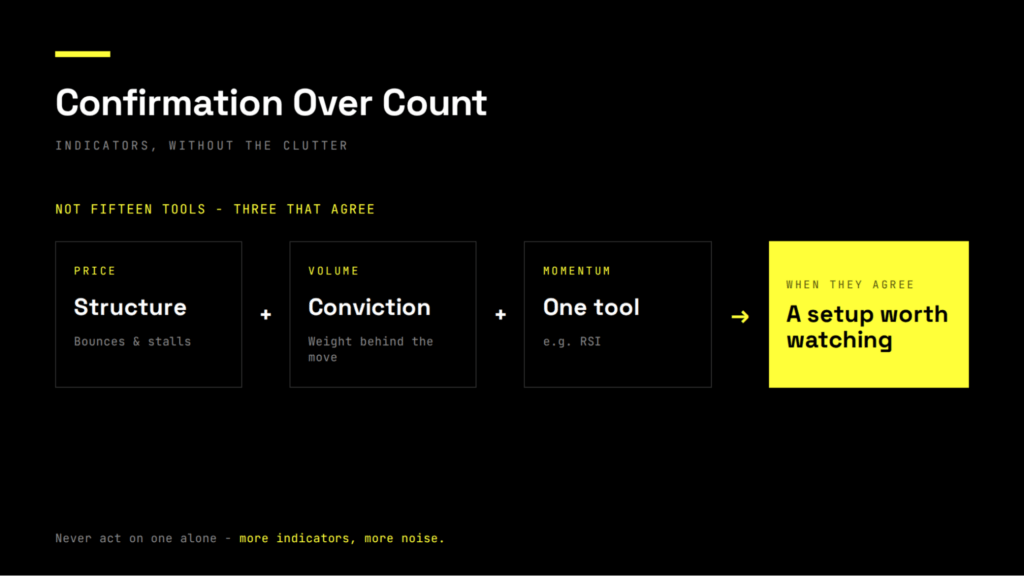
You do not need fifteen indicators. Beginners are usually better served by reading price structure (where price has bounced or stalled before) and volume, plus one momentum tool such as the Relative Strength Index.
RSI measures momentum on a 0 to 100 scale. Readings above 70 are often called overbought and below 30 oversold, but these are starting points, not buy and sell buttons. In a strong uptrend, an asset can stay “overbought” for weeks. Treat any single indicator as a hypothesis that needs confirmation from price and volume, never as a standalone trigger. The cleaner a setup looks across price, volume, and one indicator agreeing, the more it is worth your attention.
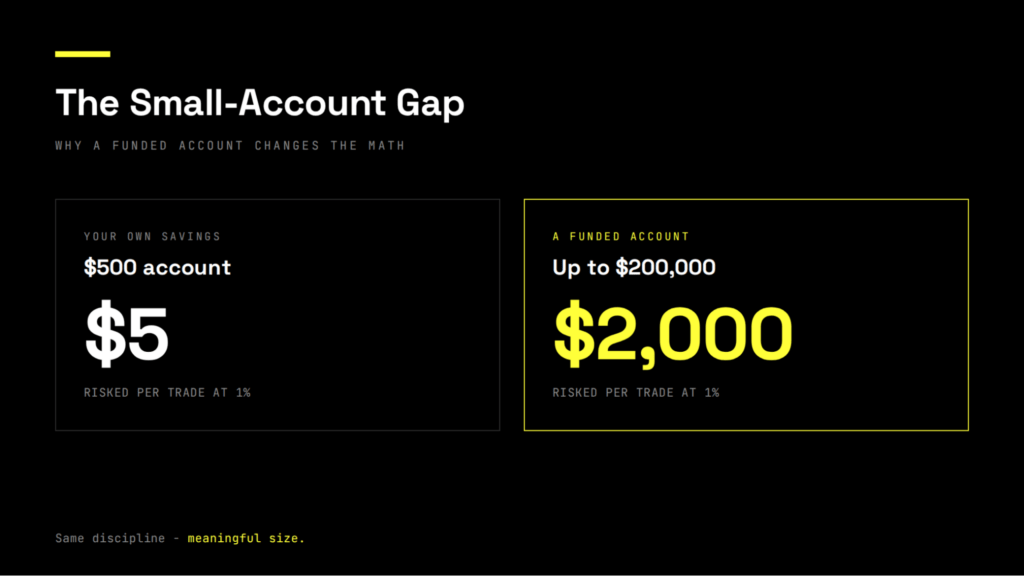
At some point most serious beginners hit the same wall. Their strategy improves but their account is too small for the gains to mean much. Risking 1 percent of $500 is sound discipline and also $5 per trade.
This is the gap that crypto proprietary trading firms aim to fill. A prop firm gives you access to its capital after you pass an evaluation, then shares the profits with you. You demonstrate that you can hit a modest target while staying inside strict loss limits, usually a daily loss cap around 5 percent and a maximum drawdown around 10 percent. Pass, and you trade a larger funded account; the firm keeps a slice, you keep the rest. Your downside is capped at the evaluation fee rather than your savings.
The appeal for a disciplined beginner is that the firm’s rules enforce the exact habits this guide describes. You cannot oversize, you cannot ignore drawdown, and you cannot revenge-trade without failing. That structure is harder to maintain on your own.
Crypto Fund Trader is one example of this model in the crypto-native space. It has operated since November 2022 under a Swiss-registered company, runs evaluations with a route through a Bybit integration, and announced in January 2026 that it had paid more than $18 million to traders. Profit splits on these programs reportedly reach up to 90 percent, with funded accounts up to $200,000 and leverage up to 1:100.
A sane on-ramp looks less exciting than the screenshots people post, which is the point.
Week one: open and secure one exchange account, complete verification, and place a few tiny spot trades just to learn the mechanics of buying, selling, and setting a stop. Treat any result as irrelevant.
Week two: pick one asset and watch it daily. Note where it bounces and stalls. Practice writing down, before each trade, your entry, your stop, and your target. Many exchanges and platforms also offer demo or paper accounts where you can rehearse with fake money.
Weeks three and four: take small real positions sized by the 1 percent rule, and keep a trading journal. Record why you entered, what you felt, and what happened. The journal teaches you more than any indicator, because it shows you your own patterns.
By the end of the month your account balance is not the score. Whether you followed your own rules is the score.
Crypto rewards preparation and punishes improvisation, and it does both faster than traditional markets because it never closes. The path of crypto trading for beginners is not complicated, but it is easy to skip the boring parts that keep you solvent: real security, small size, a stop on every trade, and a written plan.
Start spot, start small, and treat your first months as paid education. If you develop a genuine edge and the discipline to size it properly, the funded route can scale that edge without scaling your personal risk. The traders who last are rarely the boldest ones. They are the ones who were still around after the weeks when everyone else got liquidated.
How much money do I actually need to start crypto trading?
You can place real spot trades with as little as $20 to $50 on major exchanges, so knowing how to start crypto trading safely matters far more than your deposit size. Start with money you can afford to lose entirely, then scale up only once you follow your own rules consistently.
Is crypto trading for beginners even realistic given how volatile the market is?
Yes, but only if you respect the volatility instead of chasing it: small, unleveraged spot positions with a stop-loss survive the swings that liquidate overleveraged traders. Most beginners who fail lost to oversized positions and no exit plan, not to volatility itself.
Which exchange should a complete beginner use?
Coinbase is a common first choice for ease of use, with Kraken as a lower-fee alternative once you are comfortable, while Bybit suits more active traders later on. Whatever you pick, confirm it operates legally in your country and turn on app-based two-factor authentication before depositing.
Should beginners use leverage to grow a small account faster?
Generally no, not in the first several months, because leverage magnifies losses as much as gains and a normal daily move can liquidate you before your idea plays out. Learn to be consistently profitable on spot first; leverage is a tool for people who already have a proven process.
What is the difference between trading crypto and just buying and holding?
Holding means owning an asset long term and accepting the price wherever it goes, while trading means taking shorter positions that need a plan and active risk management. Neither is automatically better, and many people do both with separate pots of money.
Can a beginner realistically get a funded prop trading account?
Eventually yes, but not as a starting point, since funded evaluations are built to pass disciplined traders and fail impulsive ones who skipped building habits on a personal account first. Before paying any firm, verify its current status and payout record rather than trusting headline figures.
This article is for informational and educational purposes only and does not constitute financial advice. Trading cryptocurrencies and prop firm challenges involve significant risk; trade only with capital you can afford to lose.
-
© 2026 - All Rights Reserved.
SWISS RLCRATES AG is a provider of educational services, all information available on our site is intended solely for the study purposes related to trading on financial markets. Accordingly, we do not offer financial, investment, tax, brokerage or other advice and/or services. Trading in financial markets is a high-risk activity, past performance do not guarantee future ones. It is highly advised not to risk more, than you can afford to lose. Brokers and operators of trading platforms are persons or entities that are separate from SWISS RLCRATES AG and their own terms and conditions will apply when you use their services and products. Neither SWISS RLCRATES AG nor RLCRATES, S.L. (as MT5 license holder) operate in countries where crypto or CFD’s activity is not allowed. The content in our platform is applicable to the extent local laws and/or regulations permit.