

A crypto trading journal is a structured record of every trade you place: entry, exit, size, reasoning, and outcome, kept in one place so you can review it instead of relying on memory. Learning how to track crypto trades this way is what turns a string of wins and losses into data you can act on.
That distinction matters more in crypto than in most markets. Exchanges run 24 hours a day, a single trader might work across three or four platforms, and there’s no single year-end statement that consolidates the record the way a stock brokerage account does. The record either gets built on purpose or it doesn’t exist. That gap has a cost: behavioral finance research on retail trading accounts has repeatedly found that investors close winning positions faster than losing ones, a pattern the economist Terrance Odean documented in one of the most-cited studies of individual trading records, using data from more than 10,000 discount-brokerage accounts (Odean, “Are Investors Reluctant to Realize Their Losses?”). A separate 2020 study that tracked every individual who began day trading Brazilian equity futures between 2013 and 2015 found that 97% of those who kept trading for more than 300 days lost money, with no evidence that time in the market alone taught them anything (Chague, De-Losso and Giovannetti, “Day Trading for a Living?”). A crypto trading journal is the tool that forces a trader to check both patterns against their own results, because the entry is already on the page whether the trade worked or not.
A trade entry that skips context is just a price and a date. The fields that make a crypto trading journal useful are the ones a raw exchange export never provides.
| Field | Why it matters |
|---|---|
| Date and time (UTC) | Crypto trades 24/7 across time zones; UTC keeps entries comparable |
| Pair and platform/exchange | Patterns often differ by venue, not just by asset |
| Entry price and position size | The base numbers every other metric is built from |
| Stop-loss / invalidation level | Defines 1R, the unit that makes trades of different sizes comparable |
| Exit price and reason for exit | Separates the plan from what happened |
| R-multiple (result ÷ risk) | Converts a dollar outcome into a number you can average across trades |
| Setup or strategy tag | The field pattern recognition depends on later |
| One-line reasoning at entry | Catches decisions made on a story rather than a plan |
| Rule check / emotional note | Flags trades broken by impulse rather than by the system |
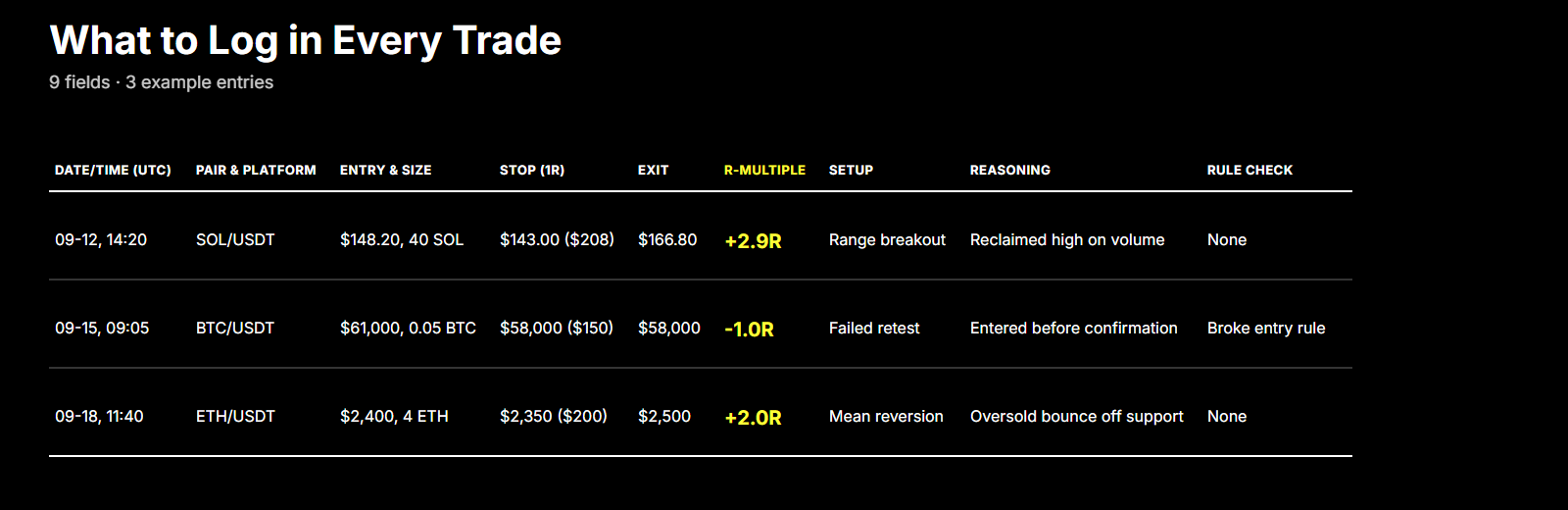
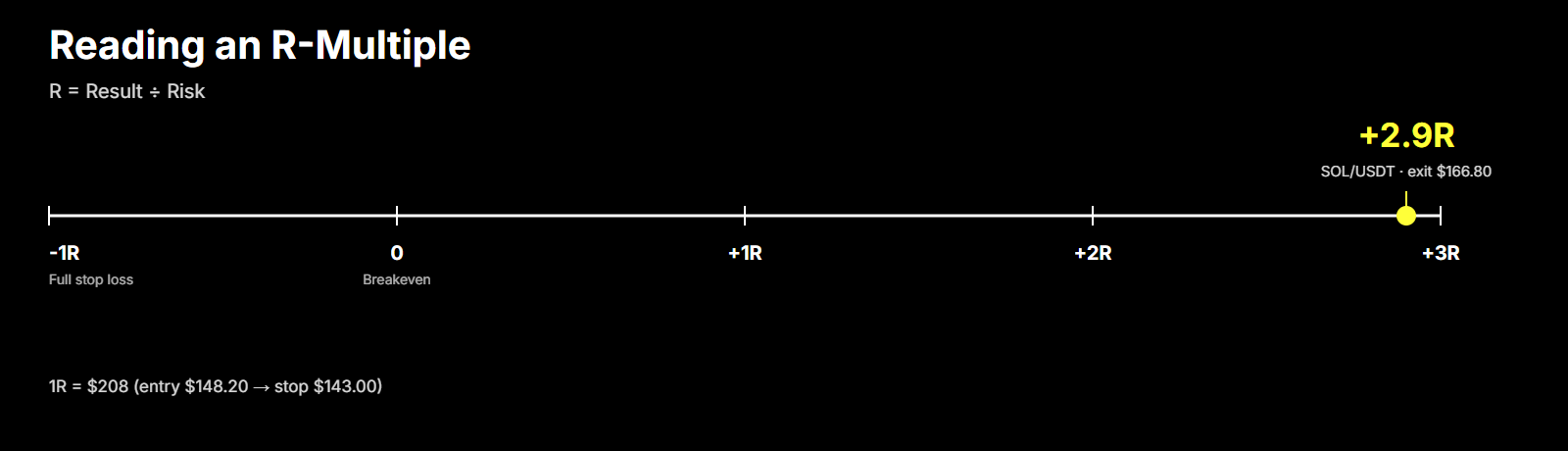
A worked entry might read: 2026-09-12, 14:20 UTC; SOL/USDT, exchange sub-account; entry $148.20, stop $143.00, size 40 SOL (1R = $208); exit $166.80 (+2.9R); setup: range breakout; reasoning: reclaimed prior high on rising volume; no rule violations. Nothing in that line depends on remembering how the trade felt three weeks later.
How you track crypto trades matters less than doing it on every trade, but the method you pick decides how much friction sits between a fill and its entry.
| Method | Best for | Trade-off |
|---|---|---|
| Spreadsheet (Sheets/Excel) | Full control over fields and formulas | Manual entry for every fill; easy to fall behind |
| Exchange trade-history export | An undisputed record of fills and fees | Rarely includes reasoning, setup tags or emotional state |
| Dedicated journaling software | Automated imports plus built-in analytics | Recurring cost; still no software fills in your reasoning |
A spreadsheet costs nothing and can be built around the exact fields above, which is why it remains the default for traders who want the R-multiple and rule-check columns their own way.
Automated options each solve a narrower problem than “journal.” Portfolio platforms like CoinTracking pull trade history directly from more than 400 exchanges and wallets and generate over two dozen custom reports on gains, losses and transaction history (CoinTracking), strong for consolidating fills but built around tax and portfolio tracking rather than setup-level review. Multi-asset journals such as TraderSync import trade history from hundreds of brokers and exchanges, including crypto, and surface pattern analysis across a trader’s history (TraderSync); Edgewonk is built specifically around trading psychology, tracking the behavioral side of a result rather than just the P&L (Edgewonk). None of them write the reasoning or rule-check fields for you. That part of a crypto trading journal stays manual no matter which method carries the rest of it.
A win rate on its own says almost nothing about whether a strategy makes money. Expectancy is the number that does.
The R-multiple framework, popularized by trader and author Van Tharp, expresses every trade as a multiple of what it risked rather than a raw dollar figure: a trade stopped out for its full risk is -1R, a trade that returns twice what it risked is +2R (R-Multiple, CrossTrade). Recording R instead of dollars is what makes a $200 position and a $20,000 position comparable in the same journal. Expectancy then combines win rate and payoff size into a single figure: win rate multiplied by average win in R, minus loss rate multiplied by average loss in R. A strategy that wins 35% of the time but averages +3R on winners and -1R on losers has a positive expectancy despite losing on most trades, while a strategy that wins 70% of the time on tiny gains and occasionally gives back a large loss can have a negative one. Win rate is morale; expectancy is economics, and expectancy only exists if the R-multiple field was filled in on every trade, win or lose.
A review that only looks at winning trades finds nothing, because the recurring mistake is almost always sitting in the losing column.
A weekly or monthly review works best sorted by cause, not by outcome: group trades by setup tag, by exit reason, or by whether the rule-check field shows a violation. That sorting is where the disposition-effect research above becomes a personal question instead of a general finding: are exits on winning trades landing well short of the planned target, while losing trades sit open past the stop? A journal’s exit-reason and R-multiple fields answer that directly, instead of leaving it to a general impression of “a rough week.” The traders who correct a pattern are the ones who can name it specifically enough to change one rule, not the ones who resolve to “be more disciplined” in general.
A trading journal stops being optional once fixed loss limits sit under the account, because one misread trade can end the evaluation before a trader gets to correct course.
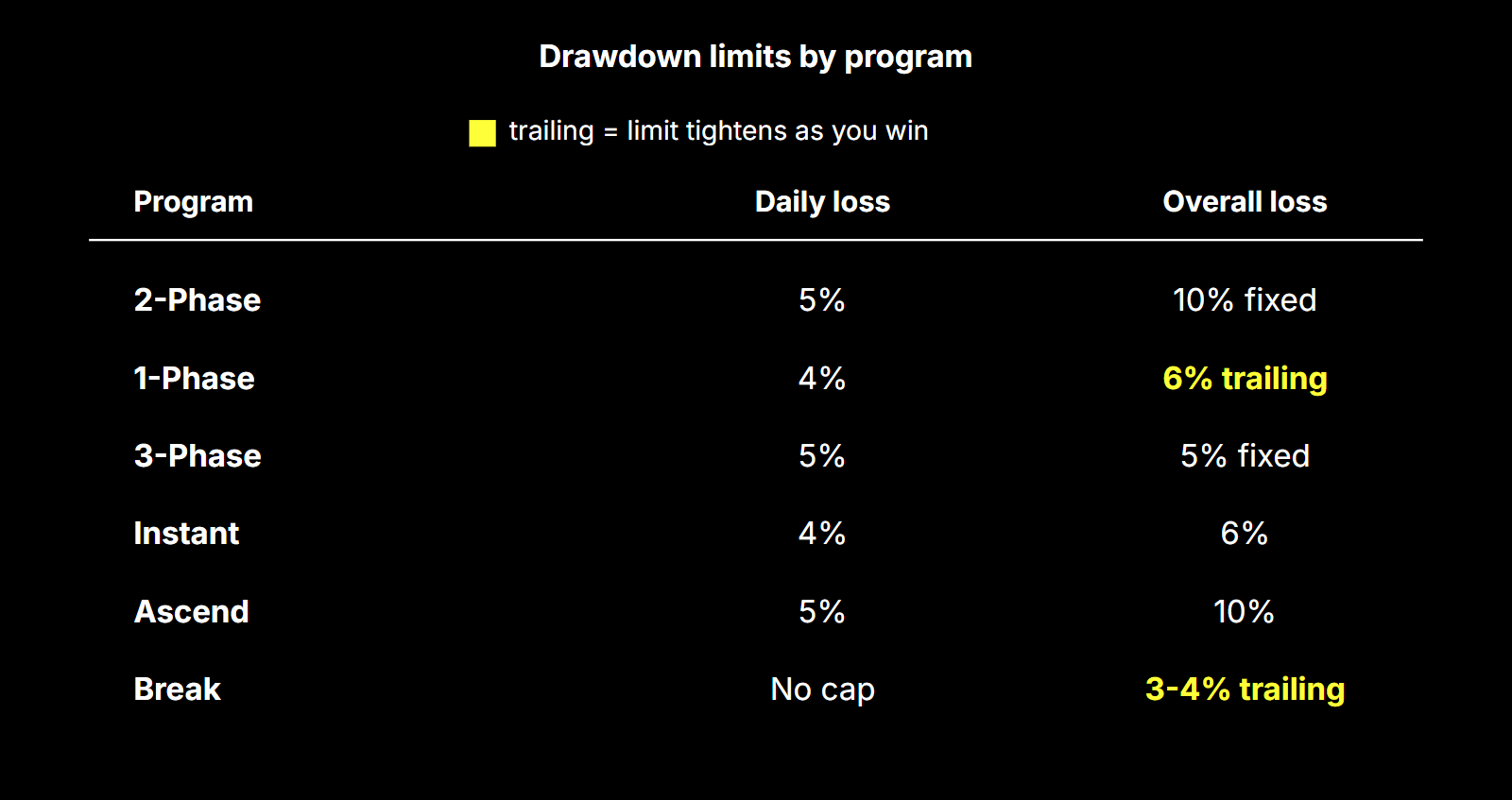
Crypto Fund Trader is a simulated trading evaluation firm: traders pass a program, then may become eligible for a performance-based scholarship reward on a simulated funded account, with no real capital or deposits involved (Crypto Fund Trader FAQ). The programs differ in exactly the way a journal needs to track: the 2-Phase evaluation runs a 5% daily loss limit against a fixed 10% overall limit, while the 1-Phase evaluation runs a tighter 4% daily limit against a 6% limit that trails the account’s own equity highs. Getting those two regimes confused mid-trade is a common and avoidable error. CFT’s own rules state that “drawdown breaches are calculated based on equity” and that the daily limit is “based on your account balance at 12:05 AM UTC each day.” A journal can only reconstruct that detail if it logs equity at that specific checkpoint, not just at the moment a position closes.
The firm’s Break program adds a rule that makes the case for journaling on its own: “No single trading day may account for more than 40% of the total profits generated on the account.” CFT checks it at the time a trader requests a reward, so a trader who hasn’t logged daily profit has no way to check that ratio beforehand, only after. On evaluations run through Bybit, CFT states it “does not add any markup, artificial spread, or fictitious slippage to the provider’s price.” That’s real-exchange execution rather than a synthetic feed, so any slippage in a fill reflects the live market and deserves its own journal field, not a number folded into the entry price. Traders running any of CFT’s simulated evaluations have a narrower margin for a rule they didn’t notice breaking, and a journal built around equity checkpoints and daily totals, not just win/loss tags, is what keeps that margin visible before it’s gone.
A journal that isn’t reviewed is just a longer version of not keeping one, so most of what breaks a crypto trading journal happens after the entry is logged.
A crypto trading journal isn’t an accessory to trading. It’s the mechanism that turns a stream of individual trades into evidence about what’s working. Learning how to track crypto trades comes down to picking a method that survives daily use, logging the fields no software fills in automatically, and reviewing by cause rather than by feeling. For a trader running a simulated evaluation, that same log carries extra weight: the rules around daily and overall loss limits are exact, the equity checkpoints don’t forgive a guess, and a journal that already has the day’s numbers in it is what lets a trader request a scholarship reward with confidence instead of hoping the math works out.
SWISS RLCRATES AG is a provider of educational services, all information available on our site is intended solely for the study purposes related to trading on financial markets. Accordingly, we do not offer financial, investment, tax, brokerage or other advice and/or services. Trading in financial markets is a high-risk activity, past performance do not guarantee future ones. It is highly advised not to risk more, than you can afford to lose. Brokers and operators of trading platforms are persons or entities that are separate from SWISS RLCRATES AG and their own terms and conditions will apply when you use their services and products. Neither SWISS RLCRATES AG nor RLCRATES, S.L. (the company that provides services with MT5) operate in countries where crypto or CFD’s activity is not allowed. The content in our platform is applicable to the extent local laws and/or regulations permit. SWISS RLCRATES AG acts as a payment/marketing agent for RLCRATES SL. SWISS RLCRATES AG is not authorized or licensed in Switzerland and does not offer any trading services with MT5 neither conducts any regulated activities.
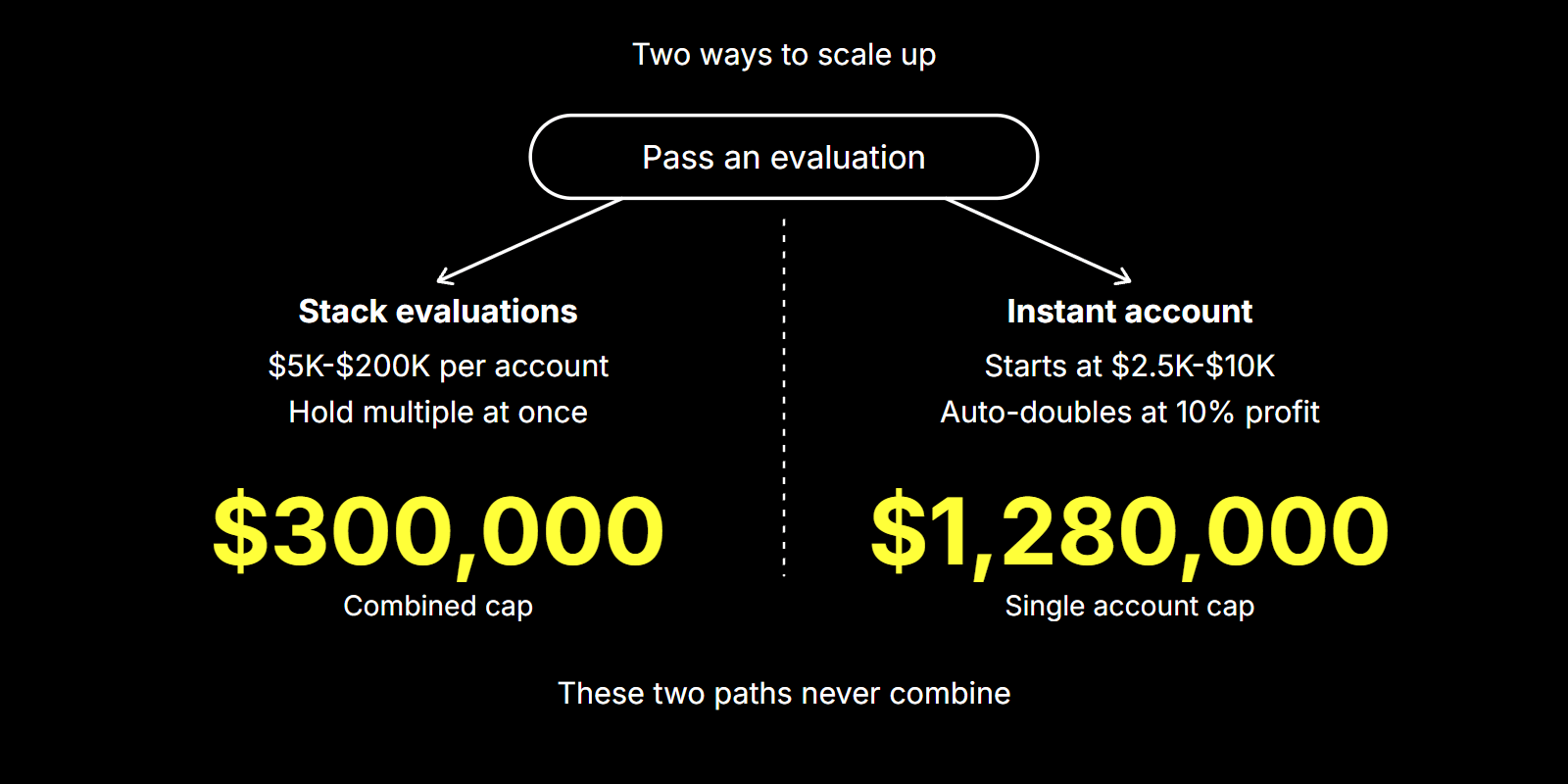
Crypto Fund Trader has exactly two routes to a bigger simulated account, and they do not combine into a third.
| Route | How size increases | Ceiling |
|---|---|---|
| Standard evaluations (2-Phase, 1-Phase, 3-Phase) | Pass more than one evaluation; account sizes run $5,000 to $200,000 each | $300,000 total simulated allocation per user |
| Instant | Automatic doubling at a profit milestone, no new evaluation purchase required | $1,280,000, with up to three active Instant accounts |
The standard route caps individual accounts at $200,000, so reaching the $300,000 per-user ceiling means holding more than one passed evaluation at once. The Instant route works differently: the account itself grows without a second purchase, up to a ceiling more than four times higher.
Crypto prop firm scaling on the Instant line runs on a single trigger: reach 10% simulated profit, and the account size doubles.
Crypto Fund Trader calls this the “Withdrawal & Upgrade” step. A trader starts an Instant evaluation at $2,500, $5,000, or $10,000, with no profit target to clear first, only the standing 4% daily and 6% overall loss limits from the first trade. Hitting 10% simulated profit on the current balance triggers the upgrade, which doubles the account’s demo size. Because each step doubles the previous balance, the ladder from a $10,000 starting account is fixed math, not a forecast:
$10,000 → $20,000 → $40,000 → $80,000 → $160,000 → $320,000 → $640,000 → $1,280,000
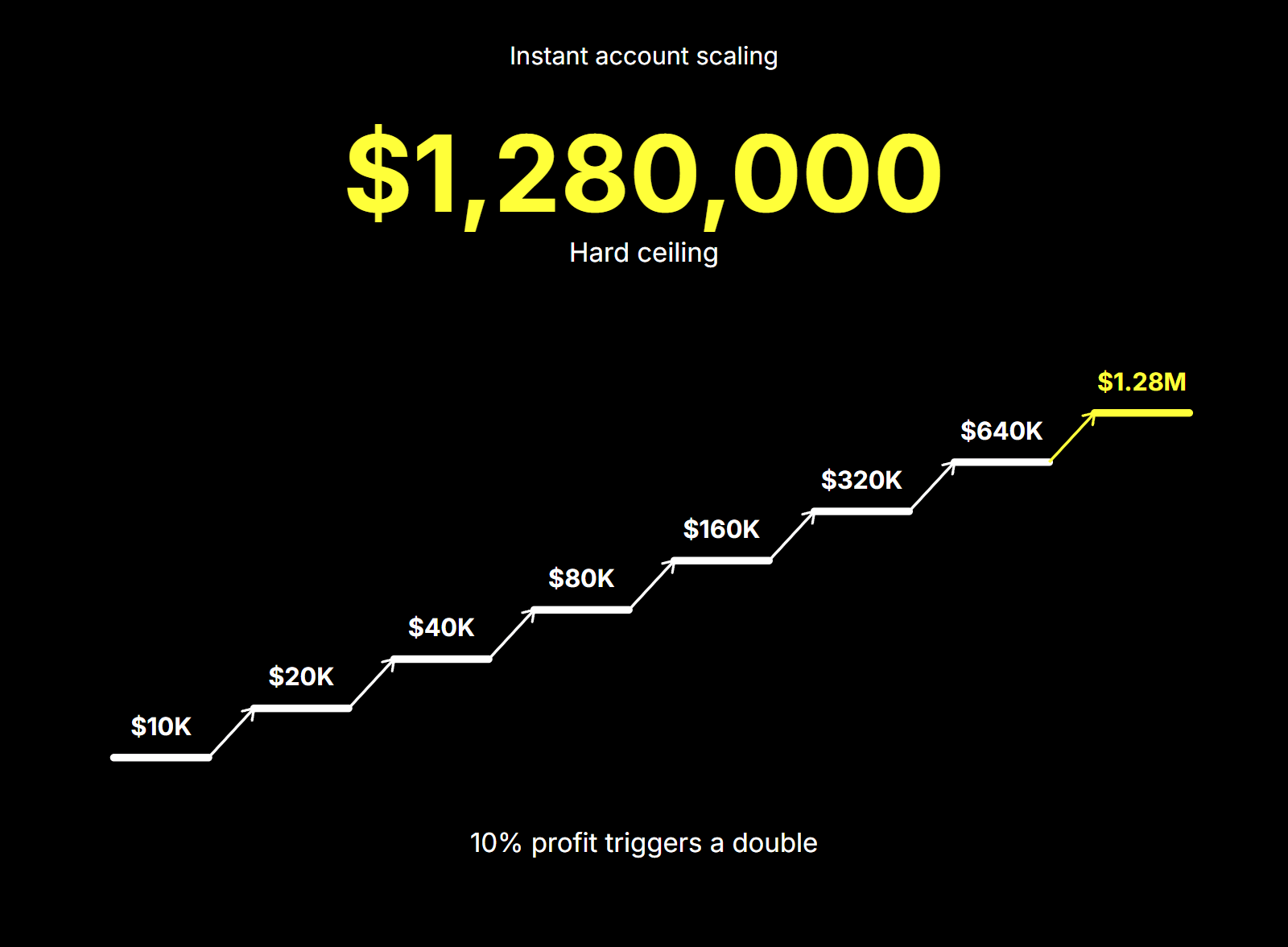
That’s seven doublings to reach the ceiling: arithmetic, not a promise about how fast or whether any account gets there. A trader can also run up to three Instant accounts at once.
A bigger account inherits the same drawdown regime as a smaller one: scaling changes the balance, not the rulebook.
Drawdown on every account is calculated on equity, so an open loss counts against the limit before a position closes, and the daily loss figure resets from the account balance at 12:05 AM UTC each day. A doubled Instant account is still governed by the same 4% daily and 6% overall loss limits it started with. The dollar amounts scale with the balance; the percentages do not. Simulated profit is also capped at $10,000 per day or per trade; equity above that threshold may be closed and the excess deducted.
One rule that does not travel across the product line is the Final Stage consistency requirement on Break: no single trading day may account for more than 40% of total profits. It applies only at reward-request time. Reverse trading, account sharing, copy trading restrictions, and KYC requirements also apply regardless of account size.
KYC is a separate gate that scaling does not skip: before any scholarship reward can be processed, KYC must be completed and approved.