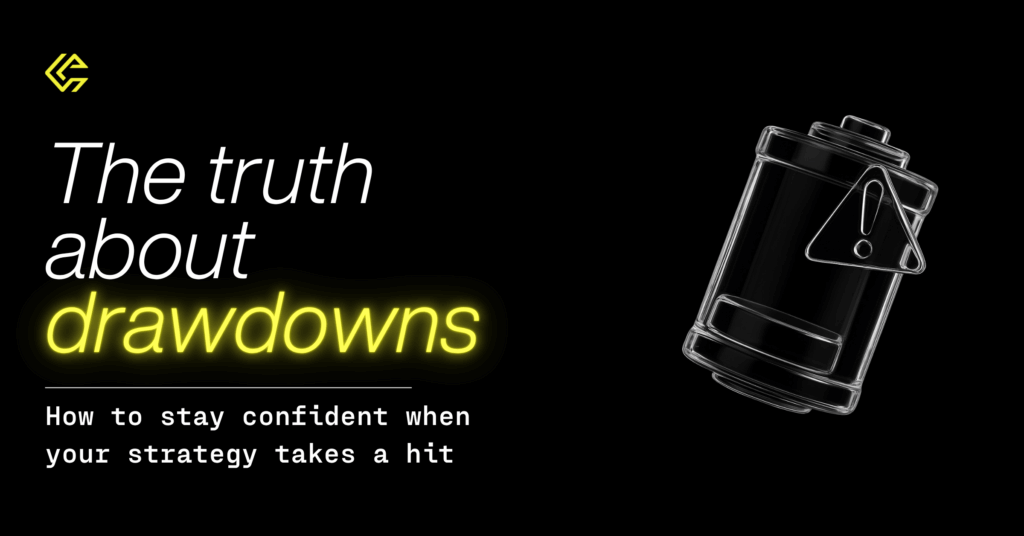
Every trader goes through drawdowns. It doesn’t matter how good your strategy is or how experienced you are, losing streaks are a part of trading.
Yet, when they happen, most traders panic. They start questioning everything — their plan, their system, and even their ability to trade. That’s when emotions take over, and poor decisions begin to follow.
But drawdowns aren’t a sign that something is broken. They’re a natural part of trading performance, and learning to handle them properly is one of the most important skills you can develop.
At Crypto Fund Trader (CFT), we’ve seen hundreds of traders recover from tough drawdowns and come back stronger than ever. The difference between those who make it and those who don’t isn’t luck, it’s mindset and discipline.
Let’s talk about what drawdowns really mean, how to stay confident during them, and how you can use those tough periods to grow as a trader.
A drawdown simply measures how much your account has dropped from its highest point. It’s the decline that happens when you hit a series of losses before your next recovery.
For example, if your account went from $10,000 to $9,000, that’s a 10% drawdown.
Most traders see this as failure. But the reality is, every profitable strategy includes periods of drawdown. Even the best systems have times when the market conditions don’t align.
Trading isn’t about avoiding losses, it’s about managing them.
A drawdown doesn’t mean your strategy stopped working. It means you’re in one of those phases where your edge is being tested.
The traders who succeed long-term are those who can handle that test without losing confidence or discipline.
Drawdowns hit harder mentally than they do financially.
When you lose, it’s not just your money that takes a hit, it’s your confidence. You start second-guessing yourself, and that can quickly spiral into fear, hesitation, or even revenge trading.
Part of this reaction comes from our natural human bias to focus on short-term results. When you see three or four losses in a row, your brain starts to panic, even if your long-term win rate is still solid.
The truth is, losing streaks don’t define your ability. They test your patience and belief in your system.
If your edge is proven, staying calm during drawdowns is the only way to let it play out.
There’s no avoiding drawdowns, but there are smart ways to manage them. Here are some steps that help you stay composed and focused during tough times.
Confidence is easy when you’re winning, but the real test comes when things aren’t going your way.
Confidence in trading doesn’t mean believing you’ll win every trade. It means believing that your system will deliver over time, even when it’s going through a rough patch.
Think of professional athletes. They don’t quit after a few bad games because they know their performance averages out across a season. The same applies to trading.
Your goal isn’t to win every day, it’s to stay consistent enough for your edge to show results across many trades.
At CFT, we see traders who remain calm during drawdowns often come out on top later. They understand that confidence isn’t about never doubting yourself, it’s about staying grounded and focused no matter what’s happening in the market.
One of the benefits of trading for a prop firm like Crypto Fund Trader is that it teaches you how to handle drawdowns the right way.
Prop firms set clear rules for risk limits, daily losses, and overall drawdowns. While some traders see this as restrictive, it’s actually a powerful training tool.
Those limits force discipline. They make sure you think before taking unnecessary trades, and they keep your losses within a manageable range.
When you trade with CFT, you learn to manage pressure while protecting capital. That discipline carries over into your personal trading as well.
Many traders who join CFT say that our structure helped them become more consistent, not just because of the funding, but because it taught them how to stay calm under pressure.
Every drawdown can teach you something valuable. It shows you where your weaknesses are, how you handle stress, and how disciplined you really are under pressure.
Instead of viewing it as a setback, use it as an opportunity to grow.
Ask yourself:
By reflecting on these questions, you turn a losing phase into a learning phase. The traders who use drawdowns to refine their approach often come out stronger and more prepared for future challenges.
Drawdowns are not the end of your trading journey, they’re part of it.
Every professional trader, every funded trader at Crypto Fund Trader, has been through them. The difference is that they didn’t quit, they learned how to handle them with discipline and confidence.
When you can stay calm during a rough patch, you show real growth. You prove that you’re not just chasing wins, you’re building long-term consistency.
At Crypto Fund Trader, we believe that mastering your mindset during drawdowns is what separates good traders from great ones. Our structure helps you stay disciplined, manage risk, and build the emotional strength needed to keep going when things get tough.
If you’re ready to trade with confidence and learn how to handle drawdowns like a professional, join Crypto Fund Trader today and take your trading career to the next level.
-
© 2026 - All Rights Reserved.
SWISS RLCRATES AG is a provider of educational services, all information available on our site is intended solely for the study purposes related to trading on financial markets. Accordingly, we do not offer financial, investment, tax, brokerage or other advice and/or services. Trading in financial markets is a high-risk activity, past performance do not guarantee future ones. It is highly advised not to risk more, than you can afford to lose. Brokers and operators of trading platforms are persons or entities that are separate from SWISS RLCRATES AG and their own terms and conditions will apply when you use their services and products. Neither SWISS RLCRATES AG nor RLCRATES, S.L. (as MT5 license holder) operate in countries where crypto or CFD’s activity is not allowed. The content in our platform is applicable to the extent local laws and/or regulations permit.