

Every crypto cycle produces the same two stories. One trader turns a few thousand dollars into a life-changing sum and posts the screenshot. Thousands of others quietly lose their deposit and post nothing. Both outcomes are real, and the gap between them is rarely luck. It is method, risk control, and honest expectations.
This guide answers how to make money with crypto trading without the fantasy. It walks through the realistic methods people actually use in 2026, day trading, swing trading, copy trading, and funded prop accounts, with the returns you can plausibly expect and the way each one goes wrong. The uncomfortable starting fact is that most retail traders lose money, with industry data consistently putting the loss rate among leveraged traders somewhere between 70 and 90 percent. The goal here is to land you on the right side of that statistic, which starts with picking a method that fits your time, capital, and temperament.
Before any method, calibrate expectations, because unrealistic targets are what push people into the oversized bets that wipe them out.
Professional traders are thrilled with consistent monthly returns in the low single digits to low double digits. Someone reliably making 5 to 10 percent a month is doing extremely well and would be managing serious capital in any traditional firm. The promises of doubling your account weekly are marketing, and chasing them is the fastest route to ruin.
Returns also scale with capital, not just skill. A brilliant 8 percent month on a $500 account is $40. The same month on a $50,000 account is $4,000. This single fact explains why serious traders care so much about access to capital, and why the prop firm route later in this guide exists at all. To make money crypto trading in amounts that matter, you eventually need either a large account or someone else’s.
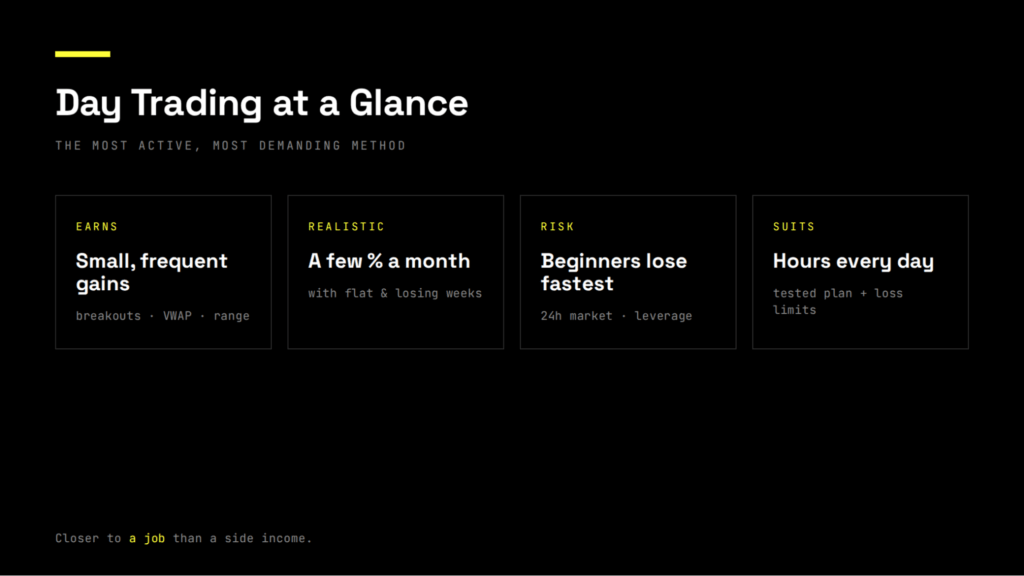
Day trading means opening and closing positions within the same day to capture short moves. It is the most active method, the most demanding, and the one with the steepest failure rate.
How it makes money: small, frequent gains from intraday volatility, using strategies like breakouts, VWAP reversion, or range trading, sized so that winners outweigh losers over many trades.
Realistic numbers: a skilled day trader might target a few percent a month on their account, with plenty of flat or losing weeks in between. The screenshots of 50 percent days exist, but they come from oversized leverage that liquidates the same accounts just as fast in the other direction.
The risks: this is where most beginners lose money fastest. The market runs 24 hours a day, the temptation to overtrade is constant, and leverage turns ordinary volatility into liquidation. Day trading also demands real screen time and emotional control, which most people underestimate.
Who it suits: people with hours to commit daily, a tested strategy, and the discipline to size by risk and walk away after hitting a daily loss limit. It is closer to a job than a side income.
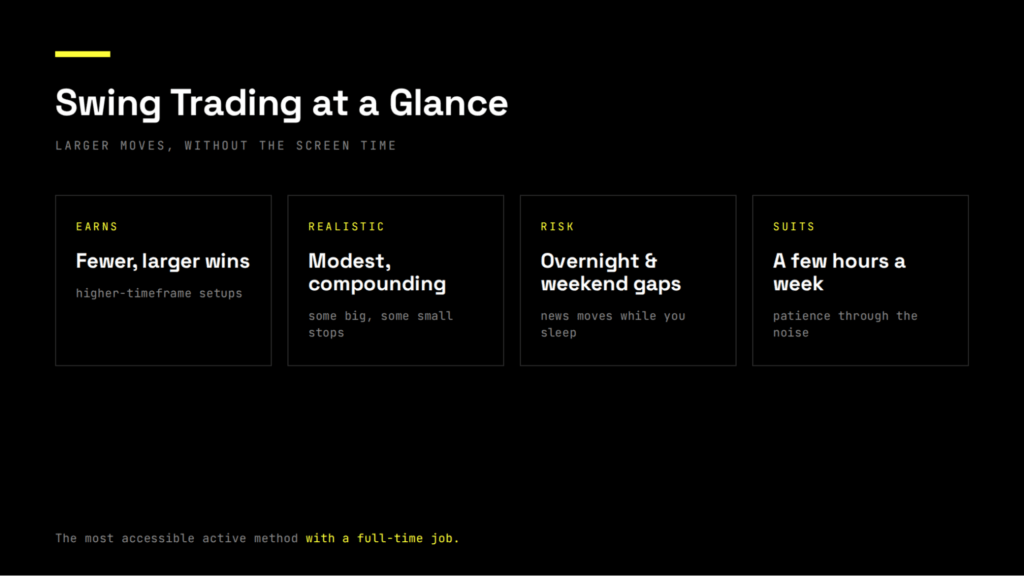
Swing trading holds positions for several days to a few weeks, aiming to capture larger moves than day trading without the screen-bound intensity. For many people with jobs, it is the more realistic active method.
How it makes money: identifying a trend or a setup on the higher timeframes, entering with a defined stop and target, and letting the position run for days while you check it periodically rather than constantly.
Realistic numbers: swing traders aim for fewer, larger wins. A reasonable expectation is modest monthly returns that compound over time, with individual trades sometimes delivering double-digit percentage gains and others stopping out for small losses. Patience is the edge.
The risks: overnight and weekend exposure means news can move against you while you sleep, and a wide stop on a leveraged position can still hurt. Swing trading also tests patience differently, since the hardest part is leaving a working trade alone and not closing it out of boredom or fear.
Who it suits: people with limited daily time who can analyze a few hours a week, hold through normal noise, and accept slower, steadier results. It is the most accessible active method for someone with a full-time job.
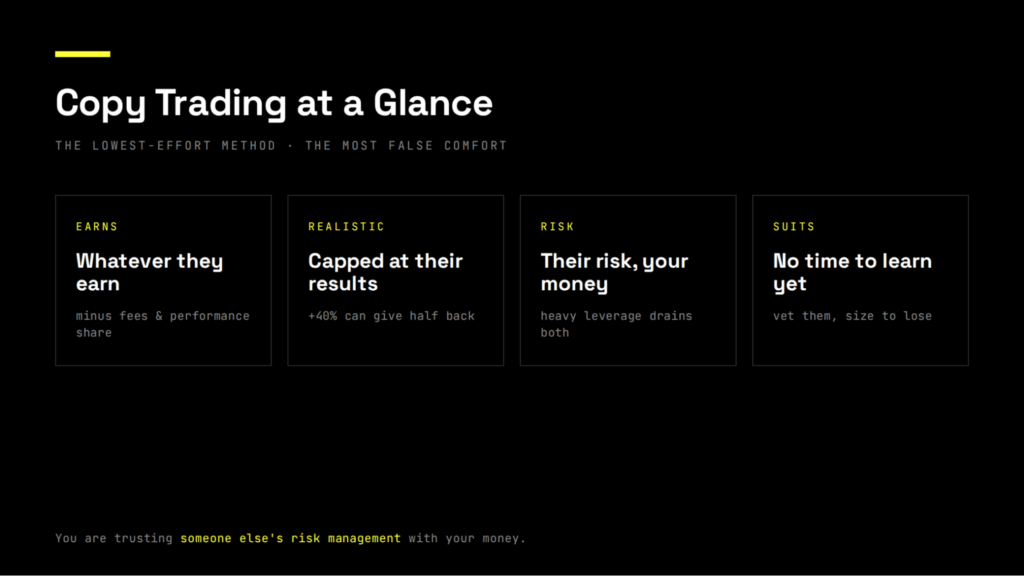
Copy trading lets you automatically mirror the trades of an experienced trader, so their entries and exits execute in your account in proportion to your capital. It is the lowest-effort active method and the one most prone to false comfort.
How it makes money: you earn whatever the trader you follow earns, minus any fees or performance share, without making the decisions yourself. Done well, it is a way to access skill you have not yet built.
Realistic numbers: your returns are capped at the performance of whoever you copy, and past results do not guarantee future ones. A trader who returned 40 percent last year may give half of it back this year. Treat advertised track records with heavy skepticism, since survivorship bias makes the winners highly visible and the blowups invisible.
The risks: you are trusting someone else’s risk management with your money, and a copied trader using heavy leverage can drain your account as fast as their own. Choosing who to copy is itself a skill, and many beginners pick based on recent flashy returns, which is exactly the wrong signal. Diversifying across a few proven, conservative traders reduces the damage from any single one blowing up.
Who it suits: people who want exposure to active trading without the time to learn it themselves, as long as they vet who they follow and size their copy allocation as money they can afford to lose.
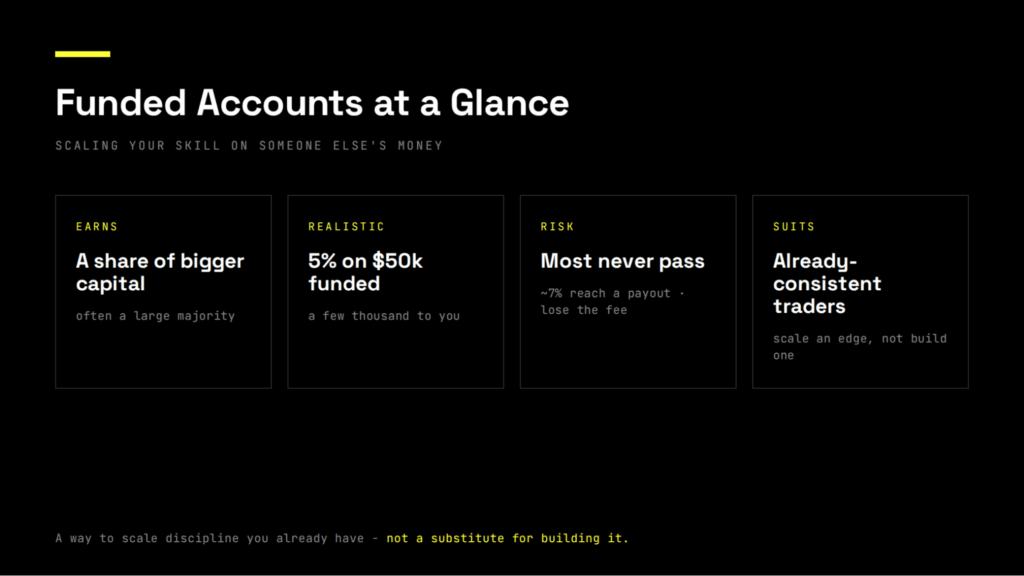
The methods above all share one ceiling: your returns are limited by your own capital. Proprietary trading firms exist to lift that ceiling. This is less a separate trading style than a way to scale the styles above using someone else’s money.
How it makes money: you pass an evaluation by hitting a modest profit target while staying inside strict loss limits, then trade a funded account and keep a share of the profits, often a large majority. You apply day trading or swing trading skills, but on capital far larger than you could self-fund, and your personal downside is capped at the evaluation fee.
Realistic numbers: the appeal is leverage on your skill. A 5 percent month on a funded $50,000 account, with a typical profit split, can mean a few thousand dollars to the trader, well beyond what the same skill earns on a small personal account. The honest counterweight is the pass rate. Industry estimates suggest only a small fraction of challenge takers, often cited around 7 percent, ever reach a payout, because the evaluations are designed to fail undisciplined traders.
The risks: you pay an upfront evaluation fee that you lose if you fail, and many people fail by breaking a drawdown rule they did not fully read. The model rewards traders who already have an edge and punishes those still searching for one. It is a way to scale existing discipline, not a substitute for building it.
Who it suits: traders who are already consistent on a personal account and want to scale without risking their savings. For someone still figuring out their strategy, a small personal account is the cheaper place to learn.
Crypto Fund Trader is one firm operating in this crypto-native space, running since November 2022 under a Swiss-registered company, with funded accounts offering leverage up to 1:100 and evaluations that can route through a Bybit integration. One honest caution that applies across the whole sector: prop firms can change their rules, terms, or standing quickly, and some have shut down with little warning. Before paying any evaluation fee, verify a firm’s current status, read the rulebook in full, and check recent independent reviews and payout reports rather than relying on headline numbers.
Not every way to grow crypto involves active trading. Two passive approaches deserve a mention for context, because they suit people who do not want to trade at all.
Holding, or long-term investing, means buying assets like Bitcoin or Ethereum and keeping them for years through the volatility. It requires no skill in timing, only the patience to sit through large drawdowns, and historically it has rewarded those who held across full cycles. The risk is real and obvious: prices can fall by large percentages and stay down for long stretches.
Staking and yield means earning a return for locking up certain assets to support a network or provide liquidity. Yields are usually modest, often low single digits to low double digits annually, and the risks include the underlying asset falling in value and, in DeFi, smart-contract failures. It is a supplement to a strategy, not a path to quick wealth.
| Method | Effort | Time Horizon | Realistic Return Profile | Main Risk |
|---|---|---|---|---|
|
Day trading
|
Very high
|
Minutes to hours
|
Small frequent gains, high variance
|
Overtrading, leverage, burnout
|
|
Swing trading
|
Medium
|
Days to weeks
|
Fewer, larger gains
|
Overnight news, patience
|
|
Copy trading
|
Low
|
Depends on trader
|
Capped at copied trader
|
Trusting another's risk control
|
|
Prop accounts
|
High skill
|
Same as your style
|
Scaled by larger capital
|
Evaluation fee, strict rules
|
|
Holding
|
Very low
|
Years
|
Cycle-dependent
|
Long, deep drawdowns
|
Alt text: Comparison table of five crypto income methods in 2026 (day trading, swing trading, copy trading, prop accounts, and holding) across effort, time horizon, realistic returns, and main risk.
Whatever method you choose, the same principles separate the traders who last from the ones who become the statistic.
Risk a small fixed fraction of your capital on any single idea, often 1 to 2 percent, so no one loss matters much. Size positions from your stop distance, not from the leverage your platform offers. Set a daily or weekly loss limit and honor it, because revenge trading after a loss turns a normal red day into a disaster. Keep a journal, since reviewing your own decisions teaches more than any course. And treat your first months in any method as paid education, expecting to lose some tuition while you learn.
The methods differ in effort and time horizon, but none of them survive without these basics. A great strategy with poor risk control still ends in a blown account.
There is no single answer to how to make money with crypto trading, because the right method depends on how much time you have, how much capital you bring, and how you handle pressure. Day trading rewards the time-rich and disciplined. Swing trading suits the patient with day jobs. Copy trading offers a hands-off entry for those who vet carefully. Prop firms scale real skill into real income. Passive holding rewards those who would rather not trade at all.
What unites the people who actually make money crypto trading is not a secret method. It is realistic expectations, strict risk control, and the patience to compound a genuine edge instead of gambling for a screenshot. Pick the method that fits your life, learn it properly on small size, and let consistency do the slow, unglamorous work that the highlight reels never show.
Can you realistically make money with crypto trading in 2026?
Yes, but most retail traders lose money, so realistic returns and strict risk control matter far more than any single method. Learning how to make money with crypto trading starts with accepting modest, consistent gains rather than chasing the screenshots.
Which crypto trading method is best for beginners?
Swing trading and carefully vetted copy trading are usually gentler entry points than day trading, which has the steepest learning curve and failure rate. Whichever you pick, start small and size every position by risk.
How much money do I need to start?
You can begin with a few hundred dollars to learn the mechanics, though small accounts produce small absolute returns even at good percentages. This is why traders who want to make money crypto trading at a meaningful scale eventually pursue more capital or a funded account.
Is copy trading a safe way to make money?
It is lower effort but not low risk, since you are trusting another trader’s risk management with your money, and a leveraged trader you copy can drain your account fast. Vet track records skeptically and spread your allocation across a few conservative traders rather than one flashy one.
Are prop firms a legitimate way to earn from trading?
The model is legitimate and lets skilled traders scale on firm capital with downside capped at the evaluation fee, but only a small fraction of challenge takers ever reach a payout. Build consistency on a personal account first, and verify any firm’s current status and payout record before paying.
What return per month is realistic for a good trader?
Consistent monthly returns in the low single digits to low double digits are considered very good, and anyone promising to double your money quickly is selling a fantasy. Returns also scale with capital, so the same skilled percentage earns far more on a larger account.
This article is for informational and educational purposes only and does not constitute financial advice. Trading cryptocurrencies and prop firm challenges involve significant risk; trade only with capital you can afford to lose.
-
© 2026 - All Rights Reserved.
SWISS RLCRATES AG is a provider of educational services, all information available on our site is intended solely for the study purposes related to trading on financial markets. Accordingly, we do not offer financial, investment, tax, brokerage or other advice and/or services. Trading in financial markets is a high-risk activity, past performance do not guarantee future ones. It is highly advised not to risk more, than you can afford to lose. Brokers and operators of trading platforms are persons or entities that are separate from SWISS RLCRATES AG and their own terms and conditions will apply when you use their services and products. Neither SWISS RLCRATES AG nor RLCRATES, S.L. (as MT5 license holder) operate in countries where crypto or CFD’s activity is not allowed. The content in our platform is applicable to the extent local laws and/or regulations permit.