
Cryptocurrency trading has evolved from a niche digital experiment into a global financial phenomenon worth trillions. Whether you’re taking your first steps into the crypto markets or looking to refine advanced strategies, this guide delivers everything you need to trade crypto with confidence in 2026 and beyond.
The crypto market never sleeps. Unlike traditional stock exchanges that close at 4 PM, cryptocurrency markets operate 24/7, offering endless opportunities for traders willing to learn the fundamentals. This continuous access, combined with high volatility, creates unique profit potential that has attracted millions of new participants worldwide.
But here’s the truth that separates successful traders from the rest: mastering how to trade cryptocurrency requires more than luck. It demands strategy, discipline, risk management, and the right platforms. Let’s dive into everything you need to know.
Cryptocurrency trading involves buying and selling digital assets to profit from price movements. At its core, you’re speculating on whether a cryptocurrency’s value will rise or fall, then executing trades based on your analysis. Unlike traditional investing, crypto trading often focuses on shorter timeframes and more active position management.
The crypto market operates on blockchain technology—a decentralized digital ledger that records all transactions transparently. This technology underpins major cryptocurrencies like Bitcoin (BTC), Ethereum (ETH), Solana (SOL), and hundreds of altcoins available for trading.
Before placing your first trade, understanding these foundational concepts is essential:
Market Capitalization: Total value of a cryptocurrency, calculated by multiplying price by circulating supply
Your trading platform directly impacts your success through fees, available assets, and execution quality. Selecting a platform that matches your trading style is the first critical decision you’ll make.
Major exchanges like Bybit have become industry leaders for serious crypto traders. Bybit offers institutional-grade infrastructure, deep liquidity across hundreds of trading pairs, and advanced charting tools essential for technical analysis. The platform supports spot trading, perpetual contracts, and derivatives—giving traders flexibility regardless of market direction.
When evaluating where to trade cryptocurrency, prioritize these factors:
Liquidity: Higher liquidity means tighter spreads and better execution prices
Getting started with cryptocurrency trading requires a methodical approach that minimizes mistakes. Follow these steps to execute your first trades properly.
Register on your chosen exchange by providing an email address and creating a strong, unique password. Most reputable platforms require identity verification (KYC) to comply with regulations. Have your government-issued ID and proof of address ready—verification typically takes 24-48 hours.
Enable two-factor authentication immediately after registration. Consider using a hardware security key or authenticator app rather than SMS-based 2FA. Create a dedicated email address for your trading accounts and use a password manager to generate complex credentials.
Deposit funds via bank transfer, credit card, or cryptocurrency transfer from another wallet. Bank transfers usually offer the lowest fees, while card payments provide instant availability. Start with an amount you can afford to lose entirely—this mindset protects you from emotional decision-making.
Begin with established cryptocurrencies like Bitcoin and Ethereum before exploring altcoins. Use fundamental analysis to evaluate a project’s technology, team, use case, and adoption metrics. Check market capitalization, trading volume, and recent price history before committing capital.
Navigate to the trading interface and select your cryptocurrency pair. Choose between market orders (instant execution) or limit orders (price control). Enter your position size, set stop-loss levels to limit potential losses, and confirm the trade. Record your entry price, reasoning, and target exit for future analysis.
No single strategy works for everyone—the best approach depends on your time commitment, risk tolerance, and experience level. Master these proven strategies to find what suits your trading personality.
HODLing means buying cryptocurrency and holding it for months or years regardless of short-term volatility. This strategy works best for traders who believe in crypto’s long-term potential and prefer minimal time commitment. You avoid the stress of daily price movements and benefit from potential compound growth over time.
Best for: Beginners and those with limited time for active trading
DCA involves investing fixed amounts at regular intervals regardless of price. By purchasing weekly or monthly, you average out your entry price over time, reducing the impact of volatility. This systematic approach removes emotional timing decisions and builds positions gradually.
Best for: Risk-averse traders building long-term positions
Swing trading captures price movements over days to weeks by identifying trends and momentum shifts. Traders analyze charts to find optimal entry and exit points, holding positions until the expected move completes. This approach requires regular market monitoring but not constant screen time.
Best for: Intermediate traders with some technical analysis knowledge
Day trading involves opening and closing positions within a single trading session to profit from intraday price movements. Successful day traders combine technical analysis, strict discipline, and rapid execution. The 24/7 nature of crypto markets provides more opportunities than traditional markets.
Best for: Experienced traders with significant time to dedicate
Scalping extracts small profits from numerous trades throughout the day, typically holding positions for seconds to minutes. Scalpers rely on high liquidity, tight spreads, and fast execution. This high-frequency approach demands intense focus and sophisticated tools.
Best for: Advanced traders with professional-grade infrastructure
| Strategy | Time Commitment | Risk Level | Technical Skill Required | Best Market Conditions |
|---|---|---|---|---|
|
HODLing
|
Minimal
|
Moderate
|
Beginner
|
Bull markets
|
|
DCA
|
Low
|
Low-Moderate
|
Beginner
|
Any market
|
|
Swing Trading
|
Medium
|
Moderate-High
|
Intermediate
|
Trending markets
|
|
Day Trading
|
High
|
High
|
Advanced
|
Volatile markets
|
|
Scalping
|
$Very High
|
Very High
|
Expert
|
High liquidity
|
Technical analysis predicts future price movements by studying historical charts and patterns. While no indicator guarantees success, combining multiple tools increases your edge.
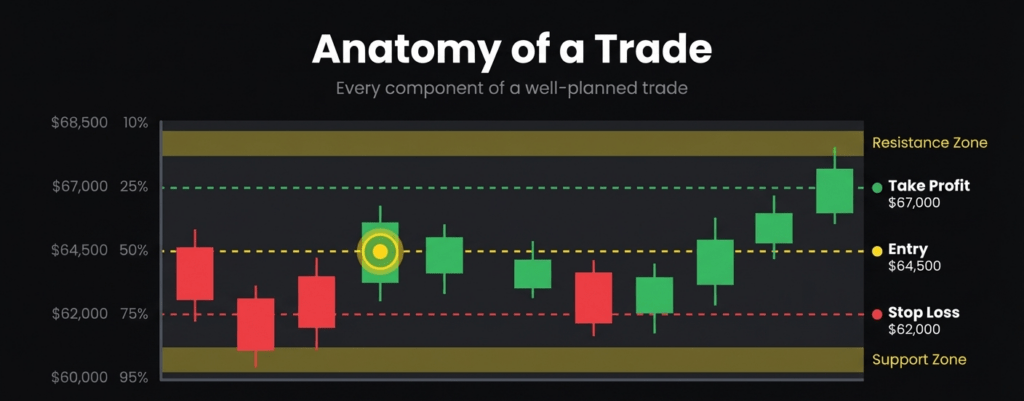
Support represents price levels where buying pressure historically exceeds selling pressure, causing prices to bounce upward. Resistance marks levels where selling pressure dominates, capping upward movement. Identifying these zones helps time entries and exits while managing risk effectively.
Moving averages smooth price data to reveal underlying trends. The 50-day and 200-day simple moving averages (SMA) are widely followed—when shorter-term averages cross above longer-term ones (golden cross), it signals potential bullish momentum. Exponential moving averages (EMA) weight recent prices more heavily, responding faster to changes.
Volume: Confirms trend strength—rising prices with rising volume suggest genuine momentum
Classic patterns that repeat across markets include:
Cup and Handle: Bullish continuation pattern suggesting upward momentum
Without proper risk management, even the best strategies fail over time. Protecting capital ensures you survive losing streaks and capitalize when your edge plays out.
Never risk more than 1-2% of your total trading capital on any single trade. This rule ensures that even a string of losses won’t devastate your account. Calculate position size by dividing your maximum risk amount by the distance to your stop-loss.
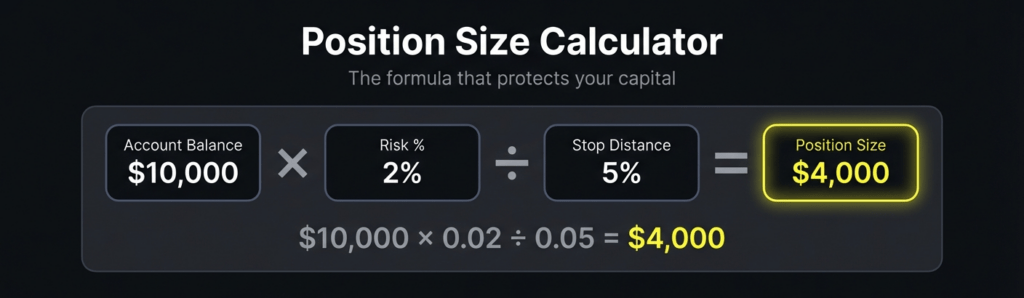
Always set stop-loss orders before entering trades. Determine your invalidation point—the price level where your trade thesis is wrong—and place your stop there. Moving stops to “give trades room” leads to catastrophic losses.
Don’t concentrate all capital in one cryptocurrency. Spread positions across multiple assets with different risk profiles. Major coins like Bitcoin and Ethereum typically offer more stability, while smaller altcoins provide higher upside with greater risk.
Emotional trading destroys accounts faster than bad strategy. Stick to your predetermined rules regardless of fear or greed. Accept that losses are part of trading—your goal is winning over many trades, not every trade.
Once you’ve developed consistent trading skills, accessing larger capital becomes the limiting factor for most traders. Proprietary trading firms offer a solution that transforms how traders scale their success.
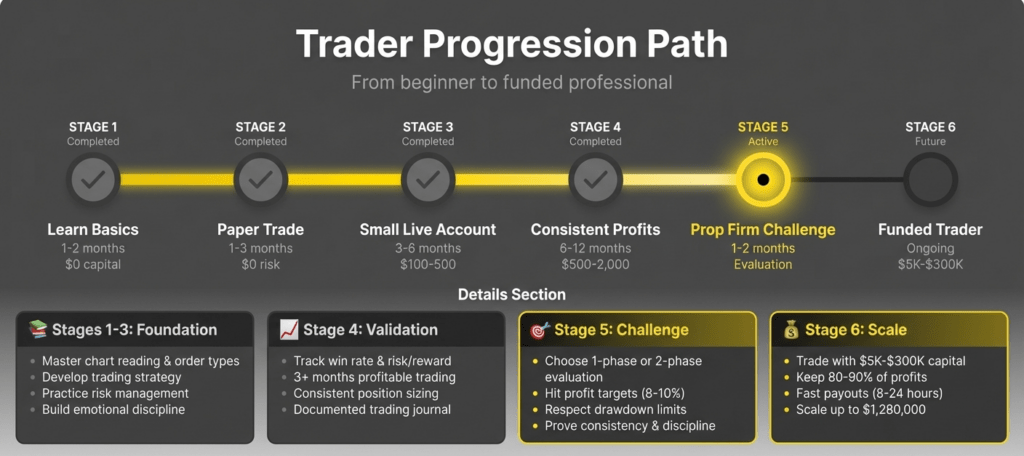
Crypto prop trading firms provide funded accounts to traders who prove their skills through evaluation challenges. Instead of risking your own limited capital, you trade with the firm’s money and keep a significant percentage of profits—often 80-90%. This model removes the barrier of insufficient capital while incentivizing disciplined, profitable trading.
For traders ready to scale beyond personal capital limitations, Crypto Fund Trader has established itself as an industry leader since November 2022. Through a strategic, exclusive partnership with Bybit—one of the world’s premier cryptocurrency exchanges—Crypto Fund Trader delivers institutional-grade execution and access to 715+ trading pairs.
What sets Crypto Fund Trader apart:
The Bybit partnership represents a significant competitive advantage. Unlike firms using synthetic price feeds, Crypto Fund Trader connects traders to real market liquidity through one of the industry’s most trusted exchanges. This means accurate pricing, tight spreads, and execution quality that matches professional trading environments.
Whether you choose the 1-phase or 2-phase challenge, the evaluation focuses on what matters: disciplined trading, consistent risk management, and sustainable profitability. Pass the challenge, and you’ll access demo capital with performance-based rewards that can genuinely accelerate your trading career.
Learning from others’ failures saves both capital and time. Avoid these pitfalls that derail even promising traders.
Leverage amplifies both gains and losses. Using 10x or 20x leverage means a 5-10% adverse move liquidates your entire position. Start with minimal leverage (2-3x maximum) until you’ve demonstrated consistent profitability.
“It will come back” is the most expensive phrase in trading. Positions that move against you without stops can generate losses that take months to recover. Always define your exit before entering.
Fear of missing out drives impulsive entries at exactly the wrong time—usually after a significant move has already occurred. Stick to your strategy and remember: another opportunity always comes.
More trades don’t mean more profits. Each trade carries commission costs and error potential. Quality setups matter more than quantity—sometimes the best trade is no trade.
Markets evolve constantly. Strategies that worked yesterday may fail tomorrow. Commit to continuous learning through courses, market analysis, and reviewing your own trades.
Consistent routines separate professional traders from amateurs. Structure your trading day for maximum effectiveness.
Review overnight price action, check economic calendars for market-moving events, and identify key support/resistance levels on your watchlist. Determine which setups you’re looking for before the trading session begins.
Focus on executing your planned strategy rather than reacting emotionally to price movements. Log every trade with entry reasoning, position size, and target levels. Avoid distractions and social media noise during active trading.
Analyze your trades honestly—both winners and losers. Identify what you did well and what needs improvement. Update your trading journal and adjust strategies based on actual results, not emotions.
Success in cryptocurrency trading isn’t about finding a magic indicator or secret strategy. It’s about mastering fundamentals, managing risk ruthlessly, and executing with discipline day after day.
Start with the basics: choose a reputable platform, understand order types, and practice with small positions. Develop your edge through technical analysis and strategy testing. Protect your capital with strict risk management—this is non-negotiable.
As you prove consistency, explore scaling through prop trading opportunities like Crypto Fund Trader. Their partnership with Bybit, combined with flexible evaluation paths and generous profit splits up to 90%, provides a legitimate pathway from skilled trader to seriously funded professional.
The cryptocurrency market rewards those who approach it with respect, preparation, and persistence. Your journey to trading mastery begins with the next trade you take—make it count.
Start by choosing a reputable cryptocurrency exchange, completing identity verification, and funding your account with a small amount you can afford to lose. Learn basic order types (market and limit orders), practice with established cryptocurrencies like Bitcoin or Ethereum, and develop a simple trading strategy before risking significant capital.
Yes, $100 is enough to begin learning cryptocurrency trading and understanding market dynamics. However, if you want to trade with larger capital without risking personal funds, crypto prop trading firms like Crypto Fund Trader offer evaluation programs where successful traders access funded accounts from $5,000 to $300,000.
Crypto trading can be profitable, but success requires proper education, disciplined risk management, and a proven trading strategy. Studies suggest most retail traders lose money due to emotional decisions and overleveraging—consistent profitability comes from treating trading as a skill that takes months or years to develop.
Most day traders fail because they lack a defined trading strategy, ignore risk management rules, overtrade, and let emotions drive decisions. Successful cryptocurrency trading requires strict discipline, proper position sizing (risking only 1-2% per trade), and continuous education—skills that take significant time to develop.
Yes, you can learn crypto trading independently through online guides, technical analysis courses, trading simulators, and paper trading practice. Start with foundational concepts like candlestick charts, support and resistance levels, and risk management before progressing to live trading with small amounts.
Unlike stock markets, cryptocurrency markets operate 24/7, so there are no official “best hours”—however, volatility typically peaks when US and European trading sessions overlap (8 AM–12 PM EST) and during major news events. Traders using prop firms like Crypto Fund Trader benefit from this around-the-clock access through platforms like Bybit, enabling flexible trading schedules.
-
© 2026 - All Rights Reserved.
SWISS RLCRATES AG is a provider of educational services, all information available on our site is intended solely for the study purposes related to trading on financial markets. Accordingly, we do not offer financial, investment, tax, brokerage or other advice and/or services. Trading in financial markets is a high-risk activity, past performance do not guarantee future ones. It is highly advised not to risk more, than you can afford to lose. Brokers and operators of trading platforms are persons or entities that are separate from SWISS RLCRATES AG and their own terms and conditions will apply when you use their services and products. Neither SWISS RLCRATES AG nor RLCRATES, S.L. (as MT5 license holder) operate in countries where crypto or CFD’s activity is not allowed. The content in our platform is applicable to the extent local laws and/or regulations permit.