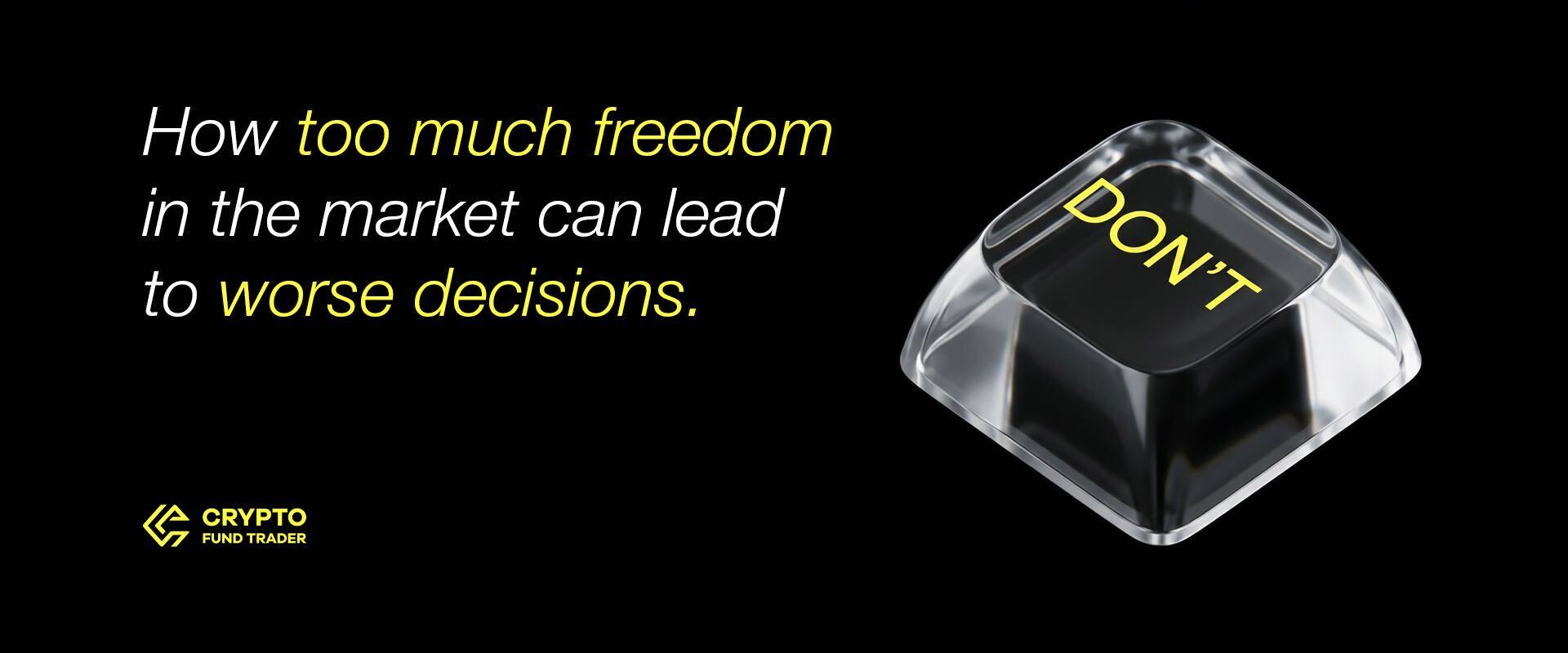
How too much freedom in the market can lead to worse decisions
By Crypto Fund Trader
One of the reasons people are attracted to trading is freedom.
There is no boss telling you when to enter a trade. No fixed schedule. No limit on how many positions you can open. The market is available almost all the time, and every decision is entirely up to you.
At first, this sounds like the perfect environment.
But for many traders, too much freedom becomes a problem rather than an advantage.
At Crypto Fund Trader (CFT), we regularly see traders struggle not because they lack knowledge, but because they have too many choices. They can trade whenever they want, risk whatever they want, and switch strategies whenever they want. Instead of creating better results, that freedom often leads to confusion, emotional decisions, and inconsistency.
In this blog, we’ll explain why unlimited freedom can hurt trading performance, how it affects decision making, and why structure is often one of the most valuable tools a trader can have.
Why freedom feels attractive at first
Most people enter trading because they want independence.
They like the idea of making their own decisions and not having to follow someone else’s rules.
Trading offers freedom in many ways:
- you decide when to trade
- you decide how much to risk
- you decide which markets to trade
- you decide which strategy to use
For new traders, this flexibility feels exciting.
However, freedom without structure can quickly become overwhelming.
The market presents endless opportunities, and having unlimited choices does not automatically lead to better decisions.
In many cases, it leads to the opposite.
Too many choices create confusion
Imagine opening your charts in the morning.
You can trade Bitcoin, Ethereum, forex, indices, or commodities. You can look at the five-minute chart, the hourly chart, or the daily chart. You can trade breakouts, reversals, trends, or range setups.
With so many possibilities, traders often fall into a cycle of constantly changing their approach.
They start asking themselves:
“Should I switch strategies?”
“Maybe another market looks better.”
“What if I move to a lower timeframe?”
Instead of creating clarity, too many choices create doubt.
The more options traders have, the harder it becomes to commit to one plan.
Freedom makes emotional trading easier
One of the hidden dangers of trading is that nobody stops you from making bad decisions.
After a losing trade, you are free to open another position immediately.
After a winning day, you are free to increase your risk.
If you feel bored, you can take trades that do not fit your plan.
The market does not force discipline.
That is why emotional trading becomes so common.
Without rules and boundaries, emotions often take control.
Traders begin reacting to how they feel instead of following a structured process.
Over time, this destroys consistency.
Why structure improves decision making
Many traders believe that rules limit their potential.
In reality, rules often improve performance.
Structure removes unnecessary decisions and allows traders to focus on execution.
For example, a trader with a clear plan may decide:
- to trade only during specific hours
- to take a maximum of three trades per day
- to risk the same amount on every position
- to focus on one or two setups
These limits reduce emotional decision making.
Instead of constantly asking what to do next, traders simply follow their process.
Less freedom in the moment often leads to better long-term results.
The illusion that more opportunities mean more profits
New traders often think that having access to more opportunities automatically increases profitability.
The logic seems simple: more markets and more trades should lead to more profits.
But trading does not work that way.
More opportunities often lead to:
- overtrading
- lower-quality setups
- decision fatigue
- inconsistent execution
Professional traders understand that success does not come from trading everything.
It comes from trading selectively.
The goal is not to find more trades. The goal is to find better trades.
Decision fatigue is a real problem
Every decision requires mental energy.
Choosing when to enter, when to exit, how much to risk, and whether to hold or close a position all require focus.
When traders make too many decisions throughout the day, the quality of those decisions often declines.
This is known as decision fatigue.
For example, a trader may start the morning patiently waiting for quality setups.
After several hours of watching charts, concentration fades. Patience disappears. Suddenly, average setups begin to look attractive.
The problem is not the strategy.
The problem is mental exhaustion.
Creating structure reduces decision fatigue and helps traders protect their focus.
Why prop firm rules exist
Many traders initially see prop firm rules as restrictions.
Daily loss limits, maximum drawdowns, and risk parameters can feel limiting at first.
But these rules exist for a reason.
At Crypto Fund Trader, the goal is not to prevent traders from succeeding. The goal is to encourage sustainable habits.
Prop firm rules help traders:
- avoid emotional decisions
- protect their capital
- manage risk consistently
- focus on long-term performance
Many traders discover that they actually perform better when clear boundaries are in place.
The structure forces discipline.
And discipline leads to consistency.
Conclusion
Trading offers more freedom than almost any other profession, but too much freedom can quietly lead to worse decisions.
Unlimited choices create confusion. Endless opportunities encourage overtrading. A lack of structure allows emotions to take control.
The traders who succeed are not necessarily the ones with the most freedom. They are the ones who create systems that protect them from making unnecessary mistakes.
At Crypto Fund Trader, we believe that structure and discipline are essential parts of long-term success. The right rules do not limit your potential—they help you reach it.
If you’re ready to build better habits, stronger discipline, and greater consistency, join Crypto Fund Trader and take the next step in your trading journey.
Categories:
Follow us on
Many traders believe that more screen time equals faster learning. But watching charts without purpose often leads to confusion, not skill.
Learning comes from reflection, not repetition.
If you take 20 random trades, you learn very little. If you take 3 high quality trades and review them properly, you learn much more.
Progress comes from understanding why trades worked or failed, not from being constantly active.