


On October 10, 2025, the crypto market endured the largest liquidation event in its history: roughly $19 billion in leveraged positions wiped out in 24 hours, 1.6 million traders liquidated, nearly twenty times the scale of the COVID-era crash. A few months earlier, a pseudonymous trader named James Wynn had turned roughly $3 million into $100 million on Hyperliquid using 40x leverage on Bitcoin. A single tweet about EU tariffs moved the market by a few percent and erased his account. By April 2026, six liquidations later, Wynn was down to $900.
This is leverage in crypto: the tool behind the screenshots of overnight fortunes and the cascades that occasionally rattle the market — and the single most misunderstood concept in digital asset trading. For beginners, it can feel like a cheat code. For the unprepared, it’s a fast track to losing capital. This guide breaks down how leverage actually works, the mechanics that destroy accounts when it goes wrong, and how disciplined traders — including those competing for funded prop firm accounts — use it as an instrument rather than a gamble.
Leverage in crypto trading is the use of borrowed capital to open a position larger than your own funds would normally allow. In practical terms, a trader puts down a small amount of money — called margin — and the exchange contributes the rest, multiplying market exposure by a chosen ratio.
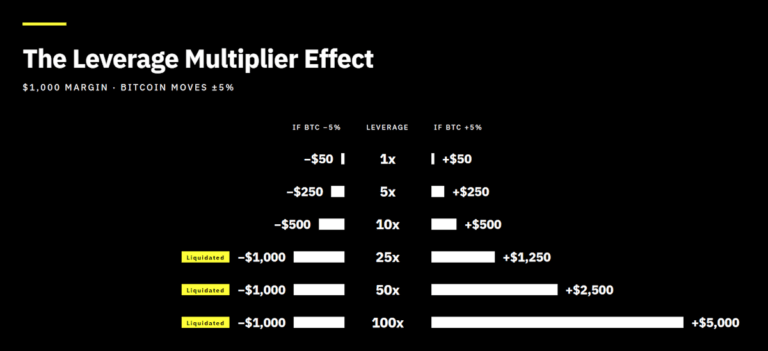
According to Coinbase, leverage allows traders “to trade larger value contracts while putting down relatively smaller amounts upfront,” giving them greater capital efficiency without committing additional funds. Kraken describes the underlying ratio plainly: with 10x leverage, every dollar of collateral controls ten dollars of trading power. The trade-off is symmetrical: leverage magnifies profits when the market moves your way and magnifies losses when it doesn’t. There is no version where only the upside scales.
Leverage works by combining a trader’s own deposit (margin) with borrowed funds from the platform to open a larger position. The trader keeps 100% of the profit or absorbs 100% of the loss on the full position size; the platform simply lends the additional capital and charges fees or interest.
A concrete example: you have $100 and open a Bitcoin trade with 10x leverage.
Crypto leverage is most commonly accessed through derivatives — particularly perpetual futures, which have no expiration date and dominate global crypto derivative volume. Spot leverage exists but is restricted in many jurisdictions; in the United States, spot trading of cryptocurrencies with leverage is prohibited for most retail investors, pushing traders toward regulated futures products.
Margin is the collateral a trader posts to open and maintain a leveraged position. Without it, leverage cannot exist — it’s the security deposit that keeps the trade alive, and it comes in two forms.
Initial margin is the upfront amount required to open a position. To trade a $10,000 Bitcoin position at 10x leverage, your initial margin is $1,000 (10%).
Maintenance margin is the minimum equity you must keep to avoid forced closure. If remaining margin drops below this threshold, the platform liquidates automatically. Maintenance margin rates are typically small (0.4–0.5% on major Bitcoin contracts at low-risk tiers), but they define the line between “still in the trade” and “position closed.”
Isolated Margin vs. Cross Margin
Crypto platforms generally offer two ways to allocate margin across trades, and the choice has significant risk implications.
| Feature | Isolated Margin | Cross Margin |
|---|---|---|
|
Collateral source
|
Only the margin assigned to that specific trade
|
Entire account balance
|
|
Maximum loss per position
|
Capped at the isolated margin allocated
|
Up to your total account balance
|
|
Best for
|
Beginners, high-leverage speculative trades
|
Experienced traders, hedged or correlated positions
|
|
Liquidation impact
|
Affects only that one position
|
Can wipe out the entire account
|
|
Capital efficiency
|
Lower
|
Higher
|
|
Management complexity
|
Higher (per-trade monitoring) |
Lower (account-wide)
|
For most beginners, isolated margin is the safer starting point — the maximum loss is defined before the trade is opened.
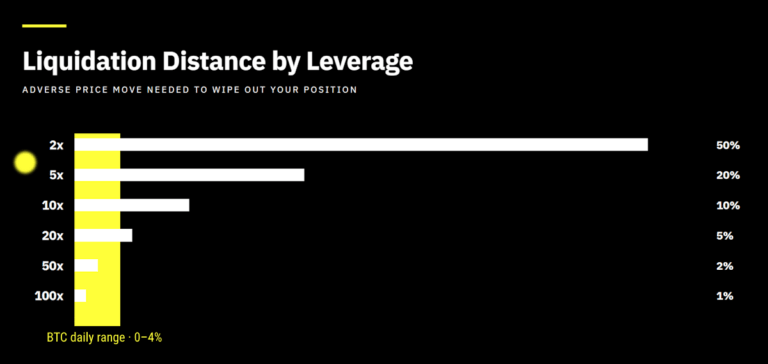
Crypto exchanges and prop firms offer a wide spectrum of leverage ratios, typically ranging from 2x on conservative platforms to 100x or even 500x on offshore venues. The right ratio depends on volatility, trader experience, and platform rules. The table below summarizes typical tiers and the price move needed to wipe out your margin:
| Leverage | Margin Required | Adverse Move to Liquidation* | Suitable For |
|---|---|---|---|
|
2x
|
50%
|
~50%
|
Beginners, large positions on volatile assets
|
|
5x
|
20%
|
~20%
|
Conservative active traders
|
|
10x
|
10%
|
~10%
|
Intermediate traders with strict stop-losses
|
|
20x
|
5%
|
~5%
|
Experienced day traders, short-term setups
|
|
50x
|
2%
|
~2%
|
Scalpers, very high-skill traders only
|
|
100x+
|
1% or less
|
~1% or less
|
Generally not recommended; extreme risk
|
*Approximate — actual liquidation prices vary with fees, funding rates, and maintenance margin requirements. The exact formula is covered below.
Regulators have noticed how extreme some of these levels are. The UK’s Financial Conduct Authority caps leverage at 30:1 for retail forex and CFD trading; Australia limits crypto margin trading to 1:2. Offshore exchanges may offer 100x or more, but seasoned traders almost universally agree that beginners should stay between 2x and 5x.
Funding rates are periodic payments exchanged between long and short traders in perpetual futures markets, designed to keep the contract’s price tethered to spot. They exist because perpetuals have no expiration date — and without a settlement event to force convergence, the market needs another mechanism to prevent perpetuals from drifting away from the spot price they’re supposed to track.
The mechanism is elegant. When the perpetual trades above spot (bullish positioning), funding turns positive — longs pay shorts. Holding longs becomes more expensive, shorts more rewarding, and the perpetual price gets pulled back toward spot. When the perpetual trades below spot, the dynamic inverts. As Deribit puts it, funding is a “zero sum game” between traders; the exchange takes no cut.
How Funding Rates Are Actually Calculated
Most major exchanges — Binance, Bybit, BitMEX — use a variation of the same formula:
Funding Rate = Premium Index + Clamp(Interest Rate − Premium Index, 0.05%, −0.05%)
Breaking that down:
Most exchanges settle funding every 8 hours (00:00, 08:00, 16:00 UTC on Bybit and Binance); some venues use shorter intervals for more volatile contracts.
The Real Cost Over Time
This is where most beginners get blindsided. Funding rates look microscopic per payment but compound aggressively over a holding period. Suppose you open a $10,000 Bitcoin long during a strongly bullish period with funding at +0.05% per 8-hour interval — not unusual when markets are euphoric:
That’s 4.5% of your position notional, paid simply to hold the trade. If your directional thesis only delivers a 3% gain over that period, you’ve lost money. During truly euphoric conditions, funding has spiked to 0.15% or higher per interval — over 13% per month in carrying costs.
For positions held longer than a few hours, funding often costs more than entry slippage and commissions combined.
Liquidation occurs when a trader’s margin falls below the maintenance level and the exchange’s liquidation engine forcibly closes the position. The mechanics are more layered than most beginners realize.
Calculating Your Liquidation Price
For an isolated-margin long position, the simplified formula is:
Liquidation Price ≈ Entry Price × (1 − 1/Leverage + Maintenance Margin Rate)
A worked example: you open a Bitcoin long at $70,000 with 10x leverage and $1,000 of isolated margin (a $10,000 notional). At a 0.5% maintenance margin rate:
Liquidation Price ≈ $70,000 × (1 − 0.10 + 0.005) = $63,350
That’s a ~9.5% drop from entry. For a short, the formula inverts. Higher leverage tightens this band dramatically: at 20x, liquidation sits ~4.75% from entry; at 50x, ~1.9%.
The Liquidation Engine and Mark Price
When the mark price — not the last traded price — hits your liquidation level, the exchange’s liquidation engine takes over. The distinction matters: mark price is calculated from a composite of spot exchanges and futures premium data, specifically to prevent liquidations from brief price wicks or single-venue manipulation.
Once the engine takes over, three outcomes are possible:
Insurance Funds and ADL
The insurance fund is the buffer that prevents one trader’s bad day from becoming everyone else’s problem — every major derivatives exchange maintains one, typically funded by residual margin from clean liquidations.
When that fund runs dry during cascading liquidation events, auto-deleveraging activates. ADL is the system most beginners have never heard of and the one that should genuinely worry them. Per Binance’s documentation, profitable traders on the opposite side of an unfilled liquidation have positions partially or fully closed at the bankruptcy price, ranked by profit percentage and effective leverage. Bybit operates similarly.
The implication is uncomfortable: in extreme conditions, even a winning trade can be force-closed at an unfavorable price because the platform needs your exposure to offset someone else’s failure.
What a Liquidation Actually Looks Like
Reading about liquidation in the abstract and watching one happen to you in real time are different experiences. Here’s how a typical leveraged trade goes wrong, using realistic numbers.
A trader opens a 20x leveraged Bitcoin long at $70,000 with $5,000 of isolated margin. Position notional: $100,000. Approximate liquidation price at a 0.5% maintenance margin rate: around $66,975. The trader sets no stop-loss because “I’ll watch it.”
The trade thesis was right. The execution killed it. Every decision after the first 5% drawdown — averaging down, adding margin, refusing to set a stop — was an attempt to escape a loss that had already been mathematically defined the moment the position opened without protective infrastructure. This is the pattern that destroys accounts: not the original mistake, but the cascading attempts to avoid acknowledging it.
Why a Stop-Loss Changes Everything
Take the same trade — $1,000 isolated margin, 10x leverage, $70,000 Bitcoin long — and compare two outcomes:
Scenario A: No stop-loss. Bitcoin drops 9.5% over a turbulent week to $63,350. The liquidation engine takes over. You lose your entire $1,000 plus liquidation fees. Cash remaining: $0.
Scenario B: Stop-loss at $69,000. Bitcoin hits your stop at a 1.43% decline and the position closes. Loss on the $10,000 notional: roughly $143. Cash remaining: $857.
The difference is not luck. It’s a single order placed at trade entry — converting an open-ended catastrophe into a defined, survivable loss.
Leverage looks the same on the surface — borrow capital, magnify exposure — but how it’s deployed varies dramatically across the trader spectrum. Understanding the differences is the fastest way for a beginner to identify which kind of trader they’re trying to become.
The Retail Trader
Retail traders typically treat leverage as a multiplier on conviction. Working with personal funds on retail exchanges, they often reach for high ratios (20x, 50x, 100x) chasing outsized returns from small price moves. Risk management is self-imposed and frequently inconsistent. Industry data consistently shows that 70–90% of retail leveraged crypto traders lose money — not because leverage is inherently destructive, but because most users size positions based on what their margin allows rather than what their risk tolerance dictates.
The Hedge Fund Trader
Hedge fund traders approach leverage as one input in a multi-factor risk framework. Institutional traders rarely talk about “10x leverage on Bitcoin” — they talk about delta exposure and portfolio-level Value-at-Risk. Funds like Galaxy Digital and Pantera Capital use leverage to construct strategies — basis trades, market-making, statistical arbitrage — where directional risk is often hedged. Position-level leverage might be 5x or 10x, but aggregate exposure is managed by risk officers and prime brokerage relationships enforcing hard caps. Performance is measured on risk-adjusted return — Sharpe and Sortino — not absolute P&L.
The Prop Firm Trader
Prop firm traders sit in the middle ground. They access institutional-grade capital — accounts from $5,000 to $1,000,000 — but operate under structured rules that mirror institutional risk discipline without the institutional overhead. A trader funded by Crypto Fund Trader, for example, can access up to 1:100 leverage, but daily loss limits (typically 5%) and max drawdown rules (typically 10%) force position sizing closer to what a hedge fund would tolerate. The result is leverage with guardrails: the upside is professional-grade, the downside is contained.
While retail traders dominate the headlines with public liquidations, a quieter shift has been happening underneath. The crypto prop trading market grew past $20 billion in 2025, steadily becoming the path of choice for traders who have the skill but not the capital to scale it on their own. For most of the industry’s history, that gap was the binding constraint on independent traders. It no longer is.
| Aspect | Retail Trader | Hedge Fund Trader | Prop Firm Trader |
|---|---|---|---|
|
Source of capital
|
Personal funds
|
Pooled investor capital
|
Firm capital, profit-shared
|
|
Typical position leverage
|
10x–100x+
|
2x–10x (with portfolio caps)
|
5x–100x (within firm rules)
|
|
Risk framework
|
Self-imposed
|
Multi-layer (PM + risk officer + compliance)
|
Firm rules (daily loss + max drawdown)
|
|
Primary success metric
|
Absolute return
|
Risk-adjusted return (Sharpe)
|
Profit + rule compliance
|
|
Failure consequence
|
Personal capital loss
|
Job loss, fund drawdown
|
Account closure, no personal loss
|
|
Education / oversight
|
None required
|
Extensive
|
Evaluation-based
|
The single concept that separates traders who survive from traders who don’t is the realization that position size flows from risk, not from leverage.
Imagine a trader who has just passed an evaluation and received a $50,000 funded account from Crypto Fund Trader. Firm rules: 1% maximum risk per trade, 5% daily loss limit, 10% max drawdown. The trader identifies a Bitcoin long setup:
Step 1: Define risk in dollars. 1% of $50,000 = $500 maximum loss per trade.
Step 2: Derive position size from the stop distance. Position size = Risk ÷ Stop distance per unit = $500 ÷ $1,500 = 0.333 BTC
Notional position value: 0.333 × $70,000 = $23,333
Step 3: This is where leverage actually enters. The trader needs $23,333 of exposure to make this setup work at 1% risk. With $50,000 in the account, the trade could technically be funded with no leverage at all. Leverage determines only one thing: how much margin gets parked against the position.
| Leverage Used | Margin Required | % of Account Used |
|---|---|---|
|
1x (no leverage)
|
$23,333
|
47%
|
|
5x
|
$4,667
|
9.3%
|
|
10x
|
$2,333
|
4.7%
|
|
25x
|
$933
|
1.9%
|
At every leverage level above, the risk is identical: $500. The stop is the same, the position size is the same. Only the margin parked against the trade changes, freeing the rest of the account for other positions.
This is leverage used correctly — a tool for capital efficiency, not risk amplification. Traders who blow up accounts didn’t lose money because of leverage. They lost it by using leverage to size up a position rather than to free up margin on a properly sized one.
Most blown accounts don’t result from a single dramatic mistake — they result from skipping the questions a disciplined trader asks before clicking buy. If you can’t answer all five clearly, the trade isn’t ready.
Failing any one of these isn’t a small problem. It’s the failure pattern that defines the 80–95% of leveraged traders who lose money.
For traders weighing whether to step into leverage at all, the contrast with spot trading clarifies the trade-offs:
| Factor | Spot Trading | Leverage Trading |
|---|---|---|
|
Capital required
|
Full position value
|
Fraction of position (margin)
|
|
Maximum loss
|
The amount invested
|
Margin + potential fees, faster
|
|
Asset ownership
|
Yes — you hold the actual crypto
|
No — you hold a derivative position
|
|
Profit potential
|
Limited to price appreciation
|
Amplified by leverage ratio
|
|
Liquidation risk
|
None |
High, depending on leverage
|
|
Funding/borrowing costs
|
None
|
Yes |
|
Long and short flexibility
|
Limited (must own the asset)
|
Trade both directions equally
|
|
Suitable for beginners
|
Yes |
Only with strong preparation
|
Spot trading is the natural starting point for accumulating long-term positions and learning market dynamics. Leverage is a specialist tool — useful for active traders with clear strategies, dangerous for everyone else.
This article focused on the foundational mechanics of leverage. Several adjacent topics deserve their own deep dives:
The principles in this article apply to all of them, but specifics vary in ways worth studying before deploying capital.
Leverage is one of the most powerful instruments in modern markets, and it’s exactly as helpful or harmful as the person using it. Traders who use it well treat each trade as a calculated risk rather than a bet, size positions based on what they’re willing to lose, and accept that survival — not maximum gain — is the metric that compounds over time.
For beginners, the smart path is incremental: learn spot trading first, then explore leverage at low ratios with isolated margin and disciplined stops. For traders who already have an edge, the next question becomes capital — and that is where the evaluated funding model has shifted the landscape. Firms like Crypto Fund Trader let skilled traders demonstrate performance under structured rules and access institutional-grade capital without risking their own savings. It’s not a shortcut — most evaluations are designed to fail traders who haven’t already developed the habits this article describes. But for those who have, the capital is now available in a way it simply wasn’t a few years ago.
Leverage doesn’t reward courage. It rewards preparation. And in a market that runs 24/7 and doesn’t owe anyone anything, that preparation is the only real edge there is.
If leverage kills 80–90% of traders, why does anyone use it?
Leverage doesn’t kill accounts — position sizing without risk controls does. Experienced traders use leverage as a capital efficiency tool: instead of parking $23,000 in one trade, they post $2,300 in margin and free the rest for other setups, while keeping the actual dollar risk identical. The 80–90% loss stat reflects traders who size positions based on what their margin allows, not what they’re willing to lose. Those are two completely different decisions.
My trade was right but I still got liquidated. How?
You were right on direction but wrong on timing, and leverage has no patience. At 20x, Bitcoin only needs to drop 5% before the liquidation engine takes over — that’s a normal daily candle on a slow day. The market doesn’t care that it would have recovered by Thursday. Without a stop-loss and proper position sizing, even correct trades get killed by routine volatility before the thesis plays out.
What’s the actual difference between cross and isolated margin? Does it matter?
It matters enormously and choosing wrong is one of the most common account-killing mistakes. Isolated margin caps your loss on one trade to whatever you assigned to it — the rest of your account is untouched. Cross margin draws from your entire balance to keep a losing position alive, which means a single bad trade can wipe everything. Beginners should always use isolated. Cross margin is for experienced traders running correlated or hedged positions who know exactly what they’re doing.
If crypto runs 24/7 and I can’t watch it constantly, is leverage just a bad idea for me?
Leverage without active monitoring or pre-set stops is genuinely dangerous. Markets move while you sleep — a position that was fine at midnight can be liquidated by 3am on a macro headline. The practical fix isn’t staring at charts around the clock; it’s placing your stop-loss and liquidation buffer at trade entry so the position manages itself. If you can’t or won’t do that before you open the trade, then yes, leverage is a bad idea for you right now.
This article is for educational purposes only and does not constitute financial advice. Trading cryptocurrencies with leverage carries substantial risk and is not suitable for all investors. Always do your own research and consider your financial situation before trading.
-
© 2026 - All Rights Reserved.
SWISS RLCRATES AG is a provider of educational services, all information available on our site is intended solely for the study purposes related to trading on financial markets. Accordingly, we do not offer financial, investment, tax, brokerage or other advice and/or services. Trading in financial markets is a high-risk activity, past performance do not guarantee future ones. It is highly advised not to risk more, than you can afford to lose. Brokers and operators of trading platforms are persons or entities that are separate from SWISS RLCRATES AG and their own terms and conditions will apply when you use their services and products. Neither SWISS RLCRATES AG nor RLCRATES, S.L. (as MT5 license holder) operate in countries where crypto or CFD’s activity is not allowed. The content in our platform is applicable to the extent local laws and/or regulations permit.