

Crypto Fund Trader caps standard evaluations at $300,000 and Instant accounts at $1,280,000. Here’s how the scaling mechanics actually work, where the ceilings sit, and which rules decide whether your account gets there.
[ RANK ]
How to Scale Up Crypto Prop Trading: From $10K to a Six-Figure Account

How to scale up crypto prop trading: from $10K to a six-figure account

To scale up crypto prop trading capital, a trader passes an evaluation, then grows the account one of two ways: stacking multiple evaluations toward a firm’s per-user allocation cap, or using an Instant-style account that doubles automatically at a profit threshold. Crypto Fund Trader caps the first path at $300,000 and the second at $1,280,000: hard stops, not projections.

Why “scaling” gets oversold

Most articles about crypto prop firm scaling read like income calculators: start with $10,000, scale to six figures, imply a payday along the way. The industry’s own numbers argue against that framing. Retail prop trading generated an estimated $850 million in revenue in 2026 across roughly 2.1 million active funded traders, but only 5% to 14% of purchased challenges ever reach a funded stage, and about 7% of challenge buyers ever collect a reward, according to Track360’s 2026 industry data. Scaling is available only to traders who clear that first bar; it’s not automatic once you buy an evaluation.

This guide skips the earnings math. It covers the mechanics of how to scale up crypto prop trading capital: where the ceilings sit, and which rules decide whether an account survives long enough to reach them, using Crypto Fund Trader’s published structure as the example.

What “scaling” actually means on an evaluation account

Scaling up crypto prop trading capital means increasing the size of a simulated funded account, not depositing more of your own money.

Crypto Fund Trader describes itself as a simulated trading evaluation firm: traders buy an evaluation, trade a simulated account across crypto, forex, indices, commodities, or stocks, and, if they pass and stay compliant, may become eligible for a simulated funded account of up to $300,000 in virtual capital, plus performance-based rewards. Nothing about scaling changes that structure. A larger account is still demo capital: a bigger balance raises the notional amount a trader is evaluated against, not a transfer of real funds. Every number in this guide refers to that simulated allocation.

Two ways to scale up crypto prop trading

Crypto Fund Trader has exactly two routes to a bigger simulated account, and they do not combine into a third.

RouteHow size increasesCeiling
Standard evaluations (2-Phase, 1-Phase, 3-Phase)Pass more than one evaluation; account sizes run $5,000 to $200,000 each$300,000 total simulated allocation per user
InstantAutomatic doubling at a profit milestone, no new evaluation purchase required$1,280,000, with up to three active Instant accounts

The standard route caps individual accounts at $200,000, so reaching the $300,000 per-user ceiling means holding more than one passed evaluation at once. The Instant route works differently: the account itself grows without a second purchase, up to a ceiling more than four times higher.
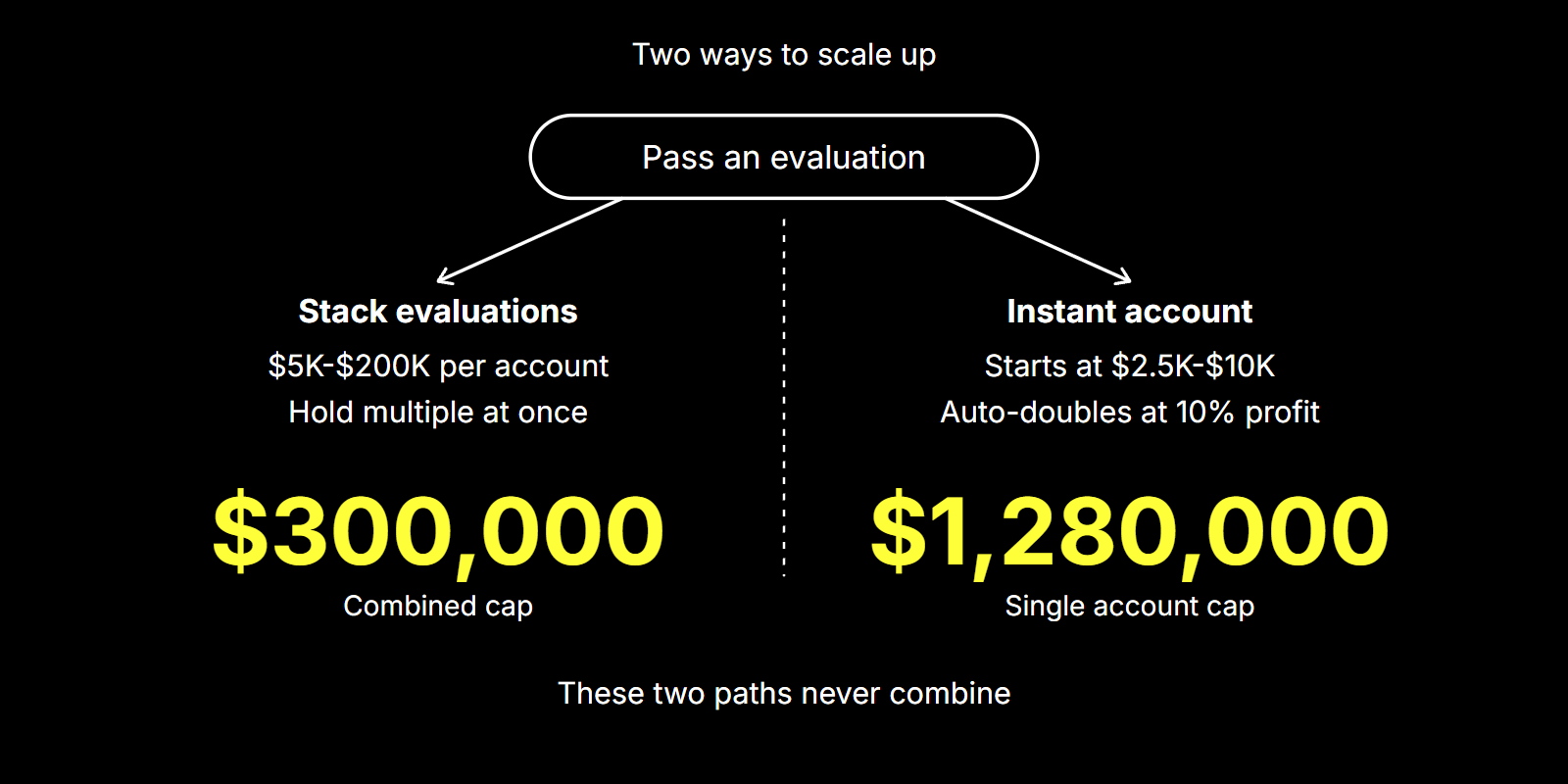
Diagram comparing two ways to scale up crypto prop trading capital: stacking evaluations up to a $300,000 combined cap, or an Instant account that auto-doubles up to $1,280,000.

Program Profit target Daily loss / Overall loss
2-Phase
Phase 1: 8%, Phase 2: 5%
5%
1-Phase
10%
4% / 6%, trailing
Break
5% ($25k) / 6% ($50k, $100k)
none / 4% trailing ($25k, $50k) or 3% trailing ($100k)

How crypto prop firm scaling works, step by step

Crypto prop firm scaling on the Instant line runs on a single trigger: reach 10% simulated profit, and the account size doubles.

Crypto Fund Trader calls this the “Withdrawal & Upgrade” step. A trader starts an Instant evaluation at $2,500, $5,000, or $10,000, with no profit target to clear first, only the standing 4% daily and 6% overall loss limits from the first trade. Hitting 10% simulated profit on the current balance triggers the upgrade, which doubles the account’s demo size. Because each step doubles the previous balance, the ladder from a $10,000 starting account is fixed math, not a forecast:

$10,000 → $20,000 → $40,000 → $80,000 → $160,000 → $320,000 → $640,000 → $1,280,000
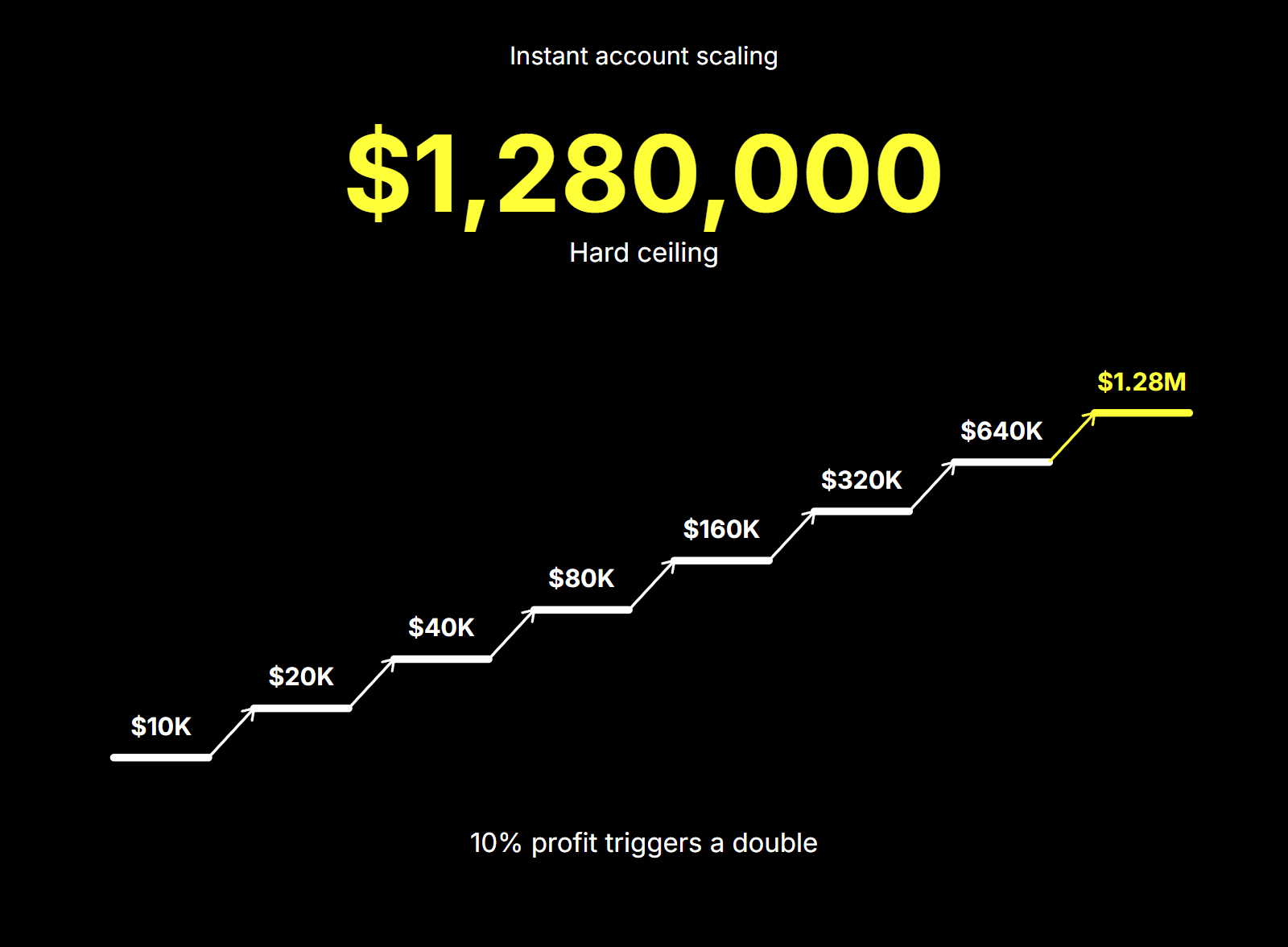
Chart showing a Crypto Fund Trader Instant account doubling from $10,000 to a $1,280,000 ceiling in seven steps, each triggered by 10% simulated profit.

That’s seven doublings to reach the ceiling: arithmetic, not a promise about how fast or whether any account gets there. A trader can also run up to three Instant accounts at once.

The ceiling: why $300,000 and $1,280,000 are hard stops

Both scaling ceilings are hard stops, not milestones a trader can negotiate past. The standard evaluation route tops out at $300,000 in combined simulated allocation per user, while the Instant route tops out at $1,280,000 across up to three active Instant accounts.

The $300,000 ceiling applies to the total of standard evaluations held by one user, not to a single account. The $1,280,000 ceiling belongs to the Instant Withdrawal & Upgrade path and is reached through the account-doubling ladder. Reaching either number does not turn simulated capital into a cash balance or remove the firm’s risk, compliance, KYC, or reward rules.

The 90% add-on is separate from account-size scaling: it can increase reward eligibility, but it does not raise either allocation ceiling.

Risk and compliance rules that decide whether you keep scaling

A bigger account inherits the same drawdown regime as a smaller one: scaling changes the balance, not the rulebook.

Drawdown on every account is calculated on equity, so an open loss counts against the limit before a position closes, and the daily loss figure resets from the account balance at 12:05 AM UTC each day. A doubled Instant account is still governed by the same 4% daily and 6% overall loss limits it started with. The dollar amounts scale with the balance; the percentages do not. Simulated profit is also capped at $10,000 per day or per trade; equity above that threshold may be closed and the excess deducted.
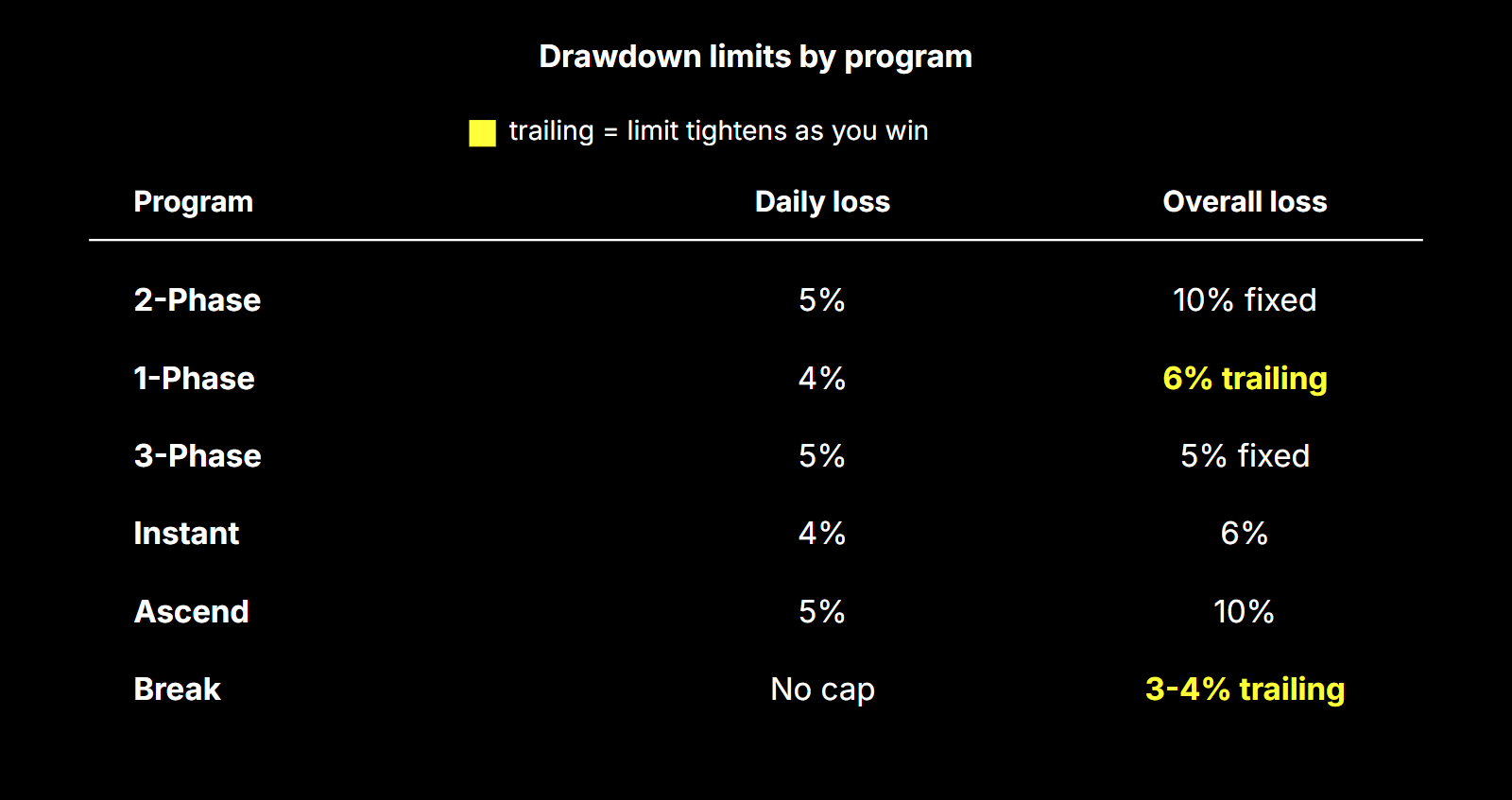
Table of daily and overall drawdown limits for Crypto Fund Trader's six evaluation programs, highlighting which use a trailing loss limit.

One rule that does not travel across the product line is the Final Stage consistency requirement on Break: no single trading day may account for more than 40% of total profits. It applies only at reward-request time. Reverse trading, account sharing, copy trading restrictions, and KYC requirements also apply regardless of account size.

KYC is a separate gate that scaling does not skip: before any scholarship reward can be processed, KYC must be completed and approved.


Choosing a path: a practical checklist

The right way to scale up crypto prop trading capital depends on which evaluation line a trader is already in: the two routes do not overlap.

  • Confirm whether the account is on the Instant line before assuming automatic doubling applies.
  • Track cumulative simulated allocation against the $300,000 ceiling when stacking standard evaluations.
  • Re-read the drawdown regime at every size tier: a $640,000 Instant account carries the same 4%/6% limits in larger dollar terms.
  • Keep KYC documentation current before requesting a reward.
  • Do not apply Break’s 40% consistency rule to other programs.
  • Treat the 90% performance add-on and account-size scaling as separate decisions.

Where this fits inside a real evaluation firm

Crypto Fund Trader runs six evaluation lines, but only Instant carries the automatic scaling mechanism described here; the other lines require holding multiple passed evaluations instead.

Bybit-based evaluations change what the account measures. Trades run on the trader’s own Bybit sub-account, connected by API, against Bybit’s live order book. CFT states it does not add markup, artificial spread, or fictitious slippage. KYC is still mandatory before any reward.

None of this changes the two hard numbers: up to $300,000 through standard lines, or up to $1,280,000 through the Instant Withdrawal & Upgrade mechanism. All of it is virtual capital in a simulated environment, with reward eligibility of up to 80% or 90% with the add-on.

Frequently asked questions

Is a doubled account actually more money? No. Doubling changes the simulated balance, not real money sitting anywhere.

Does doubling happen automatically? On Instant, reaching 10% simulated profit triggers the upgrade without buying anything new.

Do drawdown percentages get easier after scaling? No. The percentages stay fixed; only the dollar amounts scale.

Which route scales faster? Instant doubles automatically, while standard stacking requires passing multiple evaluations and has a $300,000 cap.

Does the 90% add-on affect account size? No. It changes reward eligibility, not the $300,000 or $1,280,000 ceilings.

Is Bybit different from CFD-style accounts? Yes. Bybit evaluations use a live order book through the trader’s own sub-account, but KYC is still required before rewards.

This article is for informational and educational purposes only and does not constitute financial advice. Trading cryptocurrencies and prop firm challenges involve significant risk; trade only with capital you can afford to lose.

Categories:

Follow us on