

The crypto market in 2026 looks different than it did even a year ago. Bitcoin and Ethereum spot ETFs have pulled in steadier institutional flows, liquidity on major exchanges has deepened, and intraday volatility, while still considerable, no longer behaves like the chaotic 2021 cycle. For traders who don’t want to scalp every five-minute candle but also don’t want to passively HODL through every drawdown, swing trading has quietly become the most practical middle path.This guide breaks down a complete swing trading crypto strategy for 2026 — what it is, the technical setups that still work, how to manage risk, and what changes when you’re trading a prop firm account instead of your own capital.
Swing trading in crypto is a strategy of holding positions for several days to a few weeks to capture medium-term price moves, rather than scalping intraday noise or holding for years. The goal is to ride a defined directional swing — usually 5% to 30% in major coins, sometimes more in altcoins — between identifiable support and resistance zones.
Unlike day trading, swing trading doesn’t require you to stare at charts during US-Asia overlap. Unlike long-term investing, it doesn’t ask you to stomach an 80% drawdown in faith that the next cycle will recover it. It sits in the middle: active enough to compound capital meaningfully, patient enough to fit around a job, a family, or a prop firm evaluation.
Industry data suggests crypto swing trades typically last 2–5 days on average, shorter than equity swings (5–15 days) because of crypto’s higher volatility and 24/7 schedule. That speed is an advantage — and a trap. Sudden weekend gaps and overnight whale moves are part of the territory.
A working swing trading crypto strategy combines three pillars: technical chart analysis on multiple timeframes, disciplined risk management, and a defined plan for entries and exits before the trade is placed. Skip any of the three and you’re not swing trading — you’re gambling on a multi-day timeframe.
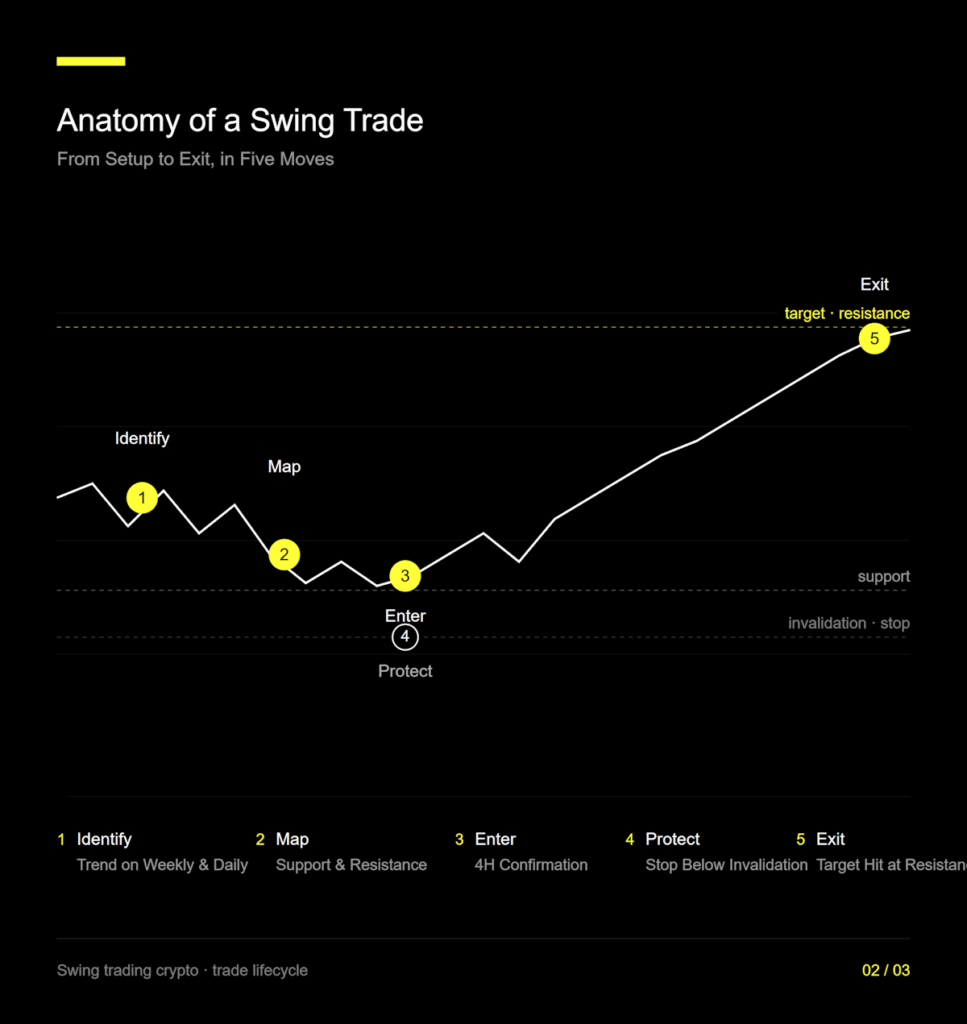
The standard workflow most professional swing traders use looks like this:
In practice, that means fewer trades, wider stops, and larger targets than a day trader would use — and a much higher tolerance for sitting still.
The most effective swing trading strategies for crypto in 2026 fall into four repeatable setups: trend pullbacks, range trading, breakout-and-retest, and RSI divergence reversals. Each one suits different market conditions, which is why experienced traders carry several setups in their toolkit instead of forcing one approach onto every market.
| Strategy | Best Market Condition | Typical Hold | Core Tools | Skill Level |
|---|---|---|---|---|
|
Trend Pullback
|
Strong trending market
|
3–10 days
|
EMA 20/50, Fibonacci 0.5–0.618
|
Beginner-friendly
|
|
Range Trading
|
Sideways / consolidating
|
2–7 days
|
Horizontal S/R, RSI
|
Intermediate
|
|
Breakout & Retest
|
Post-consolidation expansion
|
4–14 days
|
Volume, prior range high/low
|
Intermediate
|
|
RSI Divergence Reversal
|
Late-stage trend exhaustion
|
3–8 days
|
RSI, higher-timeframe structure
|
Advanced
|
A quick note on each:
The most useful indicators for swing trading crypto are simple and few: the 50- and 200-day EMA for trend, the RSI for momentum and divergence, Fibonacci retracements for entry zones, and volume to confirm breakouts. Stacking ten indicators on one chart usually means you’re hiding from the price action, not reading it.
A clean swing trading toolkit in 2026 typically includes:
Liquidity matters more than most traders realize. Slippage on a 4-hour stop-loss in a thin altcoin can quietly eat half your edge. Stick to high-volume pairs unless you have a specific reason not to.
Risk management in crypto swing trading comes down to three numbers: a maximum risk per trade (usually 1–2% of account), a minimum reward-to-risk ratio (1:2 or better), and a hard stop-loss placed at the level that invalidates the trade idea. Everything else is decoration.
Concretely, most professionals enforce these rules:
Expect losing streaks of four to six trades in a row even with a sound system. That’s normal variance, not a reason to abandon the plan.
Swing trading inside a prop firm account works the same as personal trading in principle, but the firm’s drawdown structure, evaluation timeframe, and weekend-holding rules can quietly invalidate setups that would be perfectly fine on your own capital. The trader’s edge has to fit the rulebook — not the other way around.
The details that matter most for swing traders:
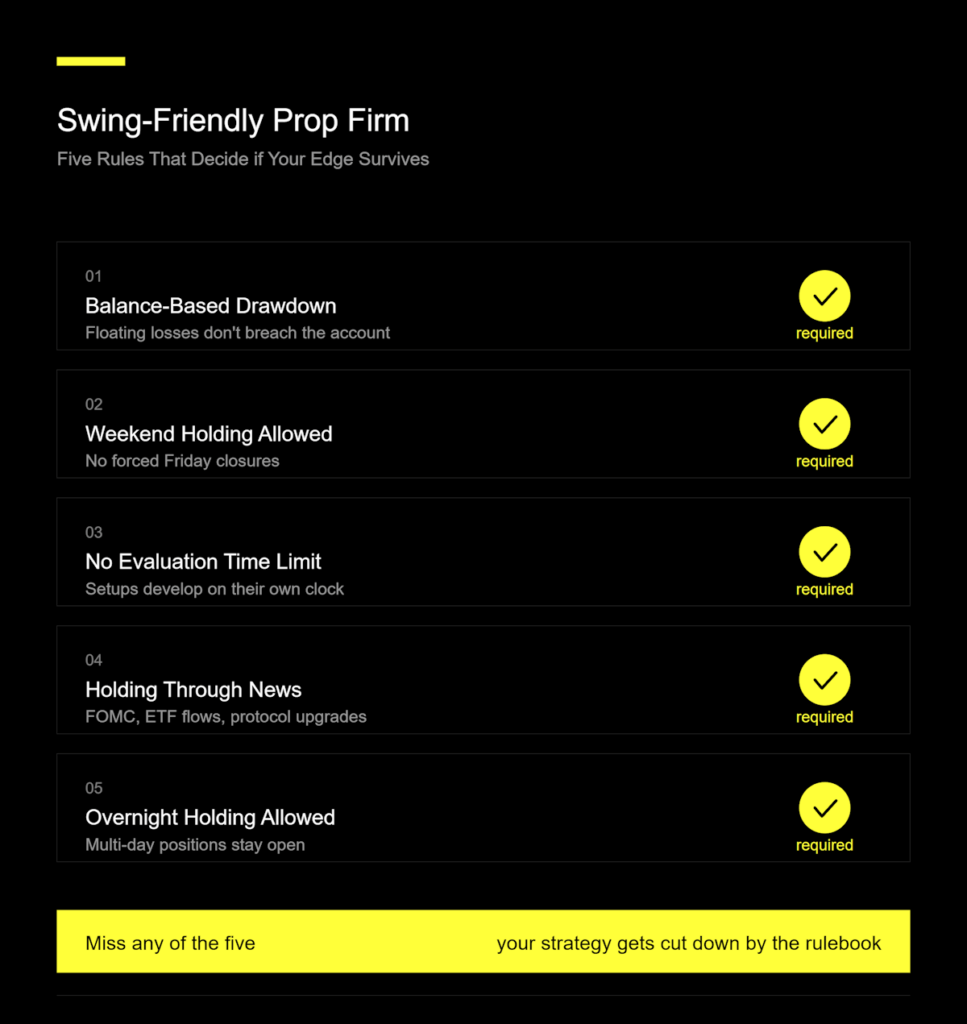
This is where firm selection becomes part of the strategy itself. A swing trader’s edge can be perfectly valid and still get cut down by a rulebook that doesn’t fit it. The crypto prop trading market crossed $20 billion in 2025, and 2026 has seen a noticeable shift in traders’ favor — flatter evaluation windows, more transparent drawdown mechanics, and faster payout cycles. But not every firm has caught up, and the gap between the swing-friendly programs and the rest is widening fast.
Crypto Fund Trader sits among the small group that built specifically around this style of trading. The structure most relevant for swing traders includes balance-based drawdown handling, no minimum trading days, weekend and overnight holding allowed, real exchange execution through a Bybit-backed setup, and an 80% profit split that scales upward with consistency. Two-phase evaluations start at low entry fees, with crypto withdrawals available once funded — the kind of operational details that quietly determine whether a strategy survives contact with the rulebook.
The traders entering funded programs now are doing so into the most flexible conditions the industry has ever offered. How long that window stays open is anyone’s guess; firms compete hard, but rule structures tighten the moment a cycle turns. For traders who already have a working swing strategy and have been waiting for the right capital, “later” has been getting more expensive than “now.”
The mistakes that most often end swing trading accounts are not exotic. They’re the same handful of habits, repeated:
Confusing conviction with analysis. Holding a losing trade because “it has to bounce” is not a strategy.
Swing trading crypto in 2026 doesn’t reward the loudest traders. It rewards the ones who pick three or four setups, define their risk to the dollar, and execute the same plan whether the chart is screaming or sleeping. The market is more institutional than it used to be, but the edge is still available — it just shows up as patience, position sizing, and the discipline to wait for the trade you actually planned.
Whether you’re trading personal capital or working through a prop firm evaluation, the strategy is the same. The difference is that with funded capital, the rulebook is part of the trade. The traders compounding meaningfully in this cycle are the ones who matched their style to a firm that respects it — and started before the conditions that make this possible got rewritten. Choose the firm that fits your style, treat the rules as the boundary your edge operates inside, and let the setups come to you.
Okay but isn’t swing trading crypto just a slower way to lose money? Why not just hold BTC?
Swing trading and HODLing solve different problems. HODLing works if you can sit through 60–80% drawdowns without panic-selling. Swing trading compounds actively and keeps drawdowns controlled — but only with a real plan. Most people failing at it aren’t swing trading; they’re holding losing bags and calling it a strategy.
How do you set a stop-loss without crypto wicking you out every night?
Stops belong below actual structure — swing lows, key support zones — not at arbitrary percentages. Getting wicked out constantly means stops are too tight or entries are poorly timed. Reduce size to afford a wider stop while keeping risk under 1–2% of account.
Is any swing strategy viable in a bear market, or do you just wait it out?
Range trading and short-side setups work well in downtrends. Selling relief rallies into resistance on the 4H chart is the mirror of buying dips — same logic, inverted. Traders who only go long bleed in bear markets. Sometimes the real edge is sitting in stablecoins.
Aren’t retail swing traders just competing with algos now? What’s the edge?
Retail swing traders’ edge is patience and selectivity, not speed. Algos optimize for noise and microstructure — not for clean 10–15% multi-day trend moves after breakouts or sentiment shifts. The market is more institutional, but A-grade setups with proper sizing still outperform algo noise over time.
What if news nukes the market overnight while I’m in a trade?
Position sizing is the answer. A 1% risk per trade limits overnight gap damage to 3–4% of account even in a severe move. Reduce exposure before known event risk — FOMC, major token unlocks, ETF decisions. You won’t catch every move, but you won’t blow up either.
This article is for educational purposes and does not constitute financial advice. Crypto trading involves substantial risk; trade only what you can afford to lose.
-
© 2026 - All Rights Reserved.
SWISS RLCRATES AG is a provider of educational services, all information available on our site is intended solely for the study purposes related to trading on financial markets. Accordingly, we do not offer financial, investment, tax, brokerage or other advice and/or services. Trading in financial markets is a high-risk activity, past performance do not guarantee future ones. It is highly advised not to risk more, than you can afford to lose. Brokers and operators of trading platforms are persons or entities that are separate from SWISS RLCRATES AG and their own terms and conditions will apply when you use their services and products. Neither SWISS RLCRATES AG nor RLCRATES, S.L. (as MT5 license holder) operate in countries where crypto or CFD’s activity is not allowed. The content in our platform is applicable to the extent local laws and/or regulations permit.