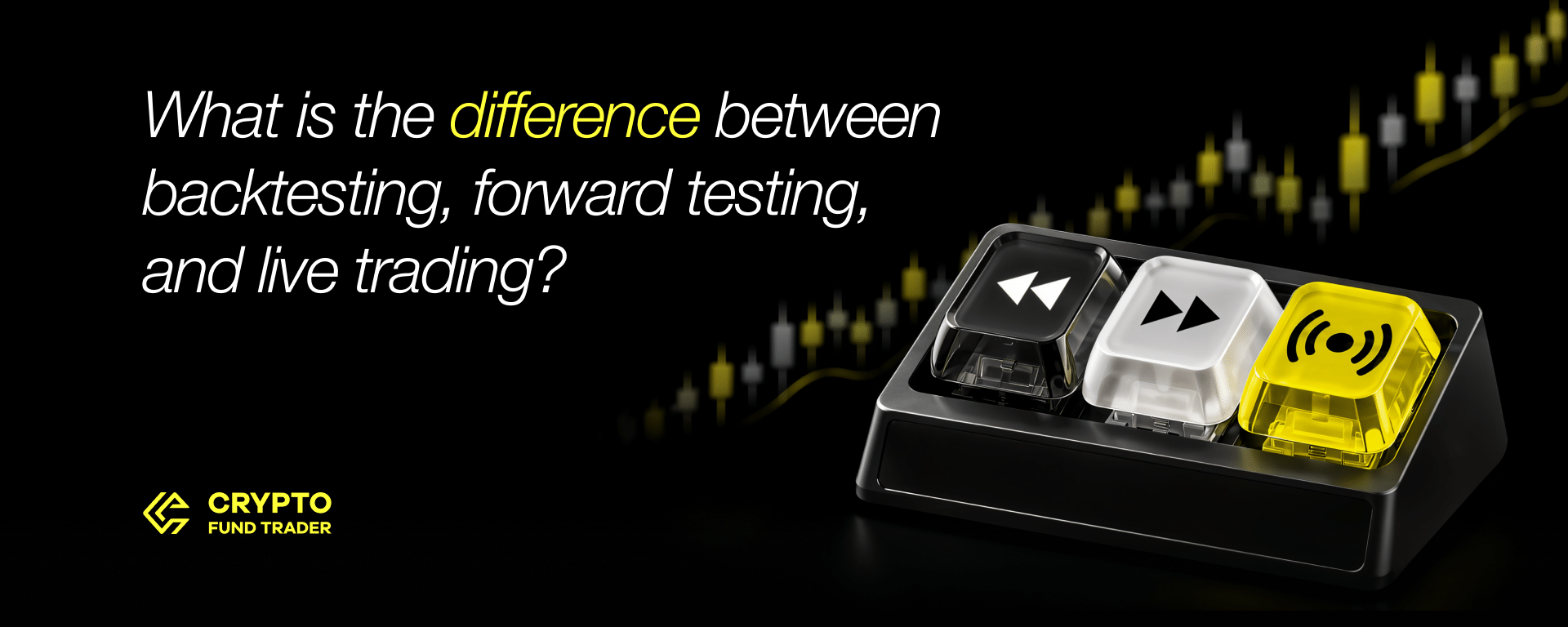
What Is the Difference Between Backtesting, Forward Testing, and Live Trading?
By Crypto Fund Trader
Developing a trading strategy is only the beginning. Before relying on it in the markets, traders need to understand how well it actually performs and whether it can deliver consistent results under different conditions.
This is where backtesting, forward testing, and live trading come into play.
Although these three methods are closely connected, each serves a different purpose. Backtesting helps traders evaluate a strategy using historical market data, forward testing allows them to test it in current market conditions, and live trading shows how it performs with real money at risk.
Understanding the differences can help traders avoid common mistakes and make more informed decisions before committing capital to a strategy.
What Is Backtesting?
Backtesting is the process of testing a trading strategy against historical market data to see how it would have performed in the past.
Instead of entering trades in real time, traders go through historical price movements and apply their strategy’s rules to previous market conditions.
For example, a trader developing a breakout strategy might review historical Bitcoin charts and identify every situation where price broke above a certain resistance level. They then record whether the strategy would have resulted in a winning or losing trade based on their predefined entry, stop-loss, and take-profit rules.
By repeating this process across a large sample of trades, traders can begin to understand how their strategy behaves.
Backtesting can provide useful information about several important metrics, including win rate, average risk-to-reward ratio, expectancy, and maximum drawdown.
One of its biggest advantages is that it allows traders to evaluate an idea without putting real money at risk. It can also help identify weaknesses before a strategy is used in live market conditions.
However, backtesting has limitations.
Historical performance does not guarantee future results. Market conditions change, and a strategy that performed well in the past may not produce the same results in the future.
Another common problem is overfitting. This happens when traders adjust their strategy so heavily around historical data that it performs well on the specific period tested but struggles when applied to new market conditions.
A good backtest should therefore be based on clear rules and realistic assumptions, rather than constantly adjusting parameters until the results look impressive.
What Is Forward Testing?
Forward testing takes the strategy out of historical data and puts it into current market conditions.
Instead of reviewing trades that have already happened, traders apply their strategy to live price movements as the market develops.
This can be done through a demo account, paper trading, or another environment where trades are monitored in real time without risking significant capital.
The main purpose is to see whether the strategy performs as expected outside of historical testing.
For example, a trader might have backtested a strategy and found that it produced positive results over several hundred historical trades. They can then forward test the same strategy over the next 50 or 100 opportunities to see whether the results remain consistent.
Forward testing also reveals practical issues that backtesting may not fully capture.
A strategy might look simple when reviewing historical charts, but executing it in real time can be more difficult. Traders need to make decisions while prices are moving, manage positions, and deal with changing market conditions.
It also gives them an opportunity to evaluate whether their rules are clear enough to follow consistently.
One important thing is to avoid changing the strategy every time a trade loses. Forward testing only provides useful information when the rules remain consistent enough to evaluate properly.
What Is Live Trading?
Live trading is when a trader executes their strategy in the actual market using real capital.
This is where the strategy is exposed to the full range of conditions that come with real execution.
Unlike backtesting and demo trading, live trading introduces financial consequences. Every loss affects the account balance, and every decision can have a direct impact on the trader’s capital.
It also introduces factors that may be difficult to replicate perfectly in testing environments.
These include slippage, commissions, spreads, order execution, and liquidity. Depending on the market and trading platform, the actual entry and exit prices may differ from what a trader expected.
Psychology also becomes more relevant. Taking a loss with real money can feel very different from seeing a losing trade on a historical chart or demo account.
Some traders struggle to follow their strategy once real money is involved. They might close winning trades too early, hesitate when a valid setup appears, or increase their risk after a losing streak.
This is why a strategy that performs well during backtesting and forward testing can still produce different results when traded live.
Live trading ultimately shows how well both the strategy and the trader perform under real conditions.
Why All Three Testing Methods Matter
Backtesting, forward testing, and live trading should not be viewed as competing methods. They are different stages of evaluating and developing a trading strategy.
Backtesting helps establish whether a strategy has potential. It allows traders to analyze historical performance, identify patterns, and understand how their rules would have worked across different market environments.
Forward testing helps determine whether those results can translate into current market conditions. It also reveals execution issues and gives traders an opportunity to practice following their rules in real time.
Live trading provides the final layer of information. It shows how the strategy performs with real execution costs, financial risk, and emotional pressure.
Skipping these stages can lead to unnecessary mistakes. For example, moving directly from an untested strategy into live trading means risking capital without having a clear understanding of its potential performance.
On the other hand, spending months backtesting without ever testing the strategy in real time can create a false sense of confidence.
The strongest approach is to use each method for what it is designed to do.
How Long Should You Test a Trading Strategy?
There is no universal answer to how long a strategy should be tested. It depends on the type of strategy, how frequently it generates setups, and how much data is available.
A scalping strategy that produces multiple opportunities every day may generate a meaningful sample of trades relatively quickly. A swing trading strategy that only produces a few setups each month will naturally require more time.
The number of trades also matters more than simply counting days or weeks.
For example, testing a strategy over two weeks might be enough to collect a reasonable sample for a high-frequency approach, but it would be insufficient for a strategy that only produces a handful of trades during that period.
It is also important to test across different market conditions. A strategy that only performs well during a strong bullish trend may struggle when the market becomes less directional.
Rather than rushing into live trading, focus on collecting enough information to understand the strategy’s strengths, weaknesses, and potential drawdowns.
Testing Your Strategy Before Trading With a Prop Firm
For traders interested in prop firms, testing becomes particularly important.
A prop firm account comes with specific conditions that traders need to understand and operate within. Depending on the programme, these may include daily loss limits, maximum drawdown, minimum trading days, or other requirements.
A strategy might be profitable over time but still be unsuitable for a particular account if its risk profile makes it difficult to operate within those limits.
This is why traders should understand not only whether their strategy can generate positive results, but also whether its drawdowns and risk requirements fit the account they intend to trade.
At Crypto Fund Trader, traders can explore different prop trading opportunities while developing their own approach to the markets. Taking the time to test a strategy and understand the relevant programme conditions can help create a more structured starting point.
Conclusion
Backtesting, forward testing, and live trading each play an important role in developing a trading strategy.
Backtesting helps you understand how your approach would have performed historically. Forward testing allows you to evaluate it in current market conditions, while live trading reveals how it performs with real capital, execution costs, and psychological pressure.
None of these methods guarantees future profitability. However, combining them gives traders a much better understanding of their strategy than relying on a few successful trades or assumptions.
The goal is to build an approach that has been properly evaluated, has clearly defined rules, and can be executed consistently.
If you are considering taking the next step into prop trading, explore the opportunities available at Crypto Fund Trader and make sure you understand the conditions of your chosen programme.
Categories:
Follow us on
Many traders believe that more screen time equals faster learning. But watching charts without purpose often leads to confusion, not skill.
Learning comes from reflection, not repetition.
If you take 20 random trades, you learn very little. If you take 3 high quality trades and review them properly, you learn much more.
Progress comes from understanding why trades worked or failed, not from being constantly active.